
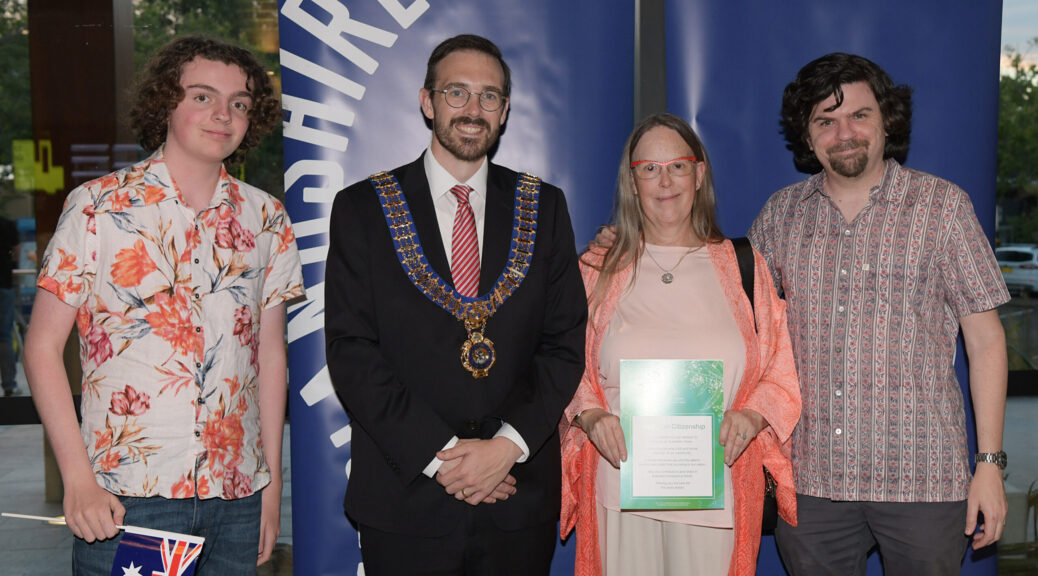
November 13th will always be a happy anniversary for me: I became an Australian citizen.
My path to citizenship was easier than many, because I married into it. Brendan is Australian and we always knew we would eventually move here. We had originally planned to leave the US in late 2021, but the pandemic made us anticipate that by a year, so I arrived in Australia as a Permanent Resident in December, 2020. I then had to wait four years (everyone does) to apply for citizenship. With the help of my excellent immigration attorney Valerie da Gama Pereira, I submitted the application in January, 2025, knowing it would take at least six months to process. On July 29th I received by email my Approval of Citizenship by Conferral.
The Ceremony
The final step was to attend a citizenship ceremony. These are held roughly quarterly at the Local Government Area (LGA) where you reside. I could not attend the September edition because I had to be in India for my final Woodstock School Board meetings on that date, so my next opportunity was November.
I was excited and anxious in the days before the ceremony. When the time finally came, Brendan, Mitchell, and I all dressed up and drove to the new performing arts center in Sutherland. We “conferees” had been told to dress nicely, and to bring a copy of our invitation to the ceremony along with photo ID. Australians tend to take event arrival times casually, often showing up at the very last minute. Not for this: there was already a line by 5pm when registration opened for the conferees, and almost everyone, conferees and guests, was seated in the hall well before the ceremony would start at 6.
Conferees had assigned seats (which would later facilitate matching people with their citizenship certificates) in the middle section of the auditorium, guests had to sit on the sides. A talented vocalist, Louise Butler, kept the crowd entertained. While I was still out in the lobby chatting with another conferee, Brendan texted me “They’re playing your song.” I couldn’t hear it from there. When I went in, I realized it was “Hallelujah” but I couldn’t tell which lyrics she was using. (That song has been interpreted in several wildly diverse ways, I suggest sticking with the version by Leonard Cohen, who wrote it.) The next song was “Colours of the Wind”. At some point she sang, very appropriately, “I am Australian.” The ceremony would prove to reflect the refrain:
We are one, but we are many,
And from all the lands on earth we come
We’ll share a dream and sing with one voice
“I am, you are, we are Australian”
The ceremony was emceed by Clare Phelan, CEO of the Sutherland Shire Council. Five or six elected councillors were present, along with the Sutherland Shire’s federal MPs, David Moncrieff and Simon Kennedy. Mr Moncrieff read a message from Tony Burke, the Home Minister whose signature is on all our citizenship certificates. Mr. Kennedy and Jack Boyd, Mayor of the Sutherland Shire, gave brief speeches. Each mentioned his Australian ancestry (for one, dating back to the First Fleet), but both also said that they had married first-generation immigrants of different cultures from themselves. One of the speeches mentioned that Australia has accepted six million immigrants since 1949. Hmm, actually, that number is out of date. The Australian Bureau of Statistics’ says: “At 30 June 2024, Australia’s population included 8.6 million people who were born overseas. The proportion of Australia’s population born outside Australia was 31.5%.”
We then read the Australian Citizenship Pledge. Version 1 goes like this:
From this time forward, under God,
I pledge my loyalty to Australia and its people,
whose democratic beliefs I share,
whose rights and liberties I respect,
and whose laws I will uphold and obey.
Version 2 is exactly the same, minus “under God.” The Version 1 people first stood and recited their pledge, then we Version 2 people (I estimate about 40% of the crowd) did the same.
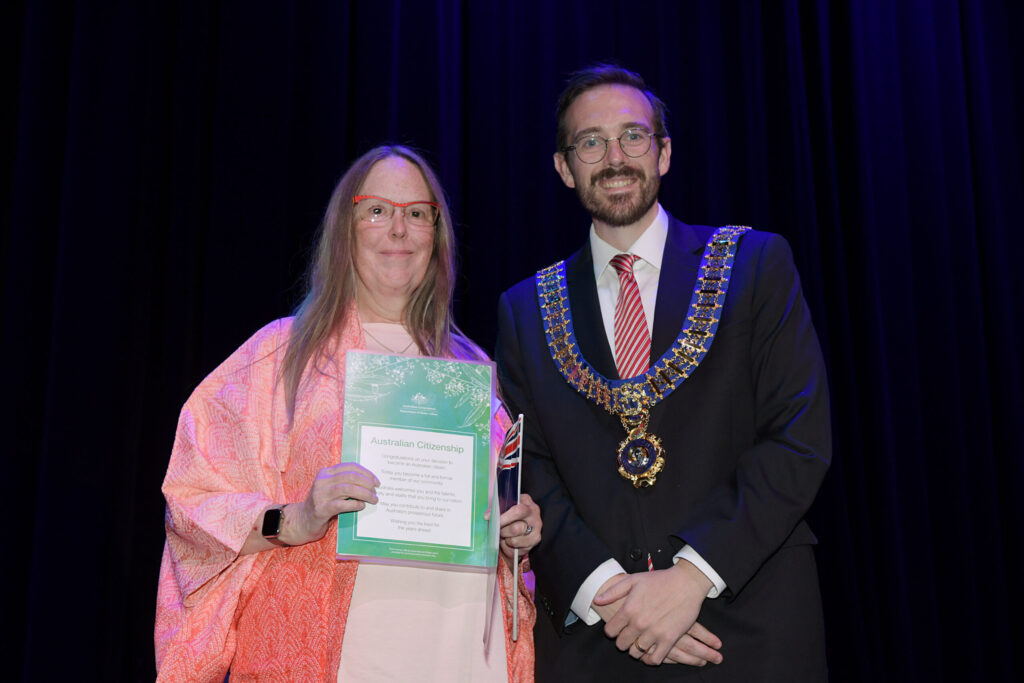
After that we were officially citizens, and it was time to receive our certificates to prove it. This worked very like a graduation ceremony: we stood up one row of seats at a time and were guided backstage where we entered the stage one by one as called. Each person was handed their packet of papers, then posed for a photo with the mayor. This group of conferees was 186 people (some multiple members of a family or couples) from 80 countries*, so the ceremony was long, but fascinating. Lots of UK and NZ people, but so many other countries were represented that after a while I began to count the major countries I hadn’t yet heard. I didn’t notice Italy or Spain, but Brendan and Mitchell said they were there (perhaps when I was backstage). A number of Indians, at least one Pakistani, some Nepalis, but I didn’t hear Bangladesh. Africans both white (South Africa and Zimbabwe) and black (I didn’t hear which countries). I was not even the oldest immigrant, though I was certainly among the oldest.
Some had clearly been immigrants more than once in their lives or their families’ – people with Indian names but UK citizenship, for example. There was one sharply dressed black man with an American-style Jr after his name, but his citizenship of origin was German. Hmm, interesting story there I’ll bet.
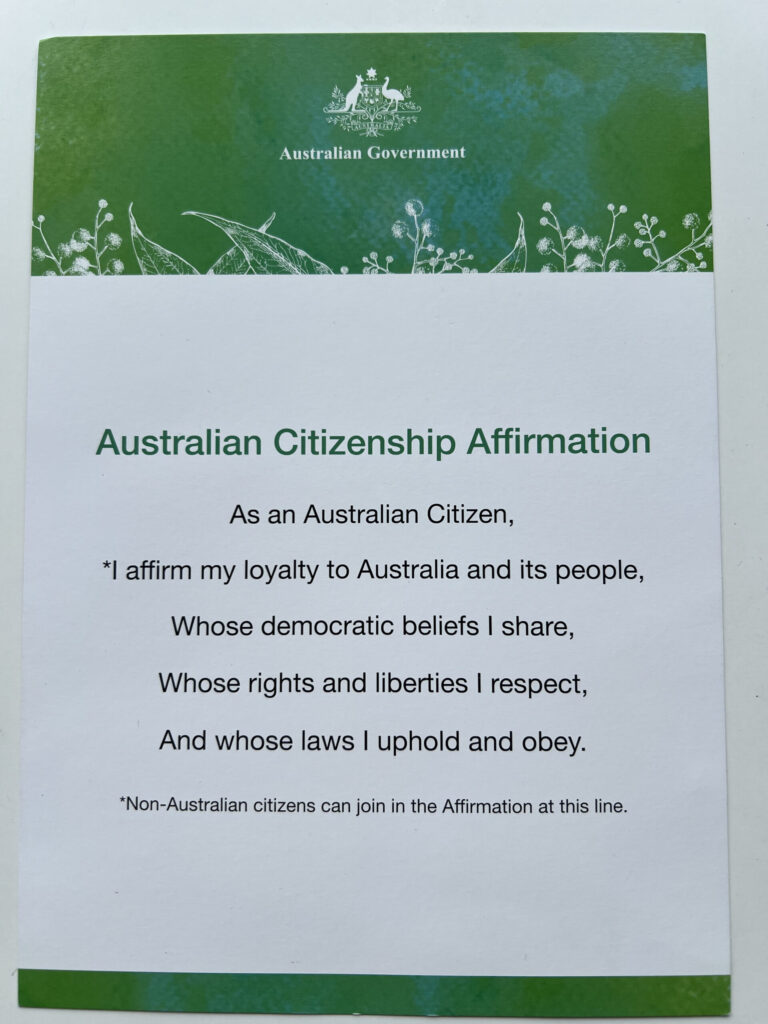
After everyone had received their certificates, we all stood to recite the Australian Citizenship Affirmation:
And then we sang the national anthem, Advance Australia Fair (only the first verse – the second is rarely sung, I’m told). I can’t find on YouTube a recording of the slightly changed new version, in which we are “one and free” rather than “young and free”. So here’s Olivia Newton-John in 1986:
After that we had more photo ops with the Mayor in the foyer (above), then everyone went off to celebrate as they saw fit. We went out for Japanese food.
Why does Australian citizenship matter so much to me?
It’s hard to overstate the significance of this step for us. Looking at my situation (a US citizen adding Australian citizenship), you might assume that I’m adding privilege to privilege, and in most ways you’re right. But this is the first time in our 10+ years together that Brendan and I have shared a citizenship. Until now, we had always known that we were vulnerable to being separated by an international border.
We were made painfully aware of this years ago by a company who used Brendan’s H1-B visa status in the US to make him stay in a job he wanted to quit. They knew exactly what this would mean to all of us, and enjoyed the power they had over Brendan’s life, using the term “visa hostage” to describe him.
By the time we left the US, Brendan had a green card (thanks to Netflix), which gave us some sense of security, but even that is no guarantee in the USA of today.
I arrived in Australia on a partner visa, not dependent on any employer, and never had any reason to think that anyone in Australia would want to kick me out. Still, I could imagine plenty of reasons (too old, too ill, too neurodivergent, didn’t work long enough in Australia before retiring…). As of November 13th, 2025, I no longer need worry: Australia made me feel very welcome, and here I’ll be staying.
* Note: The ratio of nationalities of origin will be different in different LGAs across Australia. Some of Sydney’s suburbs have large “ethnic” populations, eg Cabramatta has a lot of Vietnamese, Harris Park a lot of people from India and other parts of the subcontinent, Rockdale is “little Nepal”, and there are several Chinese-dominated suburbs. (Chinese have been coming to Australia for a long time.) Our area is still white-dominated, but the variety is increasing. I’ll be glad when we finally get a good Indian grocery store nearby!

Love this for y’all!
Congratulations!
Congratulations Dierdre! I am happy for you and your family.