Category Archives: bio

Italian Winter Weather

The first time we visited Milan, in January of 1991, there were about four inches of snow on the ground. It melted the next day, and in the 12 years we lived in Milan after that I only saw snow falling once or twice a year, some years not at all, and rarely enough to stick. For the last few years, February has been mild, April cold and rainy, and everyone complained about how the seasons weren’t what they used to be (a lament that has probably been heard since the australopithecines).

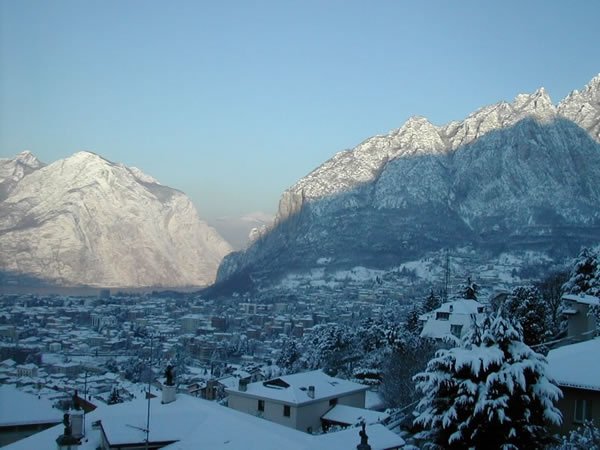
Today it’s snowing in Lecco. A lot. Just like it did the week before last, and the week before that, and I lose count before that. A few weeks ago we took in “refugees,” six of Ross’ classmates who had commuted up to an hour to get to school, only to find it cancelled because snow was falling and the heating system wasn’t working.

The kids weren’t a problem, but I’ve had enough of winter. I never liked cold weather in the first place. I was born in New Orleans, subsequently lived in Texas, Hawaii, and Thailand. I never saw snow actually falling out of the sky until we got to Pittsburgh, when I was 11. I hate having to dress up in layers and layers of clothing to go outside, then when you go into a shop or come home again you’re too hot and have to undress. I have no circulation in my hands and feet, so they’re always icy cold (cold hands, warm heart – I’d settle for the reverse). I even have chilblains on my toes this year, probably from wearing wimpy shoes in a misguided attempt to be fashionable, before I found a pair of decent-looking fur-lined boots in England.

One problem specific to Italian winters is that most of us have no control over home heating – condominium buildings are usually centrally-heated, and the thermostat is set according to government regulations. Heating goes on October 15th and off April 15th, regardless of actual outside temperatures. And it’s turned way down during hours that most people are out of the house, e.g. 10 am to noon, which happen to be my peak working hours in my home office. So I’m sitting at my desk wearing ski socks and fleece slippers (still going strong – thanks, Laura and Larry!), a turtleneck, corduroy trousers, and a Kashimiri shawl.

Heating also gets turned off at night when we’re all supposed to be in bed. There are few things more miserable than being wide awake at 4 am with jetlag, and you can’t even read in bed because it’s too cold to put your arms outside the covers (yes, there is another activity which could warm you up in bed, but that only works at 4 am when both of you have jetlag).

The End of Fear

There’s a frightening opinion piece in the New York Times, A Nuclear 9/11, about the need to stop nuclear proliferation. Some people in the know think that there’s a high risk of some form of nuclear weapon being used by terrorists on American soil, sometime in the next 15-20 years. The war in Iraq has done little or nothing to alleviate that risk, and not much else is being done about it.

I grew up with the constant threat of nuclear war between the US and USSR. That threat didn’t loom nearly as large over my generation as it had over my parents’; we never had bomb shelters or “hide under your desk” drills in school. But we did have Ronald Reagan’s massive military spending, sabre-rattling, and “Evil Empire” speeches. Perhaps I’m a hypersensitive soul, but it made me wonder sometimes whether all our hurrying and scurrying to build happy lives for ourselves and our children might be blown to naught by someone’s itchy trigger finger.

My daughter was only a few months old when the Berlin wall fell in 1989. It seemed like a good omen for her life: the world was finally emerging from the shadow of the Cold War, and her skies would be bluer than ours had been.

In 2001, as we all know, the skies got much darker. At least with the USSR we had had détente, mutually-assured destruction actually being a good deterrent. Now we’re up against people who gladly accept their own destruction, if only they can take a few of us with them.

In my research for the Woodstock School history book, I read a first-person account of World War I, by a woman who was a student at the time:

“And then the war. It was always there in those days 1914-1918, over the horizon to be sure, but it somehow took the bottom out of the world for us. We had all been brought up to know that the world was getting better and better, and [war] was more and more impossible. I suppose it will be at least a hundred years before there is such a confident, carefree generation again. The impossible had happened…”

That hundred years has nearly passed now, and we still can’t be confident and carefree. If anything, the prospect seems to recede ever further into an uncertain future. When will mankind grow up?

The Bride’s Bouquet

A year after we met, Enrico and I attended the wedding of two high school friends of mine (I was a bridesmaid). At the end, I stood among the other unmarried women while the bouquet was thrown. I wasn’t particularly keen to catch it, and am no good at catching things, so I didn’t even raise my arms. I looked up, watching the trajectory, as the bouquet arced high and then fell – straight down into my startled face (good thing I wear glasses). It bounced off and into my hands, and so I “caught” the bouquet.

I took the accidental and unsought catch as a sign that, whenever I did get married, there would be something unusual and surprising about the circumstances. Turned out I was right about that, too. But that’s another story.

Strangers on a Train

A question that often arises in the travel forums is: “What’s it like to travel in Italy with small kids?”

Speaking from my own experience, it’s great. Italians love kids, and, when you enter a train compartment with a child in Italy, you don’t get the suffering looks that you get when boarding a plane with one in the US. Everyone’s ready to ooh and aah and spoil your child rotten. Well, almost everyone.

When Rossella was three or so, we had occasion to go to Rome by train. We ended up in a compartment with four middle-aged ladies. Three of them were travelling together, and were happy to spend the entire five-hour trip entertaining Ross, who laughed and was charming and sat on their laps.

The fourth lady was travelling alone, and seemed to be allergic to children. She would draw away whenever Ross got near her, and throughout the trip showed clearly, by grimaces and sighs, that sharing a train compartment with a child was akin to being in the seventh circle of hell.

Ross, of course, was not oblivious to this. She tried her best to draw the lady out, with all her most adorable three-year-old wiles. Nothing worked, and Ross was disappointed – she was accustomed to wrapping adults around her little finger.

Towards the end of the trip, Ross looked the lady full in the face and said: “Tu sei brutta. E pure antipatica.” – “You’re ugly, and you’re not nice.”

I made all the polite remonstrances that the occasion demanded, but the other three ladies and I had to avoid looking at each other, so as not to burst out laughing. It was hard to fault Ross, who had spoken the truth as she saw it, with brutal three-year-old candor.


The Old School Tie

I went each year to Ross’ class play, taking a seat in front row center so I could videotape. One year, this put me right next to a dignified old woman who had to be Signora Pavone, the retired principal of Setti Carraro. Our friend Patrizia, whose recommendation had originally helped get Ross into the school, had asked me to say hello on her behalf, so I looked for a way to start a conversation with this rather forbidding lady.

During intermission, she was approached by a very stylishly-dressed woman, the mother of one of the students, and clearly an alumna herself. When they had finished their conversation, I turned to Signora Pavone. “I’m glad to see that this school has a tradition of alumni sending their own children,” I said. “I went to a school like that, and it’s always a good sign. I assume that lady was also a student?”

Signora Pavone gelidly replied: “That lady’s great-grandmother was also a student here.”

End of conversation. Apparently, as the mother of a first-generation student, I was a mere upstart. Ah, well. Woodstock may be a few decades younger than Setti Carraro, but at least it is led by – and produces – people who are interested in engaging with the wider world around them.