Category Archives: bio

Feeling the Seasons in Italy

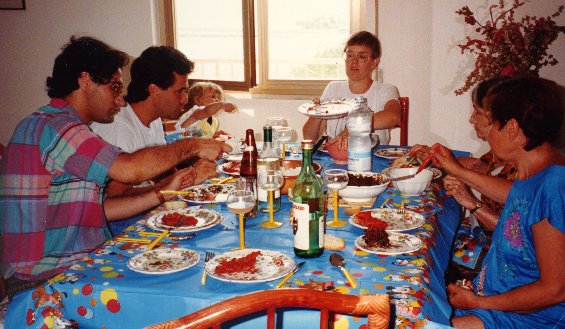
First week in August, and most of Italy is shutting down, except the beaches and some mountain resorts, which are booming with Italian vacationers. The cities will be largely left to foreign tourists and those who serve them. Kids are off school from mid-June to mid-September, and many adults take off all or most of August.

You might think this an example of “typical” Italian laziness, but the situation down here on the ground makes it clear: it’s too darn hot. In the afternoons, when it’s muggy and even the air is too hot to move, it’s simply impossible to concentrate, and all you want to do is sleep. No one can be expected to be productive; you might as well give in to Mother Nature and go on vacation.

It used to be that way in the US as well, until the invention of air-conditioning. I read somewhere that the pace of government picked up amazingly when A/C was introduced to muggy, swampy Washington.

But most of Italy is not air-conditioned. Except in some offices, I’ve never seen central A/C here the way it’s done in the US. Due to the high cost of electricity, not many families even have room air conditioners. During this June’s heat wave, so many rushed out to buy air conditioners that the national power grid couldn’t cope, and there were rolling blackouts.

Ourselves, we make do with fans, and I’ve become so unaccustomed to A/C that I’m always cold in the US. I prefer not being insulated away from the seasons, no matter how uncomfortable they sometimes get. Here in Lecco I’ve learned that there’s a wonderful breeze off the lake in the morning, so I get up early and open all the windows on the windward side of the house, cooling down and airing out the stuffiness of the night (when windows and shutters on the balcony side have to be closed, for fear of burglars). Around noon I’ll close it all up, to retain the cool when the sun moves around to that side and only hot air blows in. And then I’ll take a nap.

Reading Science Fiction

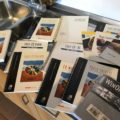
Amazon is great, but to discover something new, it helps to have a real (independent!) bookstore with a discerning owner. Thanks to one such, in an airport of all places (La Guardia, I think it was), I discovered Ted Chiang. In a ten-year career (so far), he has only written a few short stories, winning a Nebula Award with the very first, and most of them are amazing. It’s a rare writer who has challenging ideas and writes about them extremely well. Very highly recommended.

Stories of Your Life and Others by Ted Chiang – Amazon UK

One thing to be said for forced bed rest: I’ve had lots of time to read. First was a collection of Philip K. Dick short stories, including “The Minority Report.” As has happened with a number of Dick stories, the author’s initial idea was intriguing, but the movie was actually a better story.

I have read a lot of science fiction in my lifetime, from the early classics on. It’s interesting to consider the trends and technologies happening today that early sci-fi writers never contemplated. For example, there are lots of stories about gigantic central computers going mad, killing people, taking over planets or spaceships, and occasionally being useful. But I don’t recall a single story featuring personal computers as the ubiquitous tools that we all use today.

Most of the authors even more glaringly failed to consider the cultural changes likely to take place within their own lifetimes, let alone over several centuries to come. Feminism completely escaped Philip K. Dick (even though it was well underway before he died); most of his female characters are secretaries and/or wives, who spend their time tucking the children into bed and making coffee for the men.

One author who has demonstrated real foresight is Norman Spinrad. In “A World Between,” published in 1979, he described the World Wide Web, and even called it ‘the Galactic Web.’ “Little Heroes” (1987) is about the music industry’s final solution to the problem of dealing with temperamental artists: computer-generated stars. Now that we’ve seen what can be done, with Gollum in “The Two Towers,” this doesn’t seem very far off. “Pictures at 11” (1994) is about a gang of terrorists taking over a TV station in Los Angeles; that, too, seems likely to come true any day now.

David Brin is perhaps the greatest science fiction author alive. His Uplift series is set in the far future, when dolphins and chimpanzees have been genetically ‘uplifted’ to be man’s sapient peers, in a universe populated by hundreds of similarly uplifted species. Brin is literally a rocket scientist, with a PhD in astrophysics, yet he does not fall into the Asimov trap of being far better at science than characters. One of the joys of the Uplift novels is that Brin creates and describes alien cultures which are completely non-human, yet convincingly motivated by their own biologies and cultures (my favorite example is the exploding priest).

I have re-started reading Brin’s “The Transparent Society,” published in 1998, subtitled “Will technology force us to choose between privacy and freedom?” This is non-fiction. Though I haven’t read it all the way through yet, Brin’s thesis seems to be that the privacy genie is already out of the bottle: governments and corporations have a great deal of private information about us stored in databases (where it’s subject to pilfering and abuse), and we are increasingly in the lenses of security cameras wherever we go. Brin suggests that the best defense is an open society, where we citizens can in turn oversee governments and corporations, to ensure that our data is not abused.

Norman Spinrad’s site

Buy from Amazon:

UK: Norman SpinradDavid BrinTed Chiang

US: Norman SpinradDavid BrinTed Chiang

Changing Bars

We always bought coffee on a “subscription,” a punch-card system, where you pay in advance for ten coffees and get a slight discount. During our last week in Milan, I finished my last card and began paying for each coffee individually. Around the third coffee, Italo said to me: “You can still get a new subscription; it will be honored after I leave.”

I was massively confused. “I’m not buying the subscription because I’m leaving,” I said, “We’re moving.”

You’re leaving?! But so am I!”

It turned out that he had sold his bar, and would be leaving it to the new proprietors on July 15th. His explanation was that the neighborhood had changed, many of his old clients had moved (or died), and he just didn’t know how to do business in the new climate: “There’s always tension, always arguments.” The neighborhood is now multi-ethnic, with recent immigrants from South America, North Africa, and China, and Italo’s clientele was becoming noticeably more mixed. Maybe there is tension between the groups, or between immigrants and Italians. I had never noticed anything particular going on, but of course I wasn’t in there 14 hours a day like he was. It was disconcerting to realize that this neighborhood fixture was leaving just as we were. You can’t go “home” again; if you do, it will have changed out from under you.

House-Moving in Italy

We couldn’t have picked a worse time to move: record high temperatures and humidity, with people literally falling down in the streets. In a particularly horrible accident the other day, a man on a street repair crew fainted. His colleague driving the tar truck didn’t see him on the ground, and backed over him.

Our move has been far less dramatic, but involves lots of hard work and running around when we’d be wiser to take a siesta. When you rent an apartment in Italy, unless it’s advertised as “furnished,” it’s completely bare: no kitchen appliances, no light fixtures. (Toilets and showers yes, at least, but often no toilet seats.) So everyone buys and/or moves their own major appliances, and we’re taking the opportunity to upgrade our kitchen. Our old kitchen in Milan is literally one meter by two – I’ve seen bigger walk-in closets. When we moved here, we had to measure carefully to ensure that the stove and a (clothes) washing machine would fit in beside the sink. I am so thrilled now to have a huge, eat-in kitchen, even though it’s tiled (floor and walls) in a bilious shade of olive green that was popular around 1975. We’ve brought up some pieces from my in-laws’ place in Rome: a painted wood table, sideboard, and display dish rack which also happen to be olive green (decorated with flowers and birds, which is not as bad as sounds). I’ve never been particularly fond of these pieces, but they go very nicely in the olive green kitchen.

Our own kitchen stuff (which, in Milan, is in the living/dining room) is made of a light-colored wood (from Ikea), so we’re adding more pieces in that style to expand storage and work space. For the last 12 years I’ve been producing culinary miracles on a 40×60 cm worktop. Can’t wait to see what I’ll be able to do with a REAL kitchen.

So the upside is that we get to do our own kitchen. The downside is that we have to, and it’s still not in working order. Figuring out what would fit where, making buying decisions, and having things delivered and installed, is taking far more time than I expected. Getting workmen to come is proving difficult. The electrician never showed up for our appointment last Friday, and has since been impossible to reach on his cellphone. Hit by a truck? (If not, he’s about to wish had been…) At least the plumber has been reliable, and hopefully will be able to find his carpenter friend to come Monday, because there’s a worktop that will need to be cut for the sink…

We’ll move the last major stuff from Milan on Sunday, and will bring up our handyman to attach bookshelves to walls and hang paintings. I always knew Signor Gino was a treasure; I just hadn’t realized he was an irreplaceable treasure – so far we haven’t managed to find anyone in Lecco to do this sort of thing. We’ve got zillions of books sitting around in boxes because I can’t put them on the shelves yet, which is making me crazy.

Yesterday, in frustration, I vowed that I would learn to use a power drill myself, so that in future I can make my own holes in the wall. As a start, I went to the hardware department at the local Bennet (Italian Wal-Mart). After half an hour of browsing, I realized that I am indeed a complete geek: I was enjoying looking at tools, electrical connectors, wire… I bought a wire stripper, and am determined to use it! So I’ll be watching Gino closely on Sunday to see how he does all this stuff, and from here on I will be a do-it-yourselfer.

Oh, and one slight detail: I want everything done before I take off for Boston on July 4th!

Italian Brats

A survey cited by Zoomata says “a recent poll of 2,500 travel-industry professionals voted Italian kids the most obnoxious and unruly in the EU. … according to UNICEF, only 50% of parents [in Italy] reprimand their kids.”

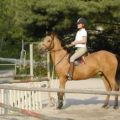
I’d have to agree that many Italian parents are over-indulgent with their kids, and many young Italian children noticeably lack discipline and common courtesy. At my daughter’s riding school, I waged a never-ending battle to keep other people’s kids from running amok and scaring the horses during lessons. (Horses scare easily, and when they do, their riders often fall.)

This led to some surprising run-ins with small children. One three-year-old not only would not stop making noise, but gave me lip when I asked him to:

Me: “Stop that. You’ll scare the horses and someone could fall.”

Him: “I don’t care.”

Me: “Someone could get hurt!”

Him: “I don’t care. Anyway, it doesn’t hurt to fall.”

Me: “Oh, yes, it does. Want me to show you?”

Another child, when I asked him to be quieter, said “No.”

I asked: “Where’s your mother?”

“I’m not going to tell you.”

So I tucked him under my arm and carried him off to find her, to general astonishment. At least I resisted the very strong urge to spank him!

The teacher in my daughter’s elementary school put up with far worse. One boy called her a whore. She pretended not to hear, which surprised me. I’ve attended many schools, and in every one of them, that would have got the kid sent to the principal’s office, or suspended.