Category Archives: Italian culture

La Buona Educazione: Good Manners in Italy

Italy has four or five of those freebie newspapers, you probably have them in your city as well. The one I read regularly is Metro, partly because it’s the best of a bad lot, partly because it’s the only one distributed at the Lecco railway station. It’s not serious news, just enough to keep up on showbiz silliness (Brad Pitt and Angelina Jolie will get married on Lake Como next week – wait, no, they didn’t), and the letters page is a glimpse into what’s on the collective Italian mind.

Every now and then they publish a flurry of letters about manners, usually started by a woman complaining that no one, and especially no man, ever offers her a seat on the bus or subway – even when she’s visibly pregnant. Other women chime in with similar experiences, then the men recount how no one ever gave them a seat, even when they were on crutches, or how some women are snappishly offended to be classified as old enough to need such courtesies.

How well I remember traversing the city every day to daycare, standing with a heavy two-year-old Rossella in my arms because, if I put her down, she was likely to get stepped on or bashed in the head with someone’s heavy bag.

Once she asked, in a loud, clear voice: “Why won’t anyone let us sit down?” (This was during the phase when she only spoke Italian, so everyone understood it.)

“Because,” I answered equally loudly, and in Italian, “no one is civil enough to notice that there’s a mother here with a child in her arms who needs to sit down.”

That finally got us a seat.

During my recent visit to Texas, I was startled that men kept leaping ahead to open doors for me. This reminded me of a fellow Woodstocker who had attended the University of Texas at the same time I did. He was Bangladeshi, and had some cultural adjustment difficulties. He said to me mournfully: “I never know what to do at a door. If I don’t open a door for a girl, she gives me a dirty look. If I do, she calls me a chauvinist pig.” (I told him that he should do what was right for him, and if someone called him a pig for his good manners, she was seriously lacking in manners herself.)

The nagging problem on trains is many passengers’ failure to close the compartment doors. On a typical commuter train, each carriage divided into three sections, with two entry platforms, plus doors on each end into the next carriage. The entry platforms are not heated, so in winter it’s important to close the doors between the compartments and the entryways. (They should theoretically close by themselves, but the trains are so old that they often need a push.)

But lots of people go charging through the train, leaving a string of open doors behind them, and other passengers shouting irately after them: “Ehi! Porta!” (“Hey! Door!”) – usually ignored, because someone who is rude in the first place is rarely going to acknowledge the fact and correct his error.

I habitually sit near the door, so am often the one to get up and close it. A few times I have commented to a nearby passenger: “Tutti nati in stalla,” from the American: “Were you born in a barn?” This phrase isn’t used in Italy, so Italians find it very funny; Ross’ boyfriend doubled up laughing the first time he heard it.

Italian Surnames: The Funny, Surprising, and Just Plain Weird

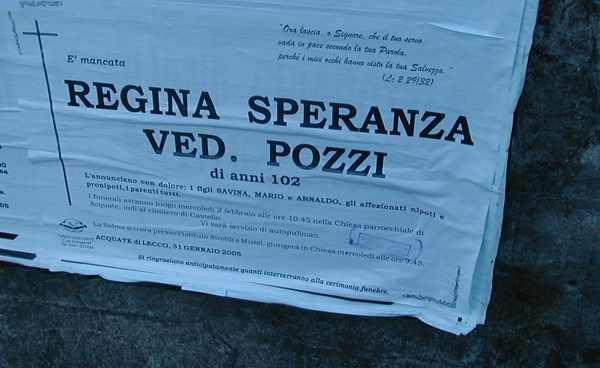
^above “Queen Hope, widow of Wells” – she lived a good long life!

Il Corriere della Sera reports today that Italy has the largest number of surnames in the world: 350,000. The ten commonest surnames cover only 1% of the population. And, with many surnames, you can also tell something about its origins by its ending.

Italian surnames are fascinating, and sometimes very funny. Some of the best don’t seem to have emigrated to the US, though Americans trying to pronounce their Italian surnames can also be funny. I met a photographer in Connecticutt with the wonderfully romantic surname “Mezzanotte” (Midnight). An Italian would pronounce this Med-za-NOT-tay, which also sounds lovely. He pronounced it Mezza-note, which doesn’t.

One of the most common surnames in Lombardy is Fumagalli, which translates literally as “smoke the chickens.” That is: blow smoke into the henhouse to stun them, so they don’t make noise while you’re carrying them away. I guess chicken thieving was common in Lombardy, hence the popular Italian saying, Conosco i miei polli (“I know my own chickens”), used when you can predict how someone will behave or react, because you know them so well.

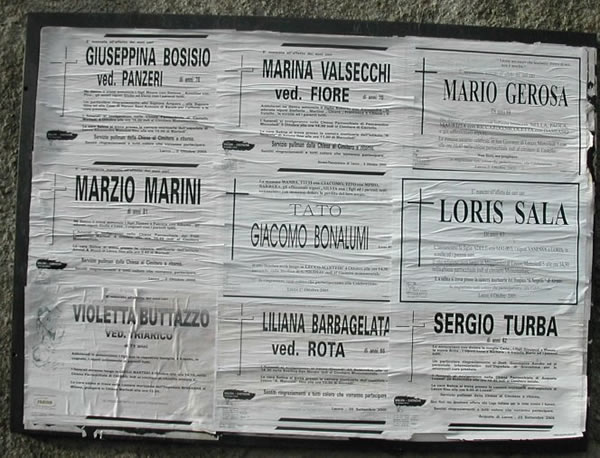
Death announcements in Lecco. Note the surnames Turba (“disturbs”) and Barbagelata (“frozen beard”)

I can’t think of examples of names in America which have a funny meaning, although some non-English names sound funny or rude to an English speaker, such as the Jewish Lipschitz or Indian Dixit (pronounced Dickshit). In Italy, there are many names which sound funny or odd even to Italian speakers, and leave you wondering how somebody’s ancestor acquired it. Examples:

  • Squarcialupi – “squarciare” is to rip, with violence; “lupi” are wolves. Okay, the ancestor was a fierce hunter.
  • On the other hand, Cantalupi – “cantare” – to sing. Sings with wolves?
  • Pelagatti – “pelare” – to peel or skin, “gatti” …cats. Presumably this guy knew more than one way.
  • Pelaratti – same thing, but rats. Now why would you bother?

Then there are the surnames which Italians fervently wish they could change, and go to great lengths to do so (it’s not easy to change a name in Italy), such as Finocchio – “Fennel,” but it’s also common slang for gay. Most red-blooded Italian males don’t want this one!

A friend of ours once worked in the office in Rome where name changes are (rarely) approved. He told us the most egregious case he ever came across was the name “Ficarotta” – broken cunt. The change was allowed.

More Funny Italian Surnames

  • Malinconico – melancholy
  • Mezzasalma – half-cadaver
  • Tagliabue – ox-cutter (butcher, I suppose)
  • Bellagamba – beautiful leg (there was a famous cardinal of this name)
  • Caporaso – shaved head
  • Denaro – money – a Mafia family in the news!
  • Contestabile – debatable
  • Falaguerra – make war
    …but…
    Acquistapace – buy peace
  • Accusato – accused
  • Peccati – sins
  • Bonanno – buon anno – good year, or happy new year
  • Borriposi – buon riposi – good rests

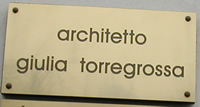
^ This architect’s surname means “big tower”.

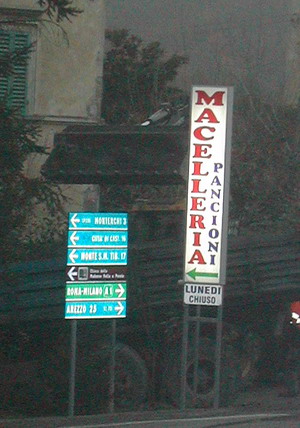
^ “Macelleria Pancioni” would be literally translated as “big bellies butcher,” though Pancioni is probably a family name.

Nov 23, 2003

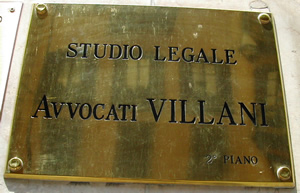
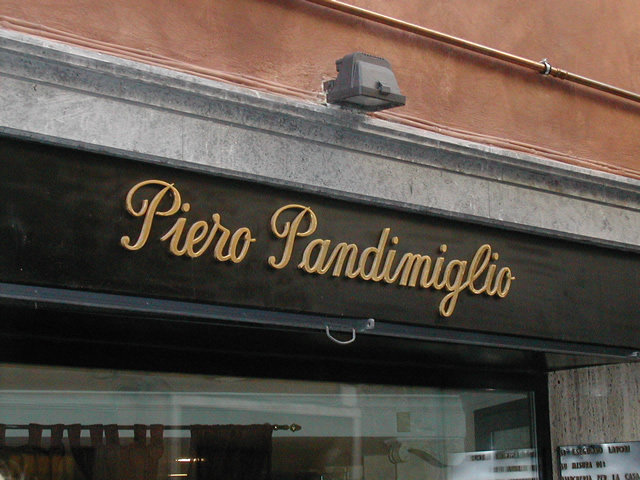
Many Italian surnames are also common words, so the potential for comedy is enormous when juxtaposed with the person’s profession, residence, or spouse. One of the funniest books we own is Mal Cognome Mezzo Gaudio, by Antonio di Stefano. The title is a pun on the saying Mal commune mezzo gaudio (A shared sorrow is half a joy); cognome means surname. The book is a treasure trove of funny names and even funnier combinations. But he missed one of my old favorites, a shop near my in-laws’ place in Rome called Enoteca Bevilacqua – the Drinkwater Wineshop.

Another name that’s funny on its own is Cazzaniga. This Lombard name may not actually mean anything, but it sounds close to cazzo negro – black dick. So there’s a common joke about it: Cazzaniga? Che nome lungo. (“What a long name.”)


where do people with your surname live in Italy?

Italian Orphan Names

Tracing Your Italian Roots

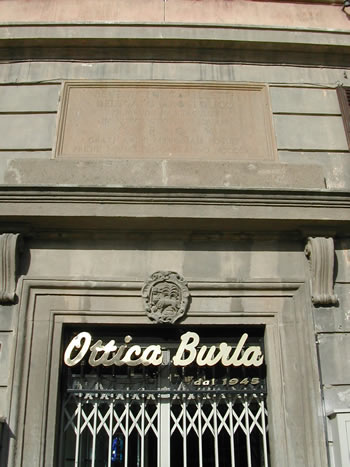
^ I assume this optical shop is named for its owner, whose surname means a joke or a trick.

^ This shop owner’s surname means “millet bread”.

Crimes of Opinion

Italy’s Laws on Opinions You’re Not Free to State

Italian law on “crimes of opinion” has recently (Jan 25th) been revised as follows (excerpted and translated from here):

“…Safeguarding of [all] faiths, instead of [just] the state religion [i.e., Catholicism] …Article 404 – (Offenses against a religious faith by means of vilipendio [~insult] or damage to property) – Anyone who, in a place designated for worship or in a public place or place open to the public, offends a religious faith, insults… things which are considered sacred or consacrated to a faith, or are used in the exercise of faith, or commits such acts during a religious function held by a minister of the faith in a private place, is punished with a fine of 1,000 to 5,000 euros.” (NB: Previously, the punishment was up to three years in jail, though I don’t know whether this was ever applied.)

“…Changes also to the Mancino law on racism, with punishment taking the form either of a fine or up to 18 months in prison for propaganda of ideas based on racial or ethnic superiority or hatred, and the instigation to commit acts of discrimination for racial, ethnic, national, or religious reasons. However, jail sentences of six months to four years are prescribed for anyone who instigates or commits acts of violence or provocation to violence for racial, ethnic, national, or religious motives.”

Hmm. How to reconcile the fact that inherent in some religions are bald statements of racial, ethnic, or sectarian superiority? Classical Hinduism encodes the idea that Brahmins are superior and Untouchables inferior to every other caste. A Brahmin’s forbidding his daughter to marry an Untouchable might therefore be punishable by law in Italy.

A “crime of opinion” seems to me a dangerous concept in itself. Who’s to decide what is and is not a reasonable opinion? Not so long ago, the idea that women should be allowed to work outside the home for equal wages as men was considered ridiculous in Europe – and is still considered ridiculous, if not illegal, in some countries.

Several European countries have laws against Holocaust denial, as recently applied in Austria to British “historian” David Irving. That, like the Italian laws about religion quoted above, is going too far. No country can (or should) make enough laws to explicitly protect against every possible kind of hurtful speech. People should be free to state whatever wacky stupidity they believe in, and other people should be free to refute it. If a nut job like Irving had a job in a reputable university, I’d be worried. But his views are anathema to most people; the resulting social and professional shunning should be sufficient punishment for him. To draw a parallel, there are white supremacists in the US who state that black people are genetically inferior to whites. They are free to state those opinions, but they don’t get hired as professors of biology (or anything else).

Trying to keep such beliefs down by law tends to be counter-productive: the believers can then present themselves as martyrs for their faith, attracting more adherents. Children raised to think for themselves will become adults who laugh at such views. Children raised to blindly follow the dictates of another person, or a book, or a way of life, are less likely to have the critical faculties needed to evaluate every opinion that comes their way.

Life with an Italian Exchange Student

My name is Kelly, and I’m a 17-year-old girl from Adelaide, the capital city of South Australia. I’m fairly average as far as things go, I go to school and have a part time job in a department store, and live in middle class suburbia. I live with my mum and my two younger brothers, and my dad, while separated from my mum, visits often. I am doing a two year accelerated Italian course, and my exam is in less than 3 months! My school offers regular exchange programs and some of my class (there are only 10 of us) decided that over this summer (winter for all you northern hemispherers) they would do this exchange. Unfortunately, due to some complicated circumstance (I think the English teacher had a baby) my school couldn’t do the exchange with the school they normally would do it with, and so we needed to find some students to stay with us during our winter, from somewhere in Italy. Intercultura came to our rescue, as they had too many students going to Perth, Western Australia, and so they sent six boys from varying parts of Italy to stay with us. We got about two weeks notice and so my family made the snap decision to host Sergio, because we wanted to, and because there was no one else who could. Sergio is the same age as me but he’s an only child, like many Italians. He looks typically Italian, not so tall (compared with Aussie guys), olive skin, dark hair and the most amazing deep brown eyes. He found my blue ones equally fascinating. He lives just outside of Reggio Emilia, in the northern Emilia Romagna region but he has his roots in Catania in Sicily though, and so can effectively now speak three different languages, Italian, English and Sicilian.

Sergio spent two months here and we have both learnt so much from each other, and still do as we talk often. Both of us had all sorts of preconceived ideas about what the other would be like, due to stereotypes. Sergio told me that Italians thought that Australians were very much like Crocodile Dundee, and the men treated the women like they were below them. He soon learned that most Australian women are more than capable of telling someone to “Bugger off” and that unfortunately kangaroos just don’t survive in the average suburban backyard, where about 80% of Australians live.

I personally was completely unsure what to expect. Here Italians are portrayed tossing pizzas and twirling moustaches saying “Mamma mia!”, and of course the reputation Italian men have of being unfaithful and slippery lovers. You also get the fast cars, and the beautiful shoes. Of course all these things are present in Italian life, but there is so much more, as I discovered.

Culture, language, geographical differences were often very present, when Sergio came into my family and yet we both discovered that despite these things, we shared the same emotions, ideas, and liked to go out and hang with our friends, flirt (although he did this without thinking), watch movies, play sports and listen to music like most teenagers. We also discovered a mutual love for reading, and had read some of the same books but in different languages! I can’t list all of the differences but here are some I remember…

Language differences were the first to be noticed, as while his English was a lot better than my Italian (which it should be, as he has been studying it for nearly 10 years), it was far from fluent. Luckily my knowledge of Italian, my knowledge of English (the equivalent verb of ‘decompose’ is ‘decomporsi’, and so that choice of word is better than ‘rot’), his knowledge of both the languages, and a little help from the dictionary, enabled us to cross most of these boundaries. Many English words come from Latin words, despite it being a Germanic language, so there are some similarities.

Some of the things were funny, like when he discovered we used the verb ‘to pump’ to describe the action of putting air into an airbed, or to pump water. ‘Pompare’ can have sexual connotations in Italian, which I shall leave to your imagination. He and the other five boys managed to convince my friend Sarah that “Ti faccio un pompino” means, “I break your legs”, when it actually means, “I’ll give you a blowjob”. Typical teenage boy humour coming out there as they found it hilarious when she would yell it at them, thinking it was a threat. I soon learnt to take anything they said with a joking frame of mind.

Anyway, little things came up, like when he asked “Are my hairs ok?’ instead of “Is my hair ok” – because hair is plural in Italian, you ask if all your individual hairs are ok, rather than the body of hair. Makes sense to me. Also, saying, “the my shirt” (“la mia camicia”) instead of just ‘my’. He also found it weird how we Aussies inflect our last syllable, so that ‘no’ sounds like ‘noi’, and we apparently talk too fast and abbreviate everything, which I’m sure is like most languages. I retaliated by saying that at least he doesn’t have to learn at least 30 different conjugations for the verb ‘essere’ or ‘to be’ and know what context you have to use them in. In terms of pronunciation, he was horrified at our lax treatment of vowels, tried to teach me the correct way to say ‘t’ and to teach us all the difference in sound when letters are doubled, like the difference between ‘saremo’ and ‘saremmo’ the future and the conditional ‘noi’ form of ‘essere’. This distinction is important when you come to words like ‘pene’ and ‘penne’, meaning ‘penis’ and ‘pens’ (or pasta) respectively. The whole experience left me thinking about the crazy ways we say things in English and how it doesn’t make a lot of sense at all, as well as a better understanding of Italian, and left him being almost fluent in English.

Language leads into culture quite easily, as you can see from above; most English speakers could quite easily say ‘pump’ without imagining sex. I remember the first big conversation I had with Sergio was about religion. I think it was because Mum wanted to make sure he would be ok about going to church, so it wasn’t such as stupid thing to do as it sounds. Knowing that most Italians say they are Catholic, and my church is a Protestant one, I was curious to learn about the differences. Sergio told me that his family rarely goes to church and that most families are like this. He said that he thinks there is a God, but that he doesn’t agree with many of the Catholic ideals. This had occurred to me, as being a fairly smart girl I noted that most parents in Italy have only one child, and this feat usually requires some kind of contraception. Also, I was told that it is rare for an 18 year old to still be a virgin. Anyway, he was ok with going to church, but was slightly shocked when I took him to a youth group service at another church on Friday night. Think a modern building, a loud band, coloured lights, overhead projector with the song words shown, games being played to show God’s message, most of the crowd being under 30, and after one can play table tennis, drink coke and chat with friends. His words were, “This isn’t a church, this is a discoteca!” That was funny, and I explained to him that it didn’t matter how loud the band played as long as the message was getting across to the kids, very different to the quiet reverence and traditions he had seen in churches in Italy.

Another thing me and my friends who were hosting the other boys discovered was the love of politics. At a barbecue (where we all put our sausages in our bread and they didn’t) a virtual shouting match arose between the six guys, all rapid-fire Italian that none of us could understand.

I asked what it was about, and was told they were discussing politics and the differences between the north and the south of Italy. Sergio, his parents originally from Sicily, was quite fired up at Lucio, the rich boy from Parma. We were just like “Um, ok.” Australians as a whole are pretty laid back and we have very few severe political issues or debates with two major parties both of which are not extreme in any sense, and so politics rarely ever comes up in conversation unless we have a referendum or something.

We had some other different things, ways of seeing life, how important jobs are, family (I have 12 cousins, he has 1) and food. He ate so much, and yet didn’t gain a kilo. I don’t eat a lot because I feel sick if I overeat, but he told me that I would be considered to be sick in Italy because I didn’t eat. Australians are also very fat people, like Americans; and although I believe our fresh food is of good quality we have a lot of fast food alternatives, which Sergio didn’t touch. He also didn’t understand why we would put pineapple on our pizza, or marshmallows in hot chocolate or even milk in our tea.

Gosh, I’ve written so much, only one more paragraph to go. The environment, we discovered, was different here than in Italy. In Italy it is considered a big deal to drive the length of the country, which I believe is about 1000km. It is around 800km to drive to Melbourne, the nearest capital city to Adelaide, and this is a drive my family has done so many times I’ve lost count. This means we have a lot of space, and one of the first comments Sergio had was “Every house has a garden!” Italy is so squished that space saving is a way of life or so I’m told. Another comment was “Everything is so new”. This is because Europeans have only occupied Australia for a little over 200 years, hardly long enough to have ancient monuments. With such a large country we have every type of environment and climate you could want, from tropical in the north to snow in the mountains. Adelaide is fairly mild, a little like southern Italy. We get most of our rain in winter; the daytime maximum rarely ever drops below 10 degrees Celsius, and we get no snow, which Sergio found odd, when he arrived in the middle of winter and it was 13 degrees and we thought that was freezing.

Sergio’s face when he first saw a kangaroo was quite hilarious too. We took him to a nearby wildlife park, as only in the country can you see them, and we were just wandering by them, so used to them, and Sergio just stopped. He couldn’t stop looking at them; it was like he was looking at an alien. It was only then I realized what odd animals they actually are, so once again I was learning through him! We now talk via email and the phone and his parents have said that I am like a daughter to them now and would love to have me stay in the future, which I intend to do!

Probably I could write a whole book on what each of us learnt, both being curious and able to talk to each other for hours, but I won’t! I was lucky in having such a nice guy come and stay, some of my other friends had different experiences with the other guys, so I am very grateful to have had such a great time with him and learn so much.

Editor’s Note:

This has been exchange student week for me. First I heard from Kelly, asking to subscribe to my newsletter and explaining why she was interested. I suggested that she write something about her experiences, which she very quickly did.

Then I got email from a 16-year-old American girl looking for a host family so she could come to Italy on an exchange program next school year. We’re not set up for it ourselves (and are hardly a typical Italian family), but I gave her some suggestions on other places to ask, and will ask around for her as well.

Kids These Days: Italy’s Young People, and Their Manners

Lynn Truss, author of Eats Shoots and Leaves has a new rant out about how the world’s manners are going to pot, and her personal crusade to reverse this phenomenon. I totally sympathize.

I ride the schoolbus in the mornings. That is to say, I take the normal bus line that goes down the hill to Lecco’s railway station, but I happen to take the run that’s scheduled for the benefit of kids going to school. It’s a small bus, and fills up quickly.

Six to eight kids get on at the same stop I do. Even when the bus pulls up with its door right in front of me, they crowd in to get on before me and get seats. A couple of unfortunate older women who get on at later stops have no hope of getting seats, nor does it ever occur to the kids to offer them. A 10-year-old boy who gets on at a stop before mine routinely uses his backpack to hold a seat for a friend. One day an older woman got on, and I suggested to the boy that he give this seat to the lady. He just looked at me as if I was from Mars, and did not even answer. Perhaps his mommy told him not to speak to strangers. (I could have offered the lady my own seat, but she was quickly so hemmed in with backpacks that she probably preferred not to struggle through to it).

Another day he went so far as to reserve two seats. I gently suggested that it would be polite of him to offer one seat to the lady. He stared at me as if “good manners” was a novel concept. I asked him what his mother would think of him not offering a seat. He’s still young enough to respond to this sort of guilt trip so, reluctantly, he complied. He was too shy to tell the lady (she was standing by the door facing the other way), so I called her over and said: “This young gentleman would like to offer you a seat.” She and I smiled at each other complicitly. Later, after he got off, we shook our heads sadly together over the shocking behavior of today’s youth.

Older kids are harder to embarrass. One day, when I had had more than enough of the kids trying to climb in front of me, I spread my arms, blocked the door, and said jokingly (but firmly): “Let the old lady [meaning myself] get a seat.” An adolescent boy took exception to this, and afterwards Ross, when travelling alone, often heard him muttering imprecations about me when he thought she had her iPod on and couldn’t hear him (“That’s the daughter of that bitch…”). Ross told me about this; she was touchingly angry about it (I didn’t care), and considered whether to confront him, or maybe have her older friends beat him up.

No need for violence: Ross is quite scary enough all by herself. One day as we got on the bus together, she leaped on and grabbed a seat, right next to this boy. That was the last seat, so she offered it to me, and stood herself. I hadn’t even noticed the boy when Ross said to him, in a loud and dangerous voice: “Well, you’re sitting right next to my mother now. What are you going to do about it?” He just about sank into the floor. Perhaps that will have cured him of making rude remarks about people’s mothers. <smile>

Riding the Bus

Oct 4, 2006

I wrote last year about the irritations of riding the bus with the schoolkids in the morning. They haven’t learned any more manners this year. As always, they gather where they think the bus doors will be when it stops, then elbow each other to get in first. When I see the bus coming I move in that direction, but consider it beneath my dignity to blatantly step in front of them all – someone’s got to set an example of civilized manners. Once the door is open, I let those ahead of me in “line” board, politely but firmly block anyone else from cutting in front of me (provoking some mutters, which I pretend to ignore), and, when finally on the bus, I give the driver an eye-roll about the kids’ lack of manners.

Evidently he agrees with me. The other morning, the bus pulled up very carefully and stopped a meter short of its usual position – right in front of me. I assumed that this was just coincidence, but as I stepped onto the bus, rightfully before everybody, the driver gave me a complicit grin. I smiled sweetly back. We’d pulled one over on the kids for once.

International Manners

Jan 17, 2006

In response to the above, Rick Freeman wrote:

“We were in Bermuda some while ago, and perhaps the most memorable thing about the trip is the way people acted on the bus … it was beyond manners, more of a whole etiquette dance. Every time there was a stop, the people who sat checked to see who came in and how they ranked. Virtually everyone got up at some point and gave their seat to someone else (older, pregnant, etc.).

Not exactly the most interesting place I’ve visited, but certainly lots of people with good manners.”