Category Archives: Italian culture

Italian Freedom Fighters: Cultural Attitudes Towards the Law

The debate about Italy’s new anti-smoking laws sputters on in some online forums. One chap had this to say on Zoomata:

“The reason Italians are upset is because we do not like to be told what to do. In fact, this law will be very difficult to enforce in the South, especially in the Naples area. Some have said that it will actually encourage people to smoke. To narrow minded Americans this may be difficult to understand. But, in Italy, Italians feel that they should have the freedom to decide. That is why many laws are so often disregarded in Italy. Italians are probably the world’s greatest free thinkers and lovers of freedom. Any law which forbids is viewed as an infrigment upon their rights.”

I managed to post a fairly polite reply, but this guy got my blood boiling. One of the traits I like least in Italian culture is this “every man for himself” attitude. An Italian’s loyalty is first to self, then to family, then to paese, and almost none to country. (NB: I’m not crazy about American-style “my country right or wrong” patriotism, either.)

In Italy, laws are often disregarded, not because they are felt to be wrong for the community, but because they are inconvenient for the individual: “Why should I obey the speed limit? I’m in a hurry.” This is a declaration, not of independence, but of sheer self-centeredness. Lowering and enforcement of speed limits have reduced overall highway fatalities in Italy, but every individual Italian asserts his right to drive as fast as he can get away with.

Probably for historical reasons, Italians have little sense of themselves as a unified country and culture, and almost no sense of shared “ownership” of a community and its resources. People deposit trash along country roads because it’s easier than going to the dump, never thinking that they are polluting the environment and ruining the beauty of the landscape. As long as it’s not their own front yard and they don’t have to look at it, they don’t care.

So some Italian smokers continue to assert their right to pollute my breathing space, and moan that the new law shows a worrying trend towards American-style attempts to tell everybody how to live. I agree that it’s possible to push any law too far, but, so far, these folks get no sympathy from me. When I used to whine about my troubles with smoke, I got no sympathy from most of them.

In any case, Italy’s anti-smoking law seems, to the surprise of many, to be sticking. Ross recently went to a disco, and told me that the smokers all had to go out on the terrace, even though it was a cold winter night. Unfortunately, there were so many of them that, when the disco got crowded and hot, stepping out for a breath of fresh air was counter-productive: she stepped out into clouds of smoke.

Italy’s Smoking Wars

On January 10th, a much-delayed law banning smoking in public places goes into effect in Italy. It requires public spaces (restaurants, clubs, discos, offices, bingo parlors) to either wall off smokers in separate rooms, or to ensure adequate ventilation (a high volume of air exchange with a filtration system), or to forbid smoking altogether. Individuals caught breaking the ban would be fined, and restaurant etc. owners are expected to “play sheriff”, risking fines from 220 to 2200 euros if they do not.

The January 10th date already represents a compromise to allow owners to get through the holiday season (which ends with the Epiphany on January 6th), but many are gearing up to do battle against various aspects of the law, especially that requiring them to rat on their clients.

Some observers assume that this law, like so many others, will be routinely flouted in Italy. From what I’ve seen so far, I think that will depend on the attitude of individual owners. Those who are militant smokers themselves and/or cherish their smoking clientele will get away with as much as they can, while others, as I have observed before, have already banned smoking from their premises, and seem happy to have done so. They may already be discovering that, while they may lose a few clients among the fumatori accaniti (dedicated smokers), they make at least compensating gains among the non-smokers.

Smokers feel besieged the world over, as evidenced by the howls of outrage every time another country or city banishes them to the sidewalks. Having been a besieged non-smoker all my life, I feel no sympathy. For some of us, sinus and bronchitis sufferers like myself or, worse, asthmatics, any amount of smoke is a threat to health and even life. We have been effectively banned from many places and events by smoke. I greatly enjoyed an evening country dancing country-western with my DC roommate at a local club years ago, but had to leave because I was choking.

I likewise enjoyed the music and ambience at one of Milan’s jazz clubs, but have never returned since my first smoky night there years ago. Maybe now I can.

So, smokers, don’t begrudge us smoke-sufferers the opportunity to join in the fun. You always have the choice to step outside for a smoke; stepping outside to breathe isn’t much of an option for us.


The “Real” Italy

^ Of course, some people in Italy actually do sing opera for fun (and/or for a living).

To bring people to my site, I hang out in online forums about traveling and living in Italy, answering questions where I usefully can. It’s been an education for me as well, in American attitudes towards Italy.

One young woman bemoaned the fact that in her travels in Italy, and especially in Rome, she had not found the “real” Italy that she expected. Her vision of the real Italy apparently included (only) beautiful people beautifully dressed, spotless streets, and women who make pasta from scratch every day while singing along to Verdi and Puccini. She was sadly bewildered to find Rome full of immigrants (“Bulgarians and Chinamen,” as she phrased it), rude people, and young people kissing on park benches (she was of the opinion that this sort of behavior should be heavily fined – really, what planet was she from?).

Come to any country looking for a stereotype, and you’re bound to be disappointed, especially when your picture is based on the rose-colored memories of emigrant grandparents, or the more recent “live the good life in Italy” stereotype created by well-heeled foreigners who move to Tuscany, renovate a villa, and then write a book about it.

A recent post on Zoomata.com bewailed the removal of crucifixes from Italian classrooms (due to a court challenge by the Finnish mother of an Italian child); another on Fodors.com was upset over a bit of news reported in the US, that in Treviso a school’s nativity play was replaced with “Little Red Riding Hood.” Said the Fodor’s poster: “I love Italy. I thought I knew Italians, being American Italian myself.”

These two people, a Canadian and an American, both mourn Italy’s “becoming” secular rather than remaining Catholic. As second- or third-generation emigrants, they have skipped over several generations of Italian history, and apparently don’t realize that the separation of church and state in Italy was established in the Constitution (strongly modeled on the American one) in the early 1950s.

The Catholic Church still has influence in Italian life and politics, but that influence is waning (though not going down without a fight, I admit). The Church’s presence in daily life is nearly non-existent. Most Italians are still baptized etc. and would claim to be Catholic if you asked, but only about 10% (I’m guessing) are practicing Catholics.

There are still devout Catholics of course, but even they are puzzled by the attitudes of their non-practicing compatriots. One of my colleagues who is very active in his diocese told me: “These people show up wanting to marry in the church or baptize their kids. We’ve never seen them before and it means nothing to them, so we have to wonder why they bother.” If forced to think about it, these people might answer that it’s traditional, and/or that they want to please an older relative.

Italy still maintains many of the outward forms of Catholicism, but even those are being challenged, as in the above-mentioned cases of the classroom crucifixes and nativity play. Like most modern nations, Italy is wrestling with large-scale immigration and how to integrate new people, religions, and cultures into the existing culture and society. These are not easy issues, and the best answers differ even from community to community within a country. Some parts of Italy have found effective and interesting ways to bring their newly-multicultural communities together, others are still working on it. In most cases, the result will not look like the Italy that many Americans think they know.

Italians Flying the Flag

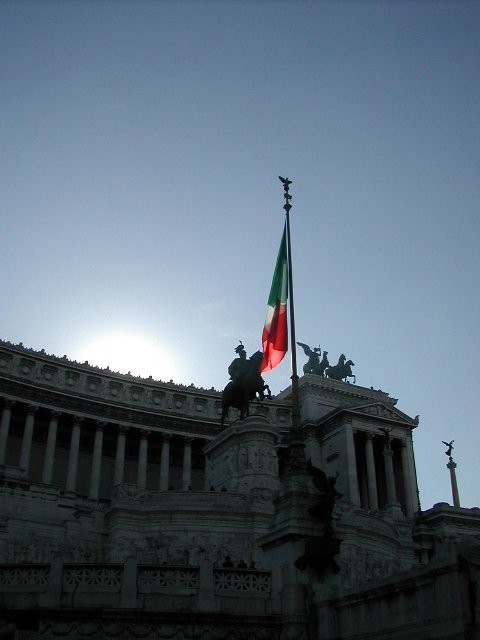
Italians are not much for patriotic displays. You rarely see Italy’s ‘Tricolore’ flag flying, except during World Cup soccer. During his first run for office ten years ago, Silvio Berlusconi brought to Italian politics the very American notion that ‘flag = patriotism = [my] political party’. Billboards for his Forza Italia party were swathed in red, white, and green. As owner of the popular AC Milan soccer team, he also managed to mix sport into his message: ‘Forza Italia’ (‘Let’s Go, Italy!’) sounds like a cheer for the Italian national team – no accident, of course.

As I recall it, that election coincided with a World Cup, or maybe it was a European championship. At any rate, between that and Berlusca, there were Tricolore flags everywhere. I asked my daughter, then three years old, if she knew what that flag meant. “Oh, yes,” she said brightly: “Those are the colors of Milan” – the football team!

photo: The Tricolore flying at the Vittorio Emmanuele monument in Rome.

What’s in a Title? Signora vs. Signorina in Italy

I’m 42 today and, waking up with blue circles and bags under my eyes, I look it. Well, that’s the result of two days on my feet in the kitchen, cooking for 35 people (yes, I did have lots of help – thank you, Shannon!) for our annual Thanksgiving/ birthday/ housewarming feast (the housewarming part is not meant to be annual). Most of the time, people say I look young for my age, and I don’t think it’s just idle flattery.

I’ve been trying to understand the logic by which Italians decide to call me signora (Mrs.) or signorina (Miss). When Ross was small and I was in daily contact with her teachers and other parents at her schools, I was accustomed to being signora, because everyone assumed that, as a mother, I must also be a Mrs.

This signora habit almost got me arrested once. I was getting off the bus in Milan, in a hurry to pick up Ross from daycare, and swept right past the squad of public transport inspectors doing one of their random checks. I completely ignored the calls behind me of “Signorina! Signorina!,” assuming they couldn’t be directed at me. So the inspectors thought I was running away to dodge a fine for travelling without a ticket (actually, I am always scrupulous about bus and train tickets, except when I forget to stamp them).

I’m often called signorina even now. This may be because I often dress informally, by Italian standards, in jeans and sweaters. In a business suit and heels, I’m almost always signora. On some occasions, the choice of address seems to be based on the speaker’s desire to flatter me, and which term they think will accomplish that.