Category Archives: Italian culture

The Family That Eats (and Drinks, and Talks) Together

News sources reported recently on a survey of American teens which shows scary correlations between the habits of the people kids spend time with, and the likelihood that they themselves will do various things (drugs, alcohol, sex). It seems that hanging out with the proverbial “wrong crowd” really can lead to trouble.

The New York Times goes on to say: “The survey suggested a simple way for parents to reduce the likelihood that their teenage children would smoke, drink or use drugs: have dinner with them. Teenagers who reported having fewer than two family dinners a week were one and a half times likelier to abuse these substances than those who had five or more dinners a week with their parents. They were also more likely to have sexually active friends or spend more than 25 hours with a significant other. But as teenagers grow older they are less likely to have family dinners, the survey found; older teenagers are also more likely to be substance abusers or engage in sexual activity.”

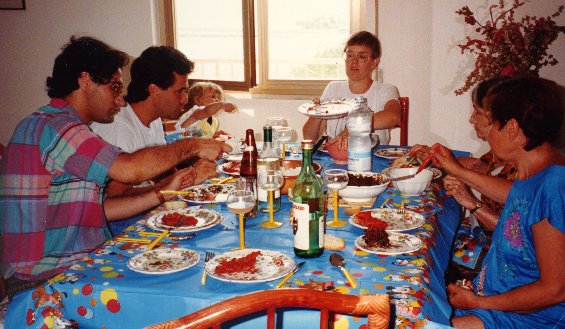
I have written before about the central role of family meals in Italian culture, and how they help Italian teenagers to grow up civilized. Eating together isn’t a panacea; drug and alcohol abuse do exist in Italy, and alcohol abuse seem to be on the rise particularly among young people.

But Italy has a long way to go to “catch up” on that front, and there is hope that it won’t go that far. After all, many Americans are attracted to Italy’s more leisurely, family-oriented lifestyle – there’s even a book about how to live an Italian lifestyle in the US. (NB: I have not read it, nor am I likely to.)

A New York Times opinion piece today on curbing teenage drinking says: “This summer, we’re celebrating the 20th anniversary of the minimum drinking age of 21, signed into law by President Ronald Reagan in 1984. That legislation has saved an estimated 20,000 lives.” The author calls for more funding for enforcement to prevent underage drinking.

At 18, Americans are old enough to vote, and to make life-or-death decisions such as joining the military. They’ve been driving since they were 16, unlike European teens (driving age is 18 here), and most are leaving home to go to college or enter the work force – they are legally independent of their parents. Yet they’re NOT old enough to drink. Huh?

As usual, American culture focuses on the wrong things. You don’t stop teenagers doing stupid things by telling them not to – which is simply hypocritical when most of their parents did the same, or worse, when they themselves were teenagers. Teenagers can spot hypocrisy miles away, and rightly despise it.

You also don’t stop kids doing “bad” things by “shielding” them. In spite of the censorship of American television, most kids are very familiar with the word “fuck” by third grade or so.

And you don’t stop teenagers having sex by pretending it doesn’t exist, or that it only exists within marriage. I’ve recently been told by a friend, who works in pregnancy prevention in the US, about studies showing that, in households where sex is freely and openly discussed, kids tend to start having sex later.

Adults drink, and swear, and have sex, and it’s useless to pretend that we don’t. Teenagers are growing up, they want to feel adult, and want to do these “grown up” things themselves. You can’t stop them doing things; you can only try to prevent them from hurting others or getting hurt themselves. (Morally and emotionally, as well as physically.)

The solution is honesty, openness, and responsibility. Let kids learn to drink responsibly, by starting at home, at family meals. Teach them to have safe sex, by talking with them about it, answering any and all questions, and getting them to a clinic for birth control. As for swearing, I learned about swearing responsibly from my dad long ago, when I was about 10 years old:

“When you drop a hammer on your toe, it’s okay to swear,” he said. “But you don’t sit at the dinner table and say: ‘Pass the fucking salt.’ “

The Italian Way of Death

My father-in-law, Mauro, died last week. Although he was 78 years old and unwell in several ways, his death was very sudden and unexpected, and may have been due to medical malpractice. As you can imagine, this possibility makes the event all the more horrifying.

Naturally, this is a time of pain and mourning for all of my husband’s family, myself included. I’ve known Mauro for 17 years. You can’t know and love someone for that long without feeling a gap when they go.

Still, long before the first shock had worn off, a part of my brain was standing back and observing, with the eyes of an anthropologist, some Italian customs that I have not previously had a chance to see close up, those related to death and mourning. Even when I’m in pain, my curiosity never deserts me – this is one of my survival mechanisms. Mauro, who never lost his own boundless curiosity about everything in the world, would approve.

So, how does death work in Italy? I should first note that I don’t have much experience with death anywhere. One of the side-effects of boarding school is that you spend most of your time with your peers and relatively young teachers, and have less exposure to ageing grandparents and their deaths (or the births of younger siblings, for that matter). The only other funeral I’ve attended so far was of my dad’s friend Harry, back when I was in college. I wasn’t at all sure what to expect in Italy.

In the US, it seems to be common during times of grief for neighbors to show up with food. So, in Abruzzo, I was amused when a neighbor delivered a watermelon. A few days later, this same lady brought over a timballo (the Abruzzese version of lasagne), which was wonderful. But by and large we were on our own for shopping and cooking (mostly handled by my brother-in-law, an inspired cook at all times – yes, even better than I am).

The direct practicalities were handled by a funeral agency, recommended by the neighbors as neither too cheap nor too grasping. What a peculiar profession to be in. Though I’ve only seen one episode of Six Feet Under, I can see what fertile grounds for a TV show the funeral industry must be. At least these guys weren’t smarmy; they were wearing street clothing, and their attitude was kind and respectful. The small agency office contained ten different models of coffins, mounted in racks on one wall. The other side of the room had display cases with samples of the various accoutrements you could add to a gravesite – lights, vases, photo frames, and statuettes of Padre Pio.

One of our first steps was to oversee the wording of the funeral posters. I have seen these everywhere in Italy, and always wondered about them – it seemed undignified to me, plastering announcements of a death all over town like election posters. (Although the death announcements often occupy specific billboards reserved for them, they are also stuck up on just about every flat surface, including electrical/phone switch boxes and the like.) But it’s the “done thing,” and we were doing all the done things.

These posters use stock phrases. Ours started with Si e’ spento serenamente oggi… which translates literally as “S/he has serenely gone out [like a candle] today…” We deleted serenamente. Then came the name and the age and “This announcement by…” – we wanted to add “sad” in front of “announcement,” but were told that this is no longer the custom – “…the wife [name], the sons [names], and all the family members.” (Even were it customary, I would not have had my name on there – it’s just too unfathomable to most people.) Then the date of the announcement and the date, time, and place of the funeral.

They told us that the posters (“We have a permit for 25 posters per person”) would go up very shortly. In fact, within an hour we had a call from someone who had clearly got the news via the posters, although we were also getting calls from all over Italy as word spread. The posters served to alert local people to the event, so that they could come to the funeral. In Mauro’s case, there were also two articles in regional newspapers.

That was Wednesday. On Thursday, a stack of telegrams arrived. Now I know why the telegraph service, otherwise never used, still exists in Italy. Even the downstairs neighbors sent telegrams. You may wonder: couldn’t they have left a card outside the door? The greeting card industry in Italy never got off the ground (which may be the fault of the postal service!), so condolence cards may simply not exist here. Telegrams are the done thing. Many of them were very long, for telegrams, with glowing tributes from university and editorial colleagues; some were formulaic condolences from local business owners, etc.

The phone rang constantly, forcing Enrico and his mother to repeat the story over and over. But perhaps that helped, as a sort of catharsis, as did the many personal visits from old friends and colleagues.

The funeral was finally held on Sunday evening. We followed the hearse to the church in our cars and, as we arrived, it started pouring rain. We waited a few minutes, but the rain clearly had no intention of even slowing. So I took off my shoes (run up marble steps in the rain in high heels? That’s just asking to add farce to tragedy) and sprinted into the church, to confounded stares from the dozen or so people gathered around at the door. I was soaked anyway, by the time I got inside.

The pall bearers (hired by the funeral agency) tried to wait out the rain for 20 minutes or so, but finally gave up and got wet. The coffin (closed, by our choice, though traditionally it would be open) was carried up the aisle and laid on cushions on the floor at the top of the aisle. It was draped with a “cushion” of flowers with a banner saying “from the wife and children”, and a bouquet from someone else was leaned on the front of the coffin. Other flower arrangements were placed on the steps leading up to the altar.

Although he didn’t know Mauro personally, the priest had not called the family for help in preparing the ceremony, so I was relieved to find that he had been talking to other people, at least. Still, I wasn’t impressed. He did the standard Sunday mass, not even a funeral mass (so I was informed by one of the cousins – I wouldn’t have known the difference), and the text of the sermon was Luke 12:35-38, the parable of the watchful servants. Which had precisely nothing to say on the present occasion; the priest himself admitted as much, and said it was the standard liturgical text for the day. Lazy! Even I, who was forcibly spoon-fed what little I know of Christianity, could have chosen a better text. [I later learned that, because the funeral was held on Sunday, he had no choice but to do a standard mass following that week’s liturgy. Don’t get me started on the institutional rigidity of the Catholic church…]

I also did not find in the least bit comforting all the stuff about how “he is now face to face with God.” It’s doubtful that Mauro himself believed that, though he was a great respecter of traditions; none of the rest of us did.

Fortunately, there is also a tradition at Italian funerals for anyone who wishes to speak after the mass is completed. The first was the mayor of Roseto, who did not take political advantage of his platform, but gave a kind and moving speech about Mauro. A colleague and then a former student (and long-time friend) followed; the latter was careful to mention that Graziella was Mauro’s professional colleague and collaborator as well as his wife. The last speaker was a poet with whom Mauro had collaborated on a book, who had known him only from that recent experience, but had some very graceful things to say. On the whole, it was satisfying that the funeral ended with remarks about Mauro himself and the real impact he had on many people’s lives, rather than the woolly stuff about “where he is now.”

The coffin was carried back out to the hearse, while the family stood and received condolences from everybody. I was kissing people I didn’t even know. I don’t know whether it’s the done thing, but I minded my American manners, and thanked the speakers for their kindness and appropriateness. (Everyone had seen me go to pieces when the coffin was brought in, so they had reason to know that I felt more than I was showing at that moment.)

We got back in our cars to follow the hearse to the cemetery. Traditionally, this procession is done on foot, but it was a long way, especially in the rain.

Mauro, who well remembered the privations of WWII and had no patience with useless expenditures, had expressed a preference to be buried the cheap way – in a vault. These vaults are very common in cemeteries in some parts of Italy, where space is at a premium and being buried in the ground therefore very expensive. It’s a condominium of the dead, an open-air building with walls containing 8 columns by 4 rows of slots, each slot with an opening about a meter square, and three meters deep. Mauro’s slot was on the top row, so a rough platform had been erected to allow the pall bearers to lift, tilt, and slide the coffin in – a procedure which risked degenerating into tragedy or farce.

An employee of the graveyard closed the opening with bricks and mortar. (I hated this; I felt claustrophobic.) He then put on a smooth layer of concrete, and stuck up a laminated paper sign with the name and dates, as a temporary headstone. Later, a made-to-order marble panel will be placed over this. Some of the friends and neighbors who had accompanied us put small bunches of flowers at the edge of the vault (rolling staircases are provided for tending the higher slots); the rest of the flower arrangements were piled on the floor below.

Then we all went home. We had a family dinner with the cousins who had come for the funeral, and that was it. No party, no wake. I think the Irish have it right on this one – you really need a big blow-out, to release tension and to celebrate, rather than mourn, the life that has passed. But it’s not the done thing here. Ah, well. There will be a memorial service sometime later, probably in Rome, so that Mauro’s many colleagues and students can pay their respects and share their memories of this remarkable man.

Aug 23, 2004

Many thanks to those who wrote condolences for Mauro’s death. I think I responded to everyone individually but, in case I didn’t – thank you. A few people wanted to know more about Mauro. I am working on a follow-up article about who he was and why so many people loved him, but I’m not sure that I’m psychologically ready to complete that one yet. This kind of grieving is new to me, and it’s harder than I ever imagined.

Summer Fun, Italian Family Style

video shot July 27, 2004 – 3.2 MB

Roseto degli Abruzzi

Most Italians spend at least part of their summer vacation at a beach somewhere. Many have vacation homes, others stay in hotels. The cheapest option is camping, but Italian campgrounds have little in common with the KOA campgrounds I remember from some American parts of my childhood.

An average Italian campground has (of course) designated areas for campers and/or tents (some also have bungalows with small kitchens and bathrooms, which you can rent in lieu of bringing a tent or camper – those cost more, of course). There are central bathrooms with toilets, sinks, and showers with hot water. Most also have a restaurant and coffee bar, and a small market where you can get camping necessities as well as food. Some have swimming pools and other recreational facilities – at the very least, table soccer and a few arcade video games. Some have swimming pools, and of course beach access.

The upscale campgrounds also have organized activities and entertainment, such as karaoke, discos, and dance lessons. These are run by animatori (“animators”), young people hired for the summer who all seem to be good-looking, talented, energetic, and endlessly cheerful.

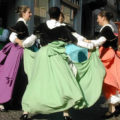
This video was shot at a friend’s campground in Abruzzo, you can probably recognize the young man and young woman who are this year’s animatori. They and the dance class participants (mostly kids) had worked up a little show; parents and other spectators were sitting in rows of chairs to watch.

NB: The word written across the underwear is SO-RP-RE-SA (surprise).

In the Company of Lawyers

I’ve spent the last two weeks interpreting (English to Italian and back again) for depositions in an arbitration between a Venezuelan and an Italian company – work that I was offered via a colleague on the board of Democrats Abroad-Milan. It was arranged at the last minute, so the hirers didn’t insist on any special qualifications beyond fluency in both languages, and an American accent (for the benefit of the court reporters coming from Miami to transcribe). The money was very, very good (and very handy right now), so I made time for the job.

It was an interesting, though exhausting, experience. It wasn’t quite simultaneous translation, but near enough, especially when the lawyer started machine-gunning questions. And I had to think hard about precise shades of meaning. In a legal situation, it’s more important to get the exact meaning of both questions and answers than to translate elegantly – which frustrated me at first, since I’m a writer, and style is important to me.

The English language skills of the witnesses varied, improving steadily as we moved up the ranks of the company (cause or effect?). Everyone we interviewed was an engineer in some sense or other, and therefore understood and used many English terms in his everyday work. (“His” is the correct pronoun – they were all men.) And there are many English words in common use in business Italian where there is no efficient equivalent in Italian, e.g. “training.”

Most of the witnesses understood English well enough to follow most of the questions, although, when a single question ran on for a hundred words, I often lost track of it myself. With some witnesses, I was a mere convenience – they spoke and understood English well enough to do it all in English, so their lawyers’ insistence that I translate both questions and answers was simply a play for time, a way of forcing the witnesses to slow down and think before they spoke. One man kept answering the questions before I had a chance to translate. His lawyers frowned at me every time this happened but, hey, he’s your witness – you tell him how to behave. He was senior enough that I wasn’t going to interrupt his train of thought to translate a question that he had clearly understood perfectly. I also didn’t want to insult anyone’s English abilities.

The last witness, a senior VP, conducted his deposition entirely in very good English, and was in no danger of shooting off his mouth.

There were two tracks of depositions going on at the same time, and in the second week professional interpreters were brought in for the other track. I learned from them that I was being a masochist – the pros work half-day shifts, and were astonished that I was doing full days, especially with no prior experience. They agreed with my finding that about 40 minutes at a time is the most one can expect to be effective – around the 45-minute mark I would begin to feel my synapses smoking. Thankfully, there were breaks every hour, to change the videotape and allow the teams of lawyers to confer among themselves.

I came away with a few observations which had nothing to do with translation. One was a reinforced belief that I would never be able to work for a typical Italian company of this type. There were six or seven levels of hierarchy among the various men we interviewed, with the guys at the top living on Mount Olympus as far as their juniors were concerned. In turn, the top guy had about 1300 people working for him, most of whose names he barely knew. <shudder> I couldn’t bear to be in an organization like that. Even at Roxio, I had direct access to the CEO (and a cubicle conveniently located outside his office). Not that that access did me much good…

I also admired the skills of the lawyers. In addition to the law (of at least three countries), they had to know the reams of documentation that had already been presented in the case, as well as the reams being generated in the current testimony, and make use of it to try to trap the witnesses into admissions which the witnesses’ lawyers were equally cleverly helping their clients to sidestep. They all brought an oratorical and actorly flair to the process, one side building up the emotional pressure and trying to cause a slip, while the other side made convenient objections and used the hourly breaks to instruct the witnesses (I presume – I was never privy to what went on between the witnesses and their counsel).

I developed techno-lust for the Blackberries that all the lawyers were so attached to. I had vaguely heard about these and knew them to be particularly popular in Washington, and had just noticed them advertised by Italian mobile phone providers. One of the lawyers told me they’re cheap in the US – as low as $120 for the device, plus $25 a month or so for the service. Not cheap in Italy, as I shortly discovered. One of the companies is charging 576 euros for the device, and after that I didn’t bother to ask how much they were charging for the service. I’ll either have to wait, or figure out whether it’s possible to use a US-purchased Blackberry with an Italian SIM card.

School “Mortality” in Italy

Today is the last day of school (in Lombardia). Making the local headlines yesterday was a 14-year-old girl who threw herself off a bridge, because she knew she would fail her first year of high school. Her reaction is both extreme and unusual, because failing one or more years of high school – any high school – is common in Italy, and doesn’t carry much stigma. Ross estimates that 8 or 9 of her class of 28 (including herself) are likely to flunk.

Some likely reasons for this high failure rate (or mortalita’ scolastica – “school mortality,” as it’s called) include:

Between a heavy curriculum and often-incompetent teachers, students are left to make their own way through reams of material covered badly, if at all, in class. Sometimes they are even expected to study and understand a new topic on their own, before any mention is made of it in class. The lucky ones have parents who can help them, and/or can afford to pay outside tutors for help in one or more subjects. These tutors are usually teachers themselves, either just starting out (and lacking, as yet, a permanent position), or retired, or teaching at other schools. I am tempted to wonder whether the problems outlined above are wilfully ignored because they provide extra income (tax-free, under the table) for otherwise underemployed and underpaid teachers.

Even for the kids bright enough to get through it all on their own, 34 hours a week in the classroom, plus homework, is a lot of studying. And it’s exhausting for parents to come home from their own jobs and then have to spend an hour or two getting their heads around academic subjects they haven’t touched in years, in order to help their children with homework.

No wonder we’re all completely burned out. Today’s the last day of school. All the kids will be doing something to celebrate the end of a gruelling year, whether they passed or not. We parents deserve a pat on the back as well, for all OUR hard work. In fact, we deserve a party. But I’m too tired to organize one right now.

Results

Jul 5, 2004

Ross did manage to pass her first year of high school, with three “academic debits.” This means that she has lots of homework to do over the summer, and by early September must be ready to prove to her teachers that she has done it. She’s very busy at theatre camp in the US for six weeks now, so August is going to be a hell of homework and nagging for all of us…

next: private school