Category Archives: Italian culture

In Italy, Dyed Hair More Common than Natural

(for women)

I read somewhere that an astonishing proportion of Italian women dye their hair – was it 60% ? Wouldn’t surprise me. Look around you on the Milan metro any crowded morning, and it’s hard to find a woman who doesn’t dye her hair. There are plenty of blondes, few of them natural. A woman’s hair color is strictly her own choice and I have nothing to say against it, but I am perplexed as to how to handle the obviously old ladies who dye their hair blonde, red, etc. I’m not sure whether they simply like their hair that improbable color, or are trying to look younger than they are. Should I offer them a seat, or would they consider that an insult?

I saw an old lady on the street once whose hair was dyed blue. Not little-old-lady style blue-rinsed silver, but bright royal blue. I liked her instantly. I’m also fond of the ones who just leave their hair alone; they look a lot better than the dyed ones. I resist the impulse to congratulate them on their good taste.

“One theory on hair dye / hair styles is that older women want to hang on to the hair that they had when they felt their most attractive. Hence in the UK you will see a fair number of 50’s hair do’s on elderly ladies now…

The argument (which I subscribe to) about blonde is that as you get older your skin tone changes and blonde is more flattering to it! Though you should never go blonder than the colour you might have been as a toddler/small child.

I plan on making my hairdresser a major beneficiary of my disposable income until my hair is white enough to go really white – my Grandmother had lovely white hair which she wore in a chignon until her death at the age of 97!!!” – Judith

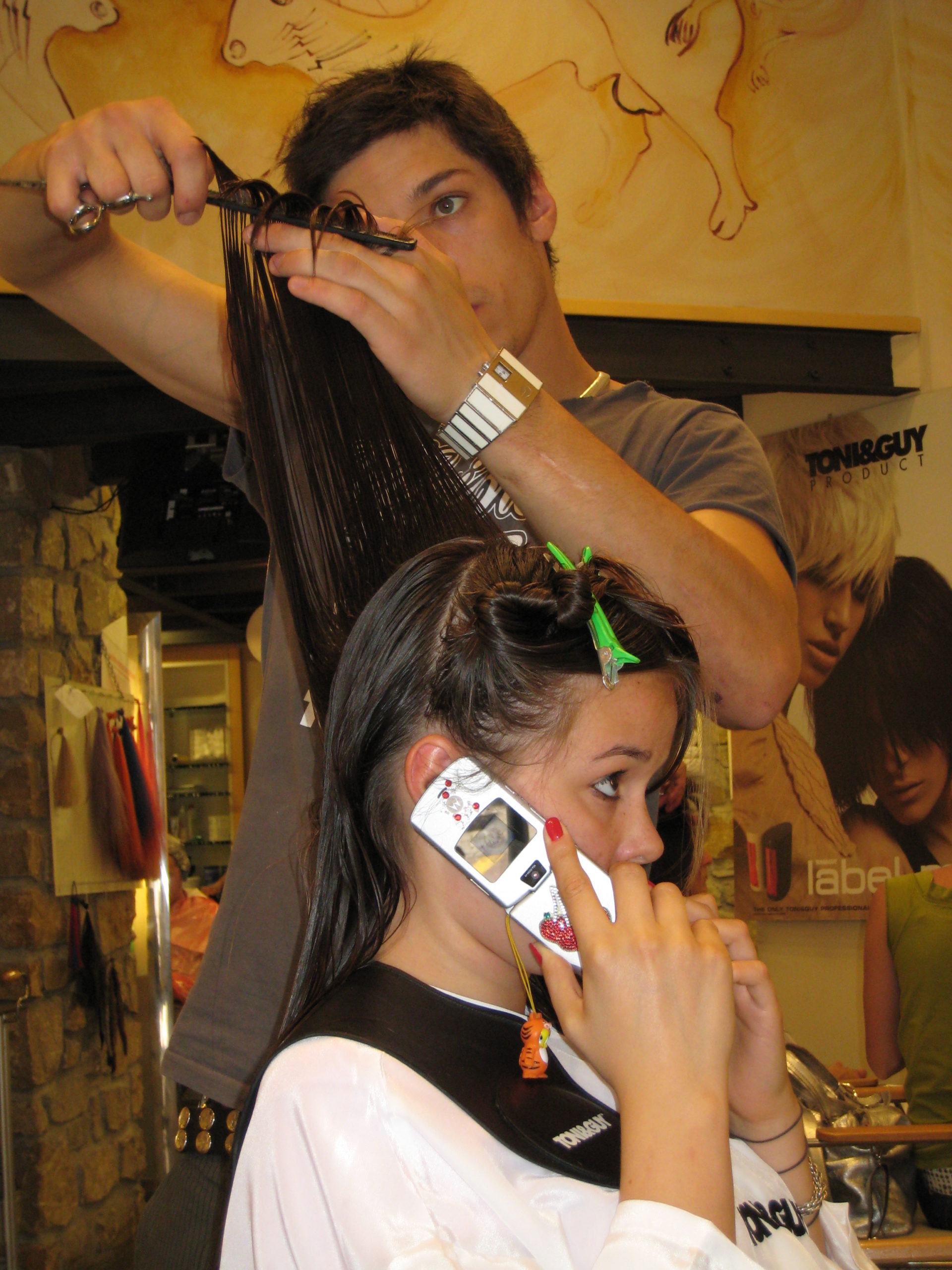
Teenagers and Cellphones – Standard Equipment for Italian Adolescents

David Pogue, technology writer for the New York Times, mentioned in his weekly column (some time ago) some ways in which Europe is technologically ahead of the US. We’re certainly far ahead in the use of SMS (short message service), by which you can use your cellphone to send text messages to someone else’s cellphone. I read elsewhere that SMS recently became available in the US, but not many people are using it. The problem, I believe, is that US cellphone companies have not yet captured the attention of the teenage market.

Italy has one of the world’s highest ratios of cellphones to people. They spread years ago from well-heeled to ordinary folk, with the introduction of pay-as-you-go plans: you buy a phone and “recharge” it with calling time whenever you need or can afford to, with no credit check or monthly fee. This has been a boon to people who cannot qualify for or afford a land-line phone, and to parents of teenagers: give the kid a set phone allowance each month, and when it runs out, they either do without or pay their own way.

Still, the cost per minute of talk is fairly high, and varies wildly depending on whether you’re calling a phone in the same network, a different network, or a land-line. SMS cost only 10 to 12 cents per message, and are less intrusive than calls; the default signal for an incoming message is a single beep. Or you can set your phone to silent mode, and keep an unobtrusive eye on it. Some kids get away with using SMS to pass notes in class.

A familiar cliche’ about teenagers is that, as soon as they come home from school, they are on the phone for hours, much to the frustration of anyone else in the family who needs to use it. But the cliché no longer matches the reality. In the US, kids come home from school and immediately get online with their computers, to text chat with the friends they just saw at school. In Italy, they come home and start tapping out SMS. With SMS, you’re more likely to reach everyone you want to talk to, as there are far more cellphones than computers with Internet connections in Italy. Plus, with a cellphone you can reach your friends no matter where you or they are – neither party is tied to a desk.

Being able to communicate textually instead of orally is great for adolescent boys, who tend to be tongue-tied in comparison with – and especially when speaking to! – their female peers. The same boy who blushes and stammers when confronted with a real live girl, sends wildly romantic SMS. At the beginning of the school year, my daughter was baffled by a boy who would spend hours in SMS conversation, but was too shy to speak with her in person. Later she was courted by a boy who doesn’t yet own a cellphone, which she considered an advantage as he was forced to actually speak to her.

Like many adults, I initially didn’t use SMS much, but am finding it increasingly useful. If I need to communicate a change of plans to my daughter while she’s in school, I can send a message. She’s got the phone set to “Silent” so it won’t disrupt classes, but I know she checks it during breaks.

School rules have evolved rapidly to cope with changing mores. At first many schools banned cellphones altogether. Some have or had rules that they must be turned off completely during school hours – rules which were routinely flouted, as so many rules are in Italy. I guess that by now most schools have given up.

There are downsides to being constantly in touch. I’ve seen my daughter (and others) sit in a roomful of friends, tapping away on her phone. I don’t get that: why not enjoy the friends you’re with, and catch up with the others later? Adults aren’t much better; during breaks in business meetings, everyones dive for their phones, missing that potentially very valuable informal time with their colleagues.


Holiday Hell – Italian Vacation Traffic

Almost every Christmas, we drive halfway down Italy to Abruzzo, where my in-laws are retired by the seaside. This puts us on the road with millions of other Italians going home for the holidays. Much of the flow is north to south: the many southern Italians who migrated to northern Italy decades ago to find work, but still have strong family ties in Sicily, Calabria, etc. So we are part of the grand “exodus,” carefully monitored by the media, with pre-analysis, traffic predictions, minute-by-minute developments, and (afterwards) death toll reports. In recent years we’ve driven on the 24th, when there’s the least traffic (except Christmas Day itself, which we may resort to one of these years). The Sunday before Christmas is also good, as no trucks are allowed on the highways.

There are trains, of course, but travelling by train with a lot of luggage is a pain, and trains have their own risks: The holiday season is when many public services choose to cause the greatest possible disruption, by going on strike. Trains don’t do it too often, but everyone else does. Public transit workers in Milan, Rome, and Genova were on strike for several days during the week before Christmas, causing huge traffic jams as everyone then had to drive to work. This probably put a considerable dent in holiday shopping; I suspect shop owners are not feeling very charitable about anyone’s right to strike at the moment.

Then another protest group got into the act. Italian milk producers are aggrieved because they keep getting fined for producing more milk than European Union quotas allow. For the last several years, they have brought attention to their plight (and won government support for discounts on their fines) by blocking major roads around Milan just before Christmas, particularly near Linate airport. There have been cases (though not this year) of holiday travelers having to walk the last five kilometers to the airport, carrying their own luggage.

(No, this has nothing to do with Parmalat, and I will refrain from any Parmalat jokes as I am sick of them already.)

Between Christmas and New Year’s there is a smaller but still significant movement of people, as many, having spent the obligatory “Natale con i tuoi” (Christmas with your family), now escape to go skiing or for more exotic destinations.

The big “counter-exodus,” of people returning to their working homes from wherever they’ve been, takes place around the Epiphany, January 6th. This year the air traffic controllers are adding to the fun by going on strike January 8th.

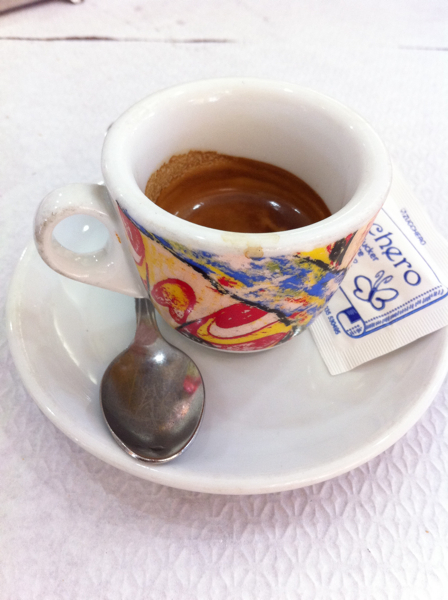
Conversation in a Bar

While having my morning coffee, I overheard a man talking to the waiter:

“I married two sisters. No, really. My first wife caught me with her sister. [Meditatively.] Who do you think is worse: the husband who sleeps with his sister-in-law, or the sister who sleeps with her sister’s husband?”

…there’s a novel in there somewhere…but probably not the sort I would enjoy writing!

Claudia’s Comment

Years ago, we visited Enrico’s cousins in Montecchio Maggiore, a small town near Verona. We went to see the local attractions, the castles of Romeo and Juliet (yes, the original Romeo and Juliet), up on two small hills above the town. Riding in the car with us was Claudia, a very intelligent ten-year-old, who had noticed that lots of Americans come to Italy as tourists.

“Why do they come here?” she asked. “What do they get here that they can’t get at home?”

“Well,” I explained, “America is a very young country. They don’t have the millennia of history, the buildings, art, and so on, that you have in Italy. So they like to come and see it here.”

“Ah,” said Claudia thoughtfully. “You mean they come here because of a lack of culture in their own country?”