Category Archives: Italian food

Italy’s Amazing Summer Fruits

sculpture above done by Ross when she attended liceo artistico

Summer has arrived, and with it everyone’s favorite fruits – along with the desire to mangiare leggero (“eat light”) in the heat. At this time of year it’s not unusual to see mounds of cherries served as dessert, antipasto, or snack at parties and dinners. Juicy, sweet, bursting with flavor, all these need is a place to discard the pits and stems:

An Italian saying related to cherries (and applied to other things) is: una tira l’altra (“one pulls another”), as in: “I ate so many because they just kept coming out of the bowl, one after the other, their stems entangled…”

Have you ever seen more perfect plums? They come in many varieties and colors (blue, red, yellow, pink, purple), and all taste as good as they look:

If you’re visiting Italy in summer, here’s a restaurant tip: instead of dessert, order frutta di stagione (seasonal fruit). You may be asked what you want specifically, so here’s a little vocabulary:

  • pesche [PESS-kay] peaches
  • prugne [PROON-yay] plums
  • albicocche [al-bi-KOK-kay] apricots
  • ciliegie [chili-AY-JAY] cherries
  • pesche noci [PESS-kay NO-chee] nectarines
  • fichi [FEE-key] figs – these are often served as an antipasto, with prosciutto crudo – don’t miss it!
  • lamponi [lam-PONE-ee] raspberries
  • mirtilli [meer-TEEL-lee] blueberries

NB: Berries are known collectively as frutti di bosco (“forest fruits”). If you get a chance to eat fresh-picked wild blueberries (very occasionally available at restaurants and fruitsellers) do NOT pass it up. If you hike, keep your eyes peeled: you can find wild raspberries and blackberries free for the picking.

Peaches, plums, apricots, and cherries may be served floating in, or alongside, a large bowl of cold water. Dip the fruit in and swish it around to clean it, then eat! Many Italians peel their peaches with a knife before eating (often they are so ripe that the peel will slip away from the flesh with very little assistance), but you’re not obliged to – you’ll find that the skin is much thinner than you’re used to on American peaches.

Italian Garden 2007: June

The garden has been largely left to its own devices in the last six weeks, and is thriving. We’ve had monsoon-like rains almost every day for weeks, so it certainly doesn’t need watering, and the vegetables are large enough now that they’re mostly holding their own against the weeds. Only three of the six zucchine plants survived: two at the bottom of the retaining wall, one in the main flat part of the orto. It looks as if the latter plant will be more productive, probably because it gets more sun. Six or so eggplant plants remain after attacks by beetles and slugs – we had a lot of beetles this year, I’ve never seen the like in Italy! – and are just now flowering:

eggplant blossom

eggplant blossom

We have lots of tomato plants, though a couple of them are hard-pressed to find sun around the enormous leaves of the broccoli plants. The broccoli had better be damned productive (in fall/winter) – they take up a lot of room!

broccoli plants

broccoli plants (the yellow blossoms in the center are zucchine) – compare with their size earlier!

The fennel stopped producing bulbs and got long and stalky, then it flowered. I pulled out most of it as it was shading out the lettuce, parsley, and green onions. But it’s so pretty I left some just to look at.

fennel blooms

fennel blooms

While I was away in May nobody dead-headed the roses, so the plants put all their energy into seeds and stopped blooming. Now that I’ve been cutting them back savagely, they’re starting to bloom again, though not as spectacularly as before.

zucchini flower on the plant

zucchine blossom – the plant produces male and female flowers. The female ones turn into zucchine, the male flowers do not, so are eaten as flowers – stuffed with ricotta cheese and fried in batter, if you’ve got the cooking skills for that (I don’t)

figs

a promising crop of figs – yum!

harvest in a basket

Jun 15, 2007 – today’s harvest from our garden: leggy lettuce (the turtles like it), parsley, zucchine, apricots (all we’ll get this year – 6), raspberries

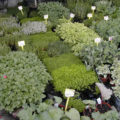
photo at top: herbs for sale at an Italian garden center

Hot Chestnuts! Two Romans Explain How

When I visited Rome for barCamp in January, I stayed with family friends Serena and Sandro – true Romans both. We had grand plans to film Sandro explaining Roman swearwords (with gestures), as an addition to my Italian slang section, but then we drank a lot of wine and laughed and talked a lot, so all the footage I got was this short clip about chestnuts.

As well as explaining a bit about chestnuts, it’s is a good example of a Roman accent, though Sandro’s is not heavy – he’s even laying it on a bit more for the video than is normal for him (at least in conversation with non-Romans). Some day we’ll get around to those videos about swearwords. Sandro is also amazingly knowledgeable on the history of Rome and religions – a resource I hope to make better use of someday.

The phrase la sua morte needs some explanation. It literally means “It’s his/her/its [proper] death.” It’s used to mean: “the very best way to cook or eat x.” I’ve never heard it used except in reference to food.

And, yes, fresh-roasted chestnuts with red wine are delicious.

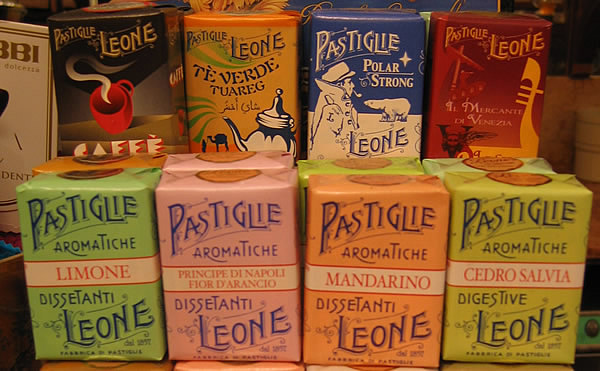
Pastiglie Leone

Leone brand candies have been around for a long time in Italy. I love the Art Deco and Art Nouveau package designs. The flavors are interesting, in concept, at least: coffee (I want a poster of this box!), Tuareg green tea, Polar strong, the Merchant of Venice (spices, I’m guessing), Lemon, Prince of Naples Orange Flowers, Mandarin (these three are “thirst-quenching”), and Lime Sage (“digestive”). And this was only half the packages on display. Photo taken at Bar Santa Marta, via Mascari, Lecco (which also features the best breakfast pastry in town).

Italian Milk

It’s the Little Things That Surprise You

When you move to a foreign country, you expect (if you are wise) that the food will be different from what you’re used to. For the adventurous this is a welcome change, a chance to explore new flavors and habits (though sometimes you also crave the taste of home, wherever that is for you).

It takes you by surprise, though, when even the basics are different.

When I was a kid, milk was simple. In Bangkok, the Foremost milk truck came to our house once a week. It was a huge refrigerated vehicle with thick little doors on the sides that opened to disgorge wonderful things: milk in orange and white cartons, ice cream, and fudgesicles. I don’t know if Foremost even had a skimmed milk option in those days; I don’t remember ever seeing it.

In the US, milk came in the same paper cartons and in big white plastic gallon jugs. We always bought gallons, and the jug was always finished before the milk went bad, in part because I drank it so fast. But even as I got older and drank less milk (when I returned to the US for college), I still bought gallons, and it never went bad.

One of the first things that surprised me in Italian food shops was the size of the milk: it came in half-liter or liter Tetra pak bricks, nothing larger. A family of three or four, especially with small kids, would easily go through one or more liters a day, and one of the cliches of Italian family life is someone having to run out to a neighborhood shop early in the morning to get milk for the family breakfast (tall, steaming mugs of hot milk, with the kids having a drop of coffee in it – caffé latte – even from very young ages).

So why wasn’t milk available in larger packages? I soon found out: it goes bad incredibly quickly. Once opened, a carton has to be finished in a day or two, three if you really push it. I initially blamed this on the packaging: the only way to open a Tetra pak brick is to cut or rip a corner off it. This can make for messy pouring (depending on the cut you make and whether you are able to hold the full brick without squeezing), and then the carton can’t be closed again in any meaningful way. At least American-style half-gallon milk cartons fold in on themselves to protect their contents.

A few years after we moved to Milan, innovations in milk packaging began to appear on supermarket shelves: round Tetra pak cartons with screw-on lids, American-style fold-in cartons (though only in a half- or one-liter size, the latter very similar to an American quart carton), and plastic bottles. At least one ecologically-minded company offered returnable glass bottles, but that didn’t last long.

However, even in resealable packaging, the milk still went bad quickly. I guess we drink less than the average Italian family. It tasted different, too. Better, worse, I don’t know – it wasn’t like the American milk I was used to, but it was certainly drinkable, and anyway I was drinking far less than I had in childhood.

But I do like milk in my coffee, and with the cereal I sometimes eat (Ross practically lives on Special K, which tastes far better in Italy than in its native land, interestingly). I’m a disorganized shopper at best, and, especially where we live now, running out in the morning to grab some milk is not an option. So trying to keep fresh milk in the house is a constant irritant.

An alternative you have probably thought of, if you’ve lived anywhere outside the US in your lifetime, is UHT milk: the ultra-high temperature process it’s subjected to gives it a shelf life of months. But it tastes horrid, and some brands worse than others. I know people who drink it all the time and are happy. I could never get used to it.

Lately there’s a new kid on the block, micro-filtered milk. I don’t know what exactly micro-filtering consists in, but the flavor is excellent and it keeps for weeks. (Maybe this is the process they’ve been using in the US all along?) This is now my milk of choice, when I can find it. Stores aren’t stocking it much yet, perhaps because the public is suspicious. Our friend Michele, who used to own a bakery (and bakeries always sell milk for those early morning breakfast emergencies), said his customers wouldn’t buy it.

I do, whenever I can. It’s so nice to be able to stock up and know that I don’t have to think about buying milk for a while!

May 10 – One of the commenters on this article wondered why you can’t buy milk in Italy in a reseable one-gallon plastic jug. Aside from the aforementioned spoilage problem, there’s also a problem of space: Italian refrigerators are much smaller than American ones, reflecting the fact that Italians shop more often, and their homes are smaller. Even in our big new house, the “big” new refrigerator we bought is only 60 cm wide.

Many American fridges these days are built with very deep doors where big beverage bottles and jugs can be stored for easy access. In Italy, it can be difficult to fit a two-liter bottle anywhere at all.

What food surprises have you encountered in a new country?