Category Archives: Italian food

Why Italians Drink Bottled Water

From time to time in the travel forums, I run across people complaining about the added expense of bottled water at restaurants in Italy. It is possible to drink tap water at any restaurant in Italy, and in some areas it’s the norm, but in many places the request is considered unusual.

Although the water that comes out of our taps is perfectly potable, urban Italians drink almost exclusively bottled water. Not because it’s bottled, but because it comes from real mountain springs (like the one pictured above), and simply tastes better.

City tap water in most parts of Italy that I’ve experienced has a heavily chemical taste – lord knows where they get it from, or what they do to it in purifying. It is also very “hard” – full of calcium. When you see how quickly the inside of your teakettle furs up from boiling tap water, you have second thoughts about trying to process that stuff through your kidneys every day. (Although the technology is available here, very few households have installed the water softening systems that are so common in the US.)

The further you get out into the country, and particularly into the mountains, the better the tap water is: it’s often piped, unprocessed, directly from mountain springs into homes. Many town squares still feature the municipal fountains where people used to get their water before indoor plumbing became common. (In some places, water is so abundant that these can’t be turned off: they simply run, all the time, a waste which always disturbs me.) In communities that have particularly good water, restaurants will put a carafe of the local water on the table before offering you the bottled.

For home consumption, most city households buy bottled water in six packs of 1.5 liter bottles. There are dozens of brands, some local, some national. San Pellegrino is a national brand in Italy – in fact, the town and springs of San Pellegrino are not far from where we live. Most Italian bottled waters actually come from mountain springs in specific locations, and are bottled near the sources for which they’re named. Most come in fizzy and non-fizzy varieties, with the fizzy ones being artificially carbonated, but a few, such as Ferrarelle, are naturally fizzy. Some have recognizable flavors, and after a while you develop preferences (I, for example, can’t stand Ferrarelle).

There is lots of competition between brands, with ads touting their supposed health-giving properties (especially for the house brands at the terme – traditional health spas), low sodium, etc. I don’t take these claims seriously, but it is indisputable that water (bottled or not) is the healthiest thing you can drink – no calories, for starters, and one of the few health statements that most experts seem to agree on is that everyone should drink lots of it. In Italy, this is no problem: not many households keep soft drinks or beer ready in the fridge, but everyone’s always got water. The only two beverages that you see on most Italian tables are water and wine.

You don’t always have to pay for good water in Italy. Enrico and I routinely recycle plastic bottles by taking them to the mountains and refilling them with good spring water:

Oh, My Darling Clementine

The fresh fruits and vegetables section of a standard American supermarket looks much the same all year round. There is no seasonal variance in the availability of any common foodstuff: you see the same tomatoes, lettuce, broccoli etc., even when they have to be imported from someplace far away where the weather is right for growing them. This everyday "luxury" is so ingrained into American habits that, when I first moved to Italy, it never occurred to me that certain items might simply not be available at some times of year. "What do you mean, it’s not the season?"

Italian fruttivendoli (greengrocers) and their customers favor the fruits and vegetables of the season. You can certainly buy, e.g., greenhouse strawberries in winter, but they’re much more expensive, and not nearly as tasty, as the ones grown outdoors in their proper time. The most flavorful foods are grown "locally" and are bought at the peak of their season, when, due to their abundance, they’re also cheapest.

Right now it’s winter and we’re flooded with agrumi (citrus) from Sicily and other southern parts of Italy (and Spain). You can get some sort of oranges (arance [ah-RAHN-chay]) all year round, but at this time of year they’re huge and juicy, a colorful antidote to the gray weather. Blood oranges – my favorites – don’t look much different from any other kind on the outside, but inside: red red red! Squeeze them to obtain a thick, syrupy juice that looks like a vampire’s breakfast.

even the packing is gorgeous! – blood oranges

My favorite citrus, however, are clementines. I guess these are what Americans call tangerines: smaller than oranges, when ripe they are loose in their skins and easy to peel. They break apart neatly into bite-sized sections that you can pop into your mouth and enjoy a squirt of juicy sweetness, without getting it all over your hands and face. Actually, clementine [cleh-men-TEEN-ay] are usually so small that you can eat half of one in a single mouthful.

These (along with Glucose biscuits) were my favorite winter travelling food in India, and are just as handy on Italian trains: I can pop a few into my backpack, peel and eat at will. If they get a little mushed, it’s no matter – a section or two may be squished, but they don’t turn black like bananas, and the rest is perfectly edible. I also keep some on my desk for mid-morning and mid-afternoon snacks. A golden pyramid of clementine offered to guests after dinner will disappear entirely as people talk and nibble, easily downing five or six each.

There are several varieties. There are clementine con o senza semi (with or without seeds), pictured at top. There are mandarini, which are tiny, with a smooth, shiny skin that fits tightly and can be difficult to peel. There are mandaranci, which I take (from the name) to be a hybrid of oranges and mandarins. There’s a larger variety of clementine which is closer to what I remember from India – not as sweet and juicy as the standard Italian version.

I don’t buy late-season fruit: it’s always disappointing after the wonders of a fine fruit at the height of its glory. I’ll enjoy the clementine while they last. Then they will slowly disappear from the shops, and we’ll have to survive on pears and apples until the early summer fruits (cherries!) start coming in.

photos shot at Il Fruttorto, Lecco

Caffeination: Italians and Their Coffee

music: Manhattan Transfer – “Java Jive”

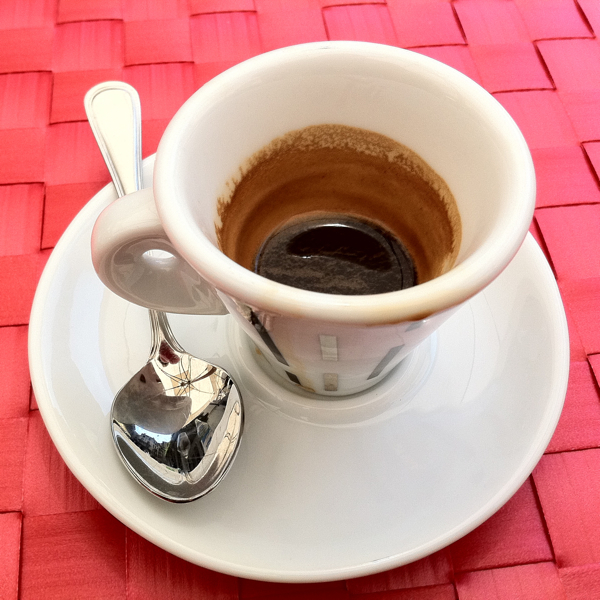
Although Italy has some of the best coffee in the world, Italians don’t drink nearly as much of it as you might think. My own routine, which I suspect to be fairly average, is:

  • one at home at 7:30, before starting my commute
  • one fairly soon after arriving at work, around 10 am
  • one right after lunch

If I’m having a particularly sleepy day I might have one sometime between 10 and 1 (pre-lunch) and/or, very rarely, one in the late afternoon. Five a day is unusual for me, and many people I know consider four overdoing it ¬– though I did talk to a barista once who said he used to drink 12 espressos a day.

Most people I’ve observed in this part of the country (Milan / Lombardia) stop with the post-lunch espresso. Some have an espresso after dinner, especially if they plan to be out later, but I don’t see many ordering post-dinner coffees in restaurants. At home we only make coffee at night if dinner guests want it for their own drives home.

It’s true that espresso is concentrated, but, per average serving, it contains less caffeine than American coffee, and Italians do not have the American habit (which I sometimes miss) of keeping a warm mugful on your desk or table and sipping at it for hours.

When foreigners come to Italy, the clash of caffeine culture can be funny. A Swedish colleague once apartment-sat for us in Milan. As part of his orientation, I took him downstairs to our usual coffee bar (which also made excellent gelato), introduced him, and asked them to treat him nicely. They talked for months afterwards about his peculiarities: he habitually ordered double espressos, which baffled them. For starters, a double won’t fit in the standard single espresso demi-tasse cup, and they disliked the aesthetics of serving espresso in a cappuccino cup. He also mostly lived on gelato that month (it was August), which, while they appreciated the compliment to their gelato, is not standard Italian behavior!

The other day, I overheard a young Italian woman on the train discussing a foreign guest who had visited their home. “We made a moka of coffee, and she thought it was all for her. She drank the whole thing!” “I could never drink that much coffee!” exclaimed her friend, “I wouldn’t sleep for days!”

When Italians make coffee at home, they most often use the moka, a screw-together pot you put on top of the stove. These come in capacities from 1 to 10 cups, and a family may own several sizes, to cope with various occasions. But a four-cup moka makes less coffee than you’d find in a Starbucks “tall” – no wonder the American guest was confused.

Yes, you can get fancy home espresso machines here just as you can in the US, but, to make consistently good espresso, they require a high degree of maintenance and skill. Most Italians can’t be bothered, especially when they can get better coffee for far less fuss at the bar down the street. (Though a few make it a point of fetishistic pride to be able to make at home a coffee “just as good as you get at the bar.” In counterpoint, some espresso machines in bars are decorated with the slogan “REAL coffee you can only get at the bar.”)

Coffee made in the moka can also involve more or less fuss, and is quite a different thing from bar espresso. It took me years to acquire the taste, and I still haven’t learned to make it consistently good. But I got tired of trying to reproduce the consistency and flavor of good American-style filtered coffee. I think that this winter, when I want a big hot drink, I’ll stick to chai.


what’s your poison?

The Perils of the Italian Quest for Fresh Wild Mushrooms

While out on a walk (which became a hike), I saw a couple of women heading into the woods with wicker baskets dangling from their backpacks – off to hunt for mushrooms. Italians, like hobbits, are very fond of mushrooms, especially the varieties which defy cultivation and can only be found in the wild (or bought, expensively, from someone else who found them).

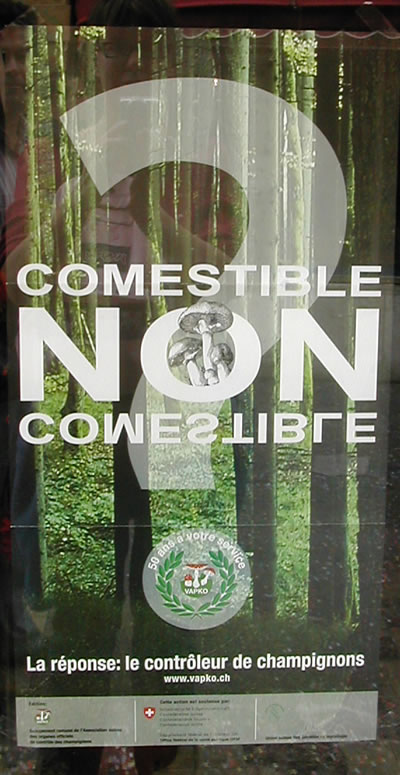
comestible

^”Edible or not? The answer: the mushroom checker.” A pharmacy sign in Switzerland.

To ensure that the mushrooms they pick are edible, many Italians have taken courses or otherwise learned how to distinguish various types. If you’re not sure, you can go to a pharmacy to have your catch examined – I guess pharmacists have to have some sort of mushroom qualification. Still, every now and then someone thinks they know more than the pharmacist does and ends up poisoning their entire family (usually not fatally). The wild mushrooms you buy in stores are certified safe, I presume.

But mushrooms have other ways of taking revenge on the humans who seek them so avidly. The mushroom courses apparently don’t include tips on how to pick them without killing yourself, so every year, during mushroom season, people fall off cliffs while out ‘shrooming. This past weekend saw one death, one serious injury, and two people needing to be rescued from whatever situation they’d got themselves into on a mountain somewhere; this morning’s local paper announces another death – all in quest of mushrooms. I think I’ll stick to buying them at the store.

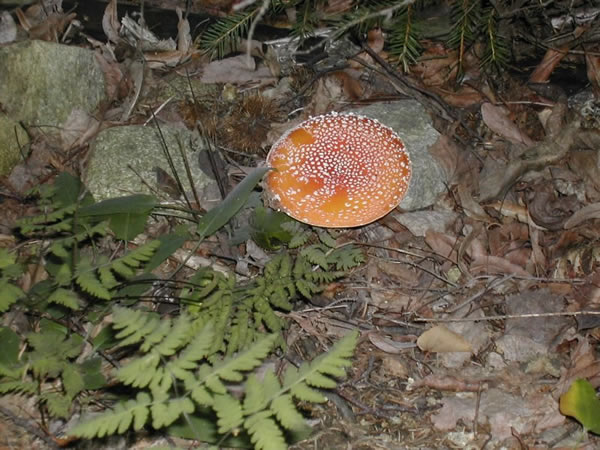
NB: The mushroom shown at top is of the “DON’T eat me” variety.


an American student in Viterbo on ‘shroom love