Category Archives: living in Italy

An American Thanksgiving in Italy

Our Thanksgiving dinner was, if I say so myself, epic. I printed out the menu in that fancy font that restaurants always use, so people wouldn’t have to ask me what they were eating; here, of course, I’ve added extensive notes.

Antipasti Vari (various antipasti) – Paola brought mini breads, we supplied salame. I didn’t do much on antipasti because so much other food was coming.

Tacchino al Forno (oven-roasted turkey) – The guests were mostly Italian, many of whom had never seen a whole turkey cooked American style. By American standards, this was a very titchy turkey – less than 13 pounds. In the US you can select from a whole range of turkey sizes; here in Italy, you either take the small female (which I did) or the humungous male. The smaller one turned out to fit all right in the 40 cm roasting pan I had bought.

I used some American technology, a Reynolds oven bag that I bought in the US two years ago on Sue’s recommendation. I filled the turkey cavity with mandarin oranges, onions, and herbes de Provence; we didn’t eat this filling, but it helped produce marvellous gravy.

Ripieno di Pane al Mais con Marroni (cornbread stuffing with chestnuts) – A Martha Stewart recipe, bless her. Martha expected me to have canned or frozen chestnuts. Here in Italy, in season, you can find fresh chestnuts in the woods yourself (difficult – everyone else wants them, too!) or buy them at the supermarket, which I did. I then roasted them in the oven and peeled them. Labor-intensive, but worth it. In my opinion, roast chestnuts by themselves smell a lot better than they taste, but when you cook them with meat or in a stuffing like this, they’re heavenly. Stuffing is unknown in Italy, and turned out to be very popular.

Insalata di Finocchio e Mela (salad of fennel and apples) – Another thanks to Martha. Everyone loved the unusual combination.

Puré di Broccoletti e Spinaci (broccoli and spinach puree) – Recipe from The New Basics Cookbook by Rosso and Lukins. Not the most popular dish on the table, especially with my family since I had made a test batch last week and we’d already had enough of it, though we liked it a lot the first time around. I’ve frozen the leftovers to eat when we’re no longer sick of it.

Fagiolini con Gorgonzola e Noci (green beans with gorgonzola and walnuts) – New Basics again, easy and tasty.

Puré di Patate (mashed potatoes) – Everyone loves €˜em. Fortunately, I had help with peeling and chopping 4 kilos of potatoes.

Selezione di Formaggi con Salse (selection of cheeses with chutneys and honey) – One of the guests brought cheeses, and I had also bought some, plus I had made two chutneys, tomato and dried apricot. Don’t be overly impressed – chutney is very easy to make. These recipes were from Madhur Jaffrey. We also had dark honey (from chestnut flowers), which goes well with many cheeses.

Dolci (sweets) – Maryellen brought a wonderful pumpkin pie which she made completely from scratch (canned pumpkin is not widely available here), Elisabetta made a scrumptious chocolate cake with pears – You’ve never had that? It’s an Italian tradition. You put thin slices of fresh pear into a fairly standard chocolate cake (it may be necessary to correct for moisture; I have not actually done this myself) – it’s a wonderful combination. Rossella had made chocolate chip cookies and brownies, but we never even got to the brownies. Her classmates have been happy to polish those off for us.

Recipe Links

Martha Stewart (and many others)

Other Madhur Jaffrey recipe books

The Patented Woman

Congratulate the neo-patentata! (newly-licensed [driver]) I finally had my road test yesterday; it had originally been scheduled for late October but, as it turned out, I was in Texas then. The driving instructor, Massimo, accompanied his mini-United Nations to the exam: one Italian teenager getting her first license; a Moldovan truck driver taking the first of many exams to be fully accredited to drive trucks in Italy; a young Egyptian man who didn’t say much; and myself. There were two other instructors, with one and two students respectively. This particular examiner is known to be quick, and on this day had some other appointment to get to, so he was moving at lightspeed. He didn’t spend more than ten minutes on any of us, and the only maneuver I had to perform was the inversione di marcia (reverse direction – a three-point turn). I was almost disappointed that I didn’t get to show off the parallel parking I had practiced so hard to master. (We had practiced reverse-in parking, too, though you rarely find that kind of parking space in Italy.)

So I have the new-style Italian driver’s license, credit card size, though it’s no more high-tech than the old paper ones – it doesn’t have a magnetic stripe or smart chip. Maybe it’s harder to counterfeit.

I’ll miss Massimo; he was good company for all those hours we spent in the car together. We did most of our driving within the confined area that the examiners use, in preparation for the exam, and it could have been (and sometimes was) very dull, seeing the same scenery over and over. I look forward to driving around some other parts of Lecco now.

The whole process cost me over 1,000 euros, but was the most efficient and certain way to a license. The driving schools have it all down to a fine art, based on many years’ experience. Their lessons for the theory exam are useful for recent immigrants who don’t speak Italian well and are taking the theory exam orally; when a new examiner joins the team, the driving instructors listen in on the oral exams to understand his personal style and favorite questions, so they can help a student prepare for any specific examiner. And they know the fine points that examiners will be looking for in the road test; in my final lesson yesterday morning, Massimo drilled it into me: “Don’t use the clutch when turning! He’ll say you’re not in control of the vehicle.”

The road test is run differently here than in the US. You use the driving school car (the same one you’ve been practicing in), and your instructor sits up front with you. The examiner sits behind you, and quietly tells you what to do. You just keep going forward unless and until he tells you otherwise. The instructor is supposedly there to use the second set of pedals in case something goes disastrously wrong, but he’s also allowed to clarify the examiner’s instructions if needed. In practice, the instructor does what he can to help, giving sly hints via a subtle nod that the examiner isn’t supposed to see.

Massimo’s other students followed in a second car (driven by another employee of the driving school). After my inversione di marcia, the examiner told me to pull over and park, and handed me my license. I signed for it, got out, and the teenager took the drivers’ seat, while I rode in the following car and chatted with the Moldovan. Then it was the Egyptian’s turn, then the Moldovan’s. We all passed.

Finally, we all rode back to the driving school together where our new licenses were photocopied (which makes them easier to replace if lost), and that was that.

I haven’t actually driven my “new” car yet (a hand-me-down from my father-in-law, who no longer drives). This afternoon I’ll drive Ross and her friend to their horses. Which could turn into an adventure. Hamish is now at a private stable on a mountain, inside the private property of a cement quarry and factory. The road from the front gate to the stable is mostly an unpaved mine access road, so you leave your regular car at the gate and drive a company jeep up the hill. The steep hill. With narrow tunnels carved out of the living stone, regulated by traffic lights. Oh, and I did I mention it’s raining…


Dec 3, 2003

Mike L. sent a few notes, comparing his driving exam experience in the Netherlands to mine in Italy:

Parallel parking is NOT a part of our exam. During the exam you will always perform two out of three maneuvers: Reverse direction as you described, taking a (short) turn backwards (you might consider this backward parallel parking), and reverse-in parking.

Driving away on a slope is also a standard item, but in Holland, its very hard to find a spot with enough a slope that would make the car go rolling backwards when you release the brakes! Usually, there is only one such place in a city, sometimes leading to a line-up of vehicles marked with a white-on-blue “L” waiting to practice…

American Stars in Italian Advertising

It’s not common to see big-name American stars in TV ads in the US, but they’re quite willing to do such ads overseas. Here in Italy I’ve seen Harrison Ford in an ad for a French car brand. Andie McDowell has for years advertised an expensive brand of shoes, and more recently cosmetics, for which she appears in TV commercials apparently speaking perfect Italian with no trace of an accent. Leonardo diCaprio has appeared in an ad for Apple Computers. Both Naomi Campbell and George Clooney have appeared in Martini ads; at least both of them actually do spend time in Italy. (In case you’re wondering, Clooney’s villa is on the posh side of Lake Como, near the city of Como – nowhere near us. If I ever run into him, I’ll let you know.)

The Clooney ad is one in a series on the theme “No Martini, no party,” and is cute enough to warrant a description: George rings a doorbell. The door opens, he’s greeted by several attractive young women, and a party is clearly going on inside. “Hello, George,” they say enthusiastically. Then they see that he’s empty-handed, and slam the door in his face, saying: “No Martini, no party.” George realizes his mistake, and returns with a case of Martini. This time the girls greet him warmly, take the box, and slam the door in his face again.

Gwyneth Paltrow has also appeared in Martini ads, which raised some comment as she has stated publicly that she doesn’t drink alcohol.

Making Room: Italian Stratagems for Living in Small Spaces

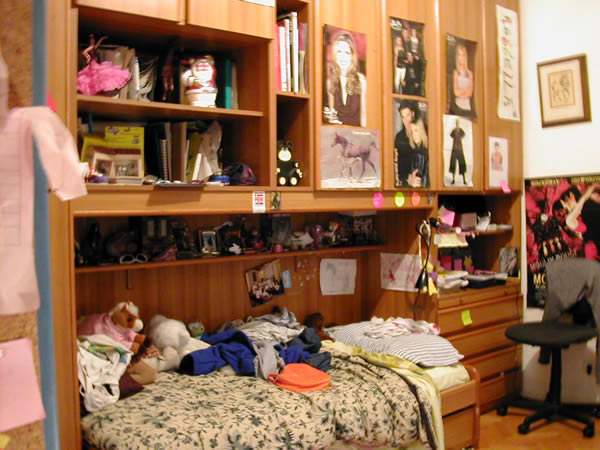
^ top cameretta a ponte in Ross’ room in Milan. Where the chair is at right, a desktop slides out, though Ross never used it that way. (This fuzzygraph is Ross’ early work when we got our first digital camera.)

Living space is tight in Italian cities, which are often geographically constrained because built into, on top of, or between mountains – the kind of urban sprawl you see in America simply can’t occur in most parts of Italy.

Even where there is room to spread out, historically Italians tended not to. This may be due to centuries of history: until recently, Italy was a collection of separate city-states which were often at war with their neighbors; people huddled into fortress towns and cities for safety, and many Italians have never lost this preference for living close together.

Urban Italians have been living in apartments, condos, and townhouses since Roman times. The apartment building was invented in ancient Rome, and even in those days single-family dwellings were only for very rich families. Italian cities today are almost entirely apartment buildings, four to five stories tall in mid-sized towns, eight to ten in larger cities. In many buildings, the lowest floor sare reserved for commercial use. Where we lived in Milan, we had a greengrocer, bar/gelateria, baker, and butcher right downstairs – extremely convenient, since I was always forgetting something in my shopping.

The primo piano (first floor above ground level) is undesirable to live on, partly because of pollution, partly because it’s more vulnerable to housebreaking (that’s why you often see bars on the lower windows of older buildings); first floor apartments are often used as offices.

The higher up you go, the higher the value of the real estate, because the higher floors get more light and air and less pollution, and are less susceptible to being robbed. But the floor space remains the same – usually small. So how do you fit, say, three people, with all their possessions, into 70 square meters (~750 square feet)?

One way is to go vertical. Ceilings in Italy are higher than the American average, (although they’ve gotten lower in modern buildings). You build your bookcases go all the way to the ceiling. Closets are divided vertically into two sections: use the top sections for out-of-season clothing, lifting the clothes on hangers up to the high rod with a long-handled hook.

In some old buildings, the ceilings are so high that apartment owners are able to build in a loft. If you don’t want to go to that much trouble or expense, you can buy a loft bed from Ikea, which leaves a nice workspace underneath. I’ve been tempted by those, but I’m scared of heights, I get up a lot at night, and getting sheets onto such a bed looks like a hassle.

Bunkbeds and loft beds are quite common for kids’ rooms, often built into closet/desk/bed units called camerette (little rooms). A cameretta a ponte (“with a bridge”) has part of the closet built over the bed. There are entire furniture stores devoted to camerette in every conceivable style, some of them the kind of fun furniture kids dream about, with playspace under the bed, a miniature staircase going up to a loft bed (the steps lift up to provide storage space) and/or a slide for disembunking.

  • also see: Housing: How Italians Live
  • My Attitude Towards Italy

    I received email from someone who had visited my website, read a few articles, and concluded that I don’t like Italy much. I am confused by this, especially since the articles she cited (Babies, Homes, and one other, I forget which) didn’t strike me as negative. I see my articles as statements of fact, though written in a wryly ironic tone that might confuse some people, especially if they come looking for “Under the Tuscan Sun”-style warm fuzzies about Italy.

    So, in case it needs clarifying, let me clarify: I do love Italy, and am very happy to live here. It’s probably the best place in the world for me to live, and, even if it wasn’t, my family is there, and that pretty much settles the question.

    But I don’t love Italy blindly. I didn’t move here because I had always dreamed of living here*. So I don’t have particular dreams about Italy to keep alive, and can allow myself to see the bad as well as the good. And I’m not trying to make money out of writing about Italy (well, it would be nice…), so I don’t have to write the kind of sunshine-and-red-wine stuff that most people seem to want to read. The Italy I live in has much to recommend it, but it’s not the Italy you see in glossy coffee-table books. The Italian families I know are not the warm, boisterous, suffocating crowds you see in American sit-coms and movies. My family, friends, and neighbors are real, modern Italians, who rarely conform to Italian-American stereotypes.

    I’m beginning to think that I should write a book about real life in Italy. Not to scare people off, but to point out that daily life in Italy has its own stresses and pains, just as daily life anywhere does. A good bottle of wine with a good meal is a lovely thing to have (even better when combined with a marvelous view), but it doesn’t cure all ills.

    You know what’s really ironic? The average Italian on the street is astonished that I would rather live in Italy than America, or that anyone would (I have had this conversation with many taxi drivers). Like much of the rest of the world, Italians see America as the land of opportunity and riches, of wide open spaces and huge houses. Most of them would not willingly leave Italy permanently, yet they seem to wish that they could participate in the American dream. And they are absolutely floored to be told that many Americans dream – of living in Italy.

    *If you’re wondering why I did move here… go here.