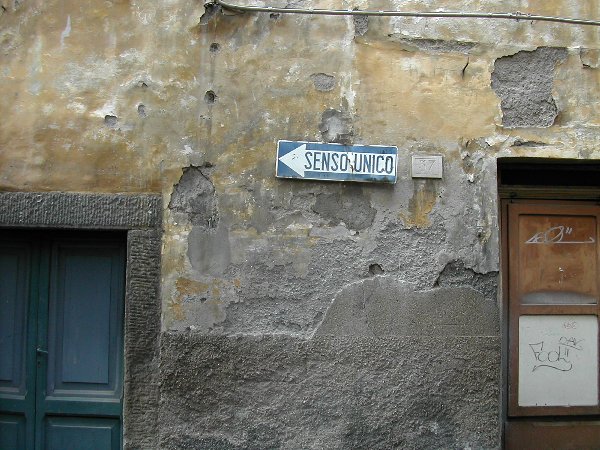
Taken during the Imaging in Italy course.

Taken during the Imaging in Italy course.
One side effect of living in Lecco is that I need to drive. Not so much to get around Lecco itself, nor even into Milan, but because our fourth family member, Hamish the horse, now lives in a place not easily reached by public transport. (Yes, there are buses, but they don’t run very often.) So it’s time to get an Italian driving license; the grace period for driving on my American one expired about 12 years ago.
Unfortunately, American licenses are not directly convertible to Italian; you have to go through the same process as an Italian first-time driver. This is far more difficult and longer than getting a license in the United States; I think that’s a good thing, given the challenges of driving in Italy.
The first step to getting a license is to pay three different fees (a total of 33 euros), and have a medical exam of sorts, mostly about vision. That plus filling out some forms gets you a foglio rosa (pink sheet) – a learner’s permit. I am doing all this through a driving school, which is costly, but makes things somewhat easier: they take care of the paperwork and standing in line for you.
Then you have to pass a written “theory” test. It’s only 30 true-or-false questions (three each on 10 topics), but if you miss more than four, you have to wait a month and a day before you can try again, and the test is harder than it looks: it demands a thorough understanding of Italian legal/bureaucratic language, at least as relates to driving. Immigrants not fluent in Italian have the option to take a much easier oral test; I could probably have gotten away with claiming this, but the oral would have taken longer to schedule, so I opted for the written.
The driving school offers theory lessons three times a week. I went to two of these, but found them excruciatingly dull. It’s no doubt great for beginners and non-fluent immigrants to have everything explained six times over, but I find it hard enough to sit through any class for 90 minutes, let alone “Road Signs for Dummies”. The only interesting part was the teacher’s endless stock of horrible stories about drivers who became distracted and “ci ha lasciato la pelle” (literally, “he left his skin,” meaning “he died”). According to the teacher, the major cause of road accidents is: “Dis- dis- …?” (prompting for the word). “Disregard for the rules?” I was tempted to offer, but I kept my mouth shut; I’d already seen that he didn’t understand my sense of humor. The answer he was looking for was “Disattention,” which I suffered in his class more than I ever have on the road.
Fortunately, the classes were not required, and I already had another source of help on Italian driving theory. Cristina, a member of the Expats in Italy online group I frequent, has a very helpful website about driving in Italy, which in turn links to WebPatente, a useful program for learning the theory and practicing for the exam, complete with audio commentary on your results.
The questions asked in the practice exams are presumably based on real exams past and present. The funniest one I ran across in my hours of practice was: “True or False: Distraction and a reduced sense of danger can be caused by… excessively spiced foods.”
This is almost as funny as the question my dad had to answer in a driving test in Indonesia, years ago:
You’re driving down the road and you see a Stop sign. You should:
a. Stop
b. Slow down.
c. Look to see if a policeman is watching.
Meanwhile, back in Italy… I had to argue with Mr. Realini, the owner of the driving school, to convince him that I could prepare myself for the exam without the help of their classes or preparatory quizzes. (NB: My attending or not made no difference to the amount of money they’re getting out of me: a flat fee of 500 euros, plus however many driving lessons at 23 euros each) But, after a couple of nasty head-on collisions with me, he agreed to schedule it for September 22nd.
So I turned up at the school at 10:45 Monday morning. Then had a last-minute panic, because I suddenly realized that the foglio rosa was required for entrance to the exam, and it had vanished from my wallet. I ran home to search (I had time because the earlier exam sessions were running late), but couldn’t find it. Mr. Realini was nice about it (“Happens all the time”), and said we should just go to the exam anyway and see if they would let me in. So myself and four 18-year-olds trooped across the street to the Motorizzazione Civile (“Civil Motoring”? not a very accurate description, in Italy), where two dozen other candidates were waiting, with the owners of their respective driving schools. Mr. Realini, perhaps to distract me, asked what I thought of George Bush, so we had a lively discussion about that. The teenagers were amused, but shy to join in.
Around 12:15 we were finally allowed into the exam room. Our names were called off a computer printout, and each of us had to stand in front of the two examiners while our packet of papers and photo ID were scrutinized. They waved away my lack of a foglio rosa, but wanted to see my permesso di soggiorno (permission to stay in Italy), which I hadn’t known I was supposed to have with me. But at least I knew exactly where that was. I started to call Enrico to bring it (he’d already spent an hour searching for the foglio rosa), but then they decided that I only needed it for the actual driving test.
When all the candidates had been checked in, the examiners asked two people to come up and witness (with signatures) that the exam packets were still sealed. They then opened the packets, and one of them signed each exam sheet before tucking one into each student’s portfolio of papers. Then he called us up one by one to collect our packets. Finally, when all were seated with our papers in front of us, we were allowed to take the sheets out and start the exam.
Almost immediately, a vociferous argument started in the main office outside. I giggled. The examiner smiled ruefully and closed the doors, but you could still hear everything. Finally he poked his head out the door and asked if they could carry on after the exam. A minute later, someone poked his head in to apologize. “Just for this, you all pass,” he joked.
Of course, the first topic on the exam was something that had not come up in the driving school handbook nor WebPatente, about directional signage for roundabouts (which have only recently become popular in Italy). The wording on one of the three questions looked like it might be one of those linguistic traps: is a road coming off a roundabout called a traversa (cross-street), or is there some arcane technical term that I hadn’t heard before? After some pondering, and going on to do most of the other questions, I marked it “false.” You can’t make corrections on this test, so you have to be sure of the answer when you make your mark!
The rest of the test I felt pretty comfortable about, except the questions about the round blue sign with a human figure walking. I was mostly, but not entirely, sure that that meant “pedestrian area,” and answered the questions accordingly.
There was also a question on precedenza (right of way), my favorite subject – just because the rules are so charmingly contrary to actual behavior. The tests use some wildly theoretical intersections, with five or six streets meeting. The situations are all plausible enough, but the correct answers are not. One that sticks in my mind shows a four-lane street with a tram (on tracks) in the middle, flanked by a truck going the same direction. There are cars waiting to cross from each side of a smaller cross-street. Theoretically, the tram goes first, because any vehicle on tracks always has right of way. After that, the car with no traffic to its right should go, then the other car, and the truck last. Yeah, right – try to convince me that, in real life, the truck isn’t going to move at the same time the tram does, or even before! The book does reiterate that, no matter what the rule of precedenza says in any given situation, you should make sure that the other drivers agree with you before you move.
The test sheet was printed in black and white, including the illustrations, but there were two colored brochures of road signs and street diagrams that you could consult for clarity (each picture used in the test is numbered; the images in the brochures have matching numbers). I realized after I had handed in my test that a careful look through the whole brochure would have resolved the pedestrian zone question for me: the sign was there, by itself, just as shown on the test, but there was also another version of it as part of a larger sign with “zona pedonale” clearly printed!
We had 30 minutes to complete the test, but no one took that long. By around 20 minutes, the last test had been handed in, and we proceeded to corrections. Again each person’s name was called, and we had to stand in front of the examiners while they checked the test against the marking sheet, and called out the number of errors with “idoneo” or “non idoneo” (suitable or un-). Only two people failed, one with five errors, one with “many.” I only had one error, on that question about the roundabout, which turned out not to have been a trick after all. So I am suitable for driving – at least in theory.
When told my result, I did the American fist-pump gesture and shouted “Yes!” The other examinees all laughed; one of the examiners said disapprovingly (in Italian): “You’re in Italy now, say Si’.”
October 6, 2003
My classmate Yuti responded:
“This reminds me of my driving test in Bombay in 1981 when I turned 18. The test is supposed consist of an oral test and a test drive. There is a fat rule book, but I was told by my driving instructor that examiners ask only one of three rules, so I was to remember only these, and not bother with the rest. I don’t remember the rules verbatim but they go something like this: (1) you cannot have someone sitting on the car bonnet while the car is in motion, (2) you cannot have more than three persons in the front (in those days cars did not have bucket seats, but one long seat like the back), and (3) you cannot drive without headlights at night. These rules had numbers, like Rule 356, 452, etc.
The examiner would ask “Recite Rule so-and-so”, and you were expected to recite the rule verbatim as per the Rule book. Sure enough, my examiner asked me to recite the rule about sitting on the bonnet. That was the extent of my oral test.
For my test drive, I was asked to reverse park between two cars, and indicate turning left and right. In those days, Indian cars did not have turn indicators, so you had to use your hands. To turn right, you stuck your hand out of the window and made a circular motion with your wrist in a clock-wise direction. To indicate a left turn, you turned your wrist anti-clockwise. It took me 10 minutes to pass both tests. I got my license within a week by bribing the examiner Rs.50 (a hefty bribe in 1981), otherwise I would have waited months for it. But I was in a hurry to hit the road.
Now you know why Indians drive the way they do!”
Rossella started high school last week, she’s going to liceo artistico (art high school). Monday was the first day of regular classes, so they’re moving through the timetable and meeting their teachers one by one. For religion class they have a Catholic priest, who nonetheless explained that his class would not be catechism: “I’m not here to convert anybody.” He asked the class why they had chosen liceo artistico; someone must have mentioned creating beautiful things, because the conversation then moved on to how to define beauty. Ross tried to express something about beauty being in the eye of the beholder. Her example was: “My mother loves India and sees beauty in it; my father can’t understand how anyone could see beauty in a place of such poverty and squalor.”
I was struck by this, because I haven’t often talked or written about India in terms of beauty (partly because I don’t have much gift for physical description). Ross is right, I do see beauty in India, and in most other places I’ve visited. Where I can’t find beauty, I can usually at least find humor and interest. I guess that is my particular, peculiar gift.
There is beauty almost everywhere, if you are open to it. Take Milan, for example. At first glance it’s drab and dingy, and not considered much of a tourist destination. As an industrial center, Milan was heavily bombed during WWII, and afterwards rebuilt hastily – and often tastelessly. The few impressive pieces of architecture left are too over the top to be called beautiful: the world’s most Gothic cathedral (unfinished – after 600 years they’re still adding frills), and a huge marble railway station, the very epitome of Fascist architecture.
But, if you’re willing to look, you can find fascinating things. One of my favorites is an apartment building in via Vivaio, done in heavy stonework to look rather like a castle, adorned with huge cherubs near the roof. Peer into the entryway and admire the interplay of red brick, polished gray stone, and golden tiles. Weirdly, you might hear a peacock’s harsh call. This is from across the street. That place is owned by a wealthy retired couple, who obtained permission from the Milan city government to knock down the adjacent building and create a huge garden for themselves, by willing the entire property to the city after their deaths. In the meantime, they have filled the garden with peacocks and flamingoes.
Many people would consider me to have the best of all possible worlds: I live in Italy, after all.
In 1995, Adaptec bought Incat Systems, the small Italian software company I was working for, and I was part of the package. I wanted to become a regular employee of Adaptec, though at a distance, since I was by then working from home with quarterly trips to the US office. The idea was radical (for Adaptec at that time, anyway), and they refused; as long as I remained in Italy, they would hire me only as a consultant at an hourly rate. It was a high rate, no complaints there, but I wasn’t a regular employee.
I happened to be at the US office when the sale was completed, so I was able to lose this fight in person, at least. We were all called in for a meeting with Adaptec HR people to explain the company benefits etc., none of which applied to me. After the official presentations, I was chatting with one of the HR people. I mentioned, wistfully, that I would have preferred to be a regular employee. “But this way you get to live in Italy,” she said. Well, yes, but it would be nice to have regular employee benefits (paid vacation, sick leave). “But you get to live in Italy!” she said.
Clearly, she dreamed of living in Italy. Many people do. Funny thing is, I never did. Until I met Enrico, I had barely even visited Europe, and never Italy. It just wasn’t on my radar screen; if I thought about my future at all, I assumed that I would somehow end up in Asia – seemed logical, given my personal history and my college degree in Asian Studies. Had I been actively seeking a husband, it wouldn’t have occurred to me to look for an Italian mathematician.
But there he was, and here we are. He claims that we could have ended up in the US: he could have looked for teaching positions there after graduate school, had the job market been better. I don’t remember ever expecting to stay in the US; perhaps I knew earlier than he did that it was inevitable we would live in Italy. When I bought my first (and only) car, I bought it with a manual transmission, knowing that almost all cars in Italy are manual, and assuming that I should keep in practice against the day.
In any event, Enrico landed a teaching position in Italy while still finishing his PhD, and any ideas of moving back to the States (for more than a sabbatical year or so) never went beyond the discussion stage. Nowadays it’s no longer even discussed; we’re here for the duration.
I don’t miss the US; didn’t have strong ties to it to begin with. Being a third-culture kid, I find it easier to live overseas, where I am “out” as an immigrant, than in the US, where people assume that I’m a native, then are baffled and resentful when I don’t behave quite the way they expect me to.
Italy for me is a happy medium, with all the comforts of developed countries (and then some), but just enough chaos, history, and cultural depth, to keep my interest. Italians are even quite like Indians in some ways, though many Italians would be horrified to hear me say so.
Zod knows there’s little to hate about living in Italy. I write (extensively) about the follies and foibles of life here, but, overall, it’s a damn comfortable life. Thanks to my husband and his family, I live in a very nice home and have few financial worries (though I do need to find some paying work…). I can concentrate on raising a daughter – a complex, demanding, and fascinating task, and the most important one of my life. I look out my windows and see mountains. I go into my huge new kitchen and cook wonderful food. We go on trips, we have friends, life is beautiful.
So what’s missing?
Italy is gorgeous and wonderful and all that, wouldn’t trade it for the world. But it isn’t the world. There’s a whole world of other countries out there, most of them equally full of interesting people, cultures, history, foods, etc. Why limit myself to just one? There are so many places I still want to visit (Australia, New Zealand), and others, especially India, that I want to visit some more. I’ve been able to do some non-US travelling in recent years, just enough to keep my feet from itching too much. When you’ve spent your formative years all over the place, settling down anywhere, no matter how wonderful, is very hard.
So I don’t expect this settled phase to last much beyond my daughter’s reaching adulthood. I’ll keep Italy as a home base, but I’ll need to get out, way out, sometimes.
Funny thing is, my daughter, who has had a very stable home life in Milan for 12 years (we’ve just moved 50 km to Lecco), also can’t wait to get out. “I’m not staying in Italy when I’m grown up,” she says. “It’s boring.”
Women in Italy don’t change their names when they marry. In the US this is the norm; most women when they marry change their surname to their husband’s, and there are simple, routine procedures in place for them to do so. It’s so usual that Americans are confused if you don’t do it. Years ago I asked the Adaptec travel service to reserve airline tickets for myself and my family, and ended up with tickets for “Mr. and Mrs. Straughan.”
Some American women don’t change their names, often for professional reasons, sometimes for political ones. Some couples hyphenate their two last names and give that as a last name to the kids. I always wondered what would happen if two such children decided to marry: would they create a quadruple surname?
In Italy, as far as I know, there is no legal procedure by which a woman could change her surname to her husband’s, even if she wanted to. In every context except the family, you’re still known by your own name, which saves headaches and maintains continuity on the professional front. Every doorbell has both names on it. On the other hand, the kids almost always get their father’s name, and it’s perfectly natural and normal to be called “Mrs. So-and-so” in some settings, such as your child’s school (perhaps simply because it’s easier for the teacher to remember).
Enrico and I got married in the US, but I never got around to changing my name, and neither of us gave it much thought. To the extent that I thought about it, I had spent so many hours of my life explaining both my names that I was perversely reluctant to give up the struggle.
I didn’t initially realize that women don’t change their names in Italy. When I began publishing articles in Italian magazines, I thought that my husband’s name might be easier for Italians to deal with. However, his great-grandfather was Swiss, so his name is neither Italian nor entirely easy, and I ended up spending almost as much time explaining that one as Straughan. And I didn’t like the look of it alongside Deirdré in print. So I switched back to Straughan, and have articles published under both names. The book was published under my own name (and Fabrizio’s).
Jan 10, 2004
The above sparked some responses. It seems that American women (and even one man friend of mine) change their names so that the whole family will have the same last name, though this desire is often complicated by multiple marriages with kids from various pairings. One friend told me about a couple she knows who wanted to share a last name in an equitable fashion, so they made one up, combining elements of each of their original surnames.
I’ve also known cases where women were glad upon marriage to give up an unappealing surname, and I had several responses were about that:
Sally: “I can think of lots of English names I would want to change. .. like Bosomworth, Ramsbottom, Drain. One girl I know refused to marry Ted unless he changed his name from Tiplady.”
And Judith: “I would change my name IF I thought my new husband’s surname better than my current one. One English girlfriend gave up ‘Loutit’ on marriage for the much more glamourous French ‘Dubresson’ – she was thrilled!”