Category Archives: Italy

Smog Days: Italy’s Pollution Problem

When I was a kid in Pittsburgh and Connecticut, waking up to find snow on the ground was always exciting, because it meant the possibility of a snow day – a day off from school due to dangerous road conditions. I’d crouch over the radio, holding my breath for the longed-for announcement that my school district was closed, so I’d be free to play all day in the wonderful snow.

It snows very rarely here in Milan, never enough to close the schools. But in January we almost had an analogous phenomenon: smog days.

Northern Italy normally gets enough rain in the winter to wash away the poisons belched into the air by oil-burning heating systems and far too many cars. But not this year: we went nearly sixty days with no rain at all. As we enjoyed the sunshine, the poisonous gases and particulates accumulated to dangerous levels. After the air quality had been officially “terrible” for nine days in a row, environmental laws forced many communities to close their streets to traffic. In Milan, we had several Sundays of no cars at all, which was very pleasant; the streets were delightfully quiet. However, this was not likely to have much effect on the smog, because many Milanese go out of town on the weekends anyway and do their driving elsewhere.

The next solution tried was four days of “alternate license plates” – on even-numbered dates, only cars with even-numbered license plates could be on the road, and vice-versa for odd dates. This meant that many more people were forced to take public transport, so, to lighten the load on the buses, trams, and subways, the regional government also decreed that all middle- and high-school students would start school at 10:00 rather than 8:00. (The kids, of course, were heartbroken.) There was even the threat of a no-cars Friday, which would have meant closing all city and state government offices and schools, but then it rained just enough for a last-minute reprieve.

We’ve since had enough wind and rain to clear the air thoroughly, but the lesson gets clearer as the air gets murkier: Italy has a serious, long-term pollution problem that we can’t depend on the weather to solve. Real, long-term solutions in sight? Few. For now, as for so many years, hopes of truly effective change appear to be lost in a sea of political wrangles, while more and more cars continue to squeeze into Italy’s smog-choked cities.


Ringing in the Euro

So now the euro, as a currency we can use at the cash register, is three weeks old, and we’ve all had time to get used to it.

The changeover really hasn’t gone badly, even in famously disorganized Italy. There were long lines at highway tollbooths and banks the first week (the holiday peak travel season and a bank strike did not help). There were some long lines at stores, especially in smaller stores with older customers. The supermarkets seemed well-prepared, with cashiers already trained and special “euro informants” wandering around armed with calculators to assist the euro-confused. To avoid problems of conversion and change, many more transations were made with credit cards and ATM cards than had been the norm for Italy.

My only gripe so far is that the coins are not designed for optimum usability. Shopkeepers who know me commented: “You’re American, so all this cents stuff must be familiar to you.” The calculations, yes, but not the actual change. The euro has three denominations of copper coins (1 cent, 2 cents, and 5 cents), then there is a range of brass-colored coins (10, 20, 50), then 1-euro and 2-euro coins (silver with a brass rim and vice-versa).

The copper coins are too similar in size and appearance; we all spend a lot of time picking through coin purses and tills trying to make correct change. (Everyone assumes that the 1-cent and 2-cent coins will rapidly drop out of circulation. They apparently were created mostly for the changeover period, to stop merchants profiting too highly when recalculating prices and rounding.)

The smallest bill is 5 euros, which is irritating; the smallest lira bill was 1000 lire (roughly 50 cents in euros or dollars). Now we have to carry coins for these smaller denominations – and they’re heavy. When I go to the UK and have both euro and pound coins, I will have to carry my wallet in a backpack!

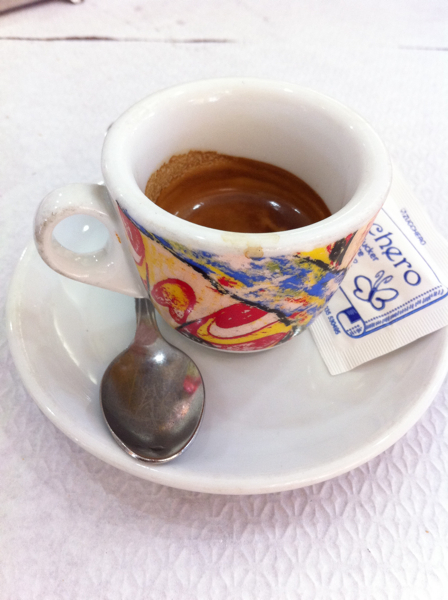
In spite of the wide availability of small coins, there have been many complaints about excessive price increases “excused” by conversion. Restaurants and coffee bars are particular culprits; in some cases the price of an espresso has gone up 20 or 30%.

Still, it’s fun having a new currency, and being part of this grand experiment. Supposedly we’ll see long-term benefits such as Europe-wide price alignment an all sorts of goods.

Now if only we could attain worldwide price alignment. I am heartily sick of things like software costing more in Europe than in the US. A few months ago I thought I might need an expensive tool for creating Windows online help files. The same software, purchase from the manufacturer’s site, cost several hundred dollars more if bought in Europe than if bought in the US. I wrote to their sales address to ask why. They replied that the English-language software was identical in Europe and the US, but gave no explanation as to why I should pay so much more to buy it in Europe. I asked again for clarification on this point. No reply. Guess whose software I didn’t buy?

Conversation in a Bar

While having my morning coffee, I overheard a man talking to the waiter:

“I married two sisters. No, really. My first wife caught me with her sister. [Meditatively.] Who do you think is worse: the husband who sleeps with his sister-in-law, or the sister who sleeps with her sister’s husband?”

…there’s a novel in there somewhere…but probably not the sort I would enjoy writing!

Claudia’s Comment

Years ago, we visited Enrico’s cousins in Montecchio Maggiore, a small town near Verona. We went to see the local attractions, the castles of Romeo and Juliet (yes, the original Romeo and Juliet), up on two small hills above the town. Riding in the car with us was Claudia, a very intelligent ten-year-old, who had noticed that lots of Americans come to Italy as tourists.

“Why do they come here?” she asked. “What do they get here that they can’t get at home?”

“Well,” I explained, “America is a very young country. They don’t have the millennia of history, the buildings, art, and so on, that you have in Italy. So they like to come and see it here.”

“Ah,” said Claudia thoughtfully. “You mean they come here because of a lack of culture in their own country?”

Exact Change Required

One thing that baffles me about Italy is the inability of retail establishments – or anyone who has to take cash payment – to make change. This in a society where most store purchases are made in cash! Automatic teller machines give out 50,000 and 100,000 lire notes (NB: At current exchange rates, one US dollar is worth about 2100 lire), but this isn’t a factor; no matter what size bill you’ve got or what your total is, shopkeepers somehow never have enough coins and or smaller bills, or, when they have them, they don’t want you to use up the whole supply! You pull out your “large” note, and watch the cashier’s face fall as she or he plaintively asks: “You don’t have anything else?”

Lack of change usually isn’t a disaster – if one shopkeeper can’t do it, he or she will run and get change from a neighboring shop. Or, if you’re in a shop where they know you, they’ll say: “Pay me next time.” Amounts up to 200 lire are simply shrugged off by either party. (There were 10 and 20 lire coins – made of aluminum – in circulation when I first came to Italy, but no longer.) It can get problematic, however, if you take a taxi late at night (pay a taxi by credit card? Unheard of!) or are shopping in an unfamiliar place.

I have grown so accustomed to this that I routinely count out exact change, or as close as I can get, everywhere I shop. Italian shopkeepers are always grateful, and don’t flinch at the extra math involved in figuring out the difference between what I gave them and what I owe. But this behavior causes cashiers in the US to stare at me in resentful bafflement: they rarely deal in cash at all, and some have a hard time figuring out how much change to give.

Back in Italy, just think what fun we’ll have in January, when we all have to start using euros! The transition from lire to euros is supposed to take two months, but no one seems to know yet how it will occur. If I pay in lire, do I get euros in change? If so, some fancy calculating will be involved – the lire-to-euro rate is not a nice, round number (it’s 1936.27 lire to the euro). The wheels of commerce are likely to grind very slowly for a while…

Mar 15, 2007

As I revisit this topic, six years and a new currency later, not much has changed.We now pay in euros, and there’s been a huge upsurge in the popularity of credit cards, but making change is still a problem.

Just today I stopped at a small supermarket near the office to buy a few items, for a total of 6.87 euros. I’m always happy to clear heavy coins out of my purse, so, standing there right in front of the cashier, I opened my wallet, pulled out a five-euro note, and then opened the coin flap to see if I had enough change to make up the remaining 1.87. I didn’t – I was about 40 cents short. I shrugged apologetically, put the five away, and pulled out the next-smallest bill I had, which was a twenty.

The cashier’s face fell.

“Don’t you have anything else?” she asked mournfully. “Two euros? I’ve been making change all afternoon.”

Sweetie, you’re a cashier – surely that’s part of the job description?