Category Archives: Italy

Alex Britti in Concert

This summer we went to a concert by Alex Britti, a singer-songwriter as yet unknown outside Europe. He’s popular with the bubblegum set for a few immensely singable songs such asLa Vasca (The Bathtub), but he considers himself more a guitarist – and turns out to be a hell of a good one.Unfortunately, we hardly got to hear him sing during the concert, due to the chorus of teenyboppers who sang along enthusiastically (and badly) with most of the songs. Early on, I asked the girls behind us to stop: “I came to hear him, not you,” I pointed out. Their mother retorted: “Lady, if you want to hear the music, buy the CD. This is a concert.”

Defeated by this, er, logic, I retired from the battle, and had to be grateful for the guitar solos: delightfully un-singalongable, and very well played. These seemed to confuse much of the audience, who muttered to each other: “What song is this?” or got up and went for a beer.

Alex Britti must be frustrated. He’s made lots of money and gained some artistic freedom thanks to his lighter bestsellers, but his audience doesn’t seem to understand or appreciate the stuff that he himself likes best!

Other musical experiences this summer were less than stellar. Roseto, the little town on the Adriatic coast where my in-laws live, used to be a pleasantly sleepy place with nothing to do at night except stroll around, eat gelato, and watch kids on the carnival rides. But now it aspires to the trendy disco status of the Adriatic’s hotter spots, so the beachfront establishments all have permission to play music til 1 or 2 am.

This would be somewhat bearable, or at least understandable, if the music was good. However, it was all REALLY bad, mostly youngsters basically doing karaoke with automated music machines – their equipment was far more impressive than their abilities deserved.

One band started out relatively promising, playing real instruments, with an admirable selection of blues tunes and guitar licks ripped off from Stevie Ray Vaughan. But the guitar wasn’t quite in tune with the keyboard, and the singer wasn’t in tune with anything. After hearing “Pride and Joy” murdered two or three times, we were ready to strangle the drunk who kept demanding encores.

We could easily perceive even that detail, because my in-laws’ apartment overlooks the beach, within a stone’s throw of two of these establishments (alas, I had no stones). After we finally dropped off to sleep at 2 am one night, I was awoken at 8:00 by a group of retirees just arrived on an group tour. “Ecco il mare!” shouted one enthusiastic fellow – “Look! The sea!” (And just what did you expect to find on a trip to the seaside…?)

Note: I have also translated some of Alex Britti’s songs into English.

How to Eat Like an Italian: Fundamentals of the Mediterranean Diet

You’ve probably heard about the “Mediterranean diet”, and know that it involves a lot of carbohydrates, olive oil, tomatoes, and other fresh vegetables, as well as lots of good red wine.

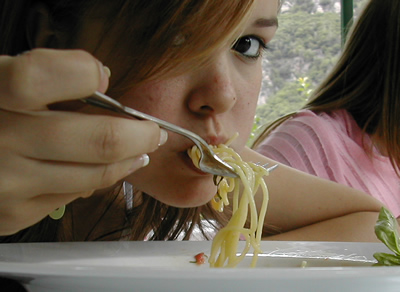
So what does a typical Italian meal look like? A restaurant meal may involve up to four courses: an antipasto, primo (first course), secondo (second course), and dessert. The antipasto and dessert are optional and often skipped, but to make a comfortably full meal you’re likely to want both the first and second courses. The first course is where you get the bulk of your carbohydrates, in a dish of pasta or rice (in the form of risotto).

A word about pasta: I have occasionally (reluctantly) eaten in trendy Italian restaurants in the US, at the behest of colleagues who thought it would be a treat for me. I do appreciate their kind intentions, but… It’s positively alarming what Americans will do to pasta! No matter what the menu claims, any single pasta dish that involves too many ingredients (sun-dried tomatoes, olives, tomato sauce, artichoke hearts, etc.) is not likely to be an “authentic” Italian dish. Furthermore, Italians don’t eat much chicken, and I have never seen an Italian put chicken in pasta. And feta cheese, being Greek, is not typically found in Italian pasta dishes.

…where was I? Ah, yes. The second course is where you get your proteins. It usually consists of meat or fish, very simply prepared, for example grilled over a log fire. You will also want to order one or more contorni (side dishes), such as vegetables, salad, or potatoes, since the meat usually arrives completely unaccompanied.

If you’re vegetarian, there’s not a lot of choice at most restaurants, but grilled scamorza (smoked cheese) and grilled vegetables are often available, and always yummy. There are some traditional vegetarian dishes such as melanzane alla parmigiana (eggplant parmesan) but, if you are a very strict vegetarian, you should ask, as often apparently vegetarian dishes do involve meat, e.g. a risotto with mushrooms will likely be cooked in meat broth.

Italian cooking is mostly very simple. It doesn’t need to be elaborate, because the basic ingredients are so good that it would be a shame to cover up the foods’ inherent flavors with heavy sauces and spices.

You can also have a cheese course after the second course, then dessert and/or fruit, then coffee. Coffee is not served with the dessert unless you specifically ask. Caveat: ordering a cappuccino after dinner is the sure mark of a tourist (if the waiter offers it, you’re in the wrong restaurant!). Italians rarely drink cappuccino after 10 am, and never after a meal.

A friend in Milan on business went alone to a restaurant for dinner. He overheard the couple at the next table – clearly Americans. When he answered his cellphone, they realized that he, too, was American, so they said hello. “The food is good here,” they said, “but the servings of pasta are really small!”

Yes, portions are small in Italy. Or, from the European point of view, portions in America are enormous! (And Europeans often add: “No wonder so many Americans are fat!”) That’s why in Italy you generally order a first course and a second course, as well as side dishes. A meal made up of a single course is called piatto unico (single plate), but these are not common.

Volterra: An Ancient Town in Tuscany

The old Roman roads still serve, though they’ve been repaved a few times in the last few millennia. We left Rome on the Via Aurelia (which goes up the west coast from Rome to Genoa), heading for a friend’s summer house in Marina di Bibbona in the Maremma region of Tuscany. Marina di Bibbona is a resort town with little to recommend it unless you’re there for the beach. Our friend commented that, since the tourists who come there are mainly German, there aren’t any good restaurants. <grin>

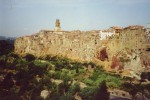
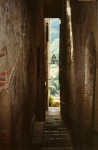
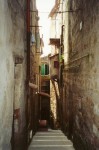
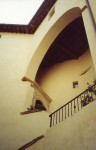
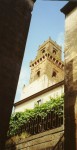
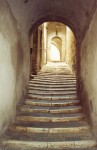
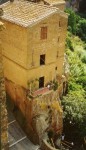
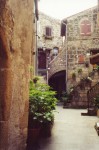
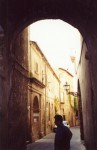
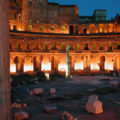
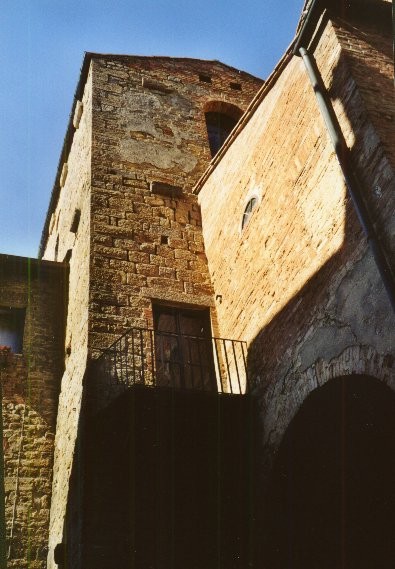
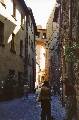
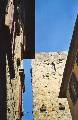
Leaving Marina di B., we headed east to Volterra, originally founded during the 8th century BC by the Etruscans. Like many such towns in Italy, it is richly layered with the accretions of successive conquering cultures.

Volterra Volterra Volterra Volterra Volterra

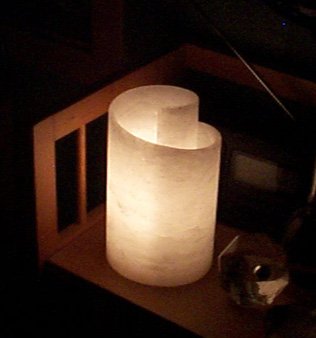
A long-exploited natural resource of the area is alabaster, found in the surrounding hills in the form of large and small nodules embedded in clay. The artisans of Volterra carve this soft, luminous stone into urns, tabletops, lamps, statues, and chess sets. The most interesting work we saw was a chess set with pieces in the liknesses of film stars (Marilyn Monroe for the queens, John Wayne for the knights, etc.). The board was made of separate, undulating strips of celluloid – all carved from alabaster, of course.

alabaster lamp, Volterra

Left: An alabaster lamp.

Castelli: Traditional Ceramics from the Hills of Abruzzo

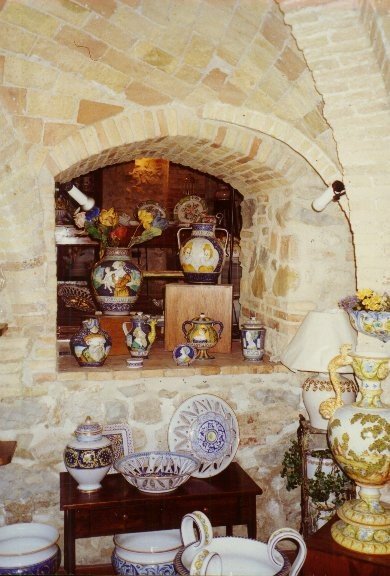
Castelli is a small town in the hills of Abruzzo (the region on the east coast of central Italy, on the Adriatic sea), famous for its hand-painted ceramics – a centuries-old tradition in the area thanks to its local deposits of clay.

You start to see shops along the road kilometers before you get there, and the town is full of shops with wares ranging from the cheap and tacky to ornate, elegant, and expensive.

The traditional designs are rich floral themes, landscapes, portraits, and animals. The people and animals are mostly copied from/inspired by San Donato, a tiny church on the outskirts of Castelli whose ceiling is entirely covered with thick, decorated ceramic “bricks”, created centuries ago as votive offerings by local families.

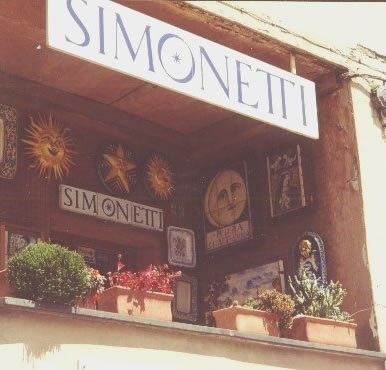
Simonetti ceramics shop, Castelli, Abruzzo, Italy

Those traditional designs are very busy, so if you prefer simple dinnerware, the Castelli style is not for you. The more elaborate pieces are better suited to hanging up as art than eating from. They are also fragile: after some years, the glaze on my serving bowl cracked when I put hot pasta sauce into it! (I still use it for salads.)

A few artisans are breaking with tradition and trying innovative, modern designs, but, at the time we visited, we didn’t see anything terribly exciting in this vein.

After extensive searching, we found a couple of simple pieces to “match” our eclectic collection of china. Then, having done enough shopping to work up an appetite, we decided it was time for lunch.

Tip: Although it’s almost impossible to eat badly in Italy, you can eat really well by asking local people for recommendations. Avoid the places advertising “tourist menus.” The food there will likely be cheap and decent, but, in Italy, you can do a lot better than decent!

We asked a shop owner to recommend a place. She sent us to Ristorante Tortella, where, she said, the Castellani themselves go when they eat out.

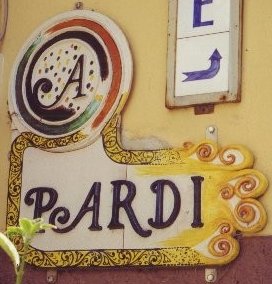
sign for Pardi ceramics shop, Castelli, Abruzzo, Italy

Lunch was indeed excellent: samples of several kinds of pasta, including maltagliati (“badly cut” – sheets of homemade pasta sliced into long triangles and rhomboids) with spinach and herbs; followed by grilled local lamb, washed down with a cheap but good local vintage of Montepulciano d’Abruzzo.

Tip: Wherever and whenever you travel in Italy, eat the local and seasonal specialties; these are almost always the tastiest items on the menu.

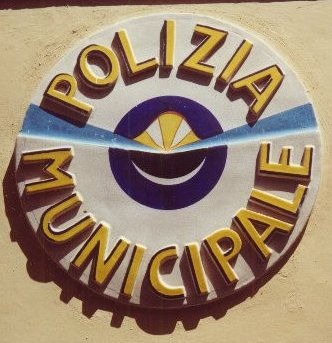
ceramic police sign, Castelli, Abruzzo, Italy