Category Archives: Italy

Another Rite of Passage Completed

Italian Middle School Exams

The Italian education system is big on exams. Ross did pass her middle school exam, with a grade of Buono (on a scale of Ottimo, Distinto, Buono, Sufficiente, Insufficiente – outstanding, distinguished, good, sufficient, insufficient). This was better than I’d expected, since most of her grades this year have been merely sufficiente. But she worked the system brilliantly.

Her results on the written tests were a mix. The test of written Italian was simply to write an essay, which Ross does well (even better when she takes a little time to concentrate on her spelling and punctuation). Math she only did half of, and probably that half badly; English was a joke for her, and French seems to have gone well. On average, a passing grade, I guess (we were not given the individual test grades).

Then she had about ten days to study for the oral. I was in a panic; I’d been told that the panel of teachers could ask almost anything that had been covered throughout the year. But her math tutor advised her to go and watch some of her friends’ orals. This she did, and also talked with some other kids. One told her he had prepared mini-essays on the specific topics he wanted to talk about, and the teachers seemed pleased to be given these before he started. Then he gave his prepared presentations, and managed to steer the exam to the topics where he felt best prepared.

While watching her friends, Ross observed that her beloved music teacher was slumped in his chair, feeling left out. After all the major subjects had been covered, he would forlornly ask a question or two, and be met with blank looks. “Did you even bring your music notebook?” he would ask in desperation. No one had.

So Ross sat down and wrote an essay about jazz, specifically on swing music during WWII (inspired by Jazz : A Film By Ken Burns – the accompanying booklet came in very handy). She chose her topics in other subjects to match: WWII for history, the atomic bomb for science. She also took in advice from her (very supportive) art teacher: “Talk about your artwork, and for god’s sake, don’t burst into tears! I expect better from you.” Not that Ross was likely to do so, but several of her classmates had sobbed through their orals.

When Ross’ exam began, she handed out her essays, then the teachers asked her what she wanted to talk about first. “I’d like to talk about jazz,” she said. The French teacher elbowed the music teacher: “Hey! It’s your subject!” He sat up and got very enthusiastic, and they had a long conversation about jazz. Then Ross spoke about the other subjects, except the atomic bomb – many kids had already talked about this, and the math/science teacher was bored of hearing it. So she picked a topic that Ross hadn’t studied and didn’t remember much about. Oh, well.

Ross had put her art pieces into a presentation binder, and spoke about each one, explaining what famous painting it was inspired by (or copied from), with some biography of the original artist. She came home quite confident that she had passed; we all heaved a sigh of relief.

Part of the exam ritual is to go and see the grades as soon as they are posted outside the school, for all to see. Ross and I were pleasantly surprised by the buono, which put her at or above the average for the class. Her Italian teacher came by on her way to a meeting, and we thanked her for the year’s work. I said I was pleased with the exam result. “There was some negotiation over that,” she replied, with a significant lift of the eyebrow. Ah, yes, the math teacher, who didn’t like Ross’ attitude or lack of math ability (“How is it possible when your father’s a math professor…?” Poor Ross has been hearing that all her life.)

I just smiled; I had a pretty good idea who had negotiated vigorously on Ross’ behalf. Half an hour later, I was standing in line to pick up Ross’ exit papers, and the music teacher ran by, late for the staff meeting. He saw me, and gave me a huge grin.


As I also mentioned earlier, cheating is widespread in Italian schools. I was writing that piece while Ross was doing her English written exam, which for her was simple and soon over.

She came home and said casually: “I’ve found a way to earn some money: I wrote Martino’s English test for him.” We were, of course, aghast. He hadn’t actually paid her, had simply asked her to do it – and, much to my disgust, she did.

After half an hour of hearing from two very angry parents a host of reasons as to why this wasn’t a good thing, she probably won’t be doing it again… or at least next time she won’t tell us!

In response to that original article, an Italian friend wrote me that, during an exam in electronics technical school, his whole class cheated together, with the assistance of their teacher. This was because one of the exam questions was on something so obscure and bizarre that you would never do it in real life, and it required the cooperation of the whole group searching through the library to find the answer. I guess the question succeeded brilliantly as a test of teamwork.

next: high school

Naming a Multicultural Baby

Having been saddled all my life with a name that no one can spell or pronounce, I am always curious about how people get their names – especially, of course, the unusual ones. In July, 2003, the New York Times ran an article about what people are naming their kids, based on the Social Security Administration’s data on popular baby names; the writer, expecting her own child, used this as the basis for research on what not to name her baby.

The upside of having an unusual name is that you’ll probably be the only person of that name in any given group. At UC Santa Cruz, I learned that a girl in my college was called Deidre, which she pronounced “Day-dree” (I’m Deirdré pronounced “Dear-druh”) – close enough for me to get excited about it, though she wasn’t impressed. Things got very weird when we ended up sharing a house the following summer, along with a third woman (named Mary). Since no one could spell or pronounce either of us, poor Mary never knew who the phone messages were for.

If you’re Italian, you most likely know someone else with the same name as you. According to my friend at Zoomata.com (and my own observations), most Italians have traditional names out of the calendar of Catholic saints, though they may get them by way of a grandparent or other relative. (The exceptions to the saints are classical Roman names such as Olivia, Livia, Lavinia, Massimo.) This gives parents a very limited pool of names to choose from, and non-standard names are rare.

The result is that, for any given name, you probably know a bunch of people who have it. Enrico and I can never refer to “Paola” without having to qualify which of several Paolas we’re talking about. Enrico himself is in the fortunate category of names which are easily recognized and not considered weird, but uncommon enough that you probably don’t know more than one. Well, maybe two.

When we had to choose a name for our own baby, we had several criteria to consider. We didn’t know that we were having a girl (we had asked not to be told, and when people asked us “What are you having?” we answered: “A baby.”); nonetheless, by some instinct, we put a lot more thought into a girl’s name than a boy’s. We wanted a name that would be easily spelled and pronounced by both sides of the family, and that might somehow signify the baby’s multiculturalness. Among others, I considered one of my favorite Indian names, Gayatri, but Enrico was afraid that would be too weird for Italy, though I argued that it’s similar to a classic Latin name, Gaia.

I initially wanted to choose a “Rose” based name, to honor my beloved aunt Rosie (Roselyn), who had been a friend as much as a relative, and an important influence on my personality and attitude. But Enrico didn’t like the Italian names Rosalia or Rosalinda – he said they sounded old-maidish. (Perhaps they were more southern Italian and/or old-fashioned).

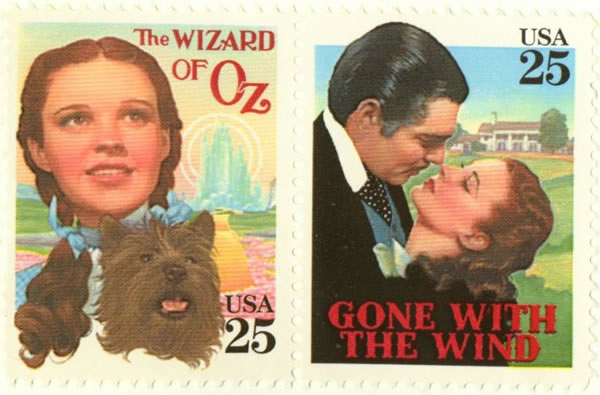
We were reading Gone with the Wind at the time; we used to read together, alternating chapters so that Enrico could hear my English pronounciation, and practice his own with corrections from me. Yes, hang on, this is relevant. When the film “Gone with the Wind” reached Italy just after WWII, the heroine’s name was translated as Rossella O’Hara. The name Rossella, meaning “little red” (originally applied to redheads) already existed in Italy, but was extremely rare until the film came along. Then it suddenly became popular, so there is a generation of Rossellas, just over 50 years old now.

“Rossella” seemed like a good name for several reasons: being best known as the Italian translation of a very American character, and that character being a strong, resourceful woman (though she certainly has her flaws). I thought it would be fairly easily spelled and pronounced by Americans, though that has proven not to be true; everyone wants to spell it with only one S, and pronounce it accordingly: Rozella. It’s a long O and a soft S: Rohss-ella (don’t forget to roll the R!). Rossella herself generally tells English-speakers to call her Ross (rhymes with “Boss”).

The name, after a period of popularity in Italy, went into decline again and isn’t used much these days, so we thought our Rossella wasn’t likely to be confused with any other Rossella in her age group. This, too, proved not to be true: there was another Rossella in her elementary class.

But we didn’t know these things when she was born. As I held my beautiful new baby in my arms, the labor nurse asked me: “What are you going to name her?”

“Rossella.”

“Oh, that’s beautiful. And thank god it isn’t Morgan or Brittany.”


^ top: 1989, the year of our daughter’s birth, was the 50th anniversary of the releases of Gone with the Wind and The Wizard of Oz; these commemorative stamps were issued in the US.

Housing: How Italians Live

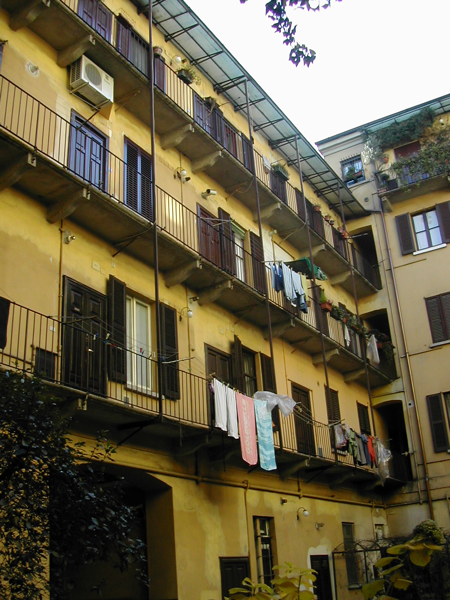
During my July trip to the US, I stayed with friends in different cities and types of homes, giving me fodder for reflection on differences in customs, styles, and expectations for housing in the US and Italy.

As I have mentioned before, renting an unfurnished apartment in Italy means completely unfurnished, so for our new home in Lecco we’ve had to put in a kitchen (including the sink) and all the appliances. (A friend here told me that she once looked at a place to rent which didn’t even have toilets!)

Appliances are different here. Refrigerators are smaller. Traditionally, Italian mammas shop for fresh food daily, so don’t need as much storage space for perishables, although the trend nowadays is to less-frequent visits to larger supermarkets, which leads to larger fridges.

In Italy, almost everyone has a (clothes) washing machine in their home, often installed in the kitchen or a bathroom (our second bathroom has a special washer-sized alcove, with pipes). In the US you’ll find shared, coin-operated machines in the basements of some apartment/condo buildings, but I’ve never seen this in Italy. Coin-operated storefront laundromats are a recent phenomenon here, and probably exist only in the big cities.

With an Italian home washing machine, a single load of laundry can take two hours, depending on the water temperature you select, because the washers heat their own water. This makes sense, since many homes have only one small, electric boiler to heat water for the shower and kitchen.

Most Italians don’t have clothes dryers. They are available, but, given the cost of electricity here (twice what Americans pay), a dryer would be very expensive to run. And dryers are bad for natural-fiber clothing – I much prefer line drying. We have a large drying rack out on the balcony which gets sun every afternoon, so things dry quickly. In winter, the trick is to hang wet clothes on or near the radiators, which humidifies the air as well as drying the clothes. In Milan I had mini drying racks designed to hang on the radiators. (In Switzerland, there is a communal drying area in the basement of some buildings. I don’t think Italians trust each other enough for that.)

Plugging in appliances can be a challenge. There are three types of electrical outlets in current use in Italy, plus one weird one that apparently enjoyed only brief popularity (I’ve only seen it in my in-laws’ former apartment in Rome). There are also variants on the two basic plugs, with or without grounding (many older buildings don’t have it, and it’s expensive to add). Aside from the grounding, it’s never been clear to me whether one type of outlet is safer or can carry more load than another. If you’ve got something that has to be plugged in at a particular spot and the plugs don’t match, you either use an adapter or change the plug on the appliance. There are never enough outlets in Italian homes; sometimes entire walls have no outlets, which can play havoc with room arrangements.

There never seems to be enough capacity, either. My in-laws’ Rome apartment was big, but very inadequately wired; you could never have two major appliances on at the same time. At night we always had to think about which bathroom water heater was already heated up and which needed to be turned on in preparation for morning showers; everything else had to be turned off before running the dishwasher, otherwise the fuses would trip and we’d have fumble our way down to the basement in the dark to turn the power back on. Here in Lecco, I’ve discovered, I can’t run the dishwasher and washing machine at the same time (this wasn’t an issue in Milan; our kitchen was too small to hold a dishwasher).

Homes are constructed differently, too. Basic building materials in Italy are concrete, brick, and sometimes stone. In the mountains, some houses are chalet-style, made of thick wooden planks. In the US, most modern houses are wood framed, with wooden or aluminum siding or stucco outside, and sheetrock inside. By European standards, they’re flimsy, and they catch fire easily. Fire trucks screaming down the street are a common sight in the US; in Europe, they’re rare. The few city fires I’ve heard of in Italy were in factories, though we do have a big problem with forest fires in the summer.

That Old College Spirit

Everyone in the world finds it cool to have logos and words from other parts of the world on their T-shirts. Here in Italy, you’d be surprised at how many people seem to have attended American Ivy League universities, until you realize that there are university logo shirts are for sale at many shops that have absolutely no connection to any of these institutions. Ironically, they’ll pile up a bunch of different universities together in one stack of shirts. At a Milanese shop currently in with the teenybopper crowd, there are shirts with Disney characters (unlicensed, I bet – there’s no copyright notice on them), “Cuba” in Coke-style lettering, and Georgetown University. I caused my daughter agonies of embarassment by asking the shopgirl: “Why Georgetown, in particular?” No other universities were represented in this particular shop, so I thought maybe the owner actually had some connection to it. The girl was merely confused; she had never heard of Georgetown University, and had no idea why they carried that particular logo.

The funniest shirt I’ve seen around lately says “The University of Yale.” I’m pretty sure the Yale regents did not approve that one.

Fess Up: What Happens when a Name Can’t Be Translated into Italian?

During our US trip last year, Ross and I visited the Texas History Museum in Austin (new since I graduated from the University of Texas in 1986). They had a temporary exhibit on Davy Crockett, the near-mythical frontiersman who was a Senator from Tennessee before moving on to Texas, where he died at the Alamo. The exhibit included a section on the Crockett revival of the 1950s or 60s, when Disney did a movie and kids wore coonskin caps (raccoon skin, with the tail on). There was a huge poster for the movie, evidently taken from the Italian release.

Most Americans probably remember that the actor who played Davy Crockett was named Fess Parker. Fess is a weird sort of name even in the US, I can’t think what it would be a nickname for. But in Italian, “fesso” means a complete idiot – not the name you want to associate with a movie hero! So the Italian movie poster renamed the actor “Fier Parker.” Fier is a non-existent name in Italy (and probably everywhere else), but you would assume it’s related to the word “fiero” – proud.

I laughed out loud in front of the poster, drawing inquiring looks from a man standing nearby, so then I had to explain to him what was funny.

August 20, 2003

John Sanders tells me that “Fess Parker was born Fess E. Parker. The E. did not stand for anything. Also Fess Parker is a graduate of the University of Texas. I read that Fess Parker learned as a young boy that fess meant ‘Proud’ in England of old.”

Richard Munde adds: “I remember my seventh grade French teacher telling us that Fess Parker was a huge star in France because of the Disney Davy Crockett series. Fess, she said, was French slang for ass and so he was re-named there too. (Can’t remember what they called him, though.)”