Everyday Italian: Newspaper Headlines, Jan 1 2009

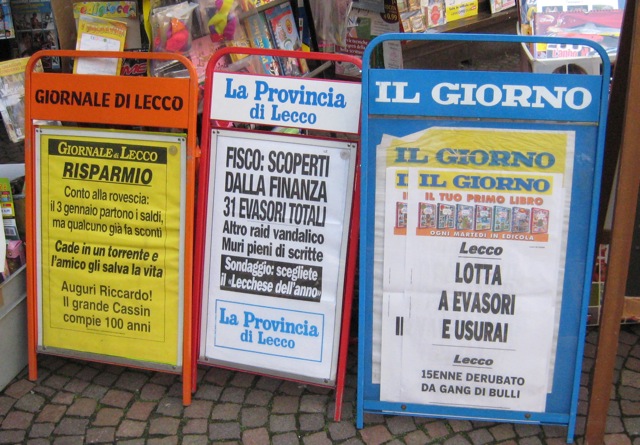
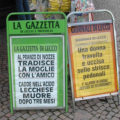
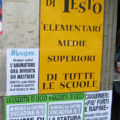
Left:

  • Savings: countdown: January 3 the sales begin, but some are already giving discounts
  • Falls into a creek and his friend saves his life
  • Happy birthday Riccardo! The great Cassin turns 100 [Italy’s “greatest living mountaineer,” a native of Lecco, turned 100 on January 2nd. There will be a statue etc.]

Center:

  • Taxes: The tax police discover 31 total tax evaders.
  • Another raid of vandalism, walls full of graffiti
  • Survery: choose the Lecchese of the year

Right:

  • Lecco: the struggle against [tax] evaders and loan sharks
  • Lecco: 15-year-old robbed by gang of bullies

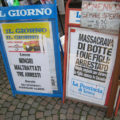
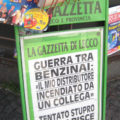
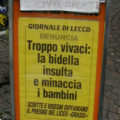
Everyday Italian: Newspaper Headlines, Dec 2008

headlines from Dec, 2008

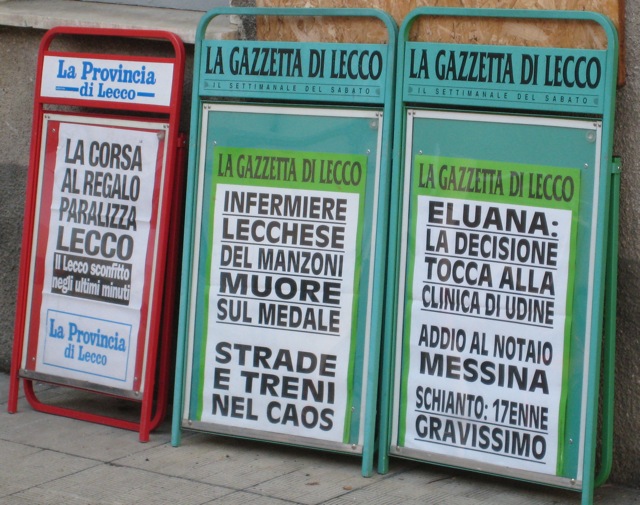
Left:

  • The race for gifts paralyzes Lecco
  • Lecco [the soccer team] defeated during the last minutes

Center:

  • Nurse at Manzoni [hospital], native of Lecco, dies on the Medale [local cliff face]
  • Roads and trains in chaos [from holiday traffic, presumably]

Right:

  • Eluana: the decision [belongs to] the Udine clinic [this is a Terry Schiavo-like case, much debated this year in Italy]
  • Goodbye to Notaio Messina [a notaio is something between a notary public and a lawyer]
  • Crash: 17-year-old in critical condition

img_5509

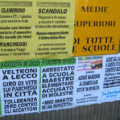
Left:

  • Incredible: the [local boating club] goes to the America’s Cup, and the city government asks them for 264 thousand euros
  • Trains and roads are disgusting: Lecchesi protest
  • Soccer: Lecco loses and closes the last round of andata [? soccer term I don’t know]

Right:

  • Hospital: they weighed one kilo between the two: Sofia and Vittoria win the challenge of life
  • Airoldi & Muzzi increases fees by 200 euros per month

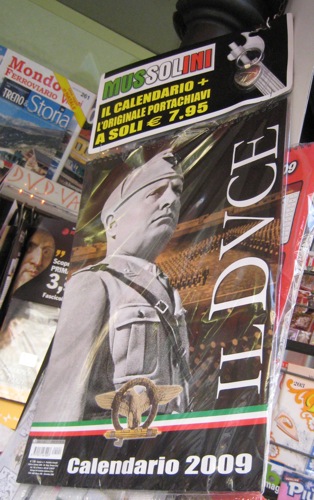
Apologia del Fascismo, in Flagrante

At this time of year, Italy’s newsstands offer a variety of calendars to suit every taste, from fast cars to naked women. But this one startled me, not least because it would seem to be in violation of Italy’s law against apologia del fascismo (“apology for Fascism”), which prescribes penalties against whoever “pubblicamente esalta esponenti, principi, fatti o metodi del fascismo, oppure le sue finalita’  antidemocratiche” – “publicly exalts exponents, principles, facts, or methods of Fascism, or its anti-democratic goals.”

According to Wikipedia, this law was watered down by subsequent court challenges to the point that defending Italian Fascism could only be considered a crime when such “exaltation” might lead to a refoundation of the original Fascist political party. Not likely to happen over a mere calendar, but the fact such a thing is openly offered for sale is enough to make me (and many Italians with longer memories) uncomfortable.

It seems obvious that the calendar (and other increasingly popular Fascist memorabilia) is designed to appeal to those Italians (e.g., young skinheads) who nostalgize about the Fascist period as a time of law and order and Italian martial glory – or, at least, a time when “the trains ran on time.” When the apologia law was instituted in 1952, Italians knew from direct and bitter experience that the Fascist period had been one of oppression and war which saw, among other horrors, the deportation of Italian Jews to German concentration camps.

Perhaps the Italian education system needs to spend a little less time on the glories of ancient Rome (Ross studied those in her first years of both middle school and high school), and more on the abominations committed by those who claimed to be following in Rome’s glorious footsteps. “Those who do not remember the past…”

Site Statistics 2008

For those, e.g. current and potential advertisers, interested in how this site performed in 2008, here are Google Analytics reports you can download. Note that visits/page views are somewhat underreported from October, more sharply so from mid-November, when I moved some of my most popular pages to WordPress and forgot to add the Google Analytics code to the new pages! My Google AdSense report, which does not rely on that piece of tracking code (I’ve had ads on my WordPress site all year) shows 717,736 total page impressions for 2008, whereas Google Analytics shows 700,111 page views.

The code is now in, so visitor stats from about December 23rd are accurate.

Dashboard Overview

Top-100-Pages

Keywords

Blogging Tip: Some Links Good, More Links Better

To improve search engine ranking and direct traffic to a site, we need to increase:

  • External links coming in to our pages.
  • Internal links, i.e. from a sun.com page to any other sun.com page (yes, internal links are useful).
  • Links going out – these show good webizenship (search engines like that, or at least it’s good karma). Outlinks also show the world that we are members of a community, taking part in conversations rather than trying to impose authority.

External Links

The best kinds of links are those that happen spontaneously: when someone finds something we’ve written worthy of sharing, and links to it from their own site, blog, forum post, etc.

To encourage that to happen, we need to have great content, AND we need to let people know it’s there.

Don’t be afraid to advertise. If you see a question, comment, blog post, etc. anywhere, and you know that a page or doc exists on the Sun site that would be useful, let people know in a forum response or blog comment.

If something you read elsewhere inspires you to write a blog post or formal document in response, let the source of your inspiration know that you’ve answered their question in depth, and where they can read that answer.

External links also increase direct traffic, depending on the popularity of the site the link is on and the pull of the material linked with that particular audience. But, even when a link only nets a few extra visitors here and there, it’s worth having for the Google juice.

Internal Links

Some ways to increase them:

  • In your own blog, link to others’ posts and/or documents within sun.com that are relevant to your topic.
  • Whenever you write/edit a document to be posted, keep in mind the importance of links. Instead of just putting footnotes and references, link directly from the relevant point in the document to the source – these are preserved as active links in PDF documents, and Google recognizes them.
  • When participating in forums such as OpenSolaris.org, use a signature with your name, some sort of descriptor of who you are (e.g., “iSCSI guru”), and a URL where the user can go for more information, such as your blog.

Tips for Links

Use good link text that tells the reader what he will get to by clicking that link (test: if the reader had only the link text to go on, would he click? Sun’s own Martin Hardee explains some of the reasons why “click here” is evil).

Deirdré Straughan on Italy, India, the Internet, the world, and now Australia