What with all the fuss in the US about sex education in schools, I was curious to know what, if anything, would be done about it in Italian schools. I got my answer recently, when Ross’ class [then age 15] had two 3-hour sessions at school. Parents were not notified before or after, and wouldn’t have known it was happening unless their kids told them. Ross told me quite a bit about it, though I’m not prepared to swear that she told me everything.
A representative of the local health agency (ASL) came with a young woman who was observing as part of her psychology studies. There was an icebreaker in which the kids (mostly jokingly) introduced each other, then an exercise in which they were told a story about a girl who needs to get across a river to see her boyfriend. The boatman says he’ll take her if she’ll have sex with him. She has no other way to reach her boyfriend, so she doesn’t know what to do. She goes to her mother, who says she doesn’t want to be involved.
The girl finally resolves to have sex with the boatman. When she reaches her boyfriend she tells him what happened, and he rejects her for having sex with someone else. The class was asked to determine who, in this improbable story, is “responsible.” (Whether they were meant to address “responsibility” in the sense of who was responsible for what happened, or in the sense of behaving responsibly, was not clear – perhaps deliberately.)
Ross told me that this degenerated into a vicious argument over abortion – “Who would be responsible if she got pregnant?”. Lecco is a very Catholic town, and the ASL lady told the class that, although abortion is legal, they would have trouble finding anyone in Lecco to perform one. I guess it’s good to be warned; fortunately, Milan is easily reached, should the need arise. More importantly, local health authorities are taking the correct steps to prevent the *need* for abortion: the kids were given detailed information on birth control and the use of condoms for disease prevention as well as birth control. They were also told that they can go to a youth clinic at their local ASL for more information, with or without their parents’ knowledge. The ASL lady said that they do try to involve parents in any big decisions (such as abortion), but that the kids have the right to keep their parents out of it if they prefer.
Interestingly, abstinence was never mentioned. I asked Ross why she thought the ASL lady didn’t discuss it as an option. “Oh, everyone would have jumped all over her.” It was clear that a number of the kids are already sexually active, and no judgment upon them was given or implied. Wow. Health care professionals who are allowed to approach teen sex realistically. What a concept.
I’m very relieved that the ASL takes these initiatives. As far as Ross and I can tell, I’m the only mother among her friends who talks to her kid about sex, and, from what Ross tells me, dangerous misinformation abounds among her Italian peers. If the parents aren’t talking to these kids, someone has to –the stakes these days are life and death. Ross’ friends know that I talk to her (I’m considered the coolest mom in Lecco for several reasons, including that), so I hope they’d feel comfortable talking to me if they needed to, but I’m glad someone more authoritative and knowledgeable is there for them – it diminishes my risk of being lynched by the good parents of Lecco!
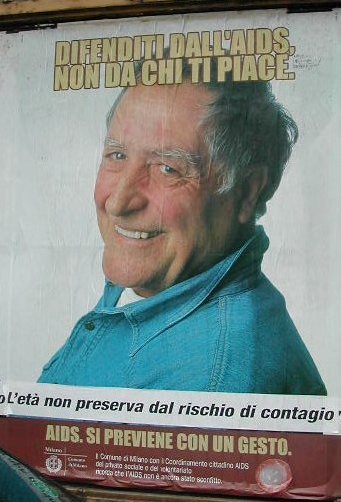
^ Top: Sex education doesn’t stop at school. The public health poster shown above says “Defend yourself from AIDS, not from someone you like. Age does not save you from the risk of contagion.”
Rossella and I had a wonderful time in New York (as expected), though I spent much of it ill with bronchitis (as usual, unfortunately). So here’s another travelogue (late, because I’ve been very busy since I got back):
Getting There is Half the Fun?
We arrived the afternoon of Thursday the 20th, on a direct flight from Milan Malpensa airport. That was the easy part. We had taken a train from Lecco to Milan’s Central Station, where we would catch an airport bus. As we were waiting on the platform in Lecco, we heard an announcement that the train just before ours had been cancelled due to “material problems,” possibly related to the snow that had fallen two days before. This missing train was to be replaced by a bus. Our own train was on time, and I had calculated a comfortable margin to catch a bus and get to the airport –I’m a paranoid traveler, I never aim to make a flight by the skin of my teeth.
Our express train made an unscheduled stop in Calolziocorte, the next town down the line, I supposed because the substitute bus service had not stopped there. Further on, we stopped unexpectedly, not at a station platform. Everyone looked puzzled as we just sat there. After a few minutes, the conductor came bustling through, saying: “Some people have blocked the line and stopped the train.” She was shortly followed by said people. They had been waiting for the cancelled local train at their small station, and the substitute bus had not arrived. After watching several other trains pass without stopping, and seeing their pleas to the stationmaster fall on deaf ears, they had taken matters into their own hands and blocked the track to force our train to stop so they could all pile on. (our train was already standing-room only). Ross and I were sitting on fold-down seats in an corridor because our suitcase would have blocked the aisle in the main part of the carriage, so we now found ourselves hemmed in by elbows and loud conversation.
At that time of day, trains into Milan are tightly scheduled, and once you’re off schedule, you often have to wait for another train coming or going on the same stretch of track. This being the case, the powers that be evidently decided that our express train might as well be a local, and thenceforth we made every stop, with more passengers getting on til we were packed like sardines. To reduce pollution, Milan had declared several days of “alternate license plates,” meaning that only cars with odd-numbered plates could drive in the city that day, increasing pressure on the trains as people who normally drove were forced to take the train.
The trip which should have taken 45 minutes took nearly two hours. My margin of comfort was eaten completely away, and there was nothing I could do but stew and stare at people’s stomachs as we stopped, started, crawled, and stopped again. No announcements were given of any sort, let alone to tell us when we might expect to arrive in Milan. I mentioned that I’m a nervous traveler, right?
We finally arrived at Milan’s Central Station and raced for the airport bus stand (down the left-hand staircase, the buses are parked right outside) and onto a bus, which fortunately was leaving immediately. Thanks to the alternate license plates, there was less traffic than usual, and we made it to Malpensa at 10 am, just about the required two hours before the flight. As it turned out, I shouldn’t have worried: the flight was half empty, so we stood in line only long enough to be asked the usual inane security questions before we reached the check-in desk.
The flight itself was uneventful; for the record, “The Princess Diaries 2” was more bearable than “Catwoman,” and “The Village” was better than both — and arrived at JFK airport on time.
We took a cab from the airport to our friend’s place near Columbia University, went out to dinner with her, bought some cough medicine, and went to bed.
Why We’re Here
As far as Rossella was concerned, we went to New York to shop. Friday morning we got an early start with breakfast at Tom’s Restaurant , a greasy spoon diner whose claim to fame is that it was used in “Seinfeld”; we went there because it was close. We had pancakes and bacon, so-so coffee, and orange juice in tiny plastic glasses that had been washed so many times they were cloudy. Thus fuelled against the cold, we hit the city.
We bought 7-day passes for the MTA (Metropolitan Transit Authority –subways and buses) for $21 each. We swiped them and went through the turnstiles, then I realized that from this side we could only go uptown, and we wanted to go downtown. I often get confused about that; New York’s is the only subway system I know that has separate entrances for uptown and downtown trains (at some stations). We crossed Broadway to the downtown entrance, swiped our cards, but the turnstile blocked us with the message “card just used.” The lady at the booth told us that, once you swipe the card, it can’t be swiped again for 18 minutes, presumably so that multiple people can’t use the same card to travel together. (Why precisely 18 minutes?) But she let us go through the turnstile immediately anyhow, “now that you know the rules.”
This was an early example of how nice almost everyone in New York was. New Yorkers have or had a reputation for being brusque, even downright rude, especially to tourists. But I’ve rarely experienced this, in many years of visits to the city. People even went out of their way, unasked, to be nice. One of the many times that Ross’ MTA card was repeatedly rejected at the turnstile for no good reason, a lady who was just coming out swiped her card so that Ross could enter.
We were constantly delighted with the service in stores. You can get good service in Italy, especially from family-owned small shops, but really bad service is sadly common, especially in chain stores where no one seems to feel any “ownership” of the customer experience. I am constantly amazed at how well-trained chain store employees are in the US; they can’t ALL have such cheerful personalities, surely?
Encouraged by all this good service –and the low dollar – we shopped a lot. Ross wanted Ugg boots , and Susan recommended buying them at Harry’s Shoes. While Ross was trying them on, another salesman came along and said “That’s the exact same style and color that Sarah Jessica Parker wore in an episode of €˜Sex & the City'”. Smart man – if Ross hadn’t been sold before, she was now! I tried on a pair myself, which immediately sold me on them. Uggs are basically a trendy excuse to wear warm, cozy sheepskin slippers in public –my feet have rarely been so happy in winter. The boots even stood up to the blizzard and subsequent days of slush with only minor salt damage.
It started Saturday morning while we were at the videoblogging conference, and continued without letup until Sunday. The streets were eerily, magically deserted (see video), but the subways ran smoothly, so we had no trouble getting from the conference (held at NYU’s Tisch School of Art) to the place we were staying uptown, back down to Tribeca for a party, and back up to Susan’s again.
Sunday we were out most of the day. Walking around in the slush, snow, and ice was tiring, but we were able to get most everywhere we wanted to go by subway, including a matinee of Hairspray, which was every bit as great as we had hoped and expected –for a good time on Broadway, I highly recommend it. The sets were gorgeous and clever. It took me a while to figure out why the backdrop of colored lights looked so familiar, til I finally dredged up a fragment of my childhood: it’s a giant Lite Brite!
Hot, Hot, Hot
I have complained before that Americans tend to overdo air conditioning. As I learned in New York, they also overdo heating, which I don’t think is good for anybody’s health. When it’s well below freezing outside (20 F), it’s a shock to the system to enter a store or home heated to 80 F. One store I went into (Best Buy) was apparently heated for the comfort of the employees (in short-sleeved polo shirts), without regard for the comfort of patrons, who were coming in off the street in multiple layers of sweaters and coats. It was so hot that I felt nauseated and nearly fainted in the checkout line. I would have liked to stay longer and look at MP3 players, but I simply couldn’t take the heat.
Videobloggers
lunch break: Leslye, Deirdré & Andrew
The official reason for the trip was to attend the world’s first conference of Video Bloggers. I originally started hanging out with them (online) last June, because I had a feeling that their interests would intersect with those ofTVBLOB, the high-tech startup I’m working for. I was right: these folks are the cutting-edge early adopters who will help to drive the development and use of technology such as ours. The videobloggers are also a fun, creative, invigorating bunch of people, so it was a privilege to hang out with them, and hear and see the results of a great deal of hard thinking (and shooting, editing, and coding) that they are putting into the joys and problems of distributing video over the Internet.
I had told Ross that, in order to accompany me to New York, she had to qualify as a videoblogger by doing at least one blog before we left. She proved (to my complete unsurprise) to be a natural in front of the camera. She’s having fun with it, and so are her classmates. What the text- and photo-based web has been to my generation, video will be to hers, so it’s good that she is already learning how to express herself both behind and in front of the camera. Several of the videobloggers told her they’re fans of her work, and her videos are already more popular (in terms of traffic) than mine!
This trip gave me food for thought on many topics, so I’ll divide this account into subheadings.
Travel Reading
Milan’s Linate airport no longer has a newsstand once you pass security, so buy your reading material before you go through! There’s a big magazine/book store near the check-in counters.
I did have a book with me: I re-read Roger Zelazny’s “Lord of Light” after many years, and greatly enjoyed it. But I read fast, so it wasn’t long enough to get me through the 10-hour flight from Madrid to Chicago (especially when that turned into an 11-hour flight – all four Iberia Airlines flights I took on this trip were late)Airport bookstores tend to be disappointingly stocked – best-selling trash and not much else. “The Da Vinci Code,” which I had read at my dad’s house in a fit of boredom and curiosity to know what the fuss was about, is not great literature. It’s very poorly written and the plot is only minimally interesting; the “big revelation” was already familiar to me since my dad read “Holy Blood, Holy Grail” years ago and told me all about it. But “The Da Vinci Code” continues to sell, along with many derivative and imitative works, plus everything else Dan Brown has ever written. Which I will never bother to read – hell, even the jacket blurbs are poorly written!
I made sure to hit a Barnes & Noble bookstore before I left Las Vegas, so on the return trip I read Sharpe’s Rifles and Master and Commander – though I didn’t plan it that way, both are series about the British military during the Napoleonic Wars, one set on land and the other at sea. A further similarity: in both, the English hero’s best friend and staunchest supporter is Irish. Both are rich in detail about military structure, equipment, etc. And both are superbly written, though O’Brian’s “Master and Commander” has more humor, most of it sly and understated.
Security
Security was a different process in each of the four airports I passed through on this trip. In Milan, I had to place my feet (with my boots on) onto a new shoe-sniffing machine. In Chicago, I had to remove my laptop from my backpack and put it through the x-ray machine separately, which seemed pointless as they didn’t do anything particular to it.
Leaving Las Vegas, I was one of many randomly selected for the full treatment – separate line, remove boots, my laptop got swabbed and sniffed, and I got the full wand treatment, plus patting along the sides of my ribcage (by a female security person). I did not get the third-degree bra-grab that some American women have complained to the press about. FYI, a full-body pat-down for all passengers has been routine at Indian airports for as long as I can remember, carried out discreetly behind screens by same-sex security personnel. I guess it’s new to Americans, but has never been a big deal to me. I’d rather get felt up than blown up.
Fortunately, I am a paranoid traveler, and had allowed myself plenty of time at the airport, so the extra time in security wasn’t a problem. Some people who did not check in so early risked missing their flights.
Tsunami
Tsunami news in America, as everywhere else in the world, focuses on the local. Italian headlines concentrate on the handful of Italian dead (with several hundred still missing). Lecco’s papers, even more narrowly focused, were about the one Lecchese confirmed dead and three more missing.
Other countries’ news media are no different. These local obsessions usually get on my nerves, but an article by Italian journalist Beppe Severgnini, published in “Il Corriere della Sera” a couple of days after the tsunami, pointed out that bringing the global down to the local is the only way for some people to grasp it. I grudgingly admit that he’s got a point.
For myself, I hope that no news continues to be good news. One story I’ve heard so far through the Woodstock grapevine is that a Sri Lankan alum a few years younger than myself (I knew his older sisters) was vacationing on Sri Lanka’s east coast with his family. They were the only survivors at the hotel where they were staying, and took four days to find each other at various hospitals (though fortunately their injuries were only minor).
Media
You can learn a lot about a country from its advertising. One theme in the US is ads about products and services designed to let you work ALL THE TIME: “Turn your car’s passenger seat into an office.” “You can never afford to lose important data” – the photo shows a guy with a laptop beside a pool, beavering away while people around him are relaxing and having fun. No wonder so many Americans crave the laid-back (as they perceive it) Italian lifestyle.
Globalization
I didn’t get to see much of the Consumer Electronics Show that we went to Vegas for – most of that time we spent tucked away in a hotel suite with our hosts, Toshiba America Electronic Components, doing demos by appointment.
We did have a few hours here and there to hit the show floor, and had to wade through the crowd every time we arrived or departed from the hotel or (god help us) tried to get lunch or coffee. So I was able to observe other attendees, and what a study that was – globalization in action! The largest single group of attendees might still be white American men, but there were very large minorities of Japanese, Chinese, and Indians, who together outnumbered the white guys.
The group we were working with from Toshiba was a microcosm of this trend: the top bosses are Japanese, two senior marketing managers are Indian (both living in the US for many years), one engineer is a recent arrival from India, and one is Japanese. There were also two women, one Chinese-American and one Caucasian.
Personally, I cheer at this: I want to see India do well, and, now that the Indian entrepreneurial spirit is finally being unshackled from government regulation, it undoubtedly will do very well. Ethnic Chinese already run much of Asia’s economy, so it’s no surprise that China is moving into position to dominate the world economy, and not just because of its huge population. I was thinking about this from Day 1 of CES (January 6th), so I was wryly amused at this week’s fanfare over a National Intelligence Council report drawing similar conclusions. You don’t need to work for the CIA to see where the world economy is heading.
Standing in the extra-security line leaving Las Vegas airport, I fell into conversation with a young Indian man carrying a shoulder bag from the CES show. It turned out that he’s from Delhi, and runs an export business from India, China, and Thailand into the US and Europe. He had come to CES to see what new technologies might be helpful in his business. He asked what I had been doing there, and I told him about TVBLOB. “For example,” I said, “You can create your own custom TV channel, and broadcast it anywhere in the world.” He got it instantly: “I could create a channel for my subscribers, and show them new goods they’d be interested in!”
Alienated
I’m beginning to wonder where in the globe I’m “from” nowadays. Most Americans I spoke to assumed I was foreign, at least during the first few days of the convention. Apparently my accent has become mid-Atlantic, and to Americans I sound British. I pick up accents quickly, however, so I suppose I was sounding more American by the end of the show, although much of my conversation was in Italian, with my Italian and Bulgarian colleagues.
Customer Service, Good and Bad
Kudos to Macy’s: When the lady at the cash register realized we were foreign (at least, one of us was), she told us we were entitled to a discount with an “International Savings Card”. To get it, all we had to do was go to the gift wrap window and show proof of overseas residence; the card gives an 11% discount on just about everything at Macy’s.
Big thumbs down for FedEx: They screwed up the outgoing shipment of our box of demo equipment because the people in Milan didn’t know what forms were needed, so it got hung up in Memphis and barely arrived in time to be useful. To send it back, I went down to the Hilton Business Center. The young lady there tried for quite a while to get her FedEx software to accept the shipment with appropriate insurance, but something was wrong, and she needed tech support for the software. This was on a Sunday, the day the CES show ended, and we then discovered that FedEx’s tech support office is not open on Sundays. Which is absurd for an international shipping company. So I shipped it UPS, which cost 50% more, but the box departed Las Vegas and arrived in Milan without further hassles.
Las Vegas
I’d never been to Las Vegas before. It’s not the sort of place I would have chosen for a vacation, and I will never go there again unless I have to – once is quite enough.
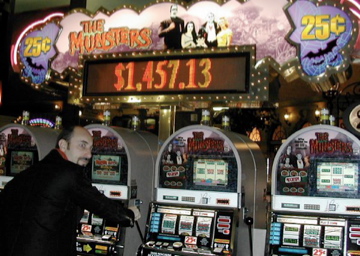
For a hyper-attentioned person like myself, Las Vegas is exhausting, especially inside the casinos. The casino floors are a wilderness of slot machines, thousands of them, with flashing lights, animated displays, moving numbers, and sound. They come in an infinite variety, with themes from TV shows, video games, movies, even the game Monopoly. Gambling (or “gaming,” as it is euphemistically called) is forbidden to minors, so you have to be at least 18 to get near these machines, and in fact most of the bettors are far older, which makes the childishness of the decor frankly bizarre. Is gambling supposed to be related to childhood in some way? Are the manufacturers mixing metaphors of childish and adult “play”?
Perhaps I shouldn’t be so hung up on dignity; everything about Las Vegas proclaims it a Disneyland for grownups. The glamour is all fake: cheap rhinestones and “crystal” chandeliers, gleaming brass, colorful carpets. Most of the shows are meant to be sexually titillating (even some for women – at least we have equality), but bare breasts and simulated sex are as far as they go, at least in this part of town. The only show I got to see was the free one outside the Treasure Island casino, presumably toned down for a general audience. It was one of the stupidest things I’ve ever seen.
I did buy a new (cheap) video camera, so was able to get some fun footage.
One of the joys of having attended Woodstock School is that I know people all over the world. Which is also one of the sorrows: when something bad happens almost anywhere in the world, it’s likely to affect someone of my extended Woodstock family.
I wrote almost two years ago about an Indian schoolmate who survived both Gulf Wars in Baghdad, with her Iraqi husband. In April of 2004, Shahnaz died of a galloping cancer. Had Iraq not been under embargo for so many years, effectively shutting down medical facilities for ordinary people, she would have had access to decent medical care, and perhaps her cancer could have been diagnosed and treated in time. As it is, she is one of tens of thousands of innocent victims. The difference is that, to me, she is no abstract figure. She’s Shahnaz, and she’s gone.
And now the tsunami. As class secretary, I have sent out email to all my classmates, and am waiting for news from the larger alumni family as well. But it’s too early to know for sure whether we’re all okay; the nosecount could take a long time. So far the classmates who have checked in are all right, though one was awaiting news of her father’s family in Madras.
Like most people in Italy, we don’t go out for dinner as much as we used to. We love to eat out, and there are many great restaurants in Italy, but who can afford them anymore?
It started with the euro. The official conversion rate was 1936.27 lire to the euro. In other words, a pizza that used to cost 8,000 lire, if converted correctly, should cost slightly over 4 euros. In practice, many restaurants just lopped off three zeros, so a pizza that used to cost 8,000 lire now costs 8 euros. It almost seems reasonable at first glance, til you realize that you are now paying almost 16,000 lire for a pizza, which no one would have dreamed of doing pre-euro.
In Milan a few weeks ago, we ate at a restaurant that we had frequented for years, and considered good quality at a medium price. This assessment proved to be sadly out of date. Between the three of us, we had three primi (first courses), two secondi (second courses), one dessert, four ¾ litre bottles of water, ½ litre of wine, and one coffee. The primi (first courses) were good, the secondi decidedly less so: Enrico’s bollito misto (boiled meats) was unimpressive – I can buy better mostarda myself! – and my agnello al scottadito (grilled lamb ribs) seemed almost fried rather than grilled, certainly not tender as they should be. And the bill was 98 euros! Definitely not worth the price.
We saw only two or three other tables of patrons while we were there, and the chef spent most of the evening standing around in the hall. Not a good sign, but no more than he deserved for charging us an arm and a leg for a sub-par meal. Until recently, some restaurants might have imagined they could rely on the less-discerning palates of tourists, but, with the dollar in free-fall, many Americans can no longer afford to come to Italy at all, or at least need to eat more cheaply while they’re here. Italian restaurateurs need to rethink their pricing and quality before they go out of business in droves.