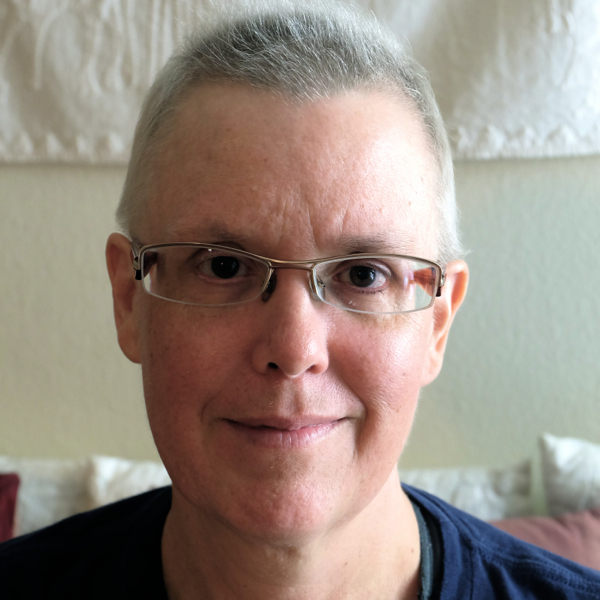
This was taken two months after my last chemo infusion. As you can see, I have hair, and even eyebrows and eyelashes!
Treatment Roundup: July
July 1 – Chemo 16.21
We went to Monterey for two nights to give me a change of scene before radiation starts. Did a lot of walking yesterday (over 10k steps), which left me tired and sore.
Foggy morning https://t.co/p8nE8R5U3i
— Deirdré Straughan (@DeirdreS) July 1, 2015
One Month Post-Chemo
I had my last chemo infusion on June 11th. Side effects I’m still having:
Eyes watering, especially when I first wake up. This is starting to abate: I no longer have tears streaming down my face every second I’m outdoors. Some women on breastcancer.org have reported that this clears up about 6 weeks after the end of chemo. Apparently it has nothing to do with having no eyelashes.
Weight. I weighed 145 pounds when I started chemo, weigh 143 at the moment. Lowest it got was 138, in April. At the worst of the chemo, I was eating less food by volume (smaller meals), but more calories, because fatty foods were the only ones that still tasted ok. Continue reading One Month Post-Chemo
Chemo and Menopause
Many kinds of breast cancer are hormone-sensitive, meaning that they grow faster in the presence of estrogen and/or progesterone, which are naturally produced in the female body until menopause. When your cancer falls into this category, part of the aim of chemo (and the Tamoxifen I’ll be taking later) is to stop the body’s production of estrogen and progesterone. This means that you go into menopause, at whatever age you happen to be.
I had been in perimenopause (ie, on the way to menopause) for years. It’s no fun. Symptoms include migraines, ferocious mood swings, insomnia, and hot flashes. Many women take hormone replacement therapy (HRT), which alleviates these symptoms by partially replacing the hormones that your body is no longer producing. I started HRT about five years ago.

My History in Customer Service
Note: I had largely forgotten about a review I wrote in 2010 of Tony Hsieh’s book Delivering Happiness: A Path to Profits, Passion, and Purpose. More importantly, I had forgotten that it included a history of my philosophy of customer service, which I think deserves separate billing. So here it is:
I have cared about good customer service, both receiving and giving, for a long time. Starting in 1993, I provided great customer service for Incat and Adaptec by being visible and responsive in early online forums (Usenet, email, discussion lists, newsletter). Eventually I was allowed to scale my efforts by hiring a couple of guys who could answer questions as well as I could. But there were huge obstacles to great customer service, such as the lack of communication and data-sharing between the internal groups at the company who dealt with customers. This siloing within companies seems to happen a lot and be considered normal, so it was difficult to get my colleagues to understand that customers neither know nor care about a company’s internal systems and power struggles. To customers, it’s all one big entity, and they are understandably frustrated when the customer service team doesn’t know what sales or support are doing or, worse, they all contradict each other.
There was a smart VP who immediately understood the problem when I presented a graphic showing all the different information stores at the company and how they did (and didn’t) connect to each other. He wanted to try to fix the situation, but soon we were all sidetracked by the spinoff of Roxio, which required us to build new systems and sites from the ground up. As webmaster, I spent 14 hours a day on that for many months, but (as I dimly recall – it was a crazy time) still tried to keep in sight my long-term goal of creating a great customer experience right across the company.
I was ahead of the curve. Long before “user community” became a fashionable term, I realized that our community of customers could help each other far more effectively than we could ever help them: there were simply far more of them than us, and they were using our products in ways than we couldn’t test in the lab. We just needed to help them to communicate with each other, and put some human intelligence into organizing the information they produced.
The kinds of online forums in widespread use today were not well known in 2000, but I designed some nascent social media features into the new Roxio website, and tried to make it a showcase for our users rather than just brochure-ware for our products. I also worked closely with our new tech support organization, trying to keep us all heading in the same direction.
For personal and professional reasons, I left that job in 2001 and went back to Italy (where my family was), so I never got to see whether my ideals of customer service were realized at Roxio.
A few years later, at TVBLOB, I chose “Director of Customer Experience” as my title because I hoped to instill in this new company, from the beginning, a culture of great customer service. We were trying to introduce an entirely new kind of technology to a mass audience, and I felt we would succeed or fail on how our end-user customers felt about us. This would, in turn, be a function of their entire user experience, from product interfaces to sales calls to technical support; it would be critically important to have all these areas aligned behind the same vision of how things should look to customers. I’m not sure whether this could have been achieved in that particular company, but personal and professional considerations took me out of that job before we even had end users.
In summary: I have long cared a a great deal about treating customers well, but realized that truly great customer service would require a corporate culture and mindset quite different from the ones I found myself immersed in. Though I tried very hard for years, I alone could not effect the changes needed. I was left with a vague hope that, somewhere, someday, some company might get it right, and I might even be part of making it happen.