Tag Archives: bio

Viva la Mamma? Motherhood, Menopause & Culture

I’m a US citizen, but I lived and raised my daughter Rossella (now 22) in Italy for 17 years. I left Italy in 2008 while Ross was at boarding school in India, and subsequently separated from my Italian husband (we were already geographically apart – he did not follow me to the US). My daughter is hurt and angry about all this; I’m told that’s normal for children of any age whose parents divorce. But Ross is further angered that I am not behaving like the mammas of her Italian friends.

During my years with Enrico, I was of course aware that I was in a cross-cultural marriage, and thought I was dealing with that well enough (maybe not). But I now realize that I had not accounted adequately for the weight of Italian cultural norms regarding la mamma.

I had worked hard to be a good wife and mother, while still trying to maintain other things I care about: work, friendships, travel. In early 2006, we were living in Lecco, I was working in Milan, and my life had settled into a steady, if hectic, groove. But I found myself pondering the many foreigners who had moved to Italy in pursuit of a dream, who were willing to sacrifice far more than I to live there.

I also began to re-examine the old wounds of a very messy childhood. I felt waves of anger – perfectly legitimate anger, but why was it coming up now? I thought I’d resolved all that, with years of therapy, and didn’t particularly want to revisit it. But I couldn’t seem to help myself.*

In the autumn of 2006, Rossella and I began discussing her desire to go to Woodstock School, and in early 2007 we began the process of getting her there. I foresaw that her going would profoundly change our family life, but the scale of those changes soon grew beyond anything I’d anticipated.

It became clear that a year at Woodstock would not be just one year away for Ross. Her school in Lecco let us know that, upon returning from her senior year at Woodstock, Ross might have to do the Italian fourth year as well, before going on to do the usual fifth year and then the maturita’ (school leaving exam). Having already repeated a year (common in Italy), she’d be in high school til age 21 – an absurdity none of us was willing to contemplate. Without the maturita’ , Ross couldn’t attend Italian university. She would have to go to college in the US. Ready or not, she was likely leaving home for good.

This was financially difficult: we had not anticipated nor saved for college in the US (university in Italy is nearly cost-free, if the student lives at home). Enrico’s salary covered our normal expenses, but would not extend to such an extravagance; I would have to find a way to pay for that, as well as the year at Woodstock. I was earning 17,000 euros (yes, that’s per YEAR) in Milan. Something would have to change.

Rescue arrived: I began working for Sun as a contractor in March of 2007, which met the immediate need to get Ross to Woodstock. But the money would have to keep coming in, so I was delighted and relieved when, after a year as a contractor, Sun offered me a full-time job. Though that offer was contingent on my moving to the US, I did not hesitate a moment in accepting it; I moved back to the US in March, 2008.

All this change occurred so quickly that I’m still processing what happened and why (while enduring still more upheavals). In retrospect, I’m more surprised that I put up with so much for so long; the sequence of events now seems almost inevitable.

And yet, for most of the time I was living in Italy, I didn’t feel that I was “putting up with” my life there. I was generally content with my home, my family, cooking, gardening, etc. Until Sun asked me to move to the US, I had no idea that I was so ready to leave Italy.

How was that possible? Was I that good at concealing inconvenient emotions, even from myself?

Louann Brizendine’s The Female Brain shed light on what kept me in that state of contentment. Her chapter on “The Mommy Brain” states: “physical cues from the infant forge new neurochemical pathways in the brain that create and reinforce maternal brain circuits aided by chemical imprinting and huge increases of oxytocin. These changes result in a motivated, highly attentive, and aggressively protective brain that forces the new mother to alter her responses and priorities in life… As long as you’re in continuous physical contact with the child, your brain will release oxytocin and form the circuits needed to make and maintain the mommy brain.”

This “mommy brain” tells you that your child’s welfare is the most important thing in the universe, with your own needs and desires coming a distant second (or third, or fourth…). As long as my child was safe and well – and those hormones kept flowing – I was content.

It now seems clear that Ross’ departure for boarding school coincided with my early menopause, when “There’s a new reality brewing in [a woman’s] brain, and it’s a take-no-prisoners view.” I’ll let Dr. Brizendine explain the details (I strongly recommend that you read the book, if you are a woman or have any women in your life), but, simply stated: the connecting and nurturing hormones (estrogen and oxytocin) are diminishing. “What had been important to women – connection, approval, children, and making sure the family stayed together – is no longer the first thing on their minds. And the changing chemistry of women’s brains is responsible for the shifting reality of their lives.”

It’s not surprising that my family were taken off guard by the changes in me – I was shocked and bewildered myself. It felt as if I had woken up from a long dream. Overnight (or so it felt at the time), I found myself wondering: “What the hell am I doing here?”

Ross’s absence probably accelerated the change: “The normal contact of living in the same house [with one’s children] provides enough sensation to maintain a woman’s tending and caretaking behaviors toward her kids – even grown-up kids. Once the kids leave the house, however… if a mother is menopausal at the same time, the hormones that built, primed, and maintained those brain circuits are also gone.”

It’s not that a mother no longer cares about her grown children, but, in American culture, she is likely to be ready to get on with her own life. Dr. Brizendine says of a patient: “she felt as though a haze had been lifted recently, and she could see in a way she hadn’t been able to before. The tugs she used to feel at her heartstrings to rescue and care for others had all but vanished. She was ready to take some risks and start walking in the direction of her dreams.”

From Brizendine’s anecdotes, and observing friends my own age, it’s very common for American women to suddenly make big changes in their lives around menopause (“65% of divorces after the age of 50 are initiated by women”). This does not happen as much in Italy, where many mothers continue their legendary nurturing as long as they are physically able. It may be that la mamma does not experience the empty-nest oxytocin shutdown because her children don’t actually leave the nest: Italian offspring may live at home til age 30 or beyond. When they finally leave, they may move no further than an apartment in the same building or immediate neighborhood, and continue to have daily contact with their parents.

Just as it is economically difficult for Italian children to leave the nest, Italian women may have no choice but to stay in a marriage, however unhappy. Many Italian women of my generation were raised by their own traditional parents to be wives and mothers. Having spent most of their lives in that role, they have few skills to offer the job market, even if there were any jobs. For this and other reasons, “fewer than half of Italian women work outside the home.”

Italy even has an informal institution which would be considered bizarre by most Americans (though I know of at least one American example): separazione in casa – separated at home. When a couple realize that their marriage is effectively over, but they cannot afford to live apart, and/or feel they should stay together for the kids, they move into separate bedrooms in the family home, and begin seeing other people. I am not close enough to any examples to know how this works out for all concerned. If amicable, I imagine it could be good for the kids, but it must be a difficult line to walk.

All in all, it’s not surprising that the mothers of Ross’ Italian friends continue to dedicate their lives to their families, contentedly or otherwise. But it also should surprise no one that I am not behaving like – nor ever claimed to be – the typical Italian mamma.


* Another book, “The Wisdom of Menopause” by Christiane Northrup mentioned in passing that renewed anger at one’s parents can be a common effect of menopause.

The title of this piece comes from a song.
 

Dad’s Funeral

I didn’t take many photos – too much else to deal with.

Ruth asked if I wanted to speak and I supposed I did, but wasn’t sure what I was going to say. I work best to deadlines, so I pulled a few notes together in the car on the way to the crematorium. What’s below is more or less what I remember of what I said, but I’d welcome corrections from anyone who was there and remembers more than I do.

My Eulogy for My Dad

Every life has a million stories, and we all see those stories from different angles.

Dad was a great storyteller, and not one to let too much truth get in the way of a good story.
We’ll surely be sharing lots of those today.

I was born in 1962, when my dad was only 23 years old – barely an adult himself. In some ways he never grew up.

But today I want to concentrate on the good things I learned or inherited from him. A lot could be said about nature vs nurture, but I had plenty of both from Dad. He was the one fixed point in nearly 49 years of my turbulent life.

My dad had a strong sense of justice. Both of my parents were active in America’s Civil Rights movement – crosses burned on our lawn – which, in a way, culminated in the election of President Obama. I worked a little on Obama’s campaign for that reason.

This sense of justice came from his love of people, and his belief that everyone in this world should have equal rights. We’ve already heard that Dad loved musicals, and this brings to mind a line from the great American musical Oklahoma!, expressing a very American attitude: “I don’t say I’m no better than anybody else, but I’ll be damned if I ain’t just as good.”

He believed that everyone had a right to equal treatment, health, wealth, and the pursuit of happiness, and he worked towards that in many parts of the world. Although I’ve spent most of my career in the corporate world, some of that has rubbed off on me in the way I approach my job and the people I work with.

Another trait of Dad’s was that he knew Storytelling, and the uses of it. This has definitely carried over to me, including, as those closest to me know, the idea that any story worth telling once is worth telling again. 😉

Dad had great courage, including the courage to live an unconventional life, which he did so thoroughly that he left me as a teenager with nothing to rebel against. I had to retreat into bourgeois respectability for 20 years. But I’m recovering.

Perhaps he paid for it all, he certainly put us through it. But I think he would have said, with the great songwriter Kris Kristofferson: “The going up was worth the coming down.”

Other Speakers

…then we all went home and drank a lot.

“He’s a walking contradiction, partly truth, and mostly fiction…”

My Dad’s Death

I haven’t been good at long-form personal communication in the last few years, partly for lack of leisure, partly because, well, these years have been rough on many fronts (outline here). But this seems like a time when telling everybody everything at once will be more efficient, and perhaps easier on me.

My father, Al Straughan, had long been ill – although, as he often emphasized, not with anything that was likely to kill him soon. In spite of 50 years of smoking, no exercise, and a lifetime of being overweight, he had a healthy heart, and there’s no family history of cancer. The lungs… not so good. In the last three years he was in the hospital just about every month with a lung infection, and the doctors seemed unable to find a root cause, except a general diagnosis of COPD.

Several years ago they did a bronchoscopy to examine an obstruction in his lung, and found a pea that Dad must have accidentally aspirated some time before. If you’re a fan of House, you may recall an episode in which a patient coughed up part of a lung for exactly this reason. Dad’s bronchi were weakened or damaged as a result, so a stent was put in at that time. (I may be getting the details wrong because I was usually not geographically close, and such a lot happened that it was hard to keep track.)

Dad had been living in the UK for at least 15 years with his third wife, Ruth, who is British. They met in Jakarta around 1987 or ’88 – he was there on a contract job, she was working for the Hilton hotel chain as a trainer (Ruth, forgive me if I get these details wrong, too). They met at a party when Dad walked up to her and said: “For once, I’d like to dance with a woman I can look in the eye.” Ruth is 6′ tall, Dad was 6’3″.

They came together to my wedding to Enrico in 1989, and soon thereafter moved to Texas, then the Maldives, then “home” to the UK (though Ruth had been away as much as there: she’d lived in Hong Kong for 15 years, then Bali…). As it turned out, the UK, with its National Health System, was the best possible place for them. Though Dad never became a citizen nor even had time to contribute much to the national coffers, the NHS took excellent and expensive care of him. There were a few procedures they chose to pay for privately to shorten wait time when Dad was in pain, but the NHS did most of it, and bore most of the cost. I am deeply grateful for this, and wish we had a national health system here in the US – it’s a matter of social justice.

Dad’s other area of health troubles was arthritis. Being overweight and never having exercised routinely contributed to the degeneration of his bones and joints such as we all suffer as we get older. He had his first knee surgery to clean up damaged cartilage in 1982, and his first knee replacement far earlier than doctors usually like to do them: the artificial joint wears out and will eventually need to be replaced again, and this is major surgery. Over the years they replaced the other knee, had to do repair work on one or both at least once, and one of these surgeries resulted in Dad being in intensive care. He had other surgeries to try to alleviate pain that was being “referred” from his deteriorating spinal column all over his body. Recently they tried implanting electrodes in his spinal cord which he could activate using a device outside his body, to interrupt the pain signals before they reached his brain. Apparently these devices are hard to tune; it was never wholly successful in stopping the pain, which was at times so severe as to keep him confined to bed. He had been effectively disabled by pain for over 10 years.

For most of this time, I was living relatively nearby in Italy, and could get over for visits fairly often, especially once the era of low-cost airlines began (I am grateful to them, too). Those of us who have internationally-scattered families know the pains of being far away when a loved one needs us. There was one week in which my mother, in Iowa, was having a large tumor removed from her ovary, and Dad, in the UK, was having yet another major operation that could have landed him in intensive care again. I chose to stay in Europe in case Dad needed me. Mom was attended by her sister, and her tumor turned out to be benign, but she never forgave me for not being with her – one of the causes of our eventual estrangement.

In 2008 I moved to the US, and visits to Dad and Ruth became fewer. I stopped by on my way to India on my last major trip for Sun Microsystems in March, 2010, then did not travel overseas for over a year. I was finally able to see them again this June, when Joyent sent me to Italy, so I extended the trip a bit and popped up to the UK for a weekend.

I can’t say that the deterioration I saw in June was shocking; I had known most of what was going on with him (I assume), and could observe some for myself in the many phone calls during which he was coughing, quickly out of breath, or simply too tired for sustained conversation. But I was deeply saddened. Caring for him had become a full-time job for him and Ruth both. His world had shrunk to their small home, sometimes just the bedroom, and the TV. This seemed cruel for a man who had lived large, hard, and adventurously all over the world in his 72 years.

I was also concerned for Ruth, who had been his only caregiver in all this time. There was little I could do to help from Italy. Again, international divides complicate everything: neither Dad nor I was living in our passport country, and by the time I moved back to the US, he was uninsurable here and could not risk even a visit to his beloved birthplace, New Orleans. This is why I give very short shrift to the brainwashed Americans who shriek: “Socialized medicine is evil! It’s not the American way!” Justice for all? Yeah. Tell me how it is right that my father could not afford to visit his native country before he died. Then go fuck yourselves.

We all knew that this June’s visit might be the last time I would see my father. I didn’t (and still don’t) understand what all was going on, but he was clearly going downhill, and he even stated baldly that, whenever he did go, there likely wouldn’t be time for me to arrive at his bedside. But he also told me that one of his doctors had said there was no reason he couldn’t live another 15 years. Then, at another moment, he mentioned that he had looked into assisted suicide in Switzerland, but could not afford it. This was all confusing, though understandable. I can’t know for sure how I would react in his situation, and I shudder to think of becoming as reduced and confined as he was. I thought of my aunt Rosie, who told me in January of 2006 that she had had enough (after 10 years of severe health problems) and was ready to go. I had replied: “I will miss you terribly, but if you feel it’s time, you should go.” She died in late March of that year.

Last weekend I was in Austin to catch up with an old school friend who was visiting mutual friends, and for my daughter Rossella’s birthday. My brother Ian also lives in Austin.

I received email from Ruth letting me know that Dad was in hospital again, with what seemed to be yet another by-now-routine lung infection. Ruth and I spoke on Sunday; he was wearing an oxygen mask and unable to talk on the phone. The doctors were not happy with his oxygen levels, and could not get them up.

That evening (would have been the deep of night in the UK), Ruth called again. He was hemorrhaging from his lungs for unknown reasons (they suspected the stent may have got misplaced) and not expected to live til morning.

I called Ross and Ian, we sat together and talked and drank for a while, but there wasn’t anything we could do, even for each other. I guess I slept a bit that night, probably not much.

The next day Ruth reported that he had regained consciousness sufficiently to let her and the doctors know that he wanted to fight for his life. We should have expected that, I suppose – going gently was just not in his character. Later that day he was transferred by ambulance to a lung hospital some distance away. He survived the trip, and another night passed in observation (and no sleep for anybody).

Tuesday he was “well” enough for an exploratory bronchoscopy. They found that the stent had indeed moved, in a way that would require surgery under general anesthesia to fix. His other lung was also “compromised”. His condition was such that he might not survive anesthesia and, even if he did, would be on a respirator. It was kinder to opt for palliative treatment and let him slip quietly away, which he did Tuesday evening, with Ruth beside him.

Ross, Ian and I will be flying over in the next week for a funeral with our English family and friends. Sometime later in the year, we will arrange a jazz funeral and burial of his ashes in New Orleans, I hope in St Roch cemetery where his parents are. It should be one hell of a party. We hope all those who knew and loved Al will be able to join us.

My eternal gratitude goes to Ruth, who (besides being a wonderful person whom I’d love anyway) did so much for him, for so long. Not out of any spirit of self-sacrifice, but because she loved him. We could all count ourselves fortunate to be loved so well. I hope that now the rest of us will have a chance to do some things for her.


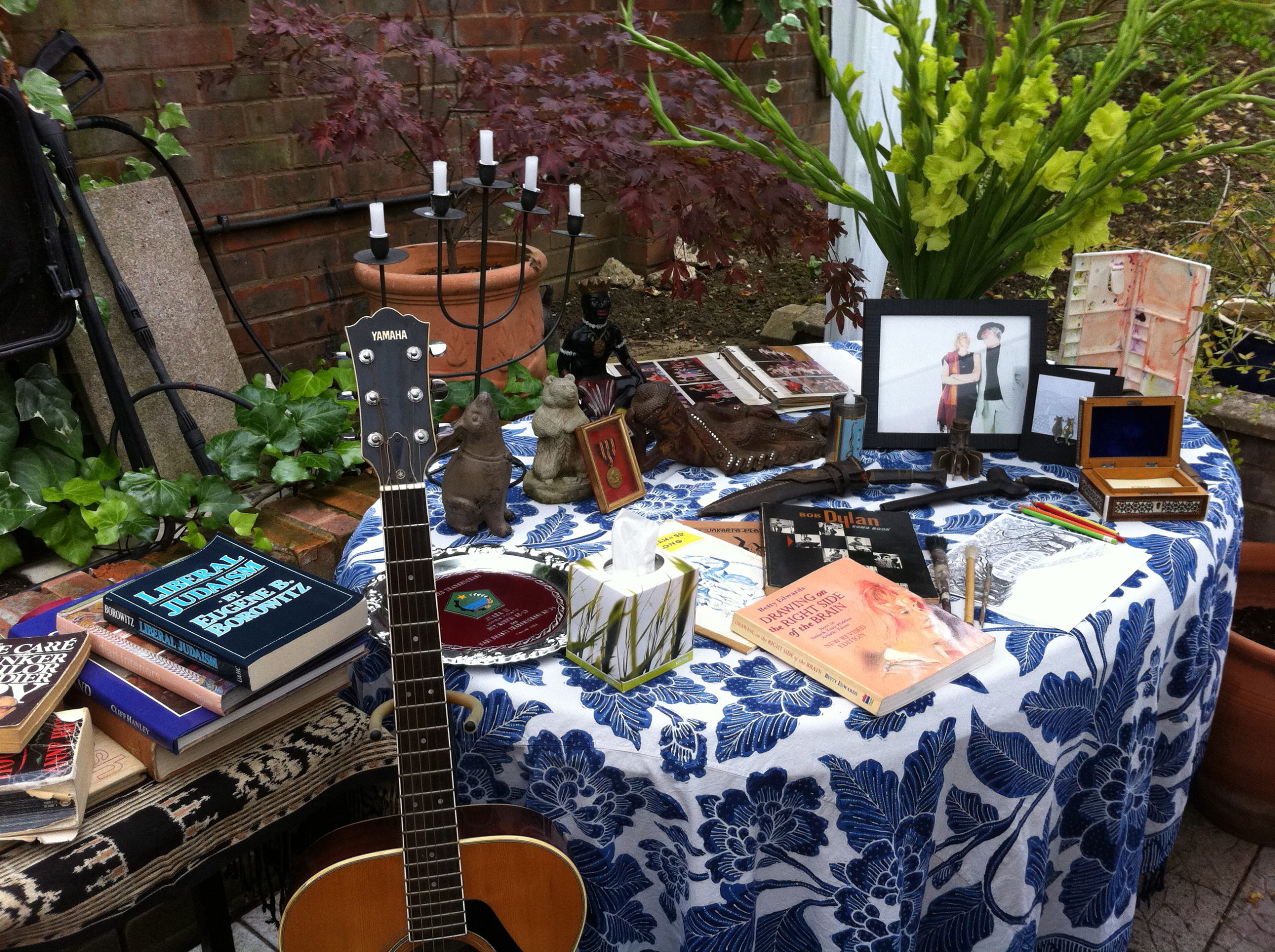
photos and other memorabilia here

The (Previous) Bombing of Tripoli

Reading the news today that US forces are bombing Tripoli brought on a quirky memory, almost completely unrelated to today’s events.

Last time the US bombed Tripoli, in 1986, I was on a study abroad year in Benares, India. I had chosen to live in Vijayanagaram Bhavan, the headquarters of the College Year in India program, so knew about all the students’ comings and goings. I also kept an eye on what was going in the world (a habit picked up from my dad the newshound). I owned a shortwave radio, and used it to listen to the Voice of America, BBC World Service, and Radio Moscow (whose announcers all sounded as if they had been raised in Nebraska).

I wrote up daily news summaries and posted them on the center’s bulletin board for my fellow students, a service they seemed to appreciate. So it was I who informed them about the US attack, which was not well received by the world community, nor by many Americans. There were fears of retaliatory attacks on American citizens worldwide. I heaved a sigh and got on with my life – been there, been threatened with death by the Islamic Jihad. We also imagined, I don’t know how realistically, the possibility of full-scale war, complete with Vietnam-style conscription of US youth.

A few days later, an American showed up at the Bhavan with a list of student names he wanted to check. His wife was a consular officer with the US Embassy in Delhi, so it was her duty to keep track of US citizens in the region in case there should be a need to whisk us all to safety. I was pleased that, having put my life in danger, my government was at least proposing to get me out of it again, and was happy to give the man the information he needed. Meanwhile, my classmates were at the other end of the verandah, muttering among themselves about the stranger and what his business might be.

As the man and I were finishing, one of the students – J, a painfully politically correct young man – came bustling up.

“Sir,” he said officiously, “I would like to lodge a complaint about the actions of the US government in Libya – ” He didn’t get to finish.

The man looked him straight in the eye and barked: “I am here to inform you that all US males over the age of 18 are being drafted into the army, and you have two days to report to the nearest recruiting center!”

J’s jaw dropped, he turned white as a sheet, and for once had nothing to say.

“Just kidding.”

The man smiled sweetly, and went about his business.

Sinus Update

…for those who are terribly concerned about the state of my head. 😉

Thanks to all who wrote or called with support and encouragement. Though I’ve had in-person support when it counted most through this ordeal, I have spent a lot of time alone in my apartment, not feeling well enough to go out for company or anything else. So “virtual” company has been more important than ever.

When we last saw our heroine (me), I was awaiting the results of another culture on the gunk in my sinuses. Pseudomonas did not show up on this one, which could mean that they simply didn’t catch it (or anything else) this time around, or that we’d finally got rid of the pseudomonas but I now had some other infection, possibly with anaerobic bacteria (which are difficult to culture). I certainly still had sinus infection symptoms (pressure, pain, fatigue). Anaerobic bacteria are easy to treat, at least, so the doctor switched me to augmentin, a milder antibiotic than the cipro I’d been taking again (with more nasty side effects) for the pseudomonas. If this worked, I might even avoid surgery.

In the meantime, I was trying to keep up a full workload including Oracle OpenWorld, my employer’s huge annual conference, which had taken over San Francisco. I managed to accomplish the tasks that no one else could do in my place: filming unconference sessions about various Solaris technologies. But it was physically punishing, especially as these were taking place about a mile from my home and I had little choice but to haul myself and equipment over there on foot. Having a full-blown migraine (which I very rarely get) on one of those days (all 24 hours) did not help.

This was followed by more, if slightly less severe, headaches which didn’t seem to be in the right place to be caused by sinus pressure. Dr. Johnson sent me for an MRI “just to make sure we’ll be cutting in the right place.”

That was a new experience. The first step was about 12 minutes of “just” imaging. If you haven’t done an MRI before, it’s like being stuck inside a car alarm: you’re in a tube with  very loud electronic noises whirling around you. Then the technician slid me out of the tube and stuck an IV into my arm to put the contrast solution – gadolinium – into me. I felt the “pinch” of the needle (why do they all call it a pinch? do they think I’ll be offended if they use the correct term, a prick?) but not much else, and he kept asking if I felt it burning going in. Nope.

He slid my head back into the machine and started it up again. Then my arm started to hurt like a sonofabitch – oh, yes, that burned. And I wasn’t supposed to move my head at all, so I couldn’t yell or swear. At some point during the three minutes of contrast imaging I was thinking: “I would rather just go ahead and die than go through any more painful procedures.” Okay, I’m a drama queen. But it really did hurt.

I later asked my friend John, who unfortunately has had a lot of experience with MRIs lately, and he confirmed that what I was feeling was the pull of the machine’s magnets on the metal in my veins. I was lucky to feel it only in my arm, and lucky that the contrast imaging didn’t take long.

The worst part was the anxious several days’ wait for results, but, as expected, these showed that there is nothing wrong (structurally, anyway) with my brain.

Meanwhile, the augmentin wasn’t doing much: the infection felt at least as bad as before, and grew steadily worse with more pressure and pain in my jaws, upper teeth, and ear, and more severe headaches (which were likely caused in part by stress).

The following week I agreed with my boss that it was time to go on medical leave. Illness is not made any easier by having to deal with scary and confusing bureaucracy, but I think we’ve finally go that sorted and, so far at least, I still have a job and a paycheck. Though the official corporate paperwork that came in the mail was careful to state that my job was guaranteed “unless your position is eliminated or there is a reduction in force.” Nothing like fear of losing your employment to aid the healing process…

I had the sinus surgery (endoscopic maxillary antrostomy) on October 7th. Normally this would be a minor procedure, but Dr. Johnson recommended that, because I was starting from a baseline of so much illness and trauma, I should take two weeks’ leave afterwards to recover. I can see now that he had a point.

I spent the night before the surgery imagining every possible worst-case scenario. It was done under general anesthesia which, as the anesthesiologist explained, differed from what I had last time only in the amount of the medication he gave me – it was the same stuff, and I hadn’t had any problems with it before, so nothing to worry about.

I remember walking to and lying down on the table in the (very cold) operating room and being bundled up with blankets and pressure pads around my legs. Next thing I knew, I was in the post-op recovery room with faces around me, but it took some time to coordinate my head and mouth to speak.

General anesthesia was different in ways I didn’t know to anticipate. It took me longer to clear my head and feel fully alert (then they put painkillers into me through the IV, so I don’t know where one effect left off and the next began). I remember people talking to me during that post-op recovery period (however long it was), but don’t remember everything that was said, and apparently I was already talking before I remember being conscious. Fortunately, I had a witness there to remind me later about the important stuff that was said to me.

I do remember Dr. Johnson saying that they found fungus inside my sinuses this time around – gross! But not unexpected when I’d been on antibiotics for so long; it’s only a wonder that I haven’t had a yeast infection yet. They’re culturing again to try to figure out what else may still be in my nose.

I guess under general anesthesia they have to intubate you, but I didn’t know about it coming or going, and had to infer it from the soreness in the roof of my mouth and my throat later on. My throat was particularly sore the next day, but this appears to be a common after-effect of surgery.

As for the procedure, there’s at least one video on YouTube, but for the moment I can’t watch it. It involves enlarging or re-opening the natural holes between the sinuses and the nose. This was done with an endoscope inserted through the nostrils, so no cutting through my mouth or face (the old-fashioned method, which I’m glad I missed out on). Still, there was cutting, and there are raw surfaces still bleeding in there. I guess in that dank, moist environment it’s harder for wounds to dry and heal. Blood only actually dripped out of my nose for a few hours after the surgery, but it’s still bleeding inside so I’m coughing and snorting it out from time to time – gently.

Once the openings were made, Dr. Johnson irrigated and flushed out the sinuses. I’m glad I was asleep through that this time.

I went home, had one strong painkiller in the evening after the IV stuff wore off, and then managed not to take any more pain medication for four days – a huge improvement.  I’ve probably been avoiding medication more than I should, as I’ve still got quite a lot of pain and, from that, fatigue. Clearly recovery will take some time yet – I tire extremely quickly.

Saw Dr. Johnson for a post-op visit yesterday, and we’re still in wait-and-see mode. The cultures haven’t shown anything, but it may still be growing. I’m off all antibiotics for the moment; it may be that the gunk left in there by the time I got to surgery was old, dead stuff that had already been killed by the antibiotics but couldn’t get out of my poor, battered nose.

Perhaps my biggest problem at the moment is boredom; I’m very sick of being cooped up in my apartment, spending way too much time alone in my own head. However, I don’t have energy to do much and, being on medical leave, I’m probably not supposed to be out having fun anyway. Dr. Johnson did say after the surgery: “I’d tell you to take it easy, but I know that’s not in your nature.” Well, my body is telling me – in no uncertain terms – that this is a time when I must take it easy. So, more or less, I am.