Tag Archives: Italian education

Education – What Skills Should We Build for a Lifetime?

I have written about my vast and varied experiences with education. I haven’t reached any firm conclusions about what education should be, I just know that a lot of what I endured didn’t work for me, and much of our daughter’s schooling to date has hasn’t worked for her. And it’s very hard to say what will work for kids in the future, or to know what sort of citizens schools should be aiming to form, let alone advise them on how to do so.

I had the good fortune to go to a remarkable high school with high academic standards, small class sizes, and talented, dedicated teachers. Given all that, I could have achieved straight A’s and a scholarship to MIT, right? The fact is, I could never be bothered to put in the work that straight A’s would have required. I studied just hard enough to stay on the honor roll (so that I could study in my room instead of in the dining room during mandatory evening study halls). I worked hard on the subjects that interested me, and coasted through the rest – I was never motivated to get grades for their own sake.

I don’t remember most of the facts I learned in high school – who does? What I remember are skills: writing (and typing!), page layout (I worked on the yearbook), editing (school newspaper), leadership (student government) and community service (I did art for the school). Some important skills (research and writing) I developed in English and history classes, but most were acquired during extra-curricular activities.

Some of the skills I use today I couldn’t have learned in high school because they simply didn’t exist back then: desktop publishing, word processing, building websites, communicating by email, designing software. As the world changes ever more quickly, it is likely that our children will need skills that we cannot imagine today, let alone teach them in school.

My college studies were even less directly relevant to my working life today. I was one of only 15 undergraduates majoring in Asian Studies at the (enormous) University of Texas, but our department was swamped with business school undergrads taking courses in Japanese language and culture, as an “obvious” asset to their business careers.

“What are you majoring in?” these young preppies would ask me.

“Asian Studies and Hindi.”

“What are you going to do with that?” they would sneer.

Lo and behold, twenty years later, my life experience and academic knowledge of up-and-coming India may well be more valuable than their knowledge of Japan. (And how I wish I’d stuck with my Chinese language studies!)

So what use is education as we know it today? I wonder. It still fulfills its social function of keeping young people out of a crowed job market, but I’m not sure that that’s a service to the young people themselves. The best we can hope for is that they learn a few universal skills that are likely to serve them later (more on that below), and, most importantly, learn how to learn – as has been said by wiser folks than me, in today’s world we must all expect to go on learning throughout our lifetimes.

Life Skills

No one should leave high school without knowing how to:

  • Type at least 50 words per minute. Sure, someday voice input with computers will become truly viable. But most of us don’t speak the way we write, nor would we want to write the way we speak. Formal writing is and should be different from everday speech, so, unless you’ve had a lot of practice at formal speech, the fastest way to get formal writing into a computer is to type it.
  • Use the Internet for research, including critical evaluation of sources. Before the web, the fact that a text made it into print for mass circulation was more or less a guarantee of quality, and it was usually reasonable to believe what you read. The Internet has made it possible for anyone to be a publisher, so we now have billions of sources, but very little quality control. The ability to distinguish true from false is therefore critically important.
  • Create websites/blogs (that is to say, publish yourself online, with whatever technology is prevalent).
  • Use other forms of online communication, including video. Today, those of us who write well have an advantage on the Internet. Over the next decade, video may well supplant the written word as the primary means of communication. People who perform well in front of and behind the camera will then have the advantage. Start practicing now!
  • Get along with all kinds of people. In today’s small and globalized world, sooner or later we find ourselves living and working with people of different cultures, languages, religions, etc. Misunderstanding and incomprehension lead to strife. You don’t have to agree with everyone you meet, but, if you could at least see where they’re coming from and imagine why they think the way they do, perhaps it would be easier to live together.

I’m sure there are more essential life skills we could be teaching our teenagers – suggestions from the floor?

Suggestions from Jakob Nielsen
Coming and Goings: Travels and Visitors, Spring 2006

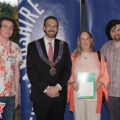
Enrico returned from Barcelona on May 15th, just as a slew of visitors arrived. My aunt Harriet (mother’s sister) stopped by for a few days on her way to join a university tour of Italian and French gardens. At the same time, blogger JD Lasica and his family stayed with us for two days out of their whirlwind tour of Italy (including a visit to TVBLOB). As I expected, everybody liked everybody and a good time was had by all. Harriet came along to a dinner given by Italian bloggers in JD’s honor, where she immediately found two Spanish-speakers to talk to (she and my mother were born in Cuba, and Harriet also speaks German and French – so she can follow most Italian as well), and her company was much enjoyed.

The blogger dinner was fun for me – a chance to meet some Italian geeky types other than my colleagues. One guest was Fausto Gimondi, who had been my editor back when I wrote for Italian computer magazines. I hadn’t seen him in nearly 15 years, and learned that in the meantime he been one of the founders of Virgilio, an Italian Internet portal which was bought out by Telecom Italia – upon which he was able to retire! Now he’s back in the publishing business, funding a new company which is publishing (among other things) the Italian version of JD’s book “Darknet”. The company specializes in putting on paper material that originated on the web. I should talk to him about my site…

I’ve been busy at work, testing and helping to refine software in preparation for TVBLOB’s presence at the big Computex show in Taiwan this week (in spite of a low-bandwidth connection on that end, we have successfully videocalled between the show floor and the office – cool!). We’re almost ready to start rolling it out to beta testers as well, and I’m eager to see how “real people” respond to it. What we’re doing is very difficult, both in the technical stuff under the hood and the interface; to see it actually, finally in the hands of end users will (I hope!) be rewarding.

School ends on Saturday – though it seems that Ross has hardly been there in the last two months. Her school, though private, is used as a polling station (I assume because it’s the only school in that particular neighborhood), so there were no classes for the Monday (April 10th) that polling was still going on and the Tuesday when ballots were counted. That was immediately followed by a long Easter break, then a national holiday on April 25th (liberation from the Nazis) and another on May 1st (Labor Day).

Last week the school was again closed on Monday and Tuesday, for local elections. June 2nd was another national holiday (Republic Day – commemorating Italy’s post-WWII vote not to have a king), and the school decided to close Saturday as well so that families could enjoy a three-day weekend.

this story continues with Pursuing a Dream of Italy

Private School in Italy

It’s been a while since I wrote about the Italian education system, specifically as relates to my daughter. Last year, her second at the liceo artistico, was a disaster. She started the year with three academic “debits” – courses she had failed the year before, and was expected to study over the summer and be tested on in the fall. She and others in her situation were given extra tutoring by the same teacher who had done such a poor job of teaching them math and physics the previous year. Needless to say, it did not do them a lot of good, especially as they were at the same time trying to keep up with all the new material being introduced in class (by the same poorly-organized teacher*). They were given two chances at the make-up exams; Ross flunked all of them.

We were puzzled as to her status at that point. The head teacher (of her class’ group of teachers) explained that she would carry forward the academic debits, which would be taken into consideration when determining her status at the end of the second year. If she passed the second year, the debits would simply be erased and forgotten. This seemed odd, since failing to pass the tests meant that she had never properly assimilated the first-year material, and now would never have another opportunity to do so.

In any case , Ross had fallen into a vicious cycle of assuming that she would fail tests, and then fulfilling that promise; none of us was surprised to be told that she would have to repeat the second year (along with a number of her classmates). Local headlines said that it was a record year for flunking in Lecco, with students at one school even contemplating a lawsuit (on what grounds I don’t know).

Although she partly (and with some justice) blamed herself, Ross was bitter, and did not look forward to repeating the year at the same school. We couldn’t think of any workable alternative, except to try the “traditional” four-year curriculum at the same liceo artistico, which would involve more hours of studio art, and no math or physics after the second year. None of us was sure this was a great idea, since the traditional program had the reputation of being a parking lot for kids who had failed repeatedly and were simply waiting to be old enough to leave school for good. But we gritted our teeth and hoped for the best.

As we got closer to September, Ross increasingly dreaded returning to school, and was thoroughly depressed by the time it started on the 12th. The first day confirmed her worst fears: her new classmates were all demotivated rejects from other schools and classes. Liceo artistico tradizionale was not the answer.

But Ross quickly found her own solution. Many of her friends attend, and recommend, a local private school. So Enrico visited the place on Tuesday, Ross and I had a look on Wednesday, we enrolled her Thursday, and she started Monday morning. Ever since we made this decision, Ross has been motivated and enthusiastic about school as I haven’t seen her in years – which is wonderful!

One irony lies in the curriculum. This school offers two indirizzi (tracks), liceo linguistico Europeo (European linguistic) and liceo della communicazione. Ross can’t do the linguistico now, having missed a year of Latin and German – too much material to catch up. The curriculum that best fits the work she’s already done and the subjects she’s interested in is communications, with a subspecialty in technology, leading to a maturita’ (national school-leaving exam) in science. This is the same exam she would have done if she had gone to liceo scientifico, an option she would never have considered! In this curriculum she’ll have extra math (five hours a week total), plus physics and chemistry, as well as IT courses. And, so far, she’s perfectly tranquil about this choice. Maybe she got her father’s math gene after all.

So, after years of pain, things are looking hopeful on the educational front. I’m sure it won’t be an entirely smooth ride, but, hell, it couldn’t get much worse than what we’ve already been through!

Tuesday: Two days in the new school – so far, so good…

* We later learned that this teacher was trying to cope at home with a husband dying of cancer… In the circumstances, it would have been in everybody’s best interest – especially the students’ – to give her a paid leave of absence.

next: school year abroad?

Sex Education in Italian Schools

What with all the fuss in the US about sex education in schools, I was curious to know what, if anything, would be done about it in Italian schools. I got my answer recently, when Ross’ class [then age 15] had two 3-hour sessions at school. Parents were not notified before or after, and wouldn’t have known it was happening unless their kids told them. Ross told me quite a bit about it, though I’m not prepared to swear that she told me everything.

A representative of the local health agency (ASL) came with a young woman who was observing as part of her psychology studies. There was an icebreaker in which the kids (mostly jokingly) introduced each other, then an exercise in which they were told a story about a girl who needs to get across a river to see her boyfriend. The boatman says he’ll take her if she’ll have sex with him. She has no other way to reach her boyfriend, so she doesn’t know what to do. She goes to her mother, who says she doesn’t want to be involved.

The girl finally resolves to have sex with the boatman. When she reaches her boyfriend she tells him what happened, and he rejects her for having sex with someone else. The class was asked to determine who, in this improbable story, is “responsible.” (Whether they were meant to address “responsibility” in the sense of who was responsible for what happened, or in the sense of behaving responsibly, was not clear – perhaps deliberately.)

Ross told me that this degenerated into a vicious argument over abortion – “Who would be responsible if she got pregnant?”. Lecco is a very Catholic town, and the ASL lady told the class that, although abortion is legal, they would have trouble finding anyone in Lecco to perform one. I guess it’s good to be warned; fortunately, Milan is easily reached, should the need arise. More importantly, local health authorities are taking the correct steps to prevent the *need* for abortion: the kids were given detailed information on birth control and the use of condoms for disease prevention as well as birth control. They were also told that they can go to a youth clinic at their local ASL for more information, with or without their parents’ knowledge. The ASL lady said that they do try to involve parents in any big decisions (such as abortion), but that the kids have the right to keep their parents out of it if they prefer.

Interestingly, abstinence was never mentioned. I asked Ross why she thought the ASL lady didn’t discuss it as an option. “Oh, everyone would have jumped all over her.” It was clear that a number of the kids are already sexually active, and no judgment upon them was given or implied. Wow. Health care professionals who are allowed to approach teen sex realistically. What a concept.

I’m very relieved that the ASL takes these initiatives. As far as Ross and I can tell, I’m the only mother among her friends who talks to her kid about sex, and, from what Ross tells me, dangerous misinformation abounds among her Italian peers. If the parents aren’t talking to these kids, someone has to –the stakes these days are life and death. Ross’ friends know that I talk to her (I’m considered the coolest mom in Lecco for several reasons, including that), so I hope they’d feel comfortable talking to me if they needed to, but I’m glad someone more authoritative and knowledgeable is there for them – it diminishes my risk of being lynched by the good parents of Lecco!

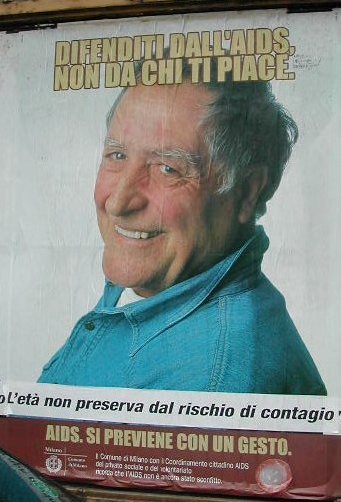
^ Top: Sex education doesn’t stop at school. The public health poster shown above says “Defend yourself from AIDS, not from someone you like. Age does not save you from the risk of contagion.”

A Travelling Show of Italian Classic I Promessi Sposi

The weekend of October 9-10, all of downtown Lecco was the stage for the Corteo Manzoniano, a “travelling” representation of that famous piece of local literature, Manzoni’s I Promessi Sposi (The Betrothed), most of whose action takes place in and around Lecco and Milan. Groups of actors in gorgeous costumes paraded among five or six fixed stages, or acted out scenes on small travelling platforms, or on horseback.

Tradimento! (Betrayal)

shot Oct 10, 2004, 1:17 mins, 3.7 MB

The betrothed couple of the title, Renzo and Lucia, attempt to trick the priest Don Abbondio into marrying them. Don Abbondio is understandably reluctant, since Don Rodrigo (a different use of the title “Don” !), the local Spanish overlord, has sent a couple of thugs (bravi) to inform him that: “Questo matrimonio non s’ha da fare.” – “This marriage should not take place.” (Don Rodrigo wants Lucia for himself.) Don Abbondio discovers the trick in time; much yelling and confusion ensue.

The Kidnapping of Lucia

22 secs, 1.8 MB

You can’t see it in this shot, but Lucia is being grabbed and bundled into the carriage, screaming. The horses didn’t like the noise and started rearing, which was scary, but after watching the scene re-enacted, I suspected that they were very well trained to look as if they were freaking out, but were actually under the control of their driver.

Procession

31 secs, 2.5 MB

I don’t know who all these characters are, but I liked the chanting and the pretty horses. Until my cellphone rang…

La Peste

1:55 mins, 5.6 MB

The plague (peste) ravages Milan. Bodies are carried away by the cartload. A grieving mother says farewell to her young daughter, placing her body tenderly on the cart, and tells the corpse-collectors: “Come back this evening to take me, and not only.”

Parade

1:59 mins , 5.8 MB

The first character you see here (with the leather banding on his shirt) is probablyl’Innominato (the Unnamed), the bad guy who turns good. The band and the music are totally out of period, but at least they’re Lecchesi – the theater company is actually from Bergamo.

The Grim Sweepers

44 secs, 2.2 MB

These stilt-walkers closed the parade. Black and purple are the colors of mourning in Italy. I have no idea why they had brooms, except the purely practical purpose of balancing the scythes on the other end.