Tag Archives: Italian language

Talking Back to Politicians: A Lesson in Modern Italian

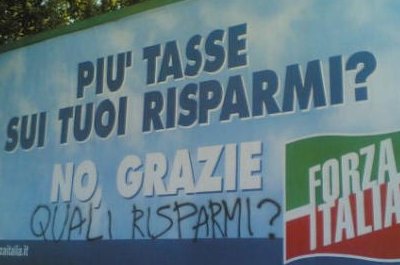
^ top: “More taxes on your savings? No, thanks!” To which someone has responded: “What savings?”

Italy doesn’t yet have a large enough Internet population to spawn interesting multimedia political parodists like JibJab. But citizens nonetheless find ways of talking back to their politicians…

Note: All these pictures were posted by readers on the site of Il Corriere della Sera (under “Elaborazioni fotografiche”).

Forza Italia (Berlusconi’s party) have done a series of posters with the theme “No, Grazie” (No, thanks) about all the terrible things that will supposedly happen if the left is elected.
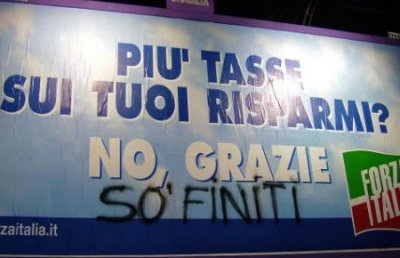
^ Same original poster, this time with the response: So’ finiti, Roman dialect for “Sono finiti” – they [the savings] are finished (used up).
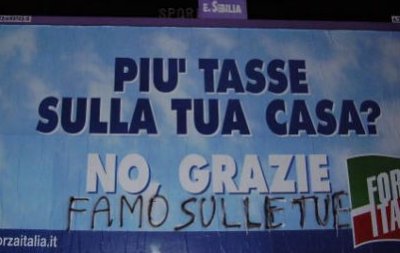
^ “More taxes on your home? No, thanks.” “Let’s tax yours.”

Famo = Roman dialect for facciamo – let’s do it. Le tue [case] refers to Berlusconi’s homes. Homes plural – he has several. Not that this is unusual in Italy, but his are rather bigger than anybody else’s…
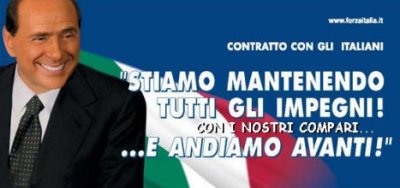
^ The original text reads: “Contract with the Italians. We are keeping all our promises!” Someone has inserted: “to our buddies.”

Final (original) line: “And we’re going ahead!”
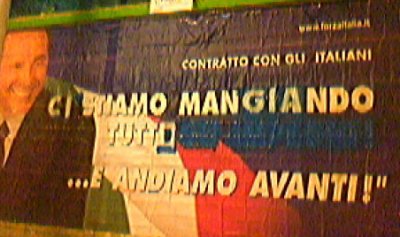
^ The same poster, altered to read: “We’re eating everything – and we’ll continue!”
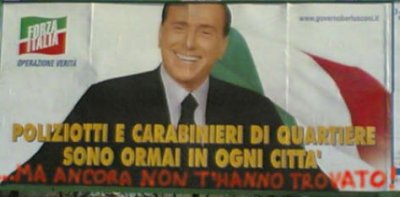
^ “Neighborhood police and carabinieri are now in every city” …and they still haven’t found you.”
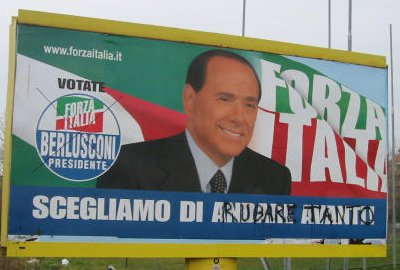
^ This one originally read: “Let’s choose to go on/move ahead.”It now says: “Let’s choose to steal a lot.”
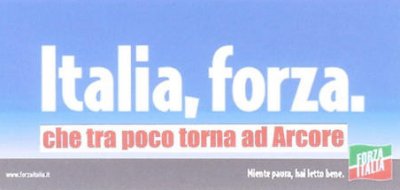
Forza Italia’s name is also a slogan, roughly translatable as “Let’s go, Italy!” (forza is what you say to urge on your sports team).

For this campaign they’ve turned it around so that it reads like an admonishment to a recalcitrant child: “Come on, Italy.” Or encouragement to someone very tired: “Come on, you can make it.”

With the added text, this translates as: “Hang in there, Italy – soon he’ll go home to Arcore.” (Arcore, near Milan, is the site of Berlusconi’s biggest villa.)

^ Casini, head of another party in Berlusconi’s coalition, claims [to have] a “A different idea.” Comment: “If only you had one.”
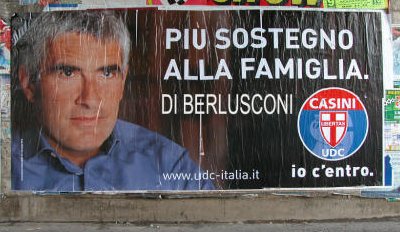
^ “More support for the family” …of Berlusconi.”

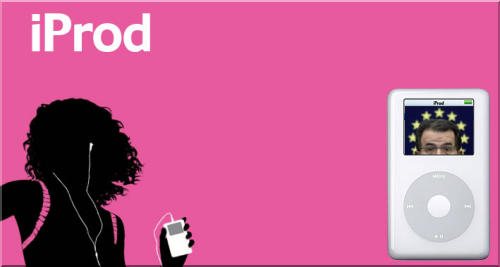
And, for the opposition, my personal favorite:
It. Figures: Dealing with Numbers in Another Language

I suspect that most people, no matter how well they speak a foreign language, find it difficult to deal with numbers in other than their native tongue. I’ve noticed many times that someone has asked me to give them numbers in their own language, “because it’s easier.” I’m no different: if I have to write down a phone number, I prefer to have it recited to me in English.

For starters, Italians have a completely different way of speaking numbers than Americans. Suppose you were reciting out loud the (fictitious) Washington phone number: (202) 123 4567. Most Americans would say: “two oh two, one two three, four five six seven.” Many Italians would say the Italian equivalent of: “Two hundred two, one hundred twenty-three, forty five, sixty seven.” Or, even more confusingly, they will break up the seven-digit number differently than Americans do and come out with: “Two hundred two, twelve, thirty four, five hundred sixty seven.”

Americans do use hundreds and thousands in phone numbers where they are round numbers, e.g. a toll-free number might be given as “one eight hundred four five five three thousand.”

Saying hundreds (never thousands) is more efficient in Italian than English, because the Italian for hundred is “cento”, and you don’t need to say “one” when there’s only one hundred. So “cento ventisette” (127) is quicker to say than “one hundred and twenty seven.” (Yes, we were all taught in grammar school that saying “one hundred AND…” is wrong, but many of us still do it.)

On the other hand, if someone starts saying “cento…” my instinct is to immediately write 100, before I hear that the tens and units columns are also occupied.

What about other kinds of numbers? Take years: the year 1956 is read by English-speakers as “nineteen fifty six” or, if you’re old-fashioned, “nineteen hundred and fifty six.” An Italian would say “mille novecento cinquantasei” (one thousand nine hundred fifty six) – twice as many syllables.

And then there’s the matter of dates. Americans write and say “April 25th, 2005,” or 4/25/05. Italians write and say “25 Aprile 2005” (venticinque aprile, due mila cinque – note that there’s no ordinal: it’s twenty-five, not 25th) or 25/4/05. Most of the rest of the world also abbreviates dates in the day/month/year format. Having lived all over the world, I can never remember which style is used where, so I’m always messing up forms that require me to fill in a date.

What’s in a Title? Signora vs. Signorina in Italy

I’m 42 today and, waking up with blue circles and bags under my eyes, I look it. Well, that’s the result of two days on my feet in the kitchen, cooking for 35 people (yes, I did have lots of help – thank you, Shannon!) for our annual Thanksgiving/ birthday/ housewarming feast (the housewarming part is not meant to be annual). Most of the time, people say I look young for my age, and I don’t think it’s just idle flattery.

I’ve been trying to understand the logic by which Italians decide to call me signora (Mrs.) or signorina (Miss). When Ross was small and I was in daily contact with her teachers and other parents at her schools, I was accustomed to being signora, because everyone assumed that, as a mother, I must also be a Mrs.

This signora habit almost got me arrested once. I was getting off the bus in Milan, in a hurry to pick up Ross from daycare, and swept right past the squad of public transport inspectors doing one of their random checks. I completely ignored the calls behind me of “Signorina! Signorina!,” assuming they couldn’t be directed at me. So the inspectors thought I was running away to dodge a fine for travelling without a ticket (actually, I am always scrupulous about bus and train tickets, except when I forget to stamp them).

I’m often called signorina even now. This may be because I often dress informally, by Italian standards, in jeans and sweaters. In a business suit and heels, I’m almost always signora. On some occasions, the choice of address seems to be based on the speaker’s desire to flatter me, and which term they think will accomplish that.

Italian Orphan Names

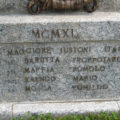
Italy has a millennia-old tradition of abandoning unwanted infants. The Romans exposed them on remote hillsides to be (hopefully) adopted by someone who needed a child or (more likely) eaten by wolves. In more recent times, babies were left on church steps, in most cases to be raised by the Church. Since no one knew who their parents were, these abandoned children were given surnames denoting their orphan status:

  • Orfanelli – little orphans
  • Poverelli – little poor (people)
  • Peverelli – slightly disguised version of the above
  • Trovato, Trovatelli – found, little foundling
  • Esposito – exposed. BTW, it’s pronounced eh-SPO-sih-toe, not ess-po-ZEE-to

These names have by now been inherited for generations, but, somewhere along the line, these folks’ ancestors were abandoned as infants.

Nicole over at zoomata.com sent me the following:

“Innocenti and Nocentini are both common names of orphan origins in Florence, from the Ospedale degli Innocenti (Hospital of the Innocents)… where babes were left, no questions asked, in a little revolving door in a corner… It’s still there, with a little iron grate over it.”

Learning Italian

When I first met Enrico, I spoke no Italian, and at some point early in the relationship I decided to learn it. I already had one language under my belt: I had studied Hindi in high school and college, and spoke it fluently. Italian is a lot easier. In terms of pronunciation, it’s one of the simplest languages on earth, having far fewer discrete sounds even than English (whereas Hindi has far more: I had had to learn to distinguish between four different T sounds and four different D sounds – aspirates and non-aspirates, dental and palatal).

Italian grammar is more complex than English, but far less complex than Hindi (not as many inflections). Italians are so delighted that you’re even trying that they will forgive a multitude of errors, which can be a handicap for a learner as they often won’t tell you when you make mistakes.

I took Italian classes at the US Department of Agriculture in Washington, DC. Taking a night class once or twice a week is not an efficient way to learn a language. I got to where I understood a lot, but couldn’t say much. That was cured in the winter of 1989, when Rossella was a baby. She and I stayed a month in Rome with my in-laws, while Enrico was hopping back and forth across the Atlantic, working on his PhD at Yale and searching for an academic job in Italy. My mother-in-law speaks no English (she does speak French), so I was forced to speak Italian. By the end of the month, Enrico’s friends were all commenting on the huge improvement in my Italian.

My spoken Italian took another leap in 1991, when I began working for Fabrizio. He conducted the interview entirely in Italian, and never mentioned that he spoke English. And he had no qualms about correcting my Italian. Some weeks after I started, I ran across a document in the office, written in near-perfect English. “Who wrote this?” I asked. “He did,” said the secretary. But, to this day, Fabrizio refuses to speak English with me. He claims that he can’t understand my accent, though he understands everyone else, American or British (or Chinese or Japanese), just fine. I don’t mind speaking only Italian with him, but it gets awkward when other non-Italian-speakers are around, as I then have to translate for their benefit.

I developed a new skill with Fabrizio: simultaneous translation and transcription. If he wanted something written in English, he would dictate it to me in Italian, and I would type it straight out in English. I’m not sure I could do simultaneous translation if I had to speak, but I can do it typing, as fast as he can talk.

All of my in-laws are university professors, so from them I learned excruciatingly correct Italian. My suoceri (mother- and father-in-law) never use strong language. At most, my suocero says things like “Perdiana!” or “Perbacco!” – “by Diana” or “By Bacchus” – I suppose it’s okay to take the name of the lord in vain, so long as it’s not a god you actually believe in. Or he says “Per tutti i dindiridin.” Don’t ask me what that means.

From Fabrizio, I learned a very different category of Italian. Not that it hasn’t been useful.