Category Archives: bio

Meeting Cat Stevens

Everyone’s had their brush with fame, or at least with famous people. My personal biggest to date occurred in Bangladesh in 1976 or ’77, when Cat Stevens came to give a lot of money to UNICEF, and to visit some of the projects he was funding in various parts of Bangladesh. (I guess this was just before he officially converted to Islam.)

There wasn’t a lot going on in Dhaka in those days, and a famous person even landing in the country was huge news. It happened that a friend of the family, part of our usual weekend music group, was a huge Cat Stevens fan. He learned Stevens’ travel schedule, and showed up at the airport every time Stevens and his entourage of one (his lead guitarist) passed through. Eventually, our friend managed to invite them over for an evening.

The result was a private concert, for about 30 of us, at someone’s house in Dhaka. I was already familiar with many of the songs, and was surprised that the two of them alone sounded just like they did on the albums, without benefit of the rest of the band or any studio mixing. Cat Stevens also looked just like his album covers, with the long curly hair and beard. He did sing one song I hadn’t heard before,”My Lady d’Arbanville.”

I don’t know if anyone got any pictures with him, but I definitely didn’t, so all I have is the memory and the story to tell. And there you have it.

The Plant of Happiness

During one of my several visits to our new home before we moved, the previous owner offered to leave us some things that wouldn’t fit into her new apartment, including a two-meter tall Yucca plant. I didn’t really care for its looks, but what the heck – it was certainly thriving. When it actually came time to move, she told me that this plant had been taken away by her (soon-to-be-ex) husband as it actually belonged to his mother, but she had a smaller version that she would leave me instead. The smaller one, only about three feet tall, was sitting in the front yard in a pot. I noticed that the neighbors also had one, planted in their yard.

Then we found out that these neighbors, too, are separating and on the road to divorce. “La chiamano la pianta della felicita’, ma dicono che porta sfiga,” remarked Enrico. [“It’s called the plant of happiness, but they say it brings bad luck.”] Given the plant’s track record – 50% of the couples in this small complex divorcing! – we decided not to take any chances. I thought a ritual dismemberment or burning of the plant would be appropriate, but Enrico felt that would be going too far. So one day he took the plant out in the car and left it in front of someone’s house in a nearby town (thereby leaving the bad luck with them, we assume!).

The following week, two friends of ours died in completely unrelated incidents in different parts of Italy (one in a car accident, one of aneurysm). We concluded that we had either got rid of the plant just in time, or had not got rid of it fast enough. I still think we should have burned it.

Dec, 2004

Mike Richter says: “The yucca has an attribute you overlooked. Those ummm ‘startling’ spines are the ‘cactus needles’ some used to play 78s back in ancient times. I had a three-meter yucca beside my front porch (until it threatened to replace the porch) and still have some of its needles in my Grafonola. I hasten to add that they are not used in place of steel or plastic ones; they tend to leave resin behind in the groove.”

Reversing Sexual Liberation

By the time I reached adolescence in the mid-1970s, women’s sexual liberation, in the West at least, had supposedly been accomplished. No longer were women divided into “good girls” and “sluts” as they had been in the 1950s and early 60s – the sluts being sought after because they would “put out,” but then despised for doing so, while every man wanted to marry a virgin. That virgin-whore dichotomy died in 1968 – didn’t it? The Pill removed the risk of pregnancy, so women were free to have sex as, when, and with whom they pleased, simply because they enjoyed it.

Well, that last was never entirely true. Even Western culture assumes that women want sex only or mostly within the context of “a loving relationship,” and feel betrayed by men who “use love to get sex.” Few people were ever really comfortable with the idea of women having sex on the “male pattern” – that is: often, casually, with many different partners, just because they liked it. Outside of pornography, one of the few fictional characters who personifies and enjoys this lifestyle (and is not ultimately punished for it) is Samantha in Sex & the City.

Even Buffy (the Vampire Slayer) couldn’t have sex just because she liked sex; a very passionate sexual relationship was presented as degrading to her because she wasn’t in love with the guy. Sex just for fun, or for comfort, was unacceptable. This is one of the few points on which I’ve ever disagreed with the Buffy writers.

It appears that we have now moved on to the service model of female sexuality, where sex is something that women do, and do often, but primarily for the benefit of men. Some girls of my daughter’s generation are using sex as a way to get male attention – not a new phenomenon, I know. A recent article in Seventeen magazine (a long-running US monthly for adolescent girls) told of girls who gave blowjobs to multiple boys at parties, then were shocked that everyone in school heard about it. Some girls Ross knows here in Italy have done much the same (or claim to have), at discos or parties. In both places, these girls are labeled “sluts,” and they do get noticed by the boys – many of whom take it for granted that these girls will perform oral sex on them as well, just for the asking. And the idiots do!

I don’t see what the girls are getting out of it, except perhaps some fleeting sense of power – the ability to give pleasure is a form of power, and some people find that in itself pleasurable. But this surely should not be the sum total of the pleasure a girl gets from sex.

The boys demanding blowjobs seem not to have any notion that they are obliged to do anything for the girls in return – nor have the girls. These boys are receiving service, not making love. I don’t know where they will learn the skills they need to uphold the long-standing reputation of Italian men as the world’s greatest lovers.

I am not anti-porn, but I can’t escape the conclusion that this attitude is leaking into the wider culture from that part of the porn industry that caters to straight men – which is the major part of the industry, right now. I got worried a few years ago when I saw girls wearing t-shirts saying “Porn Star.” The  majority of porn panders to male fantasies, offering a distorted picture of women’s sexuality.

My feminist antennae are quivering. Is this just another way to control female sexuality? Make girls believe that sex is something you do for the boys, not for your own pleasure, and they will then have sex on command, or not have sex on command, with equal indifference.

The solution to this commoditization of sex, I believe, is to teach girls, not that sex is bad or dirty, but that it should be done in an atmosphere of mutual respect, if not love. Girls should respect themselves and their sexuality, and demand respect from their partners. The question is not whether he will “respect you in the morning,” but whether he respects you NOW, enough to give as good as he gets – at least

Shotgun Wedding 2: Coca-Cola, and an Ostrich

I called Enrico in New Haven to let him know the news. He had not been happy about my traipsing off to Africa in the first place, so, while he was happy that I was pregnant, he was not at all happy that I was pregnant in Africa, and wanted me to come home immediately.

This was around week two of a four-week working trip, and I still hadn’t managed to accomplish much of the work I had been sent to do in Tanzania. I was reluctant to walk away from the project, even though I was not feeling at all well. The next morning the center shuttle van came to pick me up, and I vomited in the van. The kind driver was very concerned – he thought I had gotten malaria. I didn’t want to tell anybody at the center that I was pregnant. I knew that being pregnant and not (yet) married wouldn’t have been a big deal in Cameroon, but I wasn’t sure how Tanzanian culture would react.

Enrico left no stone unturned in trying to persuade me to drop everything and fly home. He called my parents and every friend of mine he could find a number for – between that and frequent calls to me in Tanzania, his phone bill was around $800 that month. As a result, I got calls from everyone. My parents, to my surprise, switched tracks – Mom said she didn’t feel old enough to be a grandmother, while Dad was clearly delighted at the prospect of being a granddad. My friend Stephanie, who had never even spoken to Enrico before, called in some bemusement – she had had a frantic call from him, begging her to convince me to come home.

Meanwhile, I tried to find something in Tanzania that I could stand to eat. It seems petty to say so, but the food in Arusha left a lot to be desired; I had been sorely disappointed after the wonderful cuisine of Cameroon. In desperation, I switched hotels, to the new Swisshotel across town. The hotel chain had sent a chef out from Switzerland to teach the local staff how to cook the hotel’s standard menu. Sitting in the dining room one day, I was witness to an amusing scene:

The chef was describing the menu, item by item. The steak sandwich, he explained, was a steak on a long, crusty baguette. He illustrated a long shape with his hands.

“No, no, sir,” said the Tanzanian cooks, “a sandwich is like this!”- and their hands shaped a standard American square of bread.

[Some Tanzanians have by now learned to make long sandwiches: my classmate Mahmood opened Africa’s first Subway franchise several years ago, in Dar-es-Salaam.]

The only foods I could keep down were tomatoes and salted peanuts. On my aunt Rosie’s advice, I also drank lots of Coke – she told me that Coke syrup used to be sold in pharmacies in the States as a remedy for morning sickness. It works, for morning sickness and any other form of nausea.

Between starvation, Enrico’s badgering, and frustration with the training project that was not getting accomplished, I finally decided to leave Tanzania a week earlier than scheduled, and fly to Rome to join Enrico and his family for Christmas (as originally planned). My boss wasn’t best pleased about it – “You always give the client more than you promised, not less!” Well, neither the client nor I had reckoned on me turning up pregnant…

Getting out of Tanzania involved a bit of adventure. The American woman with whom I had travelled to Ngorongoro (I’ll call her Donna) was working out in the bush on an ostrich-rescue project. Ostriches are extremely stupid; they don’t look after their nests, so the survival rate from egg to adulthood is about ten percent. Donna and her partners had a deal with the Tanzanian wildlife service whereby they would go out and collect the wild eggs, and hatch them in incubators on a farm. They would take some percentage of the chicks to ostrich farms in the US, and release older chicks back into the wild, with a greatly enhanced survival rate, resulting in a net gain in Tanzania’s ostrich population.

Donna and I had become friends; she’d come in from the bush every few days and borrow my hotel room to luxuriate in a hot shower. She planned to go back to the States soon, so I scheduled my departure to coincide with hers. There aren’t that many flights out of Arusha; we both booked on flights out of Nairobi, Kenya, which meant a few hours’ trip by jeep, across an international border.

A few days before we were to leave, Donna left a note in my hotel room: “See you soon! And I’m bringing a surprise!” Uh oh. No, she couldn’t, really – could she?

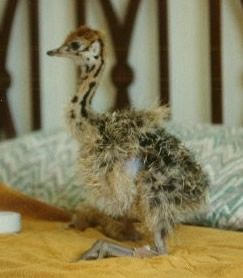
She did. She brought a baby ostrich.

The ostrich chicks bound for the US were shipped several dozen to a large crate, high enough for them to stand up in (at several weeks old, they’re about two feet tall). And they did stand up for the whole trip – anybody who sat down would get trampled and suffocated. This particular chick had a bad leg and couldn’t stand up properly; his chances of surviving the trip, let alone in the wild, were very slim.

Donna knew someone at the San Diego wildlife park who could perform the surgery little Gimpy needed to stand and run and live a normal ostrich life; the problem was to get him to San Diego. Her permit did not allow her to export ostriches except by the crateful, so she decided to smuggle him with her on the plane.

The first step was to cross the land border between Tanzania and Kenya, where passports, and possibly luggage, would be inspected. Donna put the ostrich in a gym bag which she stuffed down behind the car seat, out of sight of the driver, leaving just a hole open for his head to stick out. When we reached the border, she stuffed his head into the bag and casually tossed a jacket over it; our luggage was not checked, and we breezed on through.

Our flights from Nairobi were in the evening, many hours after our arrival, so we had booked a hotel room for the day. I didn’t feel well enough to do anything but rest, so I stayed in the room with the ostrich while Donna went out shopping. She put him on the floor near the bed, on a towel, and gave him salad and water. I lay down for a nap.

I had not known that ostriches make noise – but only when they’re happy. The jeep trip had been bumpy and traumatic, so Gimpy had stayed quiet. Now he started burbling with contentment, a soft warbling noise. I sat up in bed, startled, and looked at him. He looked at me. I lay down again. He started warbling again. I didn’t get much sleep, but, on the other hand, how many times in life do you get to hear an ostrich sing?

Getting Gimpy through Nairobi airport was going to be a little trickier. Donna took a hotel pillowcase and cut holes near the open end so that she could wear it over her arm like a shoulder bag. She put Gimpy in that, so he was snugged between her elbow and her waist, but he made too bulky a package to hide under her bush jacket. I loaned her my beloved Indian shawl, the dull brown one I had bought on a special occasion years before. Loads of sentimental value – I would not have risked it for anything less than saving the life of an ostrich. Donna draped the shawl casually over her shoulder; it looked completely natural while covering the pillow case and the ostrich.

My flight was earlier, so we went to the airport separately. I got worried for Donna when I saw that body scans and pat-downs were being performed on all passengers, and hand luggage was being x-rayed. How was she going to manage?

I got the whole story from her later, when we spoke on the phone after we had both returned to the US. Donna told me she had surveyed the security situation, and saw that she would have a problem with the body check. But she also noticed that the people manning the x-ray scanners were scarcely looking at their monitors. So she stuffed Gimpy back into the gym bag, under some other things, and he went through undetected (makes you feel good about Nairobi security, doesn’t it?). She said that, on the plane, the problem was to keep him from getting happy and making noise; she kept having to kick him. At Heathrow airport, she bought some salad and went into a breast-feeding stall in the women’s bathroom to feed him (he had to be more or less force-fed). A lady came into the bathroom with a baby, looked into the open stall, blanched, and quickly left.

Donna somehow got the ostrich all the way to California, where surgery was successfully performed, and Gimpy presumably lived out the rest of his days happily at the San Diego wildlife park. She mailed my shawl back to me, and now it’s had one more adventure than I have, having been an active participant in the great ostrich smuggling caper.

  1. The Italian Proposal
  2. Tanzania Surprise
  3. Coca-Cola, and an Ostrich
  4. Justice of the Peace

Home is Where the Art Is: Amazing Collections in Italian Homes

As everyone knows, there are many beautiful buildings in Italy. But there are also plenty of buildings that are hum-drum, ho-hum, just plain blah, or even ugly. Many fine buildings were bombed flat in WWII and, even if they hadn’t been, new ones have been built to accommodate the expanding population. Not every Italian architect is a genius, and Italy has its share of uninteresting architecture.

What’s interesting, often, is what’s inside. I’ve visited many homes where the building’s exterior, and even interior shared hallways, were bleak at best. Then you enter the private apartment and are surrounded by splendors that Americans don’t dare to dream of in ordinary homes. Persian carpets. Antique furniture. Real paintings. In Italy, antiques aren’t something you necessarily have to buy – the best stuff is not available for sale, but has been handed down in the family for generations.

I’ve written before about Setti Carraro, the first middle school that Ross attended in Milan. The school prides itself on a long history: some of the students’ mothers, grandmothers, and even great-grandmothers have attended before them. Setti Carraro is a slice of Milano perbene, a term used to describe the Milanese upper class which I cannot adequately translate. Perbene literally means “polite” or “respectable”, but it can also mean “snobby” or “pretentious”, depending who utters it. Suffice to say that Milano perbene has money, and isn’t afraid to display it.

Ross was invited to the birthday party of one of her classmates, whose mother dressed in Roberto Cavalli jeans, lacy tops, and high-heeled boots – somewhat alarming ensembles, considering that the lady is a dentist. Dentistry is a very lucrative profession in Italy, so I figured she could easily afford all that designer clothing.

When we arrived at their building to drop off Ross, I was surprised to find it unprepossessing on the outside, even ugly. Then we went inside. The first thing I noticed in the foyer of the family’s apartment was a life-size wooden statue of a saint. My eye was next drawn to a huge painting on the wall opposite the door, of a man in red and white ecclesiastical robes. The painting had a gold frame, and a museum-style plate at the bottom which said: “Portrait of Cardinal So-and-So, Tiziano” – Titian.

The salon connected to the foyer was dimly lit by 10-foot-tall glass fixtures shaped like palm trees, flanking the entrance. Its walls were completely covered in paintings. I read another tag: “Guido Reni.” Hmm. The place looked like a museum, and the paintings all seemed to be museum quality.

I mentioned this to Enrico when I returned to the car where he was waiting.

“Do you think those are originals?” I asked.

“No, they couldn’t possibly be. The family wouldn’t be allowed to keep them. By law, I think, they would have to be in a museum. They must be falsi d’autore.” (professionally-painted reproductions)

I’m no expert on art, but the reproductions explanation didn’t satisfy me. While Ross was at the party, I searched the Internet for any reference to this Titian portrait of a cardinal. I can’t remember the cardinal’s name now, but at the time I searched on that name and found nothing. Well, that’s logical – if the painting has been in the family for generations (maybe the cardinal was a relative, somewhere along the line?), it may never have been seen by the experts.

When we picked up Ross, I asked her to ask her classmate about the painting. “It could be original,” she said, and went on to explain her reasoning:

This party took place around Halloween, so the girls had decided to do a séance. To add to the atmosphere, they wanted to drape a sheet over a piece of sculpture, to represent a ghost. Ross didn’t think much of the sculpture: lacking a head or limbs, it looked like a dressmaker’s dummy (some sort of modern art). But her classmate thought it wise to ask her mother’s permission to play with it.

“Yes, you can use it, but be careful,” said the mother. “Vale due miliardi.” (“It’s worth two billion” – lire, that is. In dollars, about one million.)

She wasn’t joking. So I concluded that the paintings were probably also real, and really, really valuable.