Category Archives: bio

Life Without Buffy

We’re suffering Buffy withdrawal. Angel, the show which spun off from Buffy four years ago, is good, but it’s pretty much guy-centered. I have no complaints about watching all the good-looking men on “Angel,” but I miss the presence of powerful women, and the role model that Buffy provided for my daughter.

Ross started watching Buffy when she was 10, and at age 14 said that she would have grown up a different person without the show.

Hurt, I responded: “You weren’t exactly lacking for a strong female role model at home.”

“Yes, but Buffy made it cool.”

Which is a very good point. Being a strong, self-confident female is not easy at any age; strength is a characteristic not appreciated in women by most cultures or individuals (male or female). It wasn’t easy for me to grow into my strength (compounded, as it is, with geekiness), and I certainly wasn’t comfortable with it as a teenager, if I even had it then. And I spent most of my adolescence in the nurturing environment of Woodstock School, more accepting than most schools of student diversity. So I wouldn’t know how to advise Ross how to feel comfortable in her own skin at this age and place, if it weren’t for Buffy.

But don’t take my word for it. “[Father John] Pungente used Buffy as a role model for conveying solid values for teens. ‘She is smart, willing to learn about herself and live with who she is, even if she happens to be a vampire slayer. She is independent, reliable, maybe too much a Type-A personality, but still an entirely credible 1990s teenager. Other shows deal with teenage problems – love, sex, peer pressure, school work, family problems, body image, dreams, insecurity, self-esteem – but Buffy adapts a literary and film genre for television. The vampire myth and the sexuality it evokes speak powerfully to today’s teenagers.'” (MARTIN O’MALLEY: Orange County blues, CBC News Viewpoint | November 14, 2003)

A point often overlooked by writers about “Buffy” is the role of Xander, Buffy’s average guy friend who, unlike her other friends, has no special powers (magical or intellectual) to help him fight the forces of darkness, both interior and exterior. “You know, Xander is as important a role model as Buffy and people will never really get that, I think, most of ’em. But, the fact of the matter is that I had a two-fold intent, which was to create a role model in the idea of a girl who’s a genuine leader and the role model in a man who is not only comfortable, but turned on by that.” Joss Whedon, MSN Interview

Hear, hear. The world needs not only more women like Buffy, but more men like Xander. Unfortunately for Ross, I don’t think she’ll find many such in Italy, and even fewer in her age range.

English Teaching in Italian Schools

It is admirable that the Italian public school system now requires foreign-language classes (usually English) starting in first grade. Unfortunately, a shortage of teachers means that most kids don’t actually start til 3rd grade. And how much anyone really learns is very much open to question. Parents nowadays are frantic for their kids to speak English well, recognizing its importance in the world economy. They willingly pay for extra classes after school and summer study-abroad trips. Increasing numbers of kids go abroad for a high school junior year in an English-speaking country.

Part of the reason for the teacher shortage is that, at least until recently, you had to be a citizen of Italy to teach in public schools. This means that most foreign-language teachers are Italians, for whom the language they are teaching is at best a second language.

Recently, however, schools have begun to bring in “mother tongue” English speakers part-time, to give the kids exposure to native accents. I hope that this includes some American accents, as many Italians learn English from British teachers, and then have difficulty understanding Americans.

There is no flexibility in the Italian school system for a kid to test out of a subject he or she is already competent in, so Rossella has had to take English in school every year since third grade. Her Italian teachers of English have fallen into two categories: those who see Ross as a resource to be exploited for the benefit of the class, and those who feel threatened by a student who knows their subject better than they do.

Ross’ first English teacher, in elementary school, was probably the best she’s ever had. She would get Ross to tell the class stories or converse with her in English, so the other kids could hear a good accent. She even wanted to use Ross to talk in front of some older classes, but Ross was shy of the older kids.

In middle school, things were very different. There were two English-speakers in the class, Ross and an Italian girl growing up in the British Virgin Islands, where her parents own a restaurant. The English teacher was of the extremely threatened sort, who would correct the girls even when they were right. This woman’s pronunciation was epically wrong, including such gems as: “In England, it is traditional to eat a bowl of soap at the start of dinner.” And: “In England, pizza is pronounced pyza.” When Ross protested, the teacher said witheringly: “We are learning English, not American.”

This woman would insist that the kids memorize pages about English “civilization.” This could have been useful, both for reading English and learning about the culture of another country, except that her material was twenty years out of date. On one test she asked: “True or false: The English only drink wine on special occasions.” Rossella, having often visited her granddad and his wife in England, knew this to be false. Her answer was: “False. Why else would they have pubs?” The teacher disagreed and marked her down, even though Ross had been to England far more recently than she had.

I was even called in for a conference with this teacher once, because she was concerned about Ross’ performance! She was not interested in my suggestions that Ross was bored out of her mind and should be allowed to do something more challenging – that would have created extra work for herself. I’m not sure whether she was insulted or relieved that I conducted the conversation entirely in Italian.

Ross suffered through two years of this, then changed schools (for other reasons). I was impressed that the new English teacher immediately called me in to talk about what Ross should be doing, since it was an obvious waste of time for her to do the same elementary grammar exercises as the other kids. So Ross did some reading and writing in English, and helped the other kids. She spent a lot of time with a boy whom the teachers considered to be retarded. Ross knows something about learning disorders, and thought he was more likely dyslexic: he couldn’t read, but he could remember and work well with whatever she told him orally. The teachers were flabbergasted when Ross eventually got him to write something – in English, no less.

This year, the first year of high school, it’s bad news on the English teacher front again. Ross is forced to do the same stupid exercises as the other kids in the class, and, when she’s finished, she sits and twiddles her thumbs. She was warned in advance that this teacher is the touchy type, so at least she knew to keep her mouth shut. Ross’ friend Viola made a very good grade on the last English test, better than Ross herself (who was marked down for things like not putting a hyphen in ‘forty-nine’). Viola was so happy that she exclaimed excitedly to the teacher: “This is because I studied last night with Rossella!” Which was sooooo not what the teacher wanted to hear. Now Ross will be in demand to help all her classmates prepare for English tests; I guess she could earn some pocket money that way.

February, 2004: The current English teacher has had an epiphany. Some other classes and schools are paying 4000 euros (for the year) to bring in mother-tongue English speakers for conversation. This class doesn’t have to: they have Rossella, and the teacher has pointed out to the class that they should all be grateful for that.

The Italian Holiday Season Begins

The Christmas season is upon us; here in Lecco, holiday lights are already up over some of the main streets, though they have not yet been lit, and shopkeepers are busy decorating. At least Italian merchants aren’t quite as overeager as some others. In the US, some Christmas displays go up right after Halloween. When I was in England in early October, one department store (John Lewis) already had Christmas decorations up!

The run-up to Christmas is the only time when it’s almost as easy to shop in Italy as it is in the US. Stores, especially big ones, are open on Sundays starting next weekend; Sunday openings are a rarity at other times of year, though they are becoming more common with suburban “big box” stores. As we get closer to Christmas, shops will also stay open later, to around 10 pm.

Most small shops are owned by individuals or families, and I’ve always wondered when they get their holiday shopping done, since they are open seven days a week from late November through December 24th. They must be more organized than they expect us to be, and get it all done beforehand. In the last two or three weeks before Christmas, even food stores are open on Sundays. This would seem unnecessary, except for the last Sunday before Christmas when everyone is preparing for a feast. But there is a reason: one fine Italian Christmas tradition is gift baskets of food and wine, generally sent to professional acquaintances or employees, and sometimes to teachers. Enrico’s parents, both well-loved professors at the University of Rome, used to receive amazing baskets every year of fruit, nuts, wine, and Christmas sweets. I eagerly await the day when Enrico’s students take up this habit!

tell us about your winter travel experiences in Italy

Making Room: Italian Stratagems for Living in Small Spaces

^ top cameretta a ponte in Ross’ room in Milan. Where the chair is at right, a desktop slides out, though Ross never used it that way. (This fuzzygraph is Ross’ early work when we got our first digital camera.)

Living space is tight in Italian cities, which are often geographically constrained because built into, on top of, or between mountains – the kind of urban sprawl you see in America simply can’t occur in most parts of Italy.

Even where there is room to spread out, historically Italians tended not to. This may be due to centuries of history: until recently, Italy was a collection of separate city-states which were often at war with their neighbors; people huddled into fortress towns and cities for safety, and many Italians have never lost this preference for living close together.

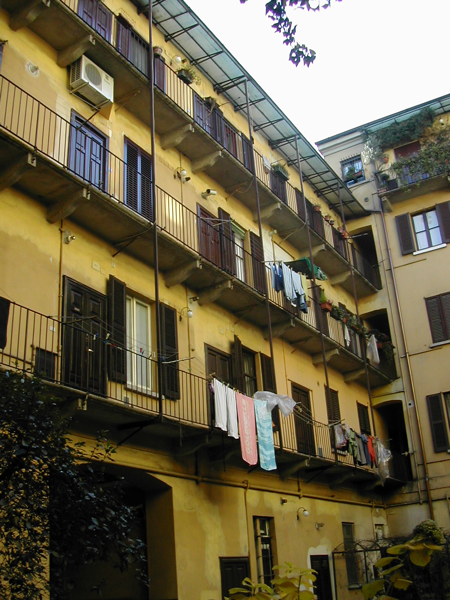
Urban Italians have been living in apartments, condos, and townhouses since Roman times. The apartment building was invented in ancient Rome, and even in those days single-family dwellings were only for very rich families. Italian cities today are almost entirely apartment buildings, four to five stories tall in mid-sized towns, eight to ten in larger cities. In many buildings, the lowest floor sare reserved for commercial use. Where we lived in Milan, we had a greengrocer, bar/gelateria, baker, and butcher right downstairs – extremely convenient, since I was always forgetting something in my shopping.

The primo piano (first floor above ground level) is undesirable to live on, partly because of pollution, partly because it’s more vulnerable to housebreaking (that’s why you often see bars on the lower windows of older buildings); first floor apartments are often used as offices.

The higher up you go, the higher the value of the real estate, because the higher floors get more light and air and less pollution, and are less susceptible to being robbed. But the floor space remains the same – usually small. So how do you fit, say, three people, with all their possessions, into 70 square meters (~750 square feet)?

One way is to go vertical. Ceilings in Italy are higher than the American average, (although they’ve gotten lower in modern buildings). You build your bookcases go all the way to the ceiling. Closets are divided vertically into two sections: use the top sections for out-of-season clothing, lifting the clothes on hangers up to the high rod with a long-handled hook.

In some old buildings, the ceilings are so high that apartment owners are able to build in a loft. If you don’t want to go to that much trouble or expense, you can buy a loft bed from Ikea, which leaves a nice workspace underneath. I’ve been tempted by those, but I’m scared of heights, I get up a lot at night, and getting sheets onto such a bed looks like a hassle.

Bunkbeds and loft beds are quite common for kids’ rooms, often built into closet/desk/bed units called camerette (little rooms). A cameretta a ponte (“with a bridge”) has part of the closet built over the bed. There are entire furniture stores devoted to camerette in every conceivable style, some of them the kind of fun furniture kids dream about, with playspace under the bed, a miniature staircase going up to a loft bed (the steps lift up to provide storage space) and/or a slide for disembunking.

  • also see: Housing: How Italians Live
  • Gender Identity Crises: Can’t They Tell I’m a Woman?

    Back in August I wrote about the difficulties of being named Deirdré, which no one can spell or pronounce. An additional problem arose when I began dealing with large numbers of people online: many people don’t know whether it’s a male or female name. The default assumption was that I was male, perhaps because people “met” me in the context of technology, and assumed that a technically-capable person had to be male (that’s a rant for another time).

    So I got used to being addressed in email as “Mr. Straughan;” it’s far better than some things I’ve been called online. My friend and colleague Adrian, meanwhile, had to contend with the fact that, in America, Adrian is assumed to be a female name (thanks to the “Rocky” movies). This Adrian is British, and male. On one memorable occasion, a member of a focus group of Roxio software users began (without prompting) to sing the praises of those wonderful online reps the company had, Deirdré and Adrian. Which was very nice, except that he thought that I was a man and Adrian a woman!

    At least people meeting me in person usually figure out that I’m female, what with my two big attributes sticking out in front. But, when I was in Benares in 1985-86, even this certainty deserted me. I had very short hair at the time, and was a lot thinner than I am now. For most of the year, I wore salwar-kameez (traditional Indian women’s clothing, which is loose around the thighs but tight-fitting up top) and there was no question as to my sex. But in winter, to stay warm, I wore western clothing: baggy canvas trousers and a bulky sweater.

    While travelling back from Kulu-Manali by bus, I was delayed in a small town where university students had blocked the road to protest something or other. I was standing outside the bus, waiting for something to happen, when a young man came bustling up, probably intent on telling me all about the noble cause, whatever it was. “Hello, Sir!” he shouted. Then, as he got a little closer, his face suddenly fell. “Oh, excuse me, Madam,” he muttered, and slunk away.

    Soon afterwards, I was back in Benares, buying something in a shop. A little old Muslim man with thick glasses engaged me in conversation (in Hindi). I don’t remember what it was about, but we had been chatting for about ten minutes when he suddenly peered at me intently through his glasses. “Oh, excuse me,” he said. “If I had realized you were a woman, I would never have spoken to you.”