Category Archives: bio

Cars

Speaking of air pollution: What is it about cars, anyway? Personally, I’m not fond of them. Because I went to high school in India, I did not learn to drive at the usual American age of 16. By the time I did learn, I had already been involved in two spectacular accidents (someday I’ll tell you about the Fabulous Flying Jeep Trick), so I am a nervous auto passenger, let alone driver.

However, Austin, Texas, is one of those American cities designed on the assumption that everyone drives, so when I transferred to university there, it was time for me to learn how. It was a triumph when I got through driving school and actually earned a license. I lost a few points on the road test for poor parallel parking, and was surprised when the driving instructor told me: “I thought you’d get 100%.” I didn’t know then that this is actually easy to do in the US!

I inherited my grandmother’s ancient AMC Hornet and began cautiously to drive it. Within a month or two, I accidentally ran a red light in a fit of nerves while trying to get onto Interstate Highway 35 (which has some of the worst-designed entrances and exits ever to grace a highway), and ran head-on into someone else’s car. That was the end of the Hornet, but at least no humans were hurt.

After that, I had few opportunities to drive, and even less desire to. My college roommates both had cars, and were kind enough to ferry me around when needed, in exchange for cooking or helping them study for exams.

During my college study abroad year in Benares, we all rode bicycles, and I travelled across northern India by train and bus. I do not recommend bus travel in the Himalayas: after a harrowing trip from Simla to Mussoorie, I understood why so many of those buses end up plunging down mountainsides!

When I began my working life, in Washington, DC, I was able to rely on the subway. But then I moved out to suburban Virginia. After several months of valiantly trying to do everything on bike and foot (even in the snow), it was time to face that car thing again. My boss let me borrow his Pontiac Fiero to practice on; I didn’t tell him about the time I accidently made it spin out on gravel. <grin> When I finally felt ready, my dad accompanied me to look for a new car. We bought the first thing we saw, a Dodge Colt (actually manufactured by Mitsubishi), on ruinous financing terms.

The Colt and I got along all right. I never wrecked it, but neither did I drive it long distances (I let Enrico do that). We gave it to his brother when we left for Italy, and it went on to sturdily face winters in the northern US and Canada.

I have never yet driven in Europe. That would mean getting an Italian driver’s license, which is hard – people routinely fail the written exam several times. I could probably handle the traffic in Milan, when it moves slowly (the other drivers would hate me, because I’d be moving even more slowly). Stopping, however, would be a challenge, since it requires parallel parking in spaces only ten centimeters longer than your car, or head-in parking with half the car on the sidewalk. I’ll stick to public transport for now. It’s the ecologically responsible thing to do.


Smog Days: Italy’s Pollution Problem

When I was a kid in Pittsburgh and Connecticut, waking up to find snow on the ground was always exciting, because it meant the possibility of a snow day – a day off from school due to dangerous road conditions. I’d crouch over the radio, holding my breath for the longed-for announcement that my school district was closed, so I’d be free to play all day in the wonderful snow.

It snows very rarely here in Milan, never enough to close the schools. But in January we almost had an analogous phenomenon: smog days.

Northern Italy normally gets enough rain in the winter to wash away the poisons belched into the air by oil-burning heating systems and far too many cars. But not this year: we went nearly sixty days with no rain at all. As we enjoyed the sunshine, the poisonous gases and particulates accumulated to dangerous levels. After the air quality had been officially “terrible” for nine days in a row, environmental laws forced many communities to close their streets to traffic. In Milan, we had several Sundays of no cars at all, which was very pleasant; the streets were delightfully quiet. However, this was not likely to have much effect on the smog, because many Milanese go out of town on the weekends anyway and do their driving elsewhere.

The next solution tried was four days of “alternate license plates” – on even-numbered dates, only cars with even-numbered license plates could be on the road, and vice-versa for odd dates. This meant that many more people were forced to take public transport, so, to lighten the load on the buses, trams, and subways, the regional government also decreed that all middle- and high-school students would start school at 10:00 rather than 8:00. (The kids, of course, were heartbroken.) There was even the threat of a no-cars Friday, which would have meant closing all city and state government offices and schools, but then it rained just enough for a last-minute reprieve.

We’ve since had enough wind and rain to clear the air thoroughly, but the lesson gets clearer as the air gets murkier: Italy has a serious, long-term pollution problem that we can’t depend on the weather to solve. Real, long-term solutions in sight? Few. For now, as for so many years, hopes of truly effective change appear to be lost in a sea of political wrangles, while more and more cars continue to squeeze into Italy’s smog-choked cities.

Car Stories

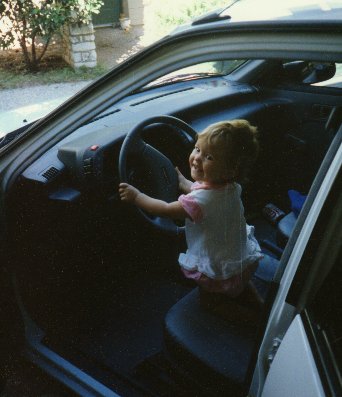
I have never yet driven in Europe. We moved to Italy when our daughter was 15 months old. During a trip around the US when she was 3 or 4, we talked about what we would do on the next leg of the trip, when we got to California:

“We’ll rent a car at the airport and I’ll drive us to where we’re staying,” I said.

“You can’t drive,” retorted Ross.

“Yes, I certainly can drive.”

“No, women don’t drive.”

This apparently logical conclusion was drawn from the fact that she had never seen me drive. However, she made this statement while in a car which my friend Sue was driving! Confronted with the fact that Sue was driving and was indubitably female, Ross had to revise her ideas.

When we arrived in California and picked up the rental car, I sat in the parking lot, carefully doing all the things you’re supposed to do when you first get into a new car: check the mirrors, adjust the seat, etc. After several minutes of watching me fiddling around, Ross burst out: “You’re so dumb you don’t even know how to drive a car!”

Thanks, kid – just what I needed to hear when I was in fact feeling a bit nervous, not having driven for a while. But a few days later she graciously told me: “You drive pretty well.”

National Self-Esteem

Can a country have an inferiority complex? Certainly the US strongly feels its own superiority, and this is reflected in its media. As pointed out in a Doonesbury cartoon years ago, a lot of American advertising uses the word “America” to sell products that have nothing to do with nationality. Mike Doonesbury asks: “Why are Americans so insecure about themselves? Do any other countries make ads that are so relentlessly chauvinistic?”

As a matter of fact, they don’t – at least not that I’ve seen. But Mike had the wrong end of the stick: the driving force here is not insecurity, but pride. Americans have a strong sense of what it means to be American, and it’s the kind of warm, fuzzy feeling that makes advertisers want to create a link (in the public mind) between their product and “being American.”

Watching American TV, you might get the idea that American is not only the best thing to be, it’s the only thing to be. The American media tends to ignore the rest of the world, at least until forced by events to sit up and take notice.

To a point, this is understandable; most news organizations report to a local/national audience whose interest in faraway events is limited. In reports of, say, an airline disaster, the local news will say that “x number of people from our country were involved, x others;” I’ve seen this in both the UK and Italy. The disasters that no one local is likely to be involved in get short shrift indeed: “x thousand people killed in floods in Bangladesh. End of story.”

But the United States is the leading player on the world stage, so other countries’ news media report extensively on America’s affairs, both internal and external. What happens in America affects the world. (This, by the way, is a huge responsibility, but one that most Americans seem unaware that they carry.)

Italy, on the other hand, seems to have an inferiority complex. It’s the world’s fifth or sixth largest economy, yet Italians seem to feel that Italy doesn’t really deserve much of a position on the world stage. Maybe I’m just imagining things, but I get this impression most strongly from the Italian news media.

The US public probably would not have noticed that Italy sent troops to the Gulf War, but the Italian TV news gave “our boys” lots of coverage, partly, I suppose, because it was easier and cheaper to interview them than soldiers of other nationalities. But sometimes it felt as if the Italian journalists were like the nerdy kid who tries too hard to get noticed by the rest of the class: “See, see! We’re there, too!”

A couple of Italian pilots managed to do something newsworthy: they were shot down, captured, and beat up by the Iraqis. The Italian press was delirious: finally, we have something momentous to say about Italy’s participation in the war.

Italy’s lack of national self-esteem shows in other ways. There are some things that everyone acknowledges the Italians are good at: food, design, leather. But beyond that, many Italians are convinced that the Americans do it better. Back when I was with Incat Systems, a small Italian company bent on conquering the global CD-R software market, we had trouble selling our software to Italians; some thought that software from Italy couldn’t possibly be any good. When half of the company moved to California and the same Easy CD software had an American address on it, more Italians were eager to buy it: it’s American, it must be good. (Whether Italian or American, Easy CD went on to take the lion’s share of the worldwide CD-R market; that’s why Adaptec bought it.)

As far as American customers knew, Easy CD was always an American product. Years later, when Easy CD Creator 4 was released, the suggested retail price (SRP) was $99 in the US, with a $20 rebate. In Europe SRP was set at the after-rebate price of $79. I got vitriolic email from an American: “How dare you give a lower price to foreigners on an American product?”

My response was: “The original Easy CD Creator was the offspring of Easy CD, developed in Italy, and CD Creator, developed in Canada. Even today, of the engineering staff in California, at least half were not born in America. So what exactly is an ‘American’ product?”

Never heard from him again.

“Brave” Opinions

I started out thinking that this newsletter would be technical, then realized that I am currently (maybe permanently) burned out on writing about my one great area of technical expertise, CD-R. So the thing took a travel-writing sort of turn, but then the events of and following Sept 11 made that seem trivial. My last edition got more serious, and one person wrote that I was “brave” to take on the topics that I did.

Honestly, I didn’t think of it as taking a big leap – I feel that I’m simply sharing thoughts with an extended circle of friends, and I hope that you perceive this as a conversation in which you are welcome to take part, even if (so far) I’m doing most of the talking. Calling this a “newsletter” doesn’t give me any particular authority, and I don’t claim to know all the answers or always to be sure of what I’m saying. One reader took issue with some of my comments in the last issue, but I think we’ve sorted that out – we’ve established that we both like a good argument. <grin>

This is different from what I was doing before for the company, and I’m still feeling my way into it. After years of technical and marketing writing, I’ve moved to the op-ed page. Here I don’t have the restrictions of representing a company, and can be candid about my own thoughts and opinions. Where there is opinion, there’s always room for dispute, so I don’t expect you always to agree with or like what I have to say. But I do hope you’ll always feel free to discuss it with me.