Category Archives: bio

Raising a Non-Believer

A reader has just written to me:

“One was on an essay about Religion as a Cause of Strife in the World – you can bet she went to town on that!”

this is a comment you wrote on Ross’ India Diary and i have always wanted to ask you why you believe that Ross has arrived at an independent opinion/thought/decision regarding religion when it is the exact same opinion/insight you and your husband have. maybe mistakenly, but i’ve gotten this impression that you are very prideful that her belief is identical to yours and see it as a sign of her independent, intelligent thought. how much of a stretch is that really? how different is that to the child who grows up with the gospel every week at church and every day at home? how “independent” can that child’s outlook ever be due to that home conditioning?

It’s very true and completely unsurprising that Rossella, like most kids, shares her parents’ beliefs (or lack of). The more interesting question is: did how she arrive at those beliefs?

One of Richard Dawkins’ most provocative theses is that schools and even parents should not be allowed to proselytize children into religion at young ages. He points to lifelong traumas (both physical and mental) inflicted upon people (and cultures) from infancy, in the name of religion.

One might reasonably ask (many have) how Dawkins’ desire to promote atheism is any different from a religious person’s desire to promote religion. The logic here seems to be: “Atheism is just another belief. Why is it okay for you to preach what you believe, but not for religious people to do so?”

Here’s the “fundamental” difference: most religions teach their adherents – and particularly children – to accept certain strictures, norms, behaviors, etc. because someone in “authority” said so. Believers may be allowed to question up to a point, but sooner or later every religion comes down to “faith” – a necessarily blind (because unprovable) belief that there is some “higher power” out there which has an opinion about how you should think and act.

This is emphatically NOT how we raised our daughter.

My husband is a professional mathematician. This means that he thinks long and hard to come up with new hypotheses about how things behave in his particular realm of mathematics. When he can support his ideas with mathematical proofs, and those ideas are new, and important enough to be brought to the attention of his colleagues, he submits them (in the form of articles) to professional mathematical journals. There his ideas are judged by his peers for their truth and interestingness and worthiness of publication. If he gets something wrong, either he or one of his colleagues will figure that out. He thanks the people who point out his errors, and goes back to the drawing board.

The same thing happens in every scientific field. Ideas are developed, tested, and submitted to a jury of one’s peers. Sometimes an idea is proven wrong immediately, sometimes later, as more research is carried out. A few hypotheses survive the judgement of the scientific community and the test of time to become theories: which is to say, scientifically-proven facts.

All of this is done in a spirit of cooperative enquiry and (more or less) humility. No one can claim to know more than anyone else on the basis of some externally-granted “authority” – a scientist must be able to back his or her hypotheses with solid, provable facts.

I’m not a scientist, but I use the classic scientific method in my job every day: Does this work? If not, why not? What went wrong? Test one variable at a time til you find out where the problem is, then fix it. It’s a simple logic which can be usefully applied in many areas of life.

Given our professional and personal biases (and our penchant for arguing about EVERYTHING), Enrico and I have raised our daughter to prize inquiry, and not to grant authority blindly. We would be hypocrites if we had not encouraged Ross to think for herself and ask questions – to which we always gave grown-up answers.

This isn’t a totally easy way to raise a teenager: “Why do I have to be home at midnight?” In a family like ours, “Because I’m the mom and I said so!” doesn’t cut it. In Ross’ most exhausting, argumentative moments, I have gritted my teeth and consoled myself: “At least I know she’s not going to do something stupid just because her friends are doing it.”

And, mostly, she hasn’t. We raised her to think for herself, and she does think — and, most of the time, she comes to very sensible conclusions.

If Ross called herself an atheist simply in imitation of me and her father, I’d have no reason to boast of her independence of mind. Perhaps at 18 she hasn’t put as much thought into her beliefs as we have, but I don’t think she’s merely parroting us. She knows that she is welcome – encouraged! – to explore what others believe (Woodstock is an excellent venue for that), and decide for herself what she thinks of it all. Her father and I remain open to discussion. Ross is no fool, and very likely someday she’ll persuade me to something I hadn’t previously agreed with. It wouldn’t be the first time.

Adventures in Colorado and New Mexico

Aug 13, Monday – Though still tired and sore from our strenuous hike the day before, I went to the Sun gym to do the physical part of my fitness assessment. Even more tired after that!

Aug 17, Friday – Took a 6 pm flight from Denver to Albuquerque, where Steve Ediger, a long-time Woodstock friend, picked me up and drove two hours to where he and Sharon Seto and their son Robin live. Steve and Sharon work at the United World College in Montezuma, New Mexico. The school year was just starting, so Sharon had to be at her dorm to welcome the kids (she supervises a dorm of 45 girls, and also runs the school’s outdoor program).

The hummingbird feeder on the porch is refilled daily, attracting dozens of birds from several species. Heard close to, hummingbirds sound disturbingly like very large insects.

Saturday we visited the local flea market.

Sunday Sharon and I went to Santa Fe, then Steve drove me back to the airport in Albuquerque.

Another busy week at Sun ensued. I was intensely disappointed to learn that the fitness assessment had been a mistake – as a contractor, I’m not allowed to use the gym! (I hope the nice guy who did it for me didn’t get in trouble for having done the assessment – he was supposed to have checked my badge, apparently.) All my motivation to start getting into shape had to be postponed. I do have his detailed assessment and recommendations to work from, at least.

Aug 26, Sunday – I survived a scary (for me) drive to Conifer, Colorado, to the mountain home of my colleague Charles. He and his wife Elaine had invited me and a long-time friend of theirs, Marj, who graduated from Woodstock in 1978 (she was a lofty senior when I was a lowly freshman, so we hadn’t really known each other in our schooldays). Marj and Elaine had met years before when both were teaching in El Salvador.

It always seems to happen with Woodstockers that we find plenty to talk about even if we didn’t know each other well (or at all) while at school. Marj had brought albums of fascinating photos from a trip she and her husband had made to the far corners of the world – fuel for conversation. Charles and Elaine are no slouches in the travel department, either – they’ve even lived in Antarctica!

Toys of Empire – Teaching Young Bengalis to be Bureaucrats of the Raj

While I was in New Mexico last weekend, Sharon and I drove to Santa Fe. The town has many museums, but we visited only one: the Museum of International Folk Art. It’s not big, but offers plenty to keep the attention. One room has drawers full of decorative panels from Bangladeshi rickshaws, and molé cloth work.

Most fascinating to me was the Girard Wing, created from the personal collection of a bi-cultural globetrotter whose taste in funky objects I completely concur with. It’s an enormous room crammed to bursting with toys, figurines, masks, and tapestries, arranged according to some interior logic of the donor, which doesn’t always make sense to the outside observer. Girard didn’t believe in labels, and I can see his point: I get distracted reading the text instead of observing the object it describes. So he put discreet little numbers on the cases, corresponding to a catalog with one terse paragraph of description per case. This was very frustrating at times – you’re left wondering: “Where is that thing from? What does it mean? Why does this mask show a person with pursed-out lips with a lizard climbing down his nose?”

And: “Why does this 18th-century Bengali story-teller’s scroll illustrating the life of Krishna feature (Indian) people and gods dressed for the French royal court in knee pants, hose, and big wigs?”

We weren’t sure if we were allowed to take photos (though there weren’t any signs saying otherwise), but I couldn’t resist snatching some shots of these.

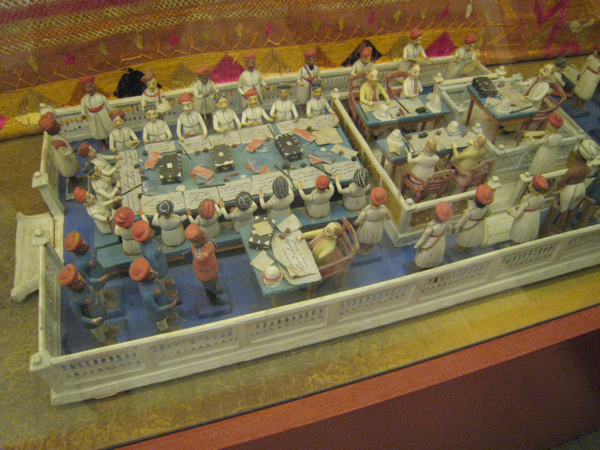
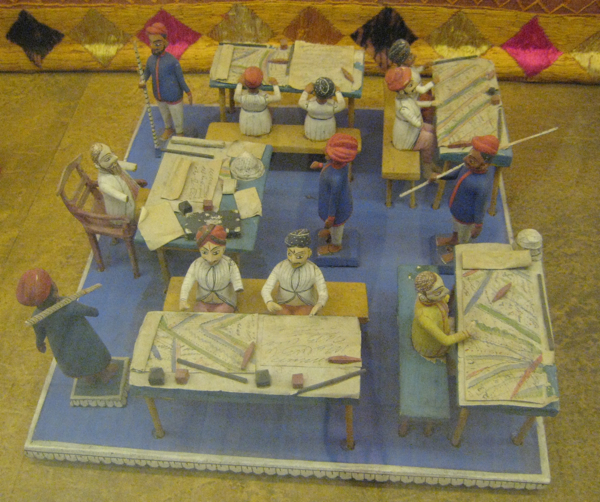
The catalog inadequately explained that they are from Bengal, and represent scenes of the workings of the British empire – intended as educational toys, perhaps to show Bengali children the (limited) jobs that would be available to them in the British bureaucracy.

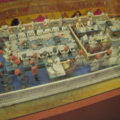
At the top of the page you can see a higher court in full session. Aren’t these guys wonderful? Look at the detail of their moustaches and beards, and the little white pith helmets on the table.

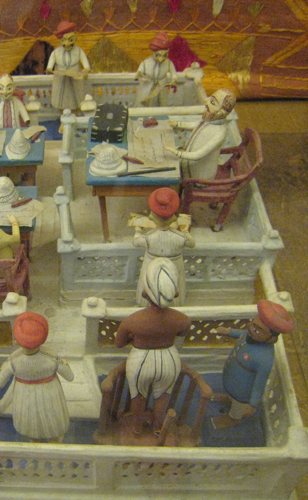
Below is a detail showing the British judge in his white jacket, with the plaintiff in the white dhoti and turban in the foreground, under the watchful gaze of a guard in blue.

2007 08 19 090

Below, I think, is a low-level magistrate’s office with a “native” judge. I’m guessing from their loincloths and hairstyle that the plaintiffs are tribal people.

2007 08 19 087


2007 08 19 088

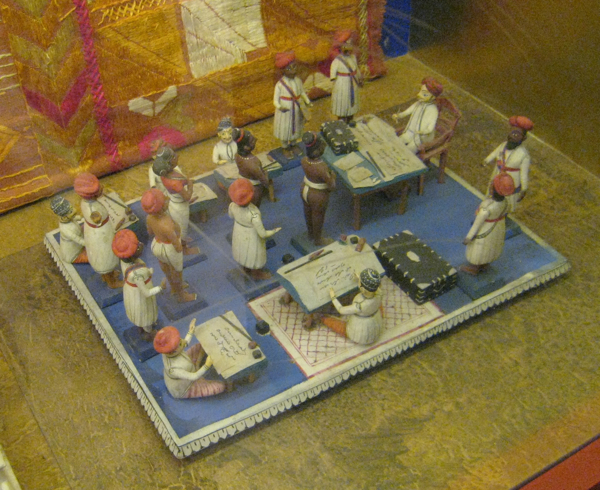
^ Here’s a surveyor’s office, everyone busily drawing maps – except their British supervisor (who appears to be a close relative of the judge). There’s even a guy with a rod, ready to go out and take more measurements.

The Silent Screams of Dying Trees

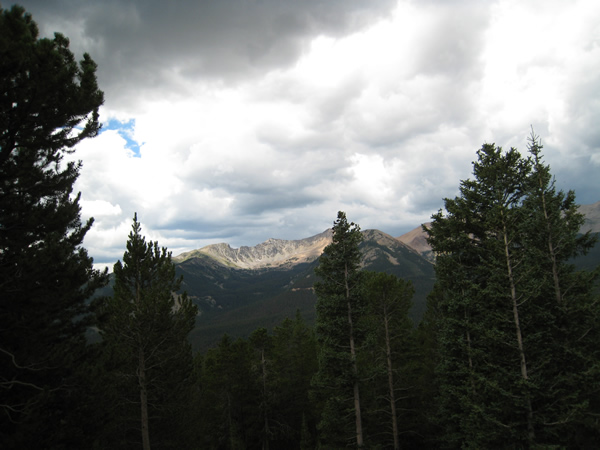
Last Sunday Tin Tin and I went to Rocky Mountain National Park. It was a beautiful drive from Boulder, through Estes Park (which is a town, not a park) and on up – and up, and up. At its highest point, the Trail Ridge Road is something over 12,000 feet in altitude (and, obviously, closed by snow for much of the year). On this particular day, the last Sunday before school starts in this area, it was also very crowded – we gave up on the Alpine information center because the parking lot was full.
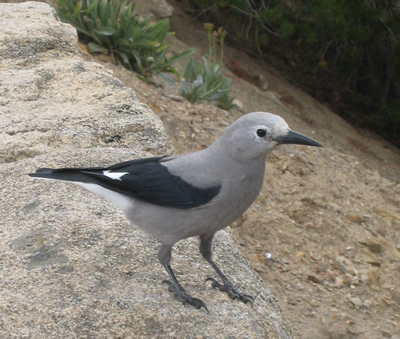
Clark's Nuthatch
< This cheeky fellow came very close, hoping for a handout of trail mix – not likely to happen, given all the dire warnings posted about feeding the animals and the presence of a park ranger six feet away!

We continued down the other side of the Continental Divide to Grand Lake, then doubled back into the park to take a walk which, according to the guidebook, was supposed to be “easy.” (More on that later.)

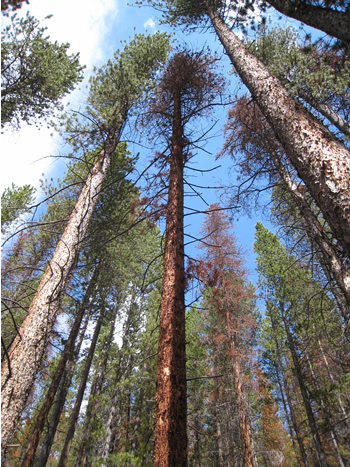
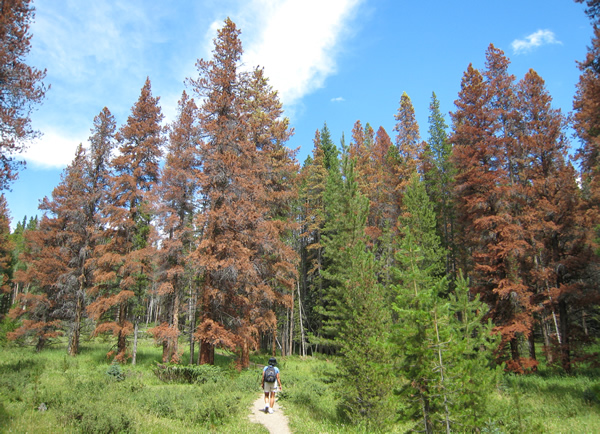
I’d just heard about the havoc being wreaked by mountain pine beetles: my friend Sharon, with whom I had dinner in Boulder a few days ago, had seen huge swathes of destruction on her drive up from New Mexico (and had overheard a tourist ask a park ranger: “Where can I get one of those pretty red trees?”).

We saw some evidence of damage on the eastern side of the range, but far, far more on the western side:
trees looking up
Tin Tin and trees

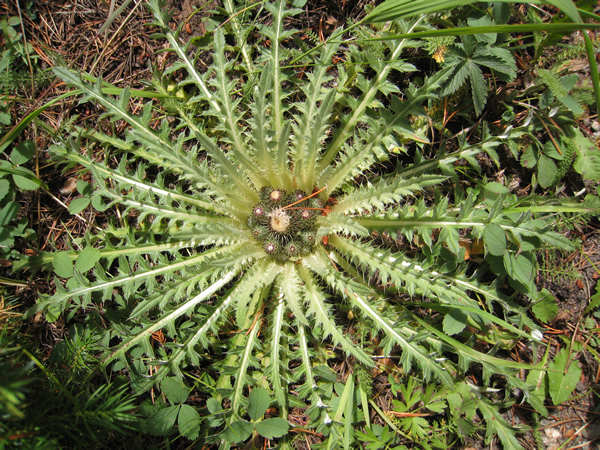
Shorter forms of life, meanwhile, are thriving:

thistle

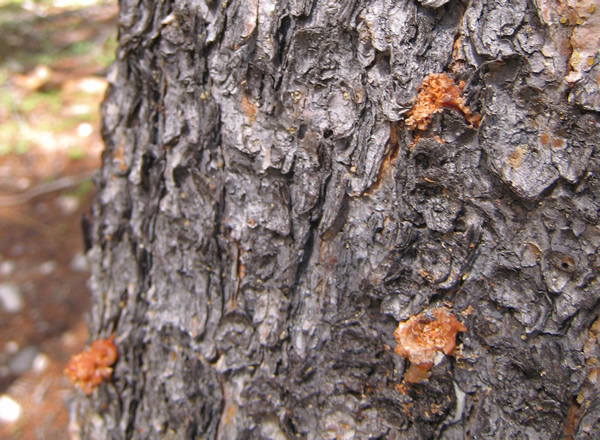
gray bark with borer damage

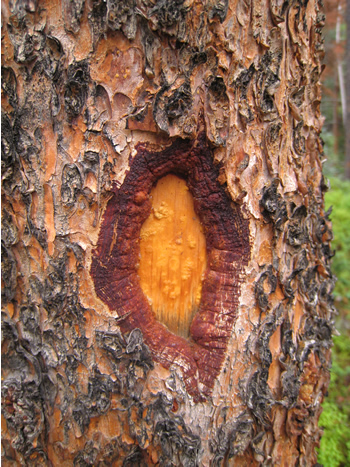
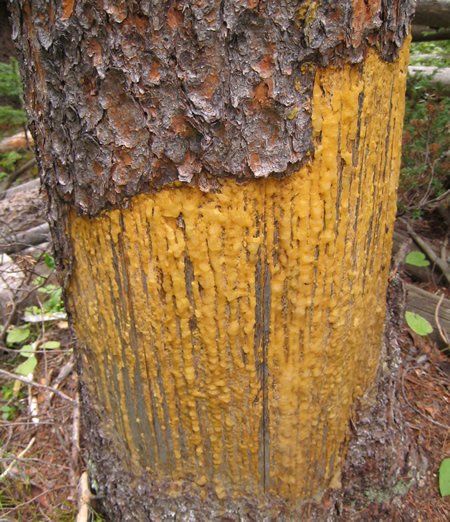
The tree above has been recently attacked by beetles: the blobs of sap show where they tunneled in to lay their eggs. Healthy trees can produce enough sap to overwhelm a few beetles and drive them off, but these trees are weakened by prolonged drought, and in the last few years the region has not seen the sustained bitter winter temperatures needed to kill eggs and larvae already inside the trees.
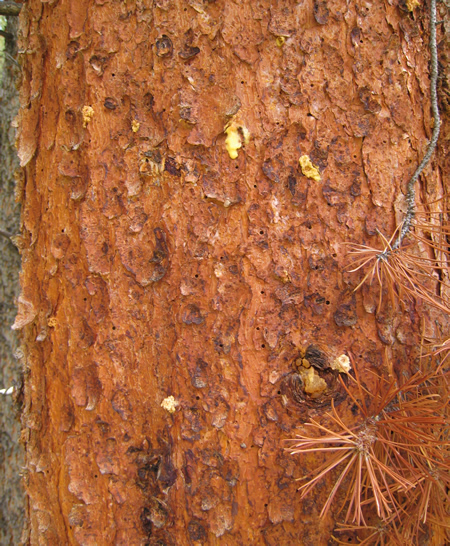
red bark from borer damage
^ This tree is much closer to death, hence the red color (and many, many holes).

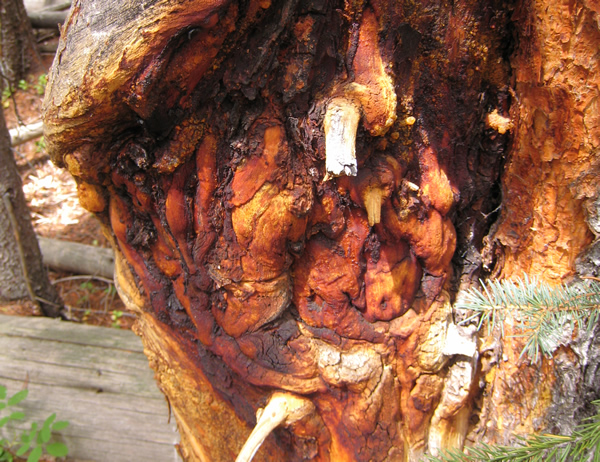
^ I don’t know what caused this, but it’s sort of pretty, though probably a bad sign for the tree.
drip
< Dunno what caused this, either. Possibly the bark was stripped off by rangers investigating the infestation.

^ …and this one’s not beetle-related, but just plain scary!

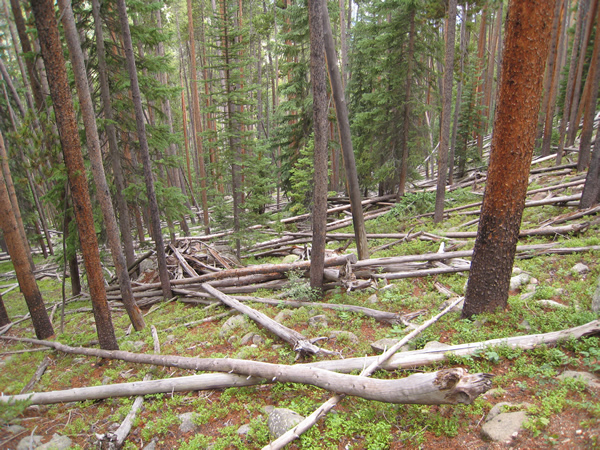
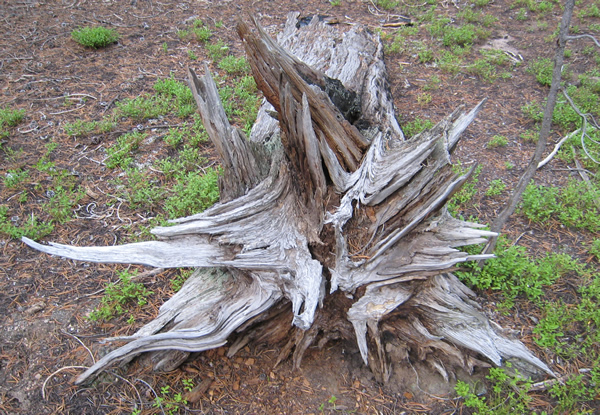
This beetle attack has been going on for years, and many trees have fallen. By some estimates, 90% of Colorado’s lodgepole pines will be lost before this is over.

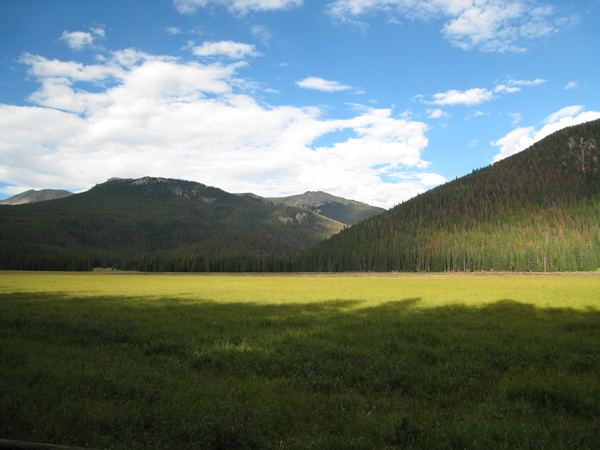
Of course there is still great beauty in the park, and always will be. Some areas are relatively untouched for now.

^ But reminders of tree death are everywhere.

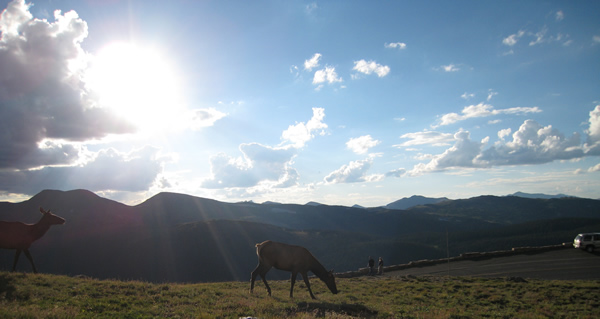
Apparently the increased sunlight to the forest floor improves the forage for elk, who certainly seem to be thriving – and completely unafraid of all the humans stopping to take pictures of them.

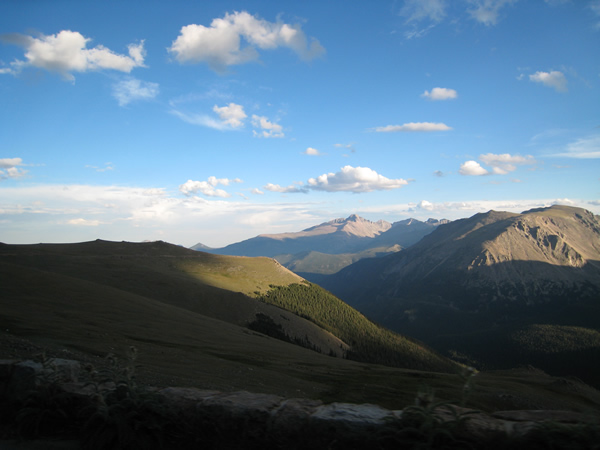
^ This was taken back on Trail Ridge Road, above the tree line, as we returned home in the evening. Very reminiscent of the high Alpine terrain in many parts of Italy – but this is higher.As for our hike… it took us three and a half hours to cover six and a half miles – not “easy” by any definition of mine! My knees and hips were screaming, although, fortunately, the steeper path was on the way up.On the way home we stopped in Estes Park for dinner. I had buffalo burger – bison is ranched for meat in this area, and widely available, even in the Sun cafeteria. It’s a flavorful meat, and supposedly healthier than cow beef. We also had a couple of excellent local wheat beer micro-brews.