Category Archives: Italian food

Winetasting – Valtellina Reds

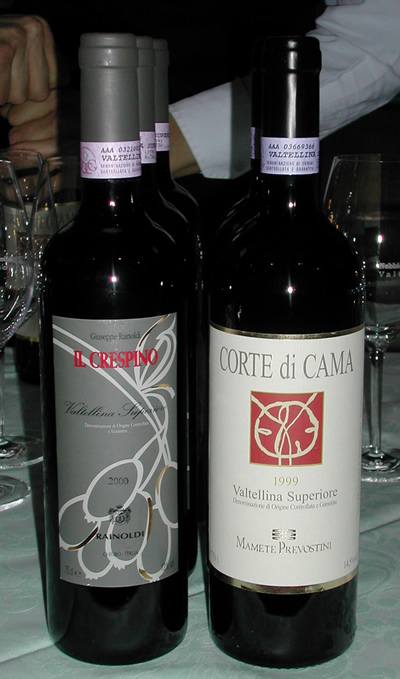
Back in February, we were invited (as Slow Food members) to attend a presentation of Valtellina wines in nearby Erba. Since we moved to Lecco, we’ve missed out on all the Milan Slow Food events, and there haven’t been many here in our area, so we were happy to go to this one even though we already know quite a few Valtellina wines – they have been our favorites for some years.

This event was a wine tasting plus dinner, at a cost of around 45 euros each if I recall correctly. Which turned out to be cheap, considering that we got a six-course meal and all the wine we could drink.

We came in towards the end of the press conference/discussion, which had about 50 attendees, most of whom seemed to be the wine producers themselves, plus a few journalists and critics who already knew Valtellina and its wines very well – very much preaching to the choir. If they really want to get these wines noticed and appreciated elsewhere, they are going to have to work harder to get the non-believers to attend their events. Amusingly, just because we were there, people seemed to assume that we were somehow involved in the industry. Enrico tried to use this to scam some free wine glasses from the head of the Triacca winery, but we never received them.

When the conference ended, we went to the reception area, where a long table was set out with about 30 different Valtellina wines, and very attentive young waiters pouring them. We could taste any or all, and between the two of us managed to get through most of them – on empty stomachs. So you’ll forgive me if I don’t remember much about the dinner!

This event happened to be the last of RistorExpo, which we had not attended – from what we saw as we passed through the expo area, next year we will definitely have to go. There had been other dinners and tastings in connection with the expo that I’m now sorry we missed. Chefs had come from other parts of Italy for some of these, so I got to chatting with a guy from New York, working at one of the famous restaurants in Tuscany, along with his delightfully extroverted Tuscan boss. We’ll have to check out that restaurant sometime.
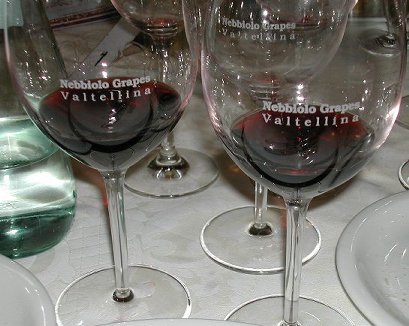
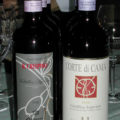
Nebbiolo Grapes - Valtellina wines At the dining tables, when we eventually reached them, each place was set with six wine glasses. We were twelve to a table, with one wine producer at each. Ours was Elena Fay, who unfortunately was sitting across the very broad round table from me, so I didn’t get to hear much of what she said. Another person at our table was a wineseller in a small town further up the lake.

As the glasses imply, Valtellina wines are made from the Nebbiolo grape, which is also the basis of many Piemontese wines. I’m not a wine expert, but I do love these rich reds, especially the Sfursat that I have written of before. Our favorite, the Cinque Stelle from Negri, has become better-known in recent years, and is now priced out of our range except for very special occasions.

Dinner was the joint effort of chefs from two different Valtellina restaurants, one of which was Il Cantinone. The dinner was so good that we went to the restaurant on another occasion, when we happened to be in Madesimo, and ate extremely well. It’s a member of the Ristoranti del Buon Ricordo group.

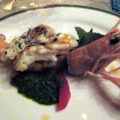
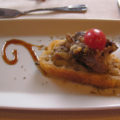
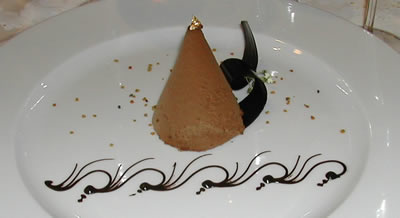
As I said, I don’t remember much about the dinner, except that it was delicious – part of the reason I’m not very good at writing descriptions of the food is that I frequently don’t remember it very well the next day! I did have the presence of mind to take a picture of the lovely dessert.
Macelleria Falorni: A Long-Standing Tradition in Greve del Chianti

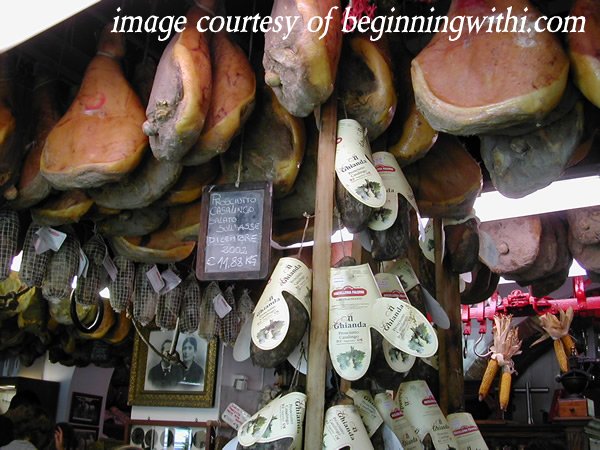
above: prosciutto and salumi, Macelleria Falorni, Greve del Chianti, Tuscany

In late July, we took a brief trip through the Chianti area, visiting our friends Rita and Lino. They live near Greve, so we visited that charming town (touristy, but tastefully so) and the famous Macelleria (butcher)Falorni.

Falorni make their own insaccati (preserved meats), such as the prosciutto (ham) and Il Ghianda (something I’d never heard of – must be native to Tuscany) that you can see here. Some of the pork products are made from the cinghiale (wild boar), others from Cinta Senese, a breed of pigs native to Tuscany.

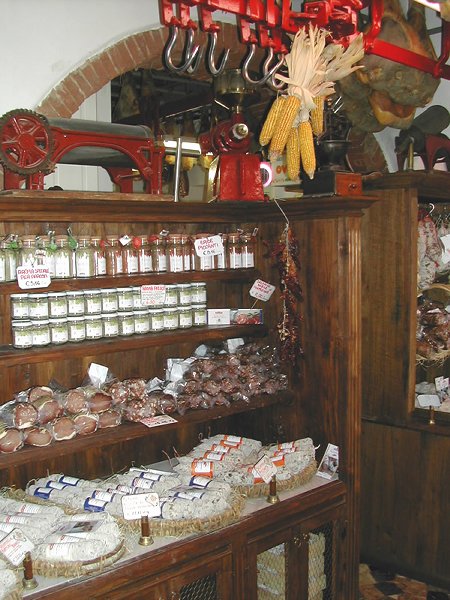
salame and canned goods,  Macelleria Falorni, Greve del Chianti, Tuscany

They also sell cheeses and yummy stuff in jars, and the shop is liberally adorned with farm implements, old photographs, signs, etc.

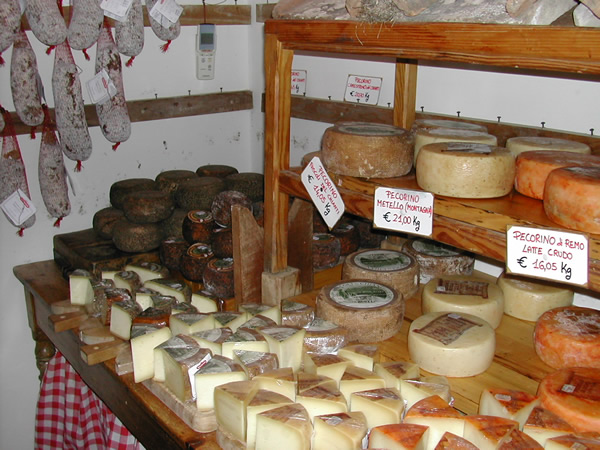
cheeses and salami,  Macelleria Falorni, Greve del Chianti, Tuscany

What photographs cannot capture, alas, is the smell! The scent of spicy, salty preserved pork is wonderful and overwhelming – vegetarians are advised to stay well clear.

Birthday Lunch at Lanterna Verde

Last Saturday we went to La Lanterna Verde, one of our favorite restaurants in the world, for the now-traditional celebration of Ross’ and Alice’s birthdays. Last year there were 11 of us, this year 10. The owners have become fond of us, though they’d like to see us more often!

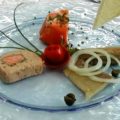
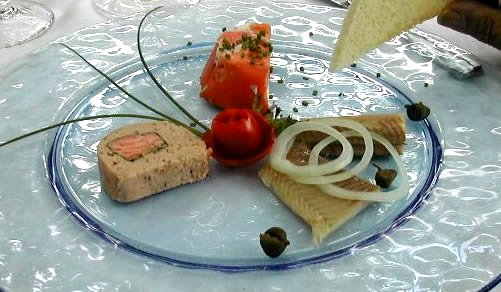
Most of us had set menus, there were six or so to choose from. Graziella had the trout meal, so her antipasto was a salmon trout mousse, ricotta (I think) wrapped in salmon trout carpaccio, and smoked trout.

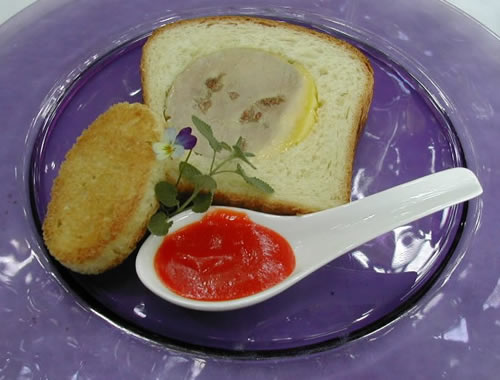
I ordered a la’ carte, and for antipasto had paté, which had figs inside and came with a sweet red pepper coulis. I actually preferred the red onion coulis they used to make – I think it’s a better complement to the paté.

paté

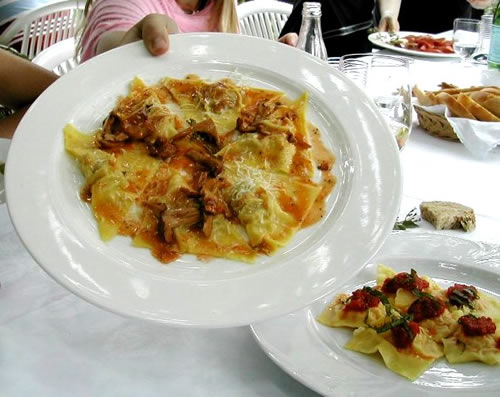
Here are a couple of primi (first course dishes): in the foreground, mushroom-filled ravioli with a chanterelle sauce and, behind, trout-stuffed ravioli with tomato and basil. This was part of the summer menu, spaghetti with a sauce of raw tomatoes, black olives, and very good olive oil.

mushroom ravioli at Lanterna Verde

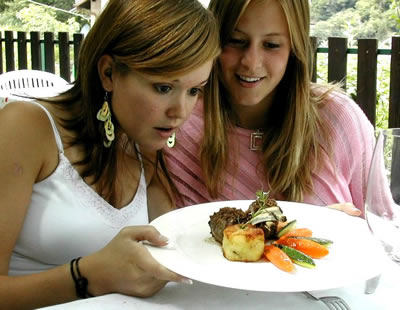
Ross and Alice in awe of Ross’ main course, I think it was lamb ribs crusted in pepper. I got distracted with eating and forgot to photograph the other main courses (we had had quite a bit of wine by then, too!).

secondo

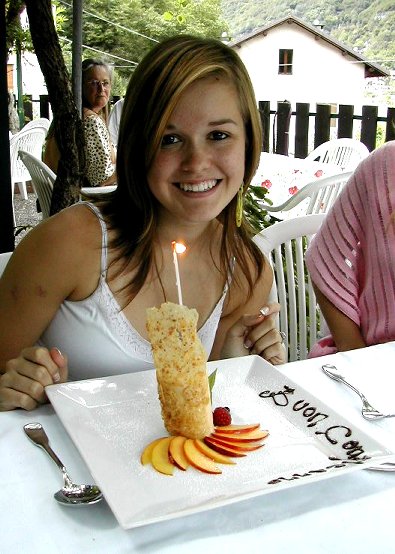
For dessert, the chef decorated the plates of our three birthday people (David and Ross share a birthday) with “Buon Compleanno” or “Auguri” in chocolate sauce.

birthday dessert

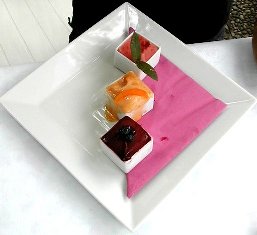
Julian had the palette of sherbets, here it doesn’t look quite as elegant as when they brought it to the table, as he had already started on it before I got this photo.

sorbet trio

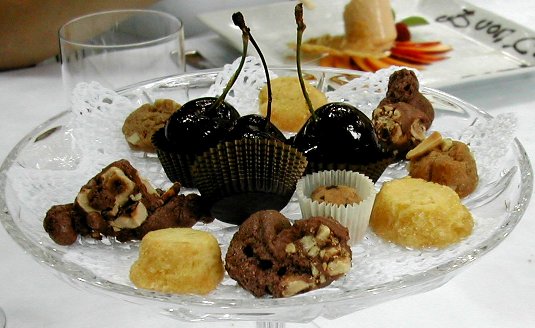
With coffee, they served these little trays of nibbles. The candy-coated cherries were amazing – a light, smooth coating of caramel on the outside, perfect sweet dark cherries on the inside.
cherries and nibbles

We like to go to Lanterna Verde during the day, because the drive up there is so pretty (it’s on the road from Chiavenna to St. Moritz, high in the Alps), and in good weather you can sit out under the pergola and enjoy a view of waterfalls on the other side of the valley.

Italian Recipes: Pasta with Red Bell Peppers

I love to cook, but I hate having to decide what to cook, so I usually make meals based on whatever I happen to have around that needs to be used, or whatever looks good at the fruttivendolo (greengrocer), butcher, supermarket, etc. that day.

Last night I hadn’t done much shopping, but had on hand:

  • one sweet red bell pepper, getting a little wrinkly
  • some vine-ripened plum tomatoes, a gift from my mother-in-law’s neighbor in Abruzzo, brought up when she came to visit last week
  • lots of red onions (almost always to be found in my fridge – I rarely use any other kind, except green ones in Asian cooking and salads)

So… let’s make a meal.

I diced up the pepper and some onion and garlic, put all that to sauté in some peppered olive oil (home-made – just add red pepper flakes and/or whole red hot peppers to a jar of good oil). I scalded the tomatoes, cooled them, slipped off the skins, diced them (removing some of the seeds, though there aren’t many in this type), and added those to the pot. A few grinds of mixed peppercorns, half a teaspoon of vegetable broth granules, and a cup or so of red wine (what was left in one of the open bottles).

I let this cook over a low flame for half an hour or so, going in to stir occasionally while I was doing other things at the computer. On impulse, I added a handful of raisins to the sauce, and later about two tablespoons of butter, to reduce the acidity and give the sauce more body.

When Ross got back from riding, I put on the water for pasta. Since this was a fairly wet sauce, I used spaghetti alla chitarra all’uovo from deCecco – egg pasta soaks up a lot of juice.

Cook, drain, and shake out the pasta, throw it it in a bowl and mix it with the sauce. I grated some aged ricotta into my dish (Ross doesn’t like most cheese, and was happy without it), which went well and added protein to the meal. Ross had the remains of a small salame. We mopped our plates with bread.

Today I bought eggplant and green beans. Hmm. What shall I do with those?

The Family That Eats Together

The other night I attended a party of Americans, with their Italian significant others and families. One American remarked that the kids present were amazingly polite, well-spoken, and self-possessed, compared with American kids of the same ages. He was right, but I hadn’t particularly noticed, because it’s what I’ve grown to expect.

I have written before about the brattiness of many young Italian kids, but I have also long observed that, by the time they reach puberty, most Italian kids are very civilized in adult company and can hold their own in adult conversations. This seems to be achieved without much discipline when the kids are younger, a noticeable difference from the US, where I have seen parents literally beating young kids into submission, and yet those same kids are not much fun to have dinner with when they’re teenagers.

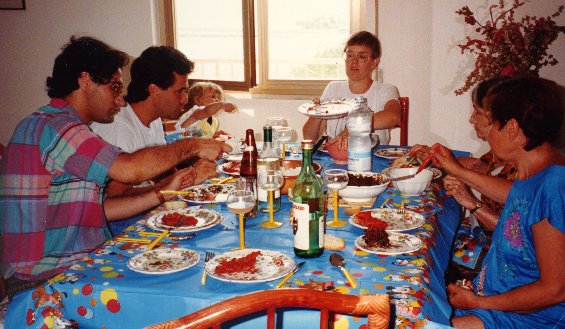
It seems that Italian families work more by example than overt discipline. Most families have at least one meal together a day, usually a leisurely one. With so much exposure to adult company, the kids naturally absorb good table manners, conversation skills, and healthy eating habits (assuming that those things are present in the family, as they usually are).

Kids also learn at home to drink like responsible adults. It’s very normal to begin sampling wine with meals from an early age, and even to be offered it in restaurants (if the parents are drinking any) from age 13 or so. By law, kids can drink in bars or buy alcohol from age 16; it’s not unusual for high school kids to spend a Saturday evening hanging out in a bar drinking beer, just like college kids do in the States.

In spite of the easy availability, most Italian young people don’t binge drink the way Americans do – partly, I suspect, because it doesn’t carry the thrill of illicit behavior. So you rarely see anyone, young or old, drunk in public – that’s not considered cool in Italy, even among teenagers.

related article: The Family That Eats (and Drinks, and Talks) Together