Category Archives: living in Italy

Living in Italy Isn’t Everything

Many people would consider me to have the best of all possible worlds: I live in Italy, after all.

In 1995, Adaptec bought Incat Systems, the small Italian software company I was working for, and I was part of the package. I wanted to become a regular employee of Adaptec, though at a distance, since I was by then working from home with quarterly trips to the US office. The idea was radical (for Adaptec at that time, anyway), and they refused; as long as I remained in Italy, they would hire me only as a consultant at an hourly rate. It was a high rate, no complaints there, but I wasn’t a regular employee.

I happened to be at the US office when the sale was completed, so I was able to lose this fight in person, at least. We were all called in for a meeting with Adaptec HR people to explain the company benefits etc., none of which applied to me. After the official presentations, I was chatting with one of the HR people. I mentioned, wistfully, that I would have preferred to be a regular employee. “But this way you get to live in Italy,” she said. Well, yes, but it would be nice to have regular employee benefits (paid vacation, sick leave). “But you get to live in Italy!” she said.

Clearly, she dreamed of living in Italy. Many people do. Funny thing is, I never did. Until I met Enrico, I had barely even visited Europe, and never Italy. It just wasn’t on my radar screen; if I thought about my future at all, I assumed that I would somehow end up in Asia – seemed logical, given my personal history and my college degree in Asian Studies. Had I been actively seeking a husband, it wouldn’t have occurred to me to look for an Italian mathematician.

But there he was, and here we are. He claims that we could have ended up in the US: he could have looked for teaching positions there after graduate school, had the job market been better. I don’t remember ever expecting to stay in the US; perhaps I knew earlier than he did that it was inevitable we would live in Italy. When I bought my first (and only) car, I bought it with a manual transmission, knowing that almost all cars in Italy are manual, and assuming that I should keep in practice against the day.

In any event, Enrico landed a teaching position in Italy while still finishing his PhD, and any ideas of moving back to the States (for more than a sabbatical year or so) never went beyond the discussion stage. Nowadays it’s no longer even discussed; we’re here for the duration.

I don’t miss the US; didn’t have strong ties to it to begin with. Being a third-culture kid, I find it easier to live overseas, where I am “out” as an immigrant, than in the US, where people assume that I’m a native, then are baffled and resentful when I don’t behave quite the way they expect me to.

Italy for me is a happy medium, with all the comforts of developed countries (and then some), but just enough chaos, history, and cultural depth, to keep my interest. Italians are even quite like Indians in some ways, though many Italians would be horrified to hear me say so.

Zod knows there’s little to hate about living in Italy. I write (extensively) about the follies and foibles of life here, but, overall, it’s a damn comfortable life. Thanks to my husband and his family, I live in a very nice home and have few financial worries (though I do need to find some paying work…). I can concentrate on raising a daughter – a complex, demanding, and fascinating task, and the most important one of my life. I look out my windows and see mountains. I go into my huge new kitchen and cook wonderful food. We go on trips, we have friends, life is beautiful.

So what’s missing?

Italy is gorgeous and wonderful and all that, wouldn’t trade it for the world. But it isn’t the world. There’s a whole world of other countries out there, most of them equally full of interesting people, cultures, history, foods, etc. Why limit myself to just one? There are so many places I still want to visit (Australia, New Zealand), and others, especially India, that I want to visit some more. I’ve been able to do some non-US travelling in recent years, just enough to keep my feet from itching too much. When you’ve spent your formative years all over the place, settling down anywhere, no matter how wonderful, is very hard.

So I don’t expect this settled phase to last much beyond my daughter’s reaching adulthood. I’ll keep Italy as a home base, but I’ll need to get out, way out, sometimes.

Funny thing is, my daughter, who has had a very stable home life in Milan for 12 years (we’ve just moved 50 km to Lecco), also can’t wait to get out. “I’m not staying in Italy when I’m grown up,” she says. “It’s boring.”

Changing Names: Italian Women Keep Their Own Upon Marriage

Women in Italy don’t change their names when they marry. In the US this is the norm; most women when they marry change their surname to their husband’s, and there are simple, routine procedures in place for them to do so. It’s so usual that Americans are confused if you don’t do it. Years ago I asked the Adaptec travel service to reserve airline tickets for myself and my family, and ended up with tickets for “Mr. and Mrs. Straughan.”

Some American women don’t change their names, often for professional reasons, sometimes for political ones. Some couples hyphenate their two last names and give that as a last name to the kids. I always wondered what would happen if two such children decided to marry: would they create a quadruple surname?

In Italy, as far as I know, there is no legal procedure by which a woman could change her surname to her husband’s, even if she wanted to. In every context except the family, you’re still known by your own name, which saves headaches and maintains continuity on the professional front. Every doorbell has both names on it. On the other hand, the kids almost always get their father’s name, and it’s perfectly natural and normal to be called “Mrs. So-and-so” in some settings, such as your child’s school (perhaps simply because it’s easier for the teacher to remember).

Enrico and I got married in the US, but I never got around to changing my name, and neither of us gave it much thought. To the extent that I thought about it, I had spent so many hours of my life explaining both my names that I was perversely reluctant to give up the struggle.

I didn’t initially realize that women don’t change their names in Italy. When I began publishing articles in Italian magazines, I thought that my husband’s name might be easier for Italians to deal with. However, his great-grandfather was Swiss, so his name is neither Italian nor entirely easy, and I ended up spending almost as much time explaining that one as Straughan. And I didn’t like the look of it alongside Deirdré in print. So I switched back to Straughan, and have articles published under both names. The book was published under my own name (and Fabrizio’s).

Jan 10, 2004

The above sparked some responses. It seems that American women (and even one man friend of mine) change their names so that the whole family will have the same last name, though this desire is often complicated by multiple marriages with kids from various pairings. One friend told me about a couple she knows who wanted to share a last name in an equitable fashion, so they made one up, combining elements of each of their original surnames.

I’ve also known cases where women were glad upon marriage to give up an unappealing surname, and I had several responses were about that:

Sally: “I can think of lots of English names I would want to change. .. like Bosomworth, Ramsbottom, Drain. One girl I know refused to marry Ted unless he changed his name from Tiplady.”

And Judith: “I would change my name IF I thought my new husband’s surname better than my current one. One English girlfriend gave up ‘Loutit’ on marriage for the much more glamourous French ‘Dubresson’ – she was thrilled!”

Housing: How Italians Live

During my July trip to the US, I stayed with friends in different cities and types of homes, giving me fodder for reflection on differences in customs, styles, and expectations for housing in the US and Italy.

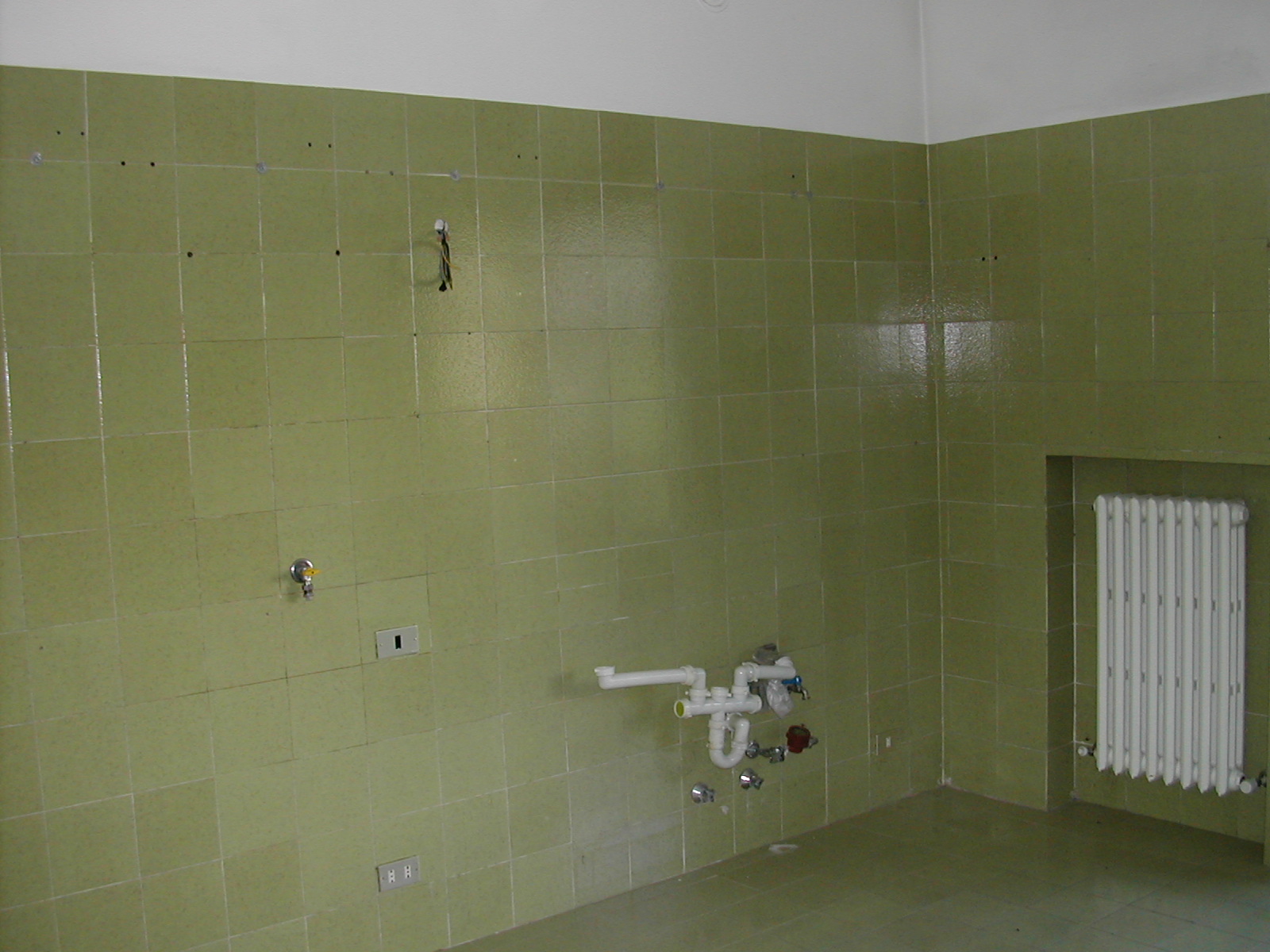
As I have mentioned before, renting an unfurnished apartment in Italy means completely unfurnished, so for our new home in Lecco we’ve had to put in a kitchen (including the sink) and all the appliances. (A friend here told me that she once looked at a place to rent which didn’t even have toilets!)

Appliances are different here. Refrigerators are smaller. Traditionally, Italian mammas shop for fresh food daily, so don’t need as much storage space for perishables, although the trend nowadays is to less-frequent visits to larger supermarkets, which leads to larger fridges.

In Italy, almost everyone has a (clothes) washing machine in their home, often installed in the kitchen or a bathroom (our second bathroom has a special washer-sized alcove, with pipes). In the US you’ll find shared, coin-operated machines in the basements of some apartment/condo buildings, but I’ve never seen this in Italy. Coin-operated storefront laundromats are a recent phenomenon here, and probably exist only in the big cities.

With an Italian home washing machine, a single load of laundry can take two hours, depending on the water temperature you select, because the washers heat their own water. This makes sense, since many homes have only one small, electric boiler to heat water for the shower and kitchen.

Most Italians don’t have clothes dryers. They are available, but, given the cost of electricity here (twice what Americans pay), a dryer would be very expensive to run. And dryers are bad for natural-fiber clothing – I much prefer line drying. We have a large drying rack out on the balcony which gets sun every afternoon, so things dry quickly. In winter, the trick is to hang wet clothes on or near the radiators, which humidifies the air as well as drying the clothes. In Milan I had mini drying racks designed to hang on the radiators. (In Switzerland, there is a communal drying area in the basement of some buildings. I don’t think Italians trust each other enough for that.)

Plugging in appliances can be a challenge. There are three types of electrical outlets in current use in Italy, plus one weird one that apparently enjoyed only brief popularity (I’ve only seen it in my in-laws’ former apartment in Rome). There are also variants on the two basic plugs, with or without grounding (many older buildings don’t have it, and it’s expensive to add). Aside from the grounding, it’s never been clear to me whether one type of outlet is safer or can carry more load than another. If you’ve got something that has to be plugged in at a particular spot and the plugs don’t match, you either use an adapter or change the plug on the appliance. There are never enough outlets in Italian homes; sometimes entire walls have no outlets, which can play havoc with room arrangements.

There never seems to be enough capacity, either. My in-laws’ Rome apartment was big, but very inadequately wired; you could never have two major appliances on at the same time. At night we always had to think about which bathroom water heater was already heated up and which needed to be turned on in preparation for morning showers; everything else had to be turned off before running the dishwasher, otherwise the fuses would trip and we’d have fumble our way down to the basement in the dark to turn the power back on. Here in Lecco, I’ve discovered, I can’t run the dishwasher and washing machine at the same time (this wasn’t an issue in Milan; our kitchen was too small to hold a dishwasher).

Homes are constructed differently, too. Basic building materials in Italy are concrete, brick, and sometimes stone. In the mountains, some houses are chalet-style, made of thick wooden planks. In the US, most modern houses are wood framed, with wooden or aluminum siding or stucco outside, and sheetrock inside. By European standards, they’re flimsy, and they catch fire easily. Fire trucks screaming down the street are a common sight in the US; in Europe, they’re rare. The few city fires I’ve heard of in Italy were in factories, though we do have a big problem with forest fires in the summer.

Feeling the Seasons in Italy

First week in August, and most of Italy is shutting down, except the beaches and some mountain resorts, which are booming with Italian vacationers. The cities will be largely left to foreign tourists and those who serve them. Kids are off school from mid-June to mid-September, and many adults take off all or most of August.

You might think this an example of “typical” Italian laziness, but the situation down here on the ground makes it clear: it’s too darn hot. In the afternoons, when it’s muggy and even the air is too hot to move, it’s simply impossible to concentrate, and all you want to do is sleep. No one can be expected to be productive; you might as well give in to Mother Nature and go on vacation.

It used to be that way in the US as well, until the invention of air-conditioning. I read somewhere that the pace of government picked up amazingly when A/C was introduced to muggy, swampy Washington.

But most of Italy is not air-conditioned. Except in some offices, I’ve never seen central A/C here the way it’s done in the US. Due to the high cost of electricity, not many families even have room air conditioners. During this June’s heat wave, so many rushed out to buy air conditioners that the national power grid couldn’t cope, and there were rolling blackouts.

Ourselves, we make do with fans, and I’ve become so unaccustomed to A/C that I’m always cold in the US. I prefer not being insulated away from the seasons, no matter how uncomfortable they sometimes get. Here in Lecco I’ve learned that there’s a wonderful breeze off the lake in the morning, so I get up early and open all the windows on the windward side of the house, cooling down and airing out the stuffiness of the night (when windows and shutters on the balcony side have to be closed, for fear of burglars). Around noon I’ll close it all up, to retain the cool when the sun moves around to that side and only hot air blows in. And then I’ll take a nap.


Getting Connected – Frustrations with Internet Service in Italy

Two months back, I wrote about the pleasant surprise of finding Telecom Italia easier to deal with than they’d ever been before. Well, “easier” is a relative term. The phone line did get turned on immediately and all the plugs are working. The first bill also arrived immediately, and was twice what it should have been; they had forgotten to give us the discount for rolling over service from Milan to Lecco. So I had to call and straighten that out – strike one for Telecom.

I had also ordered “Alice Flash Mega,” Telecom’s top of the line ADSL Internet service, which would include a wireless router to network the family laptops to my big Dell desktop machine, so we could all be online simultaneously (increasingly an issue in this family). Obviously, this couldn’t be done until the phone line was installed, and I wasn’t in a hurry since I would be travelling; what little time I was home, I could limp along with a dial-up connection (these are offered free in Italy, since we pay by the minute even for local calls).

I planned to call Telecom and remind them once I got home, but, to my surprise, the modem was waiting for me when I arrived. The first part of the instructions actually reflected reality, so I was able to get the hardware and software working very easily. I stalled where the instructions referred to a username and password that I would need to connect; none were included in the box. I figured I would have to call Telecom on Monday.

However, when I fired up the Dell on Sunday to do some non-Internet things, Windows XP informed me that my modem was connected at 831 kbps. I supposed it had to be connected to something, so I opened Internet Explorer, and was taken immediately to a sign-up page for Alice, where I was able to make up my own username and password. I was then presented with “Alice’s Room,” where I could get into some cute services like online TV, or just go straight onto the ‘net.

This Dell had never been online before (I long ago gave up the struggle to get my previous service’s ADSL modem to work under Windows XP), so I spent the rest of Sunday preparing it to face the Internet. The steps included:

  • An hour or so of Windows XP security updates.
  • AVG Anti-Virus; I’ve been using the free edition for over a year, and it seems to be effective.
  • Zone Alarm (Basic edition, also free); this is a basic, fairly simply to use firewall. Once installed, you’ll be amazed (and probably alarmed) at just how often strangers come knocking at the “door,” looking for something left open so they can come in and mess up your computer home. Or steal your data. If you keep sensitive personal data on an Internet-connected computer, especially financial data such as credit card numbers, you should be paranoid, and you should have a firewall.
  • Ad-Aware. Cleans out the tracking software installed (silently) by many websites – it’s nobody’s business what I’m doing online, least of all the advertisers’.
  • The Google toolbar, which adds Google search right into the Internet Explorer toolbar (I can’t live without this now). The new 2.0 version is currently in beta testing, and includes pop-up blocking.
  • After installing everything, I went to <http://www.grc.com/> and used Steve Gibson’s Shields Up! to see whether my computer was leaking anything to the outside world. So far, it doesn’t seem to be. NB: The GRC site is somewhat intimidating and confusing, but worth the effort to understand what’s going on, so that you can ensure that your computer (and all the data in it) is closed off to hackers.

I called Telecom Italia on Tuesday to find out when to expect the network router. Turns out they had screwed up the order and given me the most basic ADSL service, which doesn’t include networking. Strike two for Telecom. So I had to put in an upgrade request, and am now awaiting a call (“within 10 days”) from the technician who is supposed to bring the network router and install it. Installation is included in the price, otherwise I’d just tell them to bring the router and let me deal with it. I have a feeling that the technician will do no better than I could myself, and a stronger feeling that I will have to upgrade the two laptops to Windows XP in order to get all the machines to talk to each other; I had a terrible time trying to do it with a regular, wired network, and gave up in the end.

I’m also waiting for another technician to come and check the line, which is very noisy when the modem’s attached, even with the ADSL filters on the phone plugs. Not supposed to be that way. Strike three for Telecom. Oh, well. At least so far I haven’t needed a bottle of whiskey.

(later on, I needed it. Read the full Telecom Italia saga)