Category Archives: living in Italy

Generation Gap: Italy’s Ageing Population

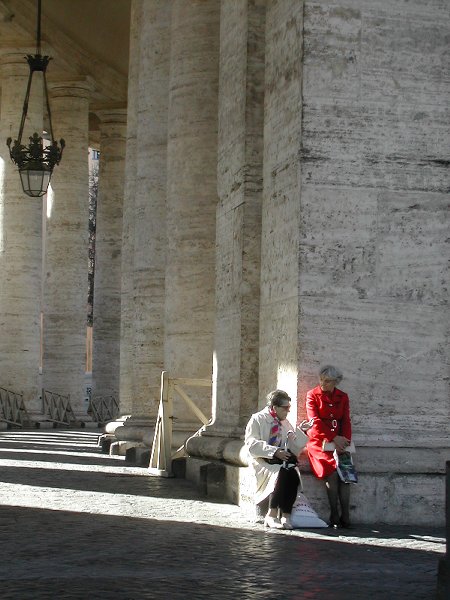
One aspect of Milan I’m really tired of is that it seems so old. Europe’s population in general is ageing, but the average in Milan seems to be even older, though I don’t know why that should be. Surely they could find some cheaper and more congenial place to retire. New Yorkers retire to Florida to get away from cold winters, icy sidewalks, and a fast-paced life that has no time for people who move slowly. Why don’t the Milanese?

Whatever the reason, there are a lot of old people in Milan. Nothing inherently wrong with that; some of my favorite people are a lot older than I am, and I count them as friends. But life in Milan must be harsh for the old, because most of them seem to be in eternally bad moods, always looking for something to complain about. This is so widespread that we notice any old person who actually looks happy. A few days ago, in the subway, Rossella and I saw an old couple smiling and laughing together. It was so unusual that it made our day.

Milan’s oldies seem especially to seek occasions to complain about the younger generations. A friend witnessed this scene:

An old man got onto a crowded bus. He planted himself in front of a young man wearing a workman’s coverall, who sprawled, exhausted, in a seat. The old man glared at him for some minutes, until a young woman nearby nervously offered him her seat.

“No,” said the old man, “I’m waiting for this jerk to get up and do the right thing.”

The younger man raised his eyes and said, “I just finished working for fourteen hours. You’re retired and haven’t done a damn thing all day. I’m not moving.”

Changing Places – Moving from Milan to Lecco

It’s a phenomenon familiar to people who have moved around a lot: when you’re about to leave a place, you are suddenly out of patience with it. Annoyances you’ve put up with for years loom large, and you count the days til you can get the hell out. This is a defense mechanism: by concentrating on what you dislike, you hope to lessen the pain of leaving the things and people you do like.

Thus with me and Milano at the moment. We’re getting ready to move to Lecco (a mid-sized town on Lake Como, not very far away), and I am at the end of my tether with everything Milanese. I’ve had enough of sidewalks used as dogs’ toilets, gypsy beggars who all whine the same tale with the same words and faux mispronunciations (I could recite it along with them), of nearly getting run over in crosswalks, of bitchy old ladies who bear a grudge against anyone younger than themselves. Most of all, I am tired of pollution and the respiratory problems that result; I hope Lecco will cure all that.

This move is different, though. I’ve been in Milan – in the same apartment! – more than twice as long as any previous place in my life. I now know what it’s like to be part of a neighborhood. The shopkeepers know my habits (odd American ones, such as making pot roast out of beef rather than veal), and will give me credit when I don’t have cash. They adore my constant striving to give them exact change, and always carrying a cloth shopping bag instead of taking plastic ones. The owner of the coffee bar downstairs frequently gives Rossella chocolates; in all these years, he never figured out that she always gives them away.

I will miss some favorite restaurants, where we’ve been regulars for years. I will miss knowing where to find things, especially things that are hard to get in Lecco, such as Indian spices, Basmati rice, and fresh coriander. I will miss being able to get almost everywhere I need to go by public transport – one of this summer’s ordeals will be
getting an Italian driver’s license
(and, believe me, it will be an ordeal). I will miss having many cinemas, theatres, and museums close by, even if we hardly ever go to them.

On the other hand, in Lecco we’ll be living three blocks from Lake Como, instead of three blocks from more gray squalor. We’ll be living in an apartment twice as large as our current three rooms, and I can finally have an office NOT in the bedroom. And a kitchen larger than one meter by two. Am I looking forward to the move? You bet.

What happened next

Making Friends in Italy

This question came up recently on one of the expats-in-Italy boards I hang out on (it had coincidentally already been on my mind): How do you make friends with Italians?

Although most of the Italians I’ve met are warm and friendly and great fun to have dinner with, I’m not sure that I have any really close Italian friends. There are Italians with whom I can enjoy a long chat when the occasion happens to arise, but no one I’d call up and pour out my heart to when I need an understanding ear. I do have friends like that, both in Italy and elsewhere, they just don’t happen to be Italians.

I’ve observed, over the years I’ve been here, that most Italians don’t make friends as easily as many Americans do. I think it’s a matter of practice. Many Americans move around a great deal (most within America, some outside), and have repeatedly faced the need to make new friends. When you move a lot, you learn to get to know people quickly.

Most Italians stay all their lives in the city of their birth (if they possibly can); some never even move out of their original neighborhood, though they may commute across town for work. Some commute between cities, working somewhere during the week and returning home on weekends. Some are forced to migrate for work, but still maintain strong ties with their paese, a word meaning both “town” and “nation” – which reflects Italy’s long history as a collection of separate city-states.

Hometown ties extend even to strangers. When we first moved to Italy, our car (donated by my husband’s parents) had a license plate from Teramo, a town in Abruzzo. We drove it to Milan for our first reconnaissance visit. Late at night, at a toll booth just outside the city, a man in a car beside us shouted excitedly: “Are you from Teramo? That’s where I’m from, but I live here. I’m in the Guardia di Finanza. If you ever need any help, just look me up!” (The Guardia di Finanza are the financial police, who investigate accounting frauds, tax evasion, etc. – I hope never to need him!)

Kids usually stay in the same school for the complete cycle at each level: five years of elementary school, three of middle school, and five of high school. As far as I can tell, Italians form their enduring friendships during their school years, and, even if they grow up to be very different from those friends in lifestyle, experiences, careers, etc., they don’t feel a strong need for new friendships in later life.

I just ran across an article in the International Herald Tribune which suggests that this is also true in other European cultures: “the therapist stated categorically that people just did not make friends any longer in middle age. That advice, suggested Draguns, reflects cultural traditions in Germany and the Netherlands, where people tend to limit their friends to those they made in school and to keep the same friends through old age…”

I’ll be curious to hear from my European readers about this, to agree or refute or expand. I wonder: do Europeans feel that American-style friendships are shallow, because they happen so quickly? Some undoubtedly are, but not all. Some of my closest friendships have been formed very quickly, often with other third-culture kids who feel the same need I do to find the right people and make friends quickly.

Update: A few years later I began meeting and hanging out with il popolo della rete – Italians who are active online – and then began to find like-minded Italians to be friends with.

What’s your experience of making friends in Italy?

Out Sick: Being Ill in Italy

You haven’t heard from me in a while (and I may not be very coherent today) because I’ve been seriously ill for two weeks now, with a lung infection that came on during a nasty flu. I’m now doing a course of injected antibiotics (the oral ones didn’t make a dent); let’s hope that works. I am really bored of being mostly in bed, though perhaps it’s fortunate that I’ve also been too tired to mind it too much.

This gives me occasion to reflect on something that works very well in Italy: the public health system. I don’t understand everything about it, and the details change from time to time, but here’s what it looks like from one patient’s perspective:

Continue reading Out Sick: Being Ill in Italy →

Is Football Worth It? The Cost of Stadium Violence in Europe

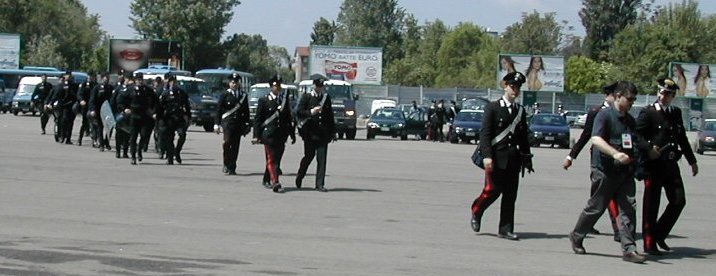
^ carabinieri arriving for a soccer match at Milan’s San Siro stadium

I used to believe that spectator sports were a way of channeling the mob’s inherent violence into vicarious forms of conflict. “Supporting” a team means joining a sort of artificial tribe, comprised of that team’s fans. You signal your membership in the tribe by wearing the team colors, chanting the team chant, and despising rival tribes. The teams on the field play out a ritualized battle in which one side wins and the other loses, with more or less actual violence and possibility of injury, depending on the sport.

Unfortunately, nowadays the tribes no longer leave the battle to the teams on the field. While in England for my MBA residential school, I had time one evening to do my usual hotel thing: flipping channels on the TV. One program showed a town’s preparations for a football (soccer) match. A trainload of fans were met at the station by mounted police in riot gear – even the horses had plastic shields over their eyes. The crowd was escorted off the train, with mounted police leading, and more walking alongside. The road from the station to the arena was lined on both sides with police, standing shoulder to shoulder in flourescent yellow jackets; the visiting fans had to walk straight along the road to the arena.

Inside the arena, a police chief remarked to the TV crew that there were 100 seats unsold for the match, so they would be able to create a buffer zone between the opposing fans. I didn’t stay with the program to see what happened, but later on saw footage of rowdy fans (faces electronically blotched out) being dragged away by police.

Some games in Milan involve similar preparations: busloads of police arrive well before the match begins, and are presumably dispersed throughout the stadium to maintain order. For games when certain nationalities of foreign fans are expected, the mayor orders all bars nearby not to serve beer after a certain time.

If I were a housebreaker, crime boss, etc., I’d be delighted to know that I could get on with my trade in peace during football games, when the bulk of a city’s police force are busy keeping the fans from killing each other.

However, I am only a taxpayer, wondering how much all this is costing me. Is football worth the cost to society, even for those who care about the sport? A few years ago, in an effort to curb stadium violence, the then-minister of sport in Italy threatened to have the games played in empty stadiums, viewable only on TV. How is it “sport” when we must go to such lengths to prevent the audience getting hurt?

The whole concept of “supporting a team” seems very artificial to me. I can understand rooting for one’s national team during the Olympics or the World Cup – at least you have a passport in common with them, and perhaps a language, culture, and history (although the increasing phenomenon of athletes migrating, to countries where they can be better supported for an Olympic bid, or get a spot on a less-exalted team, calls that into question). In a sense, you are cheering your country’s ability to produce good players – there are worse national traits to celebrate.

But it’s rare for a “local” professional football team to have a single player from the city that they supposedly represent – many of the players won’t even be from the same country. So, when we cheer for AC Milan, what are we applauding? Berlusconi’s ability to buy good players? Given the mysteries shrouding the origin of his personal fortune, this is not something that makes me cheerful. Still less do I feel that football is worth getting violent about, unless maybe I could beat up Berlusconi.


Feb 9, 2003

I wrote the above a few days ago, inspired by the TV show I saw in the UK. Today Milan’s two home teams, AC Milan and Inter, are playing each other in Milan’s famous San Siro stadium. We saw six large buses and assorted other vehicles full of police heading that way. Then, as we entered the metro station at Piazzale Lotto (closest stop to the stadium), we were suddenly confronted with several dozen riot-geared police. We had had the ill luck and bad timing to arrive just as a subway train pulled in, carrying fans of both teams. To avoid trouble, they had been put into separate cars, with police escort. The police cordoned off the station so that one group was forced to wait while the other group exited, each side singing rude songs and shouting slogans at the others. The rowdies were, predictably, young men, but the groups included women, and some confused and frightened looking children. The rest of us stood and waited until both packs of idiots had left the station.