Category Archives: living in Italy

Exact Change Required

One thing that baffles me about Italy is the inability of retail establishments – or anyone who has to take cash payment – to make change. This in a society where most store purchases are made in cash! Automatic teller machines give out 50,000 and 100,000 lire notes (NB: At current exchange rates, one US dollar is worth about 2100 lire), but this isn’t a factor; no matter what size bill you’ve got or what your total is, shopkeepers somehow never have enough coins and or smaller bills, or, when they have them, they don’t want you to use up the whole supply! You pull out your “large” note, and watch the cashier’s face fall as she or he plaintively asks: “You don’t have anything else?”

Lack of change usually isn’t a disaster – if one shopkeeper can’t do it, he or she will run and get change from a neighboring shop. Or, if you’re in a shop where they know you, they’ll say: “Pay me next time.” Amounts up to 200 lire are simply shrugged off by either party. (There were 10 and 20 lire coins – made of aluminum – in circulation when I first came to Italy, but no longer.) It can get problematic, however, if you take a taxi late at night (pay a taxi by credit card? Unheard of!) or are shopping in an unfamiliar place.

I have grown so accustomed to this that I routinely count out exact change, or as close as I can get, everywhere I shop. Italian shopkeepers are always grateful, and don’t flinch at the extra math involved in figuring out the difference between what I gave them and what I owe. But this behavior causes cashiers in the US to stare at me in resentful bafflement: they rarely deal in cash at all, and some have a hard time figuring out how much change to give.

Back in Italy, just think what fun we’ll have in January, when we all have to start using euros! The transition from lire to euros is supposed to take two months, but no one seems to know yet how it will occur. If I pay in lire, do I get euros in change? If so, some fancy calculating will be involved – the lire-to-euro rate is not a nice, round number (it’s 1936.27 lire to the euro). The wheels of commerce are likely to grind very slowly for a while…

Mar 15, 2007

As I revisit this topic, six years and a new currency later, not much has changed.We now pay in euros, and there’s been a huge upsurge in the popularity of credit cards, but making change is still a problem.

Just today I stopped at a small supermarket near the office to buy a few items, for a total of 6.87 euros. I’m always happy to clear heavy coins out of my purse, so, standing there right in front of the cashier, I opened my wallet, pulled out a five-euro note, and then opened the coin flap to see if I had enough change to make up the remaining 1.87. I didn’t – I was about 40 cents short. I shrugged apologetically, put the five away, and pulled out the next-smallest bill I had, which was a twenty.

The cashier’s face fell.

“Don’t you have anything else?” she asked mournfully. “Two euros? I’ve been making change all afternoon.”

Sweetie, you’re a cashier – surely that’s part of the job description?

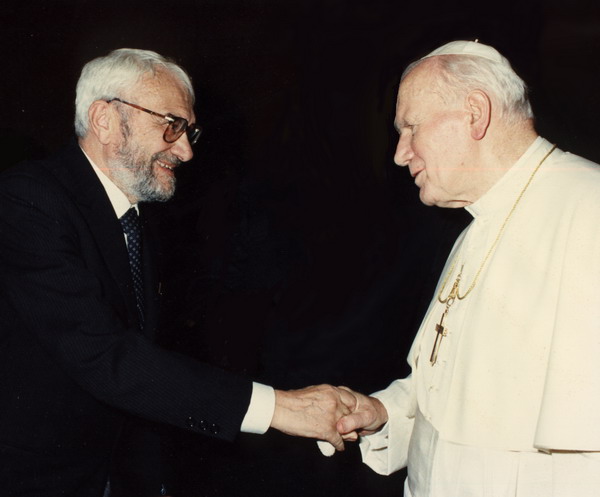
Pope-O-Vision

As popes go, John Paul II is certainly one of the best there’s ever been: he is truly upright and deeply religious, and he has tried to use his position to be a force for good in the world. I respect that, even though I’m not Catholic and don’t agree with everything he says.

But in Italy (as I often joke) we don’t have television, we have Pope-o-vision. Every day the news wires and TV report what the Pope is doing, or what he has to say about the global crisis or disaster of the day. But what he says is usually so predictable! Of course he’s going to pray for peace between the warring factions, for international understanding, for aid to the afflicted, etc. While kind and worthy, this is hardly news: he’s the Pope – what else would we expect him to say?

Occasionally he does come out with something surprising. For example: In Italy, many couples split up without officially filing for divorce (because it’s a huge, expensive hassle), and often the ex-partners end up living and even having children with someone new. The Pope declared that it was all right for these de facto new couples to take communion – as long as they weren’t actually having sex.

The Italian media’s obsession with the Pope is baffling, because so few Italians today are devoutly practicing Catholics. Evidence: The vast majority of Italians are nominally Catholic, and the Church does not believe in “unnatural” forms of birth control, yet Italy has one of the world’s lowest birthrates. (Followed closely by that other very Catholic country, Spain.)

Italy’s shift to secularity is recent. Divorce became legal only in 1970, in a parliamentary decision which the Vatican attempted to overturn by a national referendum in 1974. To the shock of the Church, 60% of the Italian people voted in favor of keeping divorce legal. Similarly, and even more strikingly, a 1978 law making abortion legal was brought to referendum in 1981, and again the Church and its political friends failed: the right to abortion was sustained by 68% of Italians. Since then, abortion has never been a serious political issue in Italy.

Returning to my original topic: My irreverence towards the Church (and indeed all religious institutions) is partly my own, but I’ve also absorbed it from the Italians, many of whom, in spite of their media’s obsessions, don’t take Catholicism as an institution very seriously. They’ve had a ringside seat on the Vatican’s activities for most of 2000 years, and they know how little the Church-with-a-capital-C has had to do with religion for much of that time.

English Not Spoken Here

At least not very well. English is taught in Italian schools from third grade on, but most people who want to learn it properly take courses outside of school and try to do a study tour in the UK or US as well.

Still, things are changing…

When I first arrived in Italy 10 years ago, all film titles were translated into Italian, with sometimes peculiar results. The first James Bond film, known in English as “Dr. No” was translated as “Licenza di Uccidere” (License to Kill). So the film distributors presumably found themselves in difficulties many years later when the English-titled License to Kill (with Timothy Dalton) was released (but I wasn’t in Italy at the time, so I don’t know what they did about that).

Almost all films are still dubbed into Italian; in Milan, you can see English-language films only in selected cinemas on certain nights of the week (one film per week). Personally I find this annoying – I like to hear the original voices. But they do it extraordinarily well. The same doppiatori (dubbing actors) tend to dub the same actors year after year, film after film, and some of them are prodigiously good – especially the guy who does Woody Allen – sounds just like him, if Woody Allen spoke Italian that well (for all I know, he may – he spends a lot of time in Venice).

What’s annoying, however, is the insistence on dubbing even the songs in musicals – it’s very difficult to translate a song so that it maintains the meter and rhyme scheme of the original, especially when it also has to maintain exact meaning in places where a song is accompanied by action. So most of these translations are abject failures.

Fortunately, this is no longer done for the few non-animated musicals that Hollywood still produces; Evita was entirely subtitled. But it’s done to all cartoon musicals, presumably because kids aren’t expected to be able to follow subtitles. So, much as I love Disney movies, I either see them in an English-speaking country, or wait til I can get them on DVD.

Dec 3, 2003

Since I wrote the above, I’ve grown less tolerant of dubbing. Perhaps I’m spoiled now by the greater availability of English-language films: at my local Blockbuster, via Amazon, via cable TV (if we had it), and occasionally even at the cinema. The few times we have seen dubbed films at the cinema recently, I’ve found them hard to follow, although I have no difficulty following Italian film or TV. I suppose the difficulty of dubbing dialog that makes sense and suits the mouth movements in the original language makes for some occasionally convoluted phrasing that is simply harder to understand. And, some of the time, half of my brain is busy wondering what the original line in English was, which distracts me from the next line.

There is a growing tendency, in Milan at least, to show some big movies in English for a week or so, I suppose for the benefit of a fairly large non-local audience. We can be confident that The Return of the King will be shown in English somewhere that we can get to it. However, it is opening in Italy far later than anywhere else in the world ­ late January! Augh!