Category Archives: living in the USA

Americans’ Phobia of Socialized Medicine

I am baffled by the people I encounter in this country who think that “socialized medicine” is evil. I’m not sure how they arrive at this conclusion. It seems that, for some, anything they can label “socialist” is automatically frightening. But we have state-run fire and police departments and military (among many other things), and the vast majority of Americans would agree that these areas of common human endeavor are best run by government.

Why, therefore, do so many instantly discard the idea that governments can effectively provide health care? Other countries’ governments are managing national health systems quite well. Do we have so little faith in the abilities of our own government?

I’ve seen socialized medicine working for my own family. I lived in Italy for 17 years (my Italian husband is still there), and have written about my (mostly positive) experiences with Italy’s national health system.

My father lives in England with his British wife, and the UK’s National Health Service (NHS) has done very well by them. Just a few weeks ago, Dad had a $60,000 operation – paid for by the British government, and he’s not even a citizen! – to implant an electronic device which interrupts pain signals from his body to his brain: a last-ditch remedy for ten years of extreme, chronic pain due to arthritis. And it’s working.

In Italy, my mother-in-law had a mastectomy within days of a tumor being discovered, and her chemotherapy and related medications were free. When our daughter broke her arm, a compound fracture requiring surgery, the surgery, hospital stay, and follow-up care were free. When I had my own cancer scares, all the tests were done within days, and I paid less than 100 euros for the biopsy. I’ve been under treatment for glaucoma for years; with my doctor’s prescription in Italy, the medicine costs 2 euros a month.

Because health care is universal in these countries, medical privacy need not be a huge concern: you’re going to get treated, no matter what you’ve got. Whereas, in the US, you must jealously guard information about any chronic or genetic condition you may have, for fear that it will damage your chances for employment and insurance.

The Problem of Choice

Some Americans fear that a government-run health system would limit their choices, which is likely true. But is that such a bad thing? Too much choice can be as bad as too little, especially when it requires so much time and knowledge to understand what’s on offer and make an informed decision.

One of the most difficult transitions for me in moving back to the US has been precisely this. I’m an intelligent and highly-educated person, but simply comprehending my health insurance options (and, thank Sun, I have options!) has been largely beyond me so far. I have insurance, but that’s about all I know, pending further study that I haven’t had time for. I can imagine how overwhelming this must seem to someone much younger (or older) and/or less experienced than I.

In Italy, things are a lot simpler. You choose a family doctor from a limited list of local practitioners, most likely someone whose office is convenient to your home. When you’re sick, you visit that doctor during his/her office hours (some by appointment, some you just sit around and wait). If you need a specialist or tests, the family doctor writes an authorization and you schedule an appointment, which will be available later or sooner depending on how busy your local providers are and how urgent your medical situation is. I once scheduled a routine mammogram 8 or 10 months in advance, but when I needed one in a hurry for a suspicious lump, it was performed within 24 hours. (NB: Bi-annual mammograms are free for all women over 45. Socialized health systems are big on preventive medicine, because it makes economic sense.)

And if you want choice in Italy, you can pay out of your own pocket to go to whatever practitioner you like.

Of course, no system is perfect. Malpractice can happen anywhere. My father-in-law was probably killed in Italy by an anesthesiologist too old to be administering an epidural. My aunt’s botched hiatal hernia operation (in Austin, Texas) led to ten years of agony and, eventually, her death. Malpractice suits are rare in Texas, so she never got the money needed to help fix what the doctor screwed up. Penny-pinching by the Medicare system (America’s version of national health, available only to the elderly and used only by those who have no choice) likely exacerbated her problems and also contributed to her death. Being poor and uninsured limits your choices far more than a national health system does.

Given all this, I don’t understand why so many Americans have such a knee-jerk negative reaction to nationalizing health care. Can anyone explain this to me?


On the Phone for Obama

I spent an instructive couple of hours this evening making phone calls on behalf of the Obama campaign. Yes, I am one of those annoying people who interrupts your dinner to ask who you’ll be voting for. (I’m in Colorado, one of the few states where the answer actually matters.)

I’ve had a fear of cold-calling ever since a short-lived, traumatic (and rather funny) attempt at phone sales during my college years, but this wasn’t so bad. Somehow I got the nice people list to call: all women over 60 (some well over), all of them polite. Although the two times I got (presumably) their husbands on the line first, they were rather abrupt.

For the few who were willing to say that they are undecided, I offered to try to answer any questions or concerns they might have, but no one took me up on that. The only woman I spoke to at any length said: “I’m just not sure. He seems so young, though that’s not an issue.” She wasn’t really happy with McCain or Obama, and is disgusted with the recent behavior of both: “They’re fighting like a couple of high schoolers.” I could only glumly agree with that.

“We’re in a rut, and I’m not sure there’s anyone in the whole history of the country who can get us out of it,” she continued. And she wasn’t just talking about the economy.

I empathize, truly I do. You haven’t heard much about Obama from me before, because I would have preferred Hillary. I like her experience and I like her balls, and I would love to see the ultimate glass ceiling  broken.

But John McCain won no points from me for selecting Sarah Palin as his running mate. In fact, that move utterly canceled the respect I used to have for him. He thinks I’d vote for Palin simply because she lacks a penis? The utter cynicism of that shows just how little respect he and the Republican party actually have for women. Palin is the polar opposite of Hillary in everything except her chromosomes, and, most worrisome, lacks almost any useful experience. By reason of her sheer lack of competence, the idea of her being McCain’s faltering heartbeat away from the presidency is frightening.

Her religious and social beliefs scare the proverbial bejesus out of me. Bristol Palin is pregnant at 17 as a direct result of her parents’ conservative ideology. You can’t stop teenagers having sex, but, if you’re a sensible and caring parent, you can at least provide them with the knowledge and birth control to prevent them getting pregnant. The failure of abstinence-only sex “education” is starkly illustrated in Palin’s own family, and I’m disgusted (though not surprised) that no one is even mentioning this as an issue. Family privacy be damned: Palin would try to impose this on every teenager in America. We have every right to discuss this – loudly.

Sarah Palin has propelled me hard into the Obama camp, and is the main reason I expect to spend quite a bit of time campaigning for him. But there are things I definitely like about Obama, too. For one, he’s a third-culture kid. Like me, he has a multicultural family and has experienced other countries and cultures by living in them. McCain’s experience of other countries, at least during his young and impressionable years, was of going to war and then being a prisoner of war in Vietnam. I don’t have a window into either man’s psyche, but human intuition tells me which one is likely to have a broader, more nuanced view of the world outside US borders.

And that’s something we desperately need now. The world is too small and too tightly interwoven nowadays for US exceptionalism to be the answer to every international question. We have to think about our role as world citizens, not just American citizens. And I think Barack Obama is far better equipped to do that than John McCain.

Folsom Street Fair 2008

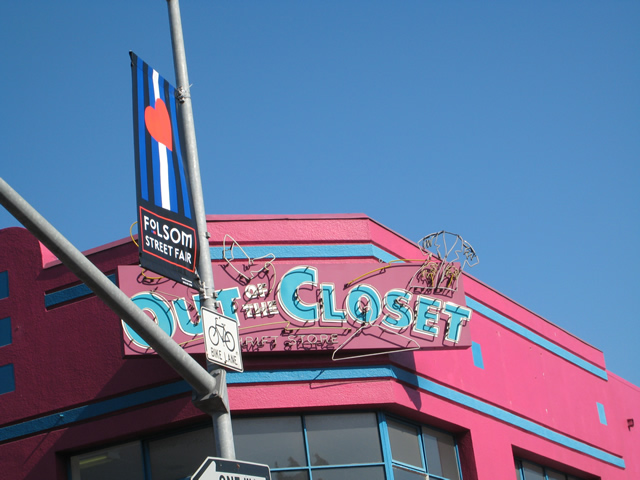
I was in the Bay Area for some conferences, and decided I might as well combine pleasure with business, and take advantage of my last opportunity to stay with Gianluca and Brian in San Francisco before they move to New York. By coincidence, that Sunday was the 25th anniversary of the Folsom Street Fair, which I had attended with Gianluca years ago. The photo at the top is of Out of the Closet, flying the leather community’s black-and-blue flag

Hello, Dolly!

Now that I’m living in the US, I have a chance to do things I haven’t done much during my years in Italy, such as go to concerts (other than classical; living in Milan, we had good access to classical music).

My dad took me to concerts fairly frequently during my childhood years in Pittsburgh. We saw Arlo Guthrie and Kris Kristofferson just about every year, and Frank Zappa once, just when "watch out where the huskies go…" was big on the radio. Concerts were a lot longer in those days, and I was young – I managed to fall asleep right in front of the speakers at Frank Zappa. To my chagrin, Dad always refused to take me to see the Rolling Stones – after Altamont, he was afraid of violence.

There are concerts in Italy, of course, but they’re mostly by Italian musicians whom I don’t care much about. The big American groups only come around every few years, and my taste rarely coincides with that of the Italian concert-going public. In other words: the musicians I’d like to hear rarely come to Italy (though Enrico did see Paul Simon just before he came on his current US visit). Enrico and I saw Jethro Tull ages ago in Milan, and David Byrne a bit more recently, then Alex Britti and Randy Newman.

I’m not in the habit of following concert schedules, but the day I did my Colorado driving test, I ate lunch in a little Nepali restaurant next door to the DMV, and picked up a local paper to read while I was eating. I happened to notice that Dolly Parton would be playing in Denver while Enrico was visiting, so I called him up and asked if he’d like to go. He’s mostly familiar with her from the movies 9 to 5 and The Best Little Whorehouse in Texas, but that was enough to make him like the idea. And, for my first concert back in the US, you can’t get more all-American than Dolly!

The ticket gods love me: without particularly trying, I got seats in the center pit, four rows from the stage. For about $100 each, after taxes, fees, and parking. And Dolly gave us our money’s worth: two hours on stage, with a pretty damn big band.

I was interested to see that a good part of the audience was gay, both men and women. Upon reflection, this makes sense: Dolly was camp long before that term entered mainstream consciousness, and drag queens strive for precisely the Dolly look: spangly tight-fitting dresses, enormous wigs, enormous boobs, and enormous makeup – plus lots of jokes about it all. Her tag line is: "It costs a lot of money to look this cheap," and she was quick to repeat it onstage, as I knew she would be.

Sadly, Dolly herself is not looking so great these days; I think she’s had an overdose of "work" (cosmetic surgery). While she sang Here You Come Again, her big crossover hit of 1977, the screen behind showed pictures and video of her during that period, and I’ve got to say: she looked a lot healthier when she was rounder. Nowadays her cheeks are hollow and her legs like two sticks. Why is it that so many famous women seem to be anorexic these days? It’s not an attractive look.

It was also interesting that her encore number, Jesus & Gravity, went over like a lead balloon: previously-enthusiastic faces turn to stone (though there were a handful who clearly did love the song). Hmm. It appears there are more atheists in America than the politicians would have us believe.