Reversing Sexual Liberation

By the time I reached adolescence in the mid-1970s, women’s sexual liberation, in the West at least, had supposedly been accomplished. No longer were women divided into “good girls” and “sluts” as they had been in the 1950s and early 60s – the sluts being sought after because they would “put out,” but then despised for doing so, while every man wanted to marry a virgin. That virgin-whore dichotomy died in 1968 – didn’t it? The Pill removed the risk of pregnancy, so women were free to have sex as, when, and with whom they pleased, simply because they enjoyed it.

Well, that last was never entirely true. Even Western culture assumes that women want sex only or mostly within the context of “a loving relationship,” and feel betrayed by men who “use love to get sex.” Few people were ever really comfortable with the idea of women having sex on the “male pattern” – that is: often, casually, with many different partners, just because they liked it. Outside of pornography, one of the few fictional characters who personifies and enjoys this lifestyle (and is not ultimately punished for it) is Samantha in Sex & the City.

Even Buffy (the Vampire Slayer) couldn’t have sex just because she liked sex; a very passionate sexual relationship was presented as degrading to her because she wasn’t in love with the guy. Sex just for fun, or for comfort, was unacceptable. This is one of the few points on which I’ve ever disagreed with the Buffy writers.

It appears that we have now moved on to the service model of female sexuality, where sex is something that women do, and do often, but primarily for the benefit of men. Some girls of my daughter’s generation are using sex as a way to get male attention – not a new phenomenon, I know. A recent article in Seventeen magazine (a long-running US monthly for adolescent girls) told of girls who gave blowjobs to multiple boys at parties, then were shocked that everyone in school heard about it. Some girls Ross knows here in Italy have done much the same (or claim to have), at discos or parties. In both places, these girls are labeled “sluts,” and they do get noticed by the boys – many of whom take it for granted that these girls will perform oral sex on them as well, just for the asking. And the idiots do!

I don’t see what the girls are getting out of it, except perhaps some fleeting sense of power – the ability to give pleasure is a form of power, and some people find that in itself pleasurable. But this surely should not be the sum total of the pleasure a girl gets from sex.

The boys demanding blowjobs seem not to have any notion that they are obliged to do anything for the girls in return – nor have the girls. These boys are receiving service, not making love. I don’t know where they will learn the skills they need to uphold the long-standing reputation of Italian men as the world’s greatest lovers.

I am not anti-porn, but I can’t escape the conclusion that this attitude is leaking into the wider culture from that part of the porn industry that caters to straight men – which is the major part of the industry, right now. I got worried a few years ago when I saw girls wearing t-shirts saying “Porn Star.” The  majority of porn panders to male fantasies, offering a distorted picture of women’s sexuality.

My feminist antennae are quivering. Is this just another way to control female sexuality? Make girls believe that sex is something you do for the boys, not for your own pleasure, and they will then have sex on command, or not have sex on command, with equal indifference.

The solution to this commoditization of sex, I believe, is to teach girls, not that sex is bad or dirty, but that it should be done in an atmosphere of mutual respect, if not love. Girls should respect themselves and their sexuality, and demand respect from their partners. The question is not whether he will “respect you in the morning,” but whether he respects you NOW, enough to give as good as he gets – at least

A Travelling Show of Italian Classic I Promessi Sposi

The weekend of October 9-10, all of downtown Lecco was the stage for the Corteo Manzoniano, a “travelling” representation of that famous piece of local literature, Manzoni’s I Promessi Sposi (The Betrothed), most of whose action takes place in and around Lecco and Milan. Groups of actors in gorgeous costumes paraded among five or six fixed stages, or acted out scenes on small travelling platforms, or on horseback.

Tradimento! (Betrayal)

shot Oct 10, 2004, 1:17 mins, 3.7 MB

The betrothed couple of the title, Renzo and Lucia, attempt to trick the priest Don Abbondio into marrying them. Don Abbondio is understandably reluctant, since Don Rodrigo (a different use of the title “Don” !), the local Spanish overlord, has sent a couple of thugs (bravi) to inform him that: “Questo matrimonio non s’ha da fare.” – “This marriage should not take place.” (Don Rodrigo wants Lucia for himself.) Don Abbondio discovers the trick in time; much yelling and confusion ensue.

The Kidnapping of Lucia

22 secs, 1.8 MB

You can’t see it in this shot, but Lucia is being grabbed and bundled into the carriage, screaming. The horses didn’t like the noise and started rearing, which was scary, but after watching the scene re-enacted, I suspected that they were very well trained to look as if they were freaking out, but were actually under the control of their driver.

Procession

31 secs, 2.5 MB

I don’t know who all these characters are, but I liked the chanting and the pretty horses. Until my cellphone rang…

La Peste

1:55 mins, 5.6 MB

The plague (peste) ravages Milan. Bodies are carried away by the cartload. A grieving mother says farewell to her young daughter, placing her body tenderly on the cart, and tells the corpse-collectors: “Come back this evening to take me, and not only.”

Parade

1:59 mins , 5.8 MB

The first character you see here (with the leather banding on his shirt) is probablyl’Innominato (the Unnamed), the bad guy who turns good. The band and the music are totally out of period, but at least they’re Lecchesi – the theater company is actually from Bergamo.

The Grim Sweepers

44 secs, 2.2 MB

These stilt-walkers closed the parade. Black and purple are the colors of mourning in Italy. I have no idea why they had brooms, except the purely practical purpose of balancing the scythes on the other end.

Shotgun Wedding 2: Coca-Cola, and an Ostrich

I called Enrico in New Haven to let him know the news. He had not been happy about my traipsing off to Africa in the first place, so, while he was happy that I was pregnant, he was not at all happy that I was pregnant in Africa, and wanted me to come home immediately.

This was around week two of a four-week working trip, and I still hadn’t managed to accomplish much of the work I had been sent to do in Tanzania. I was reluctant to walk away from the project, even though I was not feeling at all well. The next morning the center shuttle van came to pick me up, and I vomited in the van. The kind driver was very concerned – he thought I had gotten malaria. I didn’t want to tell anybody at the center that I was pregnant. I knew that being pregnant and not (yet) married wouldn’t have been a big deal in Cameroon, but I wasn’t sure how Tanzanian culture would react.

Enrico left no stone unturned in trying to persuade me to drop everything and fly home. He called my parents and every friend of mine he could find a number for – between that and frequent calls to me in Tanzania, his phone bill was around $800 that month. As a result, I got calls from everyone. My parents, to my surprise, switched tracks – Mom said she didn’t feel old enough to be a grandmother, while Dad was clearly delighted at the prospect of being a granddad. My friend Stephanie, who had never even spoken to Enrico before, called in some bemusement – she had had a frantic call from him, begging her to convince me to come home.

Meanwhile, I tried to find something in Tanzania that I could stand to eat. It seems petty to say so, but the food in Arusha left a lot to be desired; I had been sorely disappointed after the wonderful cuisine of Cameroon. In desperation, I switched hotels, to the new Swisshotel across town. The hotel chain had sent a chef out from Switzerland to teach the local staff how to cook the hotel’s standard menu. Sitting in the dining room one day, I was witness to an amusing scene:

The chef was describing the menu, item by item. The steak sandwich, he explained, was a steak on a long, crusty baguette. He illustrated a long shape with his hands.

“No, no, sir,” said the Tanzanian cooks, “a sandwich is like this!”- and their hands shaped a standard American square of bread.

[Some Tanzanians have by now learned to make long sandwiches: my classmate Mahmood opened Africa’s first Subway franchise several years ago, in Dar-es-Salaam.]

The only foods I could keep down were tomatoes and salted peanuts. On my aunt Rosie’s advice, I also drank lots of Coke – she told me that Coke syrup used to be sold in pharmacies in the States as a remedy for morning sickness. It works, for morning sickness and any other form of nausea.

Between starvation, Enrico’s badgering, and frustration with the training project that was not getting accomplished, I finally decided to leave Tanzania a week earlier than scheduled, and fly to Rome to join Enrico and his family for Christmas (as originally planned). My boss wasn’t best pleased about it – “You always give the client more than you promised, not less!” Well, neither the client nor I had reckoned on me turning up pregnant…

Getting out of Tanzania involved a bit of adventure. The American woman with whom I had travelled to Ngorongoro (I’ll call her Donna) was working out in the bush on an ostrich-rescue project. Ostriches are extremely stupid; they don’t look after their nests, so the survival rate from egg to adulthood is about ten percent. Donna and her partners had a deal with the Tanzanian wildlife service whereby they would go out and collect the wild eggs, and hatch them in incubators on a farm. They would take some percentage of the chicks to ostrich farms in the US, and release older chicks back into the wild, with a greatly enhanced survival rate, resulting in a net gain in Tanzania’s ostrich population.

Donna and I had become friends; she’d come in from the bush every few days and borrow my hotel room to luxuriate in a hot shower. She planned to go back to the States soon, so I scheduled my departure to coincide with hers. There aren’t that many flights out of Arusha; we both booked on flights out of Nairobi, Kenya, which meant a few hours’ trip by jeep, across an international border.

A few days before we were to leave, Donna left a note in my hotel room: “See you soon! And I’m bringing a surprise!” Uh oh. No, she couldn’t, really – could she?

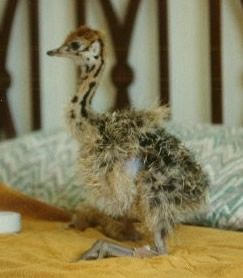
She did. She brought a baby ostrich.

The ostrich chicks bound for the US were shipped several dozen to a large crate, high enough for them to stand up in (at several weeks old, they’re about two feet tall). And they did stand up for the whole trip – anybody who sat down would get trampled and suffocated. This particular chick had a bad leg and couldn’t stand up properly; his chances of surviving the trip, let alone in the wild, were very slim.

Donna knew someone at the San Diego wildlife park who could perform the surgery little Gimpy needed to stand and run and live a normal ostrich life; the problem was to get him to San Diego. Her permit did not allow her to export ostriches except by the crateful, so she decided to smuggle him with her on the plane.

The first step was to cross the land border between Tanzania and Kenya, where passports, and possibly luggage, would be inspected. Donna put the ostrich in a gym bag which she stuffed down behind the car seat, out of sight of the driver, leaving just a hole open for his head to stick out. When we reached the border, she stuffed his head into the bag and casually tossed a jacket over it; our luggage was not checked, and we breezed on through.

Our flights from Nairobi were in the evening, many hours after our arrival, so we had booked a hotel room for the day. I didn’t feel well enough to do anything but rest, so I stayed in the room with the ostrich while Donna went out shopping. She put him on the floor near the bed, on a towel, and gave him salad and water. I lay down for a nap.

I had not known that ostriches make noise – but only when they’re happy. The jeep trip had been bumpy and traumatic, so Gimpy had stayed quiet. Now he started burbling with contentment, a soft warbling noise. I sat up in bed, startled, and looked at him. He looked at me. I lay down again. He started warbling again. I didn’t get much sleep, but, on the other hand, how many times in life do you get to hear an ostrich sing?

Getting Gimpy through Nairobi airport was going to be a little trickier. Donna took a hotel pillowcase and cut holes near the open end so that she could wear it over her arm like a shoulder bag. She put Gimpy in that, so he was snugged between her elbow and her waist, but he made too bulky a package to hide under her bush jacket. I loaned her my beloved Indian shawl, the dull brown one I had bought on a special occasion years before. Loads of sentimental value – I would not have risked it for anything less than saving the life of an ostrich. Donna draped the shawl casually over her shoulder; it looked completely natural while covering the pillow case and the ostrich.

My flight was earlier, so we went to the airport separately. I got worried for Donna when I saw that body scans and pat-downs were being performed on all passengers, and hand luggage was being x-rayed. How was she going to manage?

I got the whole story from her later, when we spoke on the phone after we had both returned to the US. Donna told me she had surveyed the security situation, and saw that she would have a problem with the body check. But she also noticed that the people manning the x-ray scanners were scarcely looking at their monitors. So she stuffed Gimpy back into the gym bag, under some other things, and he went through undetected (makes you feel good about Nairobi security, doesn’t it?). She said that, on the plane, the problem was to keep him from getting happy and making noise; she kept having to kick him. At Heathrow airport, she bought some salad and went into a breast-feeding stall in the women’s bathroom to feed him (he had to be more or less force-fed). A lady came into the bathroom with a baby, looked into the open stall, blanched, and quickly left.

Donna somehow got the ostrich all the way to California, where surgery was successfully performed, and Gimpy presumably lived out the rest of his days happily at the San Diego wildlife park. She mailed my shawl back to me, and now it’s had one more adventure than I have, having been an active participant in the great ostrich smuggling caper.

  1. The Italian Proposal
  2. Tanzania Surprise
  3. Coca-Cola, and an Ostrich
  4. Justice of the Peace

Moving House in Italy: The Bureaucracy

I read somewhere that something like a third of the US population moves house (often changing town as well) every year. Even if that number is exaggerated, it’s certainly true that Americans move far more than Europeans do, so many of the necessary steps are very routine in the US.

In Italy, it’s not so simple. Take forwarding mail. In the US, you pick up a form at the post office (and often other places), fill it out (for the entire household) with the old and new addresses, sign it, and hand it in at any post office, or even mail it. The service is free and continues for a year.

In Lecco, I had to go to the post office to pick up a form that is used so rarely that all they could give me was a poor photocopy of it. Two copies, actually, because you need to fill out a form for each adult member of the family, and supply a photocopy of each adult’s identity card; any minors should be put on one of the parents’ forms.

You should do this at least 10 days before the date you want forwarding to start, which I didn’t know when I went to the post office on the Friday before Monday’s move. But the postmaster reassured me that, since we were moving within the same town, the service would actually start Monday for regular mail. Registered mail needs a few more days to work through the system, and if you’re moving to another town it can take up to 10 days for the paperwork to reach your new post office. You can choose to forward for 6, 9, or 12 months, and you pay – 12 euros per household for 12 months.

The postmaster recommended that we also leave a note about the change of address for our mail carrier (postino, or in our case, postina, since ours was female). Enrico and I were running errands, so I asked Ross to do it. She composed a very nice note thanking the lady for her kindness and good service (deservedly so – everyone who works for the post office in Lecco seems to be very nice, as well as efficient). I don’t think the postina had ever had a note like that from a customer; when she saw it on Monday, she buzzed me to come down for the day’s mail (since we were in the midst of moving), kissed me goodbye, and wished us well in our new home.

I mentioned before that you need to notify your local town hall of your change of address, so they can send you ballots at voting time. Interestingly, it is NOT necessary to change your carta d’identita’ (identity card) for a change of address, until the card itself expires (every five years). In fact, they will refuse to change it before it expires, unless you lose or destroy it. I’m told that running it through the washing machine is a very effective way to destroy it; just be prepared to demonstrate the remaining shreds at the ufficio d’anagrafe (population records office) when you go to get it replaced.

About that ID card: Many Americans get itchy at the idea of a national ID card, even though a driver’s license (or non-driver ID from your local driving authority) is in effect used as an ID card all over the US. In Italy, and most of Europe I believe, everyone has an ID card, and thinks nothing of it. Foreign residents are also entitled to an ID card in Italy. I got by without one for years, didn’t see a real need for it until, strangely enough, it would have been handy in applying for an Indian visa. (When you apply for a visa from a country which is not your country of passport, you usually have to supply proof of residence in the country from which you are applying.) So now I have my own carta d’identita’. I previously used my US passport, which caused slight extra paperwork in opening bank accounts and so on, but was not a huge problem.

For all financial purposes in Italy, you do need a codice fiscale (fiscal number) which is more or less equivalent to an American Social Security number. The codice fiscale is made up of the first three consonants in your last and first names (e.g., in my case, STR DDR), the last two digits of your year of birth, some bits in the middle calculated from your birth month, and a number signifying your town of birth – there’s a different number for every tiny little town in Italy, but the same code (Z404) is used for EVERYONE born outside Italy, from Australia to Zimbabwe.

Because the codice fiscale is calculated and not random, it is possible for two people born in the same town on the same day to have the same codice fiscale, if they happen also to have the same name, or names with the same sequence of consonants. Theoretically this should be checked before a codice fiscale is issued, but there have been cases of identical codes being issued to two different people, resulting in all sorts of confusion, such as the man who was still alive but couldn’t draw his pension because his code sharer had died.

Some more issues pertinent to home ownership:

All homeowners pay a tassa sui rifiuti (garbage tax), calculated on the size of your home and I suppose the number of family members. When you move, you need to go to the local tax office to move your tassa sui rifiuti as well. And, as I have just learned, you can’t put garden trimmings with the rest of the umido (compostable food scraps); you have to take them to the town dump, which means that you have to have a magnetic-stripe card to give you access to the dump. This you acquire from the Ufficio d’Ambiente (Office of the Environment) at the Comune (town hall). [more on recycling]

If you move to a different town (or far across a city), you also need to change your medico di famiglia (family doctor); this is done at the local ASL office (Azienda Sanita’ Locale – local health company).

And you need to stay on top of Telecom Italia. I called them on September 8th to inform them of our move on the 27th. I called again twice, and each time was told that the process was underway. Enrico called on October 4th, and found out that the process had come to a dead stop. The previous owner of our house had had the phone line registered as a business line, possibly because he was claiming a tax deduction on using part of the house as an office. Now we’re trying to switch it to a home line, causing endless confusion at Telecom. At one point they claimed they needed to do a technical test on the line, even though I was calling them from it (the old owner’s number is still active at the house, though it was supposed to be turned off 10 days ago).

Further, our house number has a letter in it, and Telecom’s computer system doesn’t know what to do with this, and/or the paperwork can get lost in the computer depending on whether a capital or small letter is entered. Gah!

So Monday Enrico told them to start all over again with a new contract and new phone number, which the Telecom lady advised us would be faster than trying to resolve the confusion over the old contract. However, we have no idea how long it will take to get a technician out for the new line…

Deirdré Straughan on Italy, India, the Internet, the world, and now Australia