Only in Las Vegas… I wasn’t a fan before, and I’m not now, but playing minigolf under blacklight with dayglo balls is some kind of cool. Also got video clips of some rather sad animatronic robots.

Only in Las Vegas… I wasn’t a fan before, and I’m not now, but playing minigolf under blacklight with dayglo balls is some kind of cool. Also got video clips of some rather sad animatronic robots.
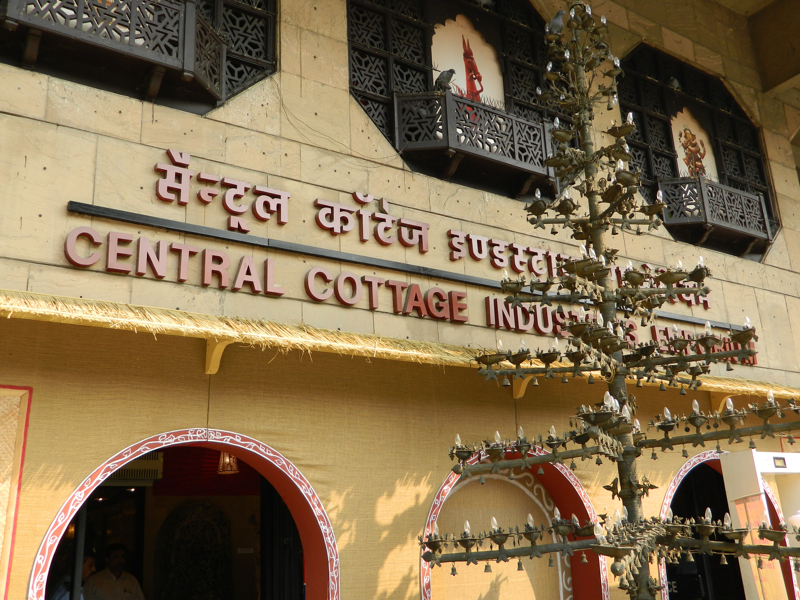
I’m not much of a shopper on my home territory, but love shopping in India, especially Delhi, which is well supplied with everything from roadside stalls to glitzy shopping malls, plus a good selection of handicrafts from all over India. The oldest and largest place to buy handicrafts (probably in all of India) is the Central Cottage Industries Emporium on Jan Path. It was there when I was in high school in the 1970s and 80s – already seeming to have been in existence for decades – and hasn’t changed much since.
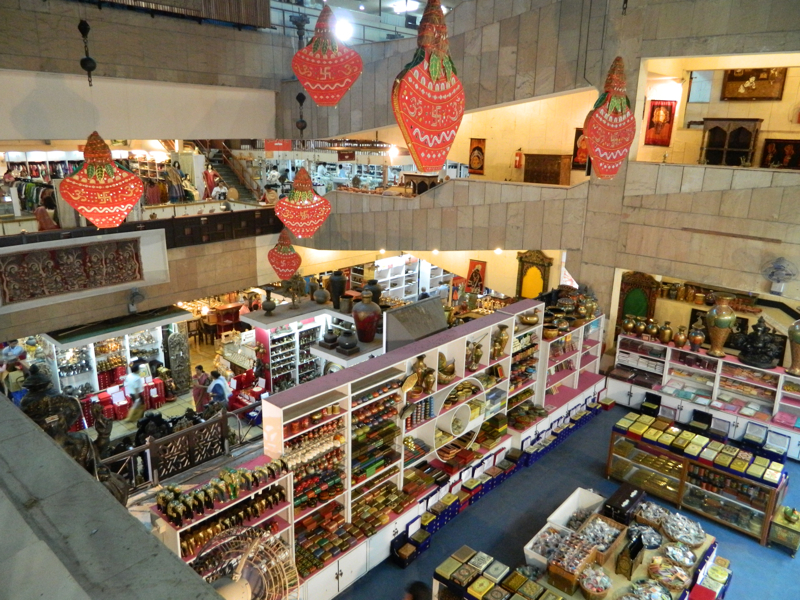
It’s an unusual building (wish I could find out who designed it), a labyrinthine series of mezzanines build around an open interior. Though better lit now that it used to be, it still feels cavernous, musty, and strangely underpopulated. (This last is reason enough to spend some time there on a hot day in Delhi – away from the crowds of people on the streets, many of whom, in this part of town, are trying to sell you something.)
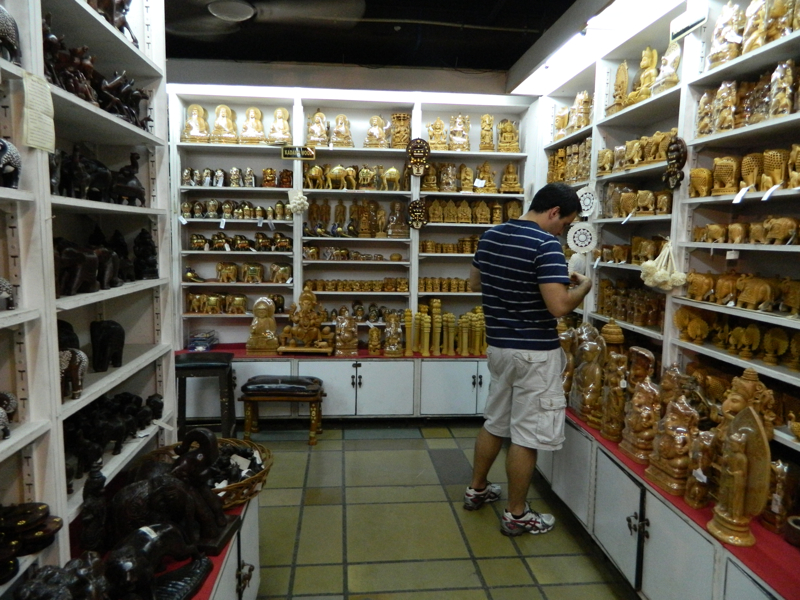
Many of the goods here are items that have been sold to tourists in India for decades, if not centuries. There are innovative twists on handicraft tradition available in India nowadays, but you won’t find them here. However, for the usual stuff, you’ll get a large selection, decent quality, fair prices, and no shopkeeper at your elbow, constantly urging you to buy.
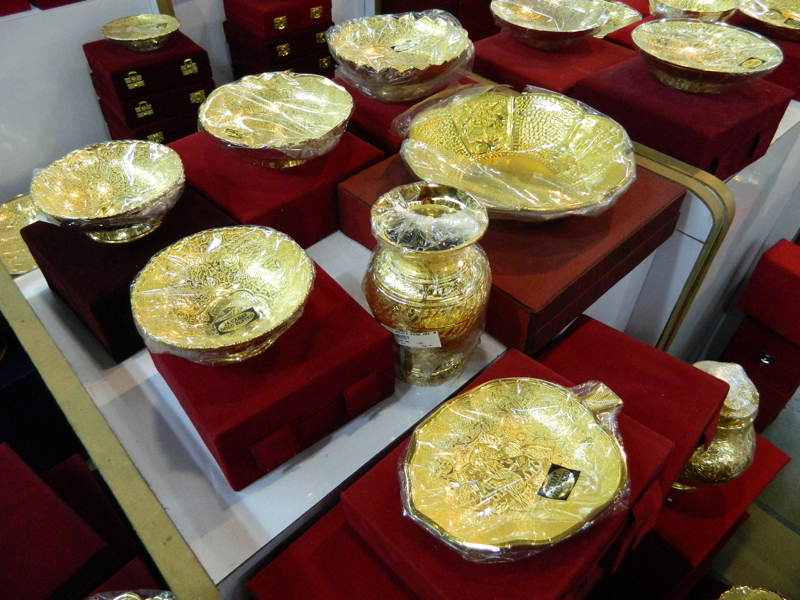
^ Gold-plated dishes as tourist tat was actually new to me, I can only guess that it’s aimed at the Middle Eastern market.
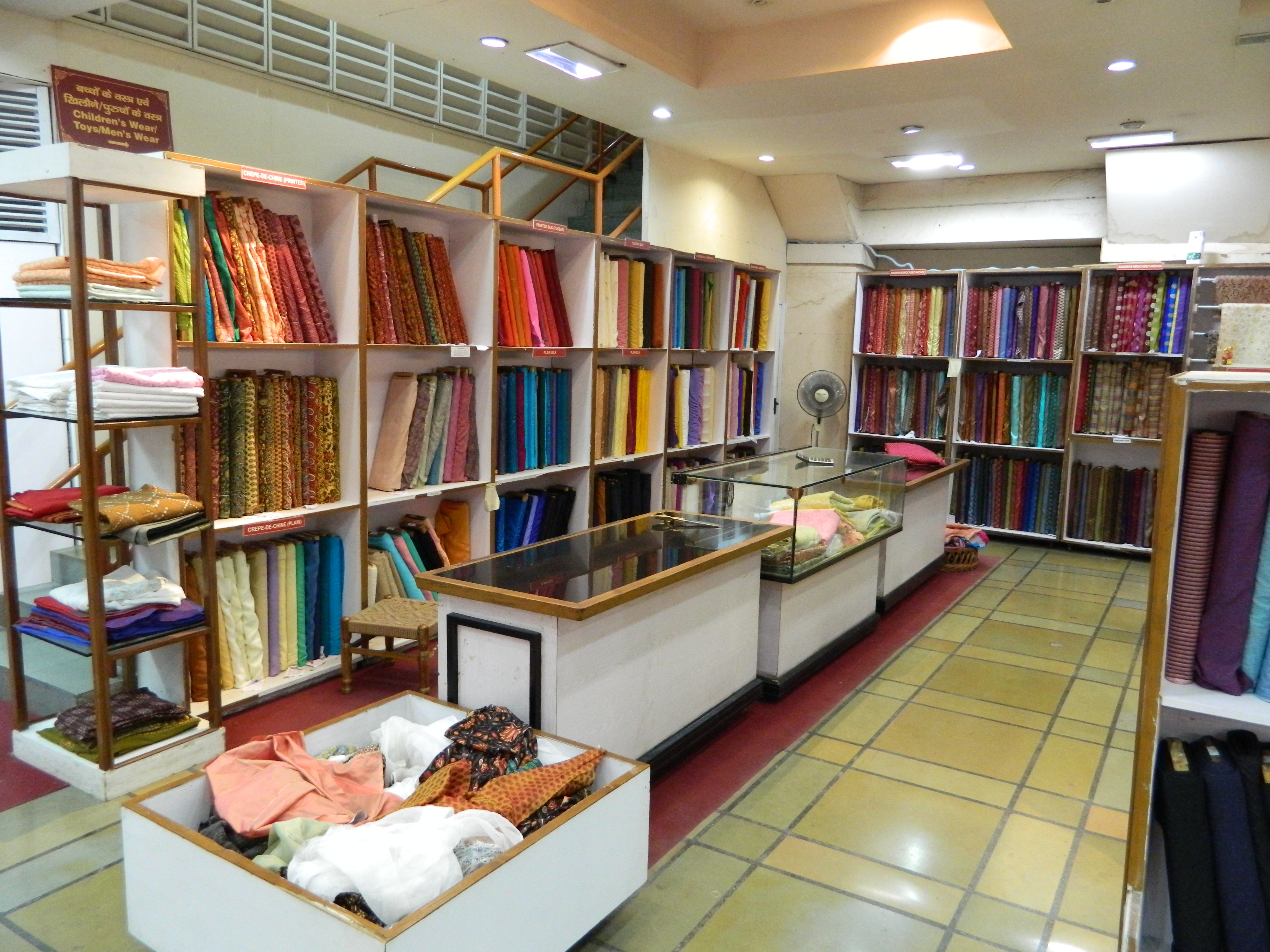
CCIE has a nice, though relatively limited, supply of textiles – silk, cotton, wool; printed, dyed, batik, embroidered; for clothing, curtains, and upholstery. If you love fabric (I do!), this is a good introduction to the breadth of traditional cloth available in India. Note the remnants bin – great for finding decorative pieces suitable for framing.
More in the photos below, and there was much more that we didn’t photograph – books, clothing, toys, tea, perfume, jewelry, bedding, cushion covers, furniture, even architectural pieces like carved doorways and columns. (I assume they will ship that sort of thing, no idea what it would cost.) There’s also a cool, quiet coffee shop on the top floor.
Actually buying anything is a bit of a process. In each section of the store, hand over your selections to the waiting personnel – that they merely wait, and don’t hassle you, is a huge improvement on every other tourist shop in Delhi! The staff write you a receipt, your goods are whisked away, and you continue shopping. This is dangerous – you end up carrying a handful of paper, with no clear idea of how much you’re acquiring.
When you’re finally finished, you take your receipts downstairs to the “cash desk”, and pay for everything at once via cash or credit card. Each of your receipts is firmly thwacked with a “paid” stamp, and the whole pile given back to you. You trot over to the nearby pickup counter, and are handed a dozen or more recycled-paper bags in various sizes, one for each section of the store you bought from. It is permissible to consolidate these into fewer bags for easier carrying. Then you’re done, and step back into the heat and roar of Jan Path.
All of Brendan‘s photos of CCIE from our October India trip are here:
^ above: the famous DTrace laser pony designed by substack. Why a pony? Read here.
This week was eventful for me professionally. I organized and ran dtrace.conf 2012, a highly technical conference, for my employer and others of the tech community that works with this technology. Yes, this is the same DTrace as in that book that I edited in 2010.
I also filmed it and ran a live video stream, while publicizing it via Twitter. And making sure everyone got fed and, at the end of the day, had beer to drink. A very busy day, but all went very well. The final, edited video is now making its way to YouTube, see the playlist of videos above.
“When you judge someone, it doesn’t define the person you’re judging – it defines you.”
Tulisa Contostavlos (story in The Guardian)
A few months ago I had a Twitter exchange with a woman in the tech industry, who wrote that girls the age of her teenage son should not be allowed dress like “skanks”. I assumed it was her son who defined them thus, and gently suggested that he should be taught not to use such terms. She replied that it was herself, not her son, who made this judgement. Her son, she added, being a teenager, was happy for them to dress that way.
I resisted the impulse to argue, because I may have to deal with this woman professionally someday. But it saddens and angers me that so many are prepared to pass judgement on other women based on their mode of dress and their (real or perceived) social and sexual comportment.
I’ve lived in places where women are judged far more harshly, and consequences for “transgression” can be severe. In Bangladesh, I was appalled that most of women on the street – and they were few – were covered head to toe in black burqas, only their eyes barely visible through black mesh. Though I was a skinny, innocent 14 year old, uninteresting to the average male gaze in my own country, in Bangladesh I didn’t feel safe, exposed to the eyes of men who assumed that any woman not completely covered up was somehow sexually available. So I dressed conservatively, by American standards (covered to the ankles – in tropical heat), and never went out alone.
Once I took a bicycle rickshaw somewhere with a woman friend. We were puzzled as to why the driver was pedaling so erratically, stopping and starting and weaving all over the road. We finally realized that he was masturbating furiously through his lunghi – apparently irresistibly turned on by the sight of our (not very) naked flesh – or by whatever fantasies and assumptions he entertained about unchaperoned foreign females. Had I or my friend been alone with him, we might have been in danger. By our own cultural norms we were modestly dressed: long skirts or trousers, loose, high-necked blouses. But those same clothes, in the eyes of the rickshaw driver, branded us as available sexual objects: our hair, faces, and arms were uncovered! Obviously, we were sluts, and lucky that we got no worse than a display of public masturbation.
In some countries, particularly those under Islamic law, it’s considered sluttish behavior for a woman to ride in a car or speak with a man who is not a relative, and punishments can be severe. Many girls worldwide have been murdered by their own families for “dishonoring” them by falling in love with the “wrong” men.
So, to define a girl or woman as a “skank” or “slut” is not just insulting: it implies a threat of physical harm as punishment for her “transgressive” behavior. Even in America, how many times have we heard – even from authority figures – that a woman “deserved what she got” because she was in the wrong place, dressed the wrong way, behaved provocatively? When you call a woman a slut, you have judged and condemned her to… whatever she gets.
Most Americans reading this were probably shocked and disgusted at the rickshaw driver’s behavior I described, but your definition of “slut” comes from your culture, just as much as his did. I don’t necessarily agree with any of you. Actually: your right to have an opinion ends where my body begins.
If you think you’re more civilized or enlightened than that rickshaw driver was, then it’s time for you to stop judging girls and women based on their dress or sexual behavior. Who a woman has sex with is none of your damned business. The idea that it might be comes from the notion that women are property, whose ability to bear children must be kept safe for a socially-approved man.
Legally and culturally, most of the people likely to read this page should be well past that. It therefore follows that you should not be using words like “slut” to threaten, shame, control, and silence women. Or you’re really not so different from that illiterate, ignorant rickshaw driver on the streets of Bangladesh.
Thanks to Brendan for insightful comments during the writing of this piece.
further reading:
I Promessi Sposi (The Betrothed), considered the first example of the modern novel in Italian (though the language is a bit antiquated today), is a story every educated Italian knows well, in part because they study it in school. We heard a lot about it in Lecco in particular because its author, Alessandro Manzoni, was the town’s most famous native son, and much of the action of the book takes place around Lecco and other parts of the Lake Como region, and in Milan.
Continue reading Learn Italian in Song: I Promessi Sposi in Dieci Minuti