Tag Archives: Italian education

Some Positive Aspects of Italian Education

Kids commuting into Lecco for high school

I have devoted many words to the things I don’t like in the Italian education system; now it’s time to talk about some things that I do like, particularly in comparison with the American system.

American schools are largely funded by property taxes in each local school district: the higher the value of the homes in the district, the wealthier the schools. This creates a vicious circle: parents buy or rent homes in the wealthiest area they can afford, so that their kids can go to better schools, then the rich (school districts) get richer, and the poor get poorer.

In Italy, the public education system is centrally managed and funded, so you don’t get these kinds of gross inequities. And there is freedom of choice: any child can go to almost any school. Elementary and middle schools give preference to kids living nearby, because most parents choose schools close to home for their young children, but most schools have room for kids from other neighborhoods as well.

The choices are not always obvious. For Ross’ preschool and elementary we chose Parco Trotter, because it was close to home and uniquely situated in a huge park. But the son of our portinaia (building concierge), living three floors below us, commuted a couple of metro stops to an elementary school which had a better reputation academically – it was well known in the neighborhood (though not by us, since we were newcomers) that Parco Trotter did not prepare kids as well for middle school. And, as I’ve mentioned, for the first two years of middle school Ross commuted across town, to an exclusive yet public school.

At the end of middle school, students choose both the type of high school they will attend, and its location. In a city like Milan, there is usually more than one of each type of school, each with its own style, history, and reputation.

You might think that students in smaller cities would have fewer choices, but they can and do go to school anywhere within a large radius. Students commute to Lecco (the provincial capital) from far up Lake Como and its surrounding valleys, and some even come from Milan – 50 kilometers away, 40 minutes by train. Others commute from Lecco to schools in Milan. I have heard of kids commuting from Milan to the liceo artistico in Lecco, even though there are two or three licei artistici right there in Milan. I would not be surprised if the reverse was also true – kids from Lecco commuting to a liceo artistico in Milan – though I don’t know the specific reasons for either choice.

This freedom of choice fosters competition among schools; a recent article in Il Corriere della Sera told how some schools are offering courses such as Japanese and Arabic to attract students, while another is popular because of a well-organized exchange program with foreign schools (I researched this one, and was disappointed to find that this is only for short visits, a week or two, but there is an increasingly popular program wherein kids go away for their fourth year and penultimate of high school).

As the differences fade between licei and technical institutes, in terms of preparing students for university, I expect competition will become even fiercer. We can hope that this leads to more innovation in curricula and other areas, as we all (parents, students, schools, government, and society at large) try to figure out how best to prepare our kids for life in today’s global economy.

Italian High Schools

Some Observations from a Non-Italian Parent

The Italian public high school system is complex, with dozens of different types of schools, divided into two major branches, licei and institutes. The licei were traditionally the college-preparatory schools, while the technical and professional institutes were intended to put people directly into the workforce. I say “were,” because the distinction was officially eliminated by educational reform legislation in 1962. It took time for these reforms to percolate through the system, but nowadays students are accepted into almost any university program from almost any type of high school, although it is still true that some types of high schools prepare you better than others for particular areas of higher study.

Liceo is the traditional, rigorous college preparatory program: five years of studies culminating in the esame della maturità, a series of nationally-set written and oral exams. There were originally four types of liceo:

  • classico, where you study Classical Greek and Latin as well as the usual subjects – Italy’s is the only school system in Europe (and probably the world) where Classical Greek can still be studied in high school;
  • scientifico, with more emphasis on science, but also Latin (“promotes rigorous thinking” is the theory);
  • artistico, which was originally a four-year program leading not to the maturità, but directly to a fine arts academy (accademia delle belle arti), or to a school of architecture.
  • magistrale, designed to train elementary-school teachers, though I believe that nowadays new teachers at all levels also need a university degree.

There are also some new types of liceo:

  • linguistico, which offers a variety of foreign languages; and
  • Europeo, which in some cases seems to have a jurisprudence/economics focus – pre-law school?

The four-year liceo artistico has now almost vanished; my daughter and most of her peers are in a five-year program, called “experimental”. Artistico has the longest hours of any school, with 19 periods a week of studio art in addition to 19 hours of academic classes, and homework in both arenas. For the first two years, everyone does the same subjects, then they choose one of four areas of specialization: architecture, art conservation and restoration, visual arts (painting and drawing), and graphic arts (which involves at least some computer graphics).

May 16, 2004 – As we are learning the painful way, this curriculum is overloaded. There is no way that 14-year-olds can learn physics or algebra in two 50-minute periods a week; even the teachers tacitly admit this, by giving occasional extra classes after school. Ross and many of her classmates have needed extra tutoring this year in one or more subjects, and a number are likely to fail the year; we’re working hard to help Ross not be one of them.

The failure rate at Italian high schools is astonishing. I don’t have any hard numbers, but practically every kid I hear about has repeated one or more years of high school – at least there is no great stigma in being bocciato (flunked). Since school is only required up to age 15 [this has since changed], one girl in Ross’ class has already dropped out. Another is probably dyslexic, but her parents have apparently never figured this out, nor is the school offering any help, except to suggest that she shift to the four-year program with fewer academic subjects.

The core curriculum seems to be the same at all licei. Nobody graduates without having read Dante and Manzoni (Ross’ class is also reading Umberto Eco), and having reviewed world history starting (again) from prehistoric man. All schools now require a second language (usually English), and many offer a third (French or German). Judging from Ross’ courseload, they’re probably also all doing math, physics, biology, and Italian. In general, I have been impressed by the articulateness and cultural depth of Italian high schoolers, and their schooling clearly has something to do with it – when they survive it.

I know less about the institutes. They are trade schools, with a basic academic curriculum, plus specific preparation in a range of areas from accounting to hospitality to construction. Most institutes theoretically prepare you to go straight into a job, but in practice many graduates of the istituti choose to go on to university.

see also: The Italian Ministry of Education website

Religion in Italian Schools

An agreement was made in 1884 between the Italian Republic and the Vatican, modified by the Lateran Concorde of 1929, and ratified in a new law in 1985, which reads:

The Italian Republic, recognizing the value of religious culture, and keeping in mind that the principles of Catholicism are part of the historic patrimony of the Italian people, will continue to assure, among the broader goals of education, the teaching of the Catholic religion in all public schools below university level.

Respecting the freedom of conscience and educational responsibility of parents, everyone is guaranteed the right to choose whether or not to take advantage of such teaching.

When enrolling, students or their parents can exercise this right, upon request of the school authorities, and their choice may not give rise to any form of discrimination.

In accordance with the law, our daughter Rossella could have started religious education as early as pre-school. I was nervous about this, not wanting her to be catechized at such a young age, but also not wanting her to be the odd kid out. During the enrollment period, parents were invited to group meetings with the principal so that he could explain the school’s philosophy. To my surprise, one father’s biggest concern was to keep his child out of religious instruction – this man looked and sounded 100% Italian, but clearly was not very Catholic. The principal explained that, because he did not want any of his staff to teach religion, he had exercised his option to have a teacher provided by the local diocese. And, in accordance with the law, it was any parent’s right to opt out of this; a supervised alternate activity would be provided. That father and I were both much relieved.

A family friend faced a dilemma with her small child: she needed daycare, but the only place available near home was a private institution run by nuns. With some misgivings, she enrolled her son, and things went on well enough for several months. Until one day the boy came home and said to his mother: “Blessed art thou among women!” She withdrew him immediately.

Rossella’s lack of religious instruction was displayed to the public one day at a museum in Milan. After seeing many paintings of the crucifixion, she said loudly (in Italian): “What does this guy think he’s doing? A balancing act?” All heads snapped around to get a look at the pagan three-year-old.

In elementary school, Ross again did the alternativa, reading myths and legends from around the world and drawing illustrations for them. They also studied a simplified version of the UN’s Convention on the Rights of the Child. There were three or four other kids in alternativa with Ross (at least one of whom was Muslim), but most of the class were doing catechism in preparation for their confirmation (cresima – chrism) at age 9 or so. In some parts of Italian society, confirmation is a very big deal, with a fancy dress for the girls, a restaurant lunch hosted by the family, and presents – a sort of mini-wedding.

Although many prefer less fanfare and expense, most families do choose for their children to go through la cresima; it’s a tradition, though it seems to have lost most of its meaning. One little girl told me firmly: “I’m only going through this so that I can have a church wedding later on. After that, they’ll never see me again.”

The school Ross attended for 6th and 7th grade was very religious. Ross agreed that she should take religion class, to learn about this part of her Italian cultural heritage. The textbook was definitely Catholic, but no mere catechism, and the teaching was not heavy-handed. When she changed schools in 8th grade, she again took religion, and did well in the class, which even discussed some other religions.

In smaller towns, many kids who are not particularly religious or Catholic opt to participate in religion classes, simply because everyone else does – no kid wants to be the weirdo. One American friend’s son even asked if he could do the cresima, so as not to be the only kid in the class who didn’t (he hadn’t been baptized Catholic, so I’m not sure if that was possible).

In Lecco, Ross decided to take religion, like everyone else. It’s taught by a priest, Don Maurizio, but I like his attitude. The first day of class he told them: “I’m not here to convert anybody.” His main aim is to provoke the kids to think and talk about moral and ethical issues. Ross is thoughtful and articulate in his class, so he likes her, and is her champion with the other teachers (who seem to be having trouble understanding her).

Evolution: How It is Taught in Italian Schools

“A new Great Awakening is sweeping the country, with Americans increasingly telling pollsters that they believe in prayer and miracles, while only 28 percent say they believe in evolution.” Nicholas Kristof, NYT, Jan 7, 2003

This shouldn’t be surprising, given that, in some parts of America, public schools are required to teach evolution with disclaimers that it is “only a theory,” some giving equal time to creationism. Thankfully, the national curricula for Italy’s public schools are not so wilfully blind, and Italians believe more firmly in the separation of church and state than some Americans do. Rossella’s current history text covers it thus:

“Until the end of the 18th century, it was generally accepted that all existing species had been created by a divine mind, according to a plan which had conceived them already perfectly adapted to their environments. This idea, inspired by the Bible, was known as creationism. … [A] new theory, called evolution, [held that] living species in the course of time undergo very slow but continuous change to adapt to their environments… based on a mechanism of natural selection… Darwinism is a fundamental component of our culture [today]…”

If I were a conspiracy theorist, I would suspect that the American public school system is being made or allowed to become dumber and dumber, so that a nation of sheep will spend their lives on the sofa, happily absorbing entertainment and “news,” with an occasional foray to the mall to spend more money than they should on things the advertisers tell them they need. All this perpetrated, no doubt, by some shadowy elite who can afford to educate their own children at America’s fine private schools and colleges.

Evolution in Italian Schools

May 3, 2004

The recent, much-disputed Moratti Reform of the Italian school system included, among other things, some vague wording that seemed to imply the removal of teaching evolution from the middle-school curriculum. After other issues had been thoroughly dissected and protested, this one excited some heated discussion, and has resulted in a press release clarifying that: “It is absolutely not true that the Ministry has removed the teaching of evolutionary theory from primary and middle schools. The discussion of Darwinian theory, a foundation of modern biological science, is assured for students from 6 to 18 years, according to gradual didactic theories. I wish in this regard to restate that the main objective of the school Reform is to create free consciences, developing a critical sense in students from the first years of their schooling. We wish to assure our children, under the guidance of teachers, a plurality of sources and opinions, so that they can compare and form their own critical consciences. We wish to stimulate all students to think, from the smallest to the oldest, so that they can form a responsible personality based on principles, values, lifestyles, and behaviors [which are] conscious, founded on respect for others, and open to comparison.”

Minister Moratti goes on to say that, given the debate in recent days, a commission has been formed to study the question of evolution and give precise pointers to create a basis for all curricula. This commission is headed by Rita Levi Montalcini (senator for life and Nobel prize winner in medicine), and includes Carlo Rubbia, Nobel for physics, Roberto Colombo, professor of neurobiology and genetics at the Università Cattolica Sacro Cuore di Milano, and Vittorio Sgaramella, professor of molecular biology at the University of Calabria.

Hmm. Minister Moratti is reputed to be of the religious right, though that is a far less heavy affiliation than it would be in the US. Her statement leaves some wiggle room for the introduction of “competing” theories on how life came about, but hopefully a panel of Nobel winners, no matter what their personal theology, will not embarrass themselves and the country by imitating, say, the US state of Georgia.

The press release

An Italian Middle School

Rossella’s middle school experience is no pleasure to think back on; in short: it was a mess. As I mentioned in my article about elementary school, we had thought that Ross was getting bad grades in elementary because she was bored, so we chose a challenging middle school, Milan’s grandly-named Educandato Statale Setti Carraro dalla Chiesa. It had been founded as a boarding school for the daughters of Napoleon’s officers (hence the old name, “Collegio delle Fanciulle” – girls’ boarding school – by which it is still known by many). Nowadays it’s a public school, but still housed in a beautiful old palazzoin the center of Milan. Well, beautiful for a school. The conte who built it had ambitions that far outran his cash, so after building this huge place he had little money left for the interiors. There is a lot of tromp l’oeil marble, as well as interesting ceiling frescoes in some classrooms, and several statues of Napoleon.

I don’t know how long ago it became public, but the school to this day runs by its own rules. Unlike most public schools, it is academically selective; Ross got in by being personally recommended by two alumni. It is also “integrated,” meaning that all grade levels are housed in a single facility with a single administration; this, too, is unusual. And it’s not fully co-ed: the school admits a few boys in the elementary school, but in middle school no new boys can enter (the school claims not to have the facilities for them), and there are no boys in high school at all. There are only four or five boys at each middle-school grade level, kept together in one class section; Ross ended up in the section with no boys at all. Which was probably all to the good: those few boys get way too much attention, and some of them come out with grossly swelled heads. A friend of Ross’, a boy one year older, happened to go to the same school, and Ross’ prior acquaintance with him was much resented by his female classmates, even though there was no romance in it.

Unusually for Italy, Setti Carraro has boarding facilities for a few students, but it’s all rather sad. Ross volunteered to stay there for two separate one-week periods, when Enrico and I both had to travel. She thought it an adventure, but the girls who were there year-round did not, and after Ross described it, I understood why. The boarding group was too small to form a community, and they didn’t have much opportunity to socialize outside of boarding, so it was a very dull life for them.

Setti Carraro prides itself on academic rigor and teacher quality. As I’ve mentioned before, it doesn’t take much to get qualified as a teacher in Italy (though that is changing), so teaching methods tend to be a combination of tradition and personal inclination. Many teachers rely heavily on rote memorization, which is easier for teachers, but not effective for many kids. Most Italian parents see nothing wrong with this, because it’s the way they learned themselves. No allowance is made for differences in learning styles or strengths.

We had attended a presentation about the school before selecting it for Ross. They told us then that the kids would be in school until 5 pm, Monday through Friday, but that lessons ended around 2:30, leaving time for a break and then study hall, so that by the time they reached home they would have no homework to do. This turned out not to be true. Some days they had classes until 4:00, and most days they came home with homework anyway. By the end of the first year, parents were protesting vigorously, but nothing changed, and we were told that this had been the pattern, year after year.

I am still trying to figure out what, exactly, “homework” means in Italy. My understanding of the term, based on experience elsewhere, is that it’s something you do on your own to reinforce or practice what you’ve learned in class. Here, however, the kids were often told to study something entirely new on their own at home, and often needed their parents’ help to absorb new material. The books were not always helpful, being written in a heavy academic style that even I found hard to follow (though I read general Italian very well). We spent hours tutoring Ross, and this is the norm for many families. I don’t know how families with multiple children are expected to cope.

Homework was also assigned for most vacations. During the summer between 6th and 7th grade, we spent several hours a day for the entire month of August helping Ross with homework, or at least trying to keep her on track to get it all done. This did not make for a relaxing vacation for anybody.

Ross’ grades continued poor through 6th grade. We hoped that, after the first year, things would settle down, she’d get into the demanding rhythm, etc. She was very conscientious about getting her homework done (and remains so to this day – one good outcome of this school), but it was never enough.

I attributed her ongoing woes to culture clashes, teaching styles, “could try harder”, whatever – grasping at straws, really. By February of her 7th grade year, I realized that there had to be something else going on. We had Ross tested by a child psychologist in Milan, and it turned out that, while extremely intelligent (no surprise there), she has some problems in concentration and memory – you could call it borderline Attention Deficit Disorder, but we didn’t bother to pursue a definitive diagnosis. The label would do her no good in the Italian education system, which barely recognizes dyslexia, let alone more “exotic” learning problems. (In the Italian press, ADD is widely reported as something that American parents invented so they could drug their children into passivity.)

This is another hole in the Italian system which makes me crazy: very few teachers have any training in recognizing or coping with learning disabilities. It’s likely that some things are overdiagnosed in the US, but many lives have been ruined by the failure of educational systems to recognize or address real problems. Ignoring learning disabilities is certainly not the answer.

I tried to explain Ross’ problem to the teachers, without much success. It was hard enough for me, motivated as I was, to figure out different ways of presenting information so that she could absorb it more effectively. Teachers with little training and no motivation weren’t likely to get far, and most of them didn’t try. In the end we all agreed that it would be best for Ross to go to a less demanding school for 8th grade.
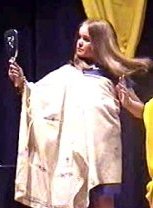
CassiopeiaThe one area in which Ross was able to shine at Setti Carraro was acting. The best teacher they had (and she was very good) believed in drama as a form of literature, and a way of learning literature. In 6th grade, they studied Greek myths, and did a series of short plays based on myth. Everyone got at least one major role, but Ross was a particular hit as Cassiopeia, the vain queen who brings down the curse of Venus. It was also noted, and duly exploited, that she learned everyone else’s lines as well as her own – no memory problems there, interestingly. In 7th grade, they did excerpts from “Orlando Furioso,” where Ross played Sacripante, a Sancho Panza sort of character, wearing a pillow for a paunch, and stomping around in my oversized Tibetan boots.