Tag Archives: Italian food

San Lorenzo Dinner at the Symposium Quattro Stagioni – Primi

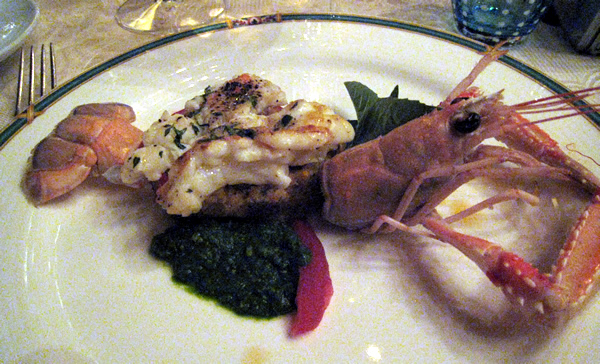
The starter was panzanella di pomodoro con scampi di Fano – tomato and bread with local scampi on a bed of arugula. As chef Lucio explained, this is a recipe inspired by the “fishermen of the hills” – those who, while owning a fishing boat down on the coast, live up in the hills, where they also have enough land to grow their own produce. Because they are farmers as well as fishermen, their cooking combines the flavors of the sea with those more traditionally associated with the countryside.

Whatever the inspiration, it was divine. I crave more of that stuffing-like panzanella bread, and would like to explore uses for it in other formats. If memory serves, with it we drank a Gavi di Gavi docg 2005.
penne

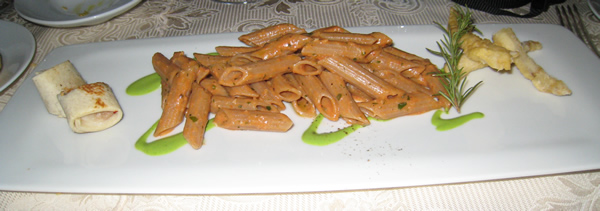
Then came Pasta di farro Latini con Sugo di Scorfano
dell’Adriatico
: penne made from spelt flour with a sauce of local scorpionfish. Sara told me that Latini brand pasta is supposed to be the best in Italy. I was sitting next to Sara’s French husband, Patrice, who agreed with me that he couldn’t really tell the difference between one pasta and another. Several of the Italians at the table stated categorically that there is a difference, but you have to be raised on pasta to appreciate it properly.

It was served with tiny sides: the rolled-up things on the left seemed to be sort of piadine (the Italian version of “wrap” sandwiches) with ham and cheese inside. On the right you see three strips of delicately batter-fried fish filet – I would have been happy to eat a lot more of that.
tartufo

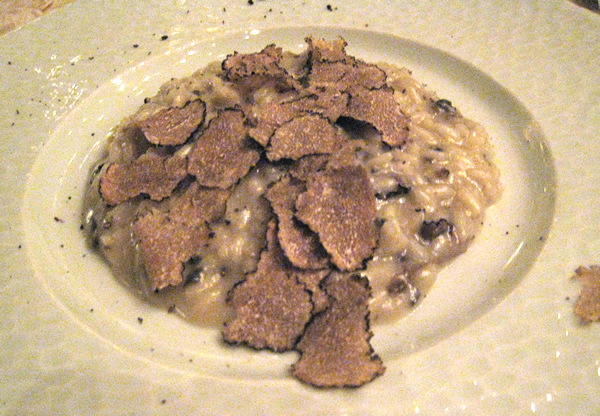
Next came Carnaroli Gran Riserva con Pecorino e Tartufo
Nero
risotto with sheep’s milk cheese and black truffle (that’s the black-edged stuff you see in slices over the top). I have not in the past been crazy about truffle, and feared this dish would be wasted on me. It was not. It was the best risotto I’ve had in my life, and two of the Italians in the group said that, as natives of regions specializing in risotto, they could testify that this was “un risotto come si deve” (risotto made the way it’s meant to be).

Wine with the pasta and risotto was Vernaccia di San Giminiano docg 2005.
San Lorenzo Dinner at the Symposium Quattro Stagioni: Aperitivi

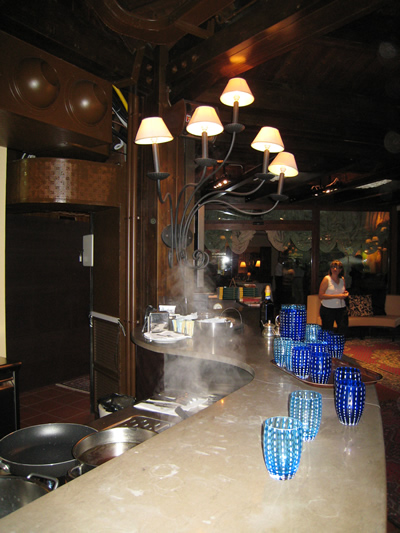
Much of the action at Symposium takes place behind the large, curved bar in the dining room, where patrons are welcome to lean over, watch, and ask questions.
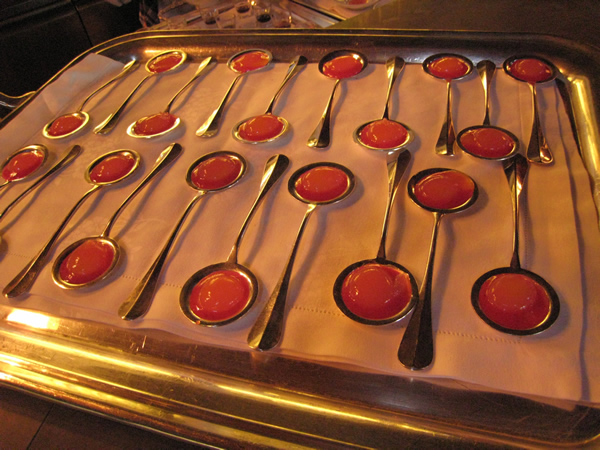
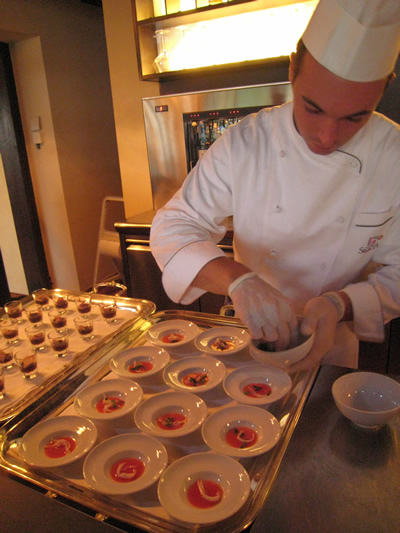
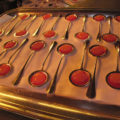
barFrom the time we arrived, Danilo was busy preparing five different nibbles for the aperitivi di benvenuto. The spoonfuls shown above, designed to be reminiscent of “an American cocktail of the 70s,” were an orange cream enclosed in a liquor-flavored gelatin resting on a strawberry cream.
danilo
Above you see on the left vetrines containing truffle broth and slivers of sea urchin (the fishiest seafood I have tasted to date). These were later topped with an onion cream.

The bowls on the right later contained fried quail’s eggs with an olive topping; I don’t remember what the orange sauce was.

Not shown is a vetrine of venison with a watermelon sauce, a most interesting combination of flavors (not so surprising to me – I often serve meat with fruit, though watermelon wouldn’t have occurred to me!).

We washed all this down with San Lorenzo’s Franciacorta docg Brut Millesimato 2003 – a nice dry bubbly.

Italian Restaurant: La Quercia di Rosa

On our way down to Abruzzo for my mother-in-law’s 80th birthday, we stopped for lunch near Modena, the home of balsamic vinegar. Quite by accident (although this kind of accident is not unusual in Italy), we found an excellent restaurant, La Quercia di Rosa (the Rose Oak – ?).

They make their own balsamic vinegar, and, as the proprietress said, it’s so good that you can put it on everything or even drink it by itself as a digestivo (after-dinner digestive drink). The thin industrial balsamic vinegar that you can buy at the supermarket is only a very distant relation to this syrupy, sweet-sour nectar.

For starters, we had it sprinkled on aged parmigiano (parmesan cheese). The combination of flavors somehow reminded me of walnuts, though there was not a single nut in sight.

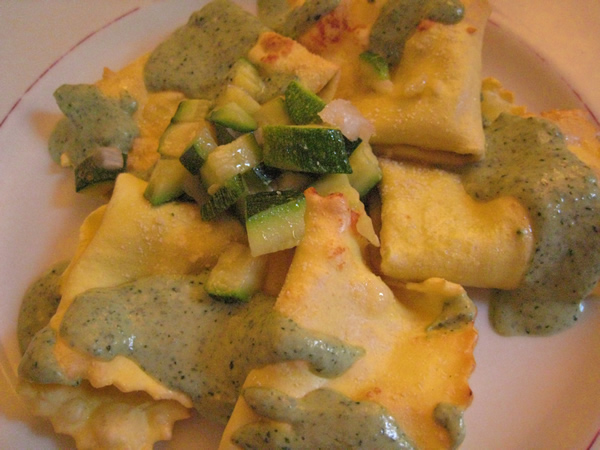
For my first course, I had pockets of lasagna dough baked with a zucchine filling, with a creamy basil sauce. Light, flavorful, and not too filling – perfect for the season.

Enrico had tagliatelle with fresh porcini (wild mushrooms) – also in season now and absolutely yummy.

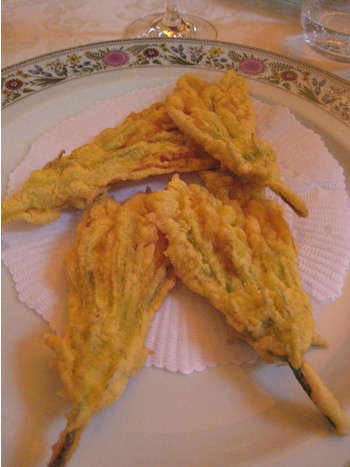
My second course was zucchine flowers, dipped in a light batter and deep fried. These were very good just as you see them above, and even better with a few drops of the house balsamic.

Enrico had tagliata di manzo (sliced steak) – very good meat, well flavored with rosemary and pepper. Ross had sole cooked with… balsamic vinegar!

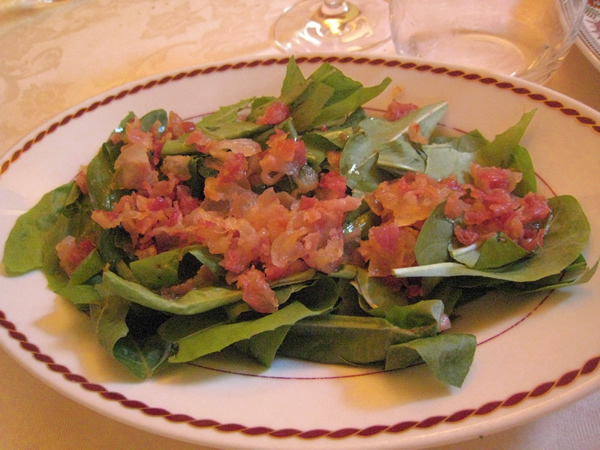
As a side dish, Enrico and I shared radicchio di campo (field greens) with a dressing of crispy pancetta (bacon – unusually for Italy, sliced thin) – we put some balsamic on that, too.

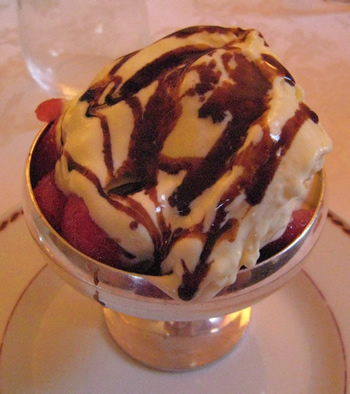
We were not surprised to notice a flask of balsamic vinegar on the dessert cart. I asked what it was used for in desserts, and here’s what I had:

Fresh strawberries with gelato di panna (cream-flavored ice cream) and balsamic vinegar. Heaven!

Total cost of the meal for three of us (two primi, three secondi, three desserts, half-bottle of wine, lots of water) was just over 100 euros.

La Quercia di Rosa

via Scartazza 22

localita’ Fossalta

41100 Modena

phone 059 280 730

email querciadirosa@libero.it

closed Tuesdays

more information about real, traditional balsamic vinegar

Italian Garden 2007: July

Unintended Consequences

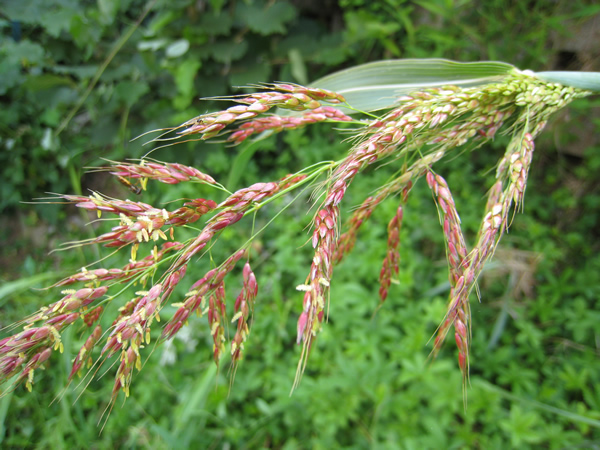
Here’s what happens when I leave my garden unattended: I get beautiful wild grains like the above – otherwise known as weeds.

A weed I had been assiduously removing (but, obviously, missed one) turns out to have charming puffy purple blossoms.

The insalata riccia (curly lettuce) bolted into meter-high stalks with delicate blossoms. Wasn’t very edible at this point, however, so I took some pictures, tore it all up, and planted onions, herbs, and more lettuce in that space.

The wild fig that I never even planted, in the lower wall, came out with a promising crop of fruit.

And the vegetables just kept on producing – I picked our first tomatoes this morning.

Italy’s Amazing Summer Fruits

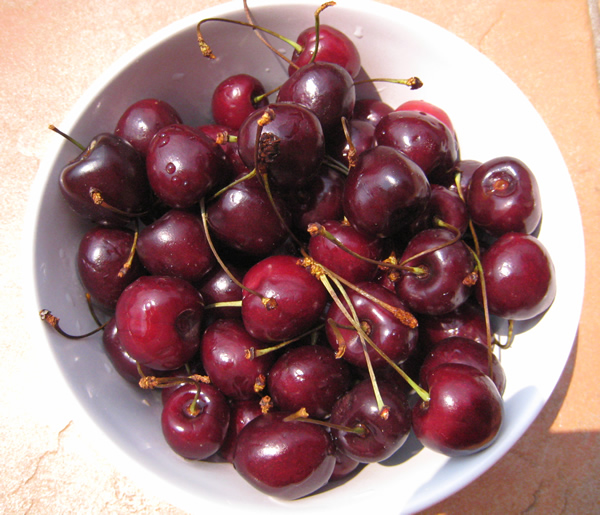
Summer has arrived, and with it everyone’s favorite fruits – along with the desire to mangiare leggero (“eat light”) in the heat. At this time of year it’s not unusual to see mounds of cherries served as dessert, antipasto, or snack at parties and dinners. Juicy, sweet, bursting with flavor, all these need is a place to discard the pits and stems:

An Italian saying related to cherries (and applied to other things) is: una tira l’altra (“one pulls another”), as in: “I ate so many because they just kept coming out of the bowl, one after the other, their stems entangled…”

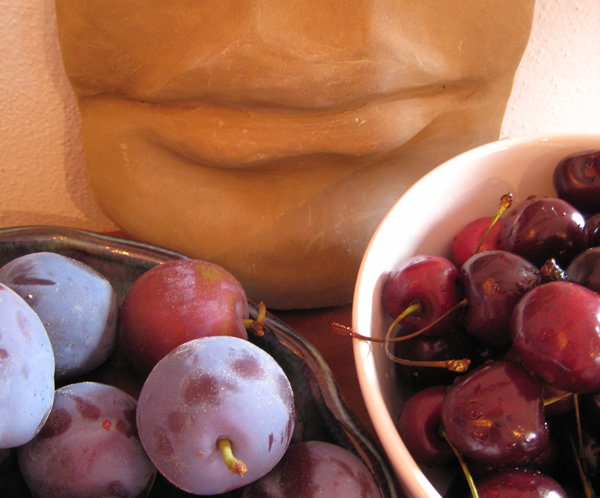
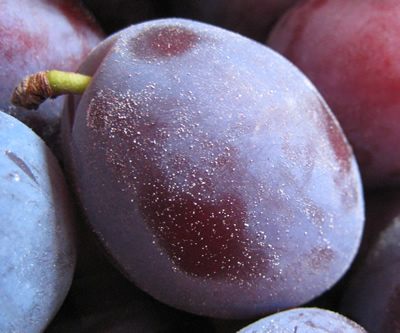
Have you ever seen more perfect plums? They come in many varieties and colors (blue, red, yellow, pink, purple), and all taste as good as they look:

If you’re visiting Italy in summer, here’s a restaurant tip: instead of dessert, order frutta di stagione (seasonal fruit). You may be asked what you want specifically, so here’s a little vocabulary:

  • pesche [PESS-kay] peaches
  • prugne [PROON-yay] plums
  • albicocche [al-bi-KOK-kay] apricots
  • ciliegie [chili-AY-JAY] cherries
  • pesche noci [PESS-kay NO-chee] nectarines
  • fichi [FEE-key] figs – these are often served as an antipasto, with prosciutto crudo – don’t miss it!
  • lamponi [lam-PONE-ee] raspberries
  • mirtilli [meer-TEEL-lee] blueberries

NB: Berries are known collectively as frutti di bosco (“forest fruits”). If you get a chance to eat fresh-picked wild blueberries (very occasionally available at restaurants and fruitsellers) do NOT pass it up. If you hike, keep your eyes peeled: you can find wild raspberries and blackberries free for the picking.

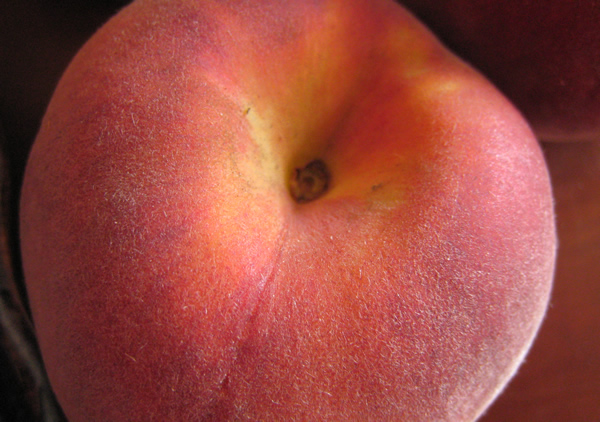
Peaches, plums, apricots, and cherries may be served floating in, or alongside, a large bowl of cold water. Dip the fruit in and swish it around to clean it, then eat! Many Italians peel their peaches with a knife before eating (often they are so ripe that the peel will slip away from the flesh with very little assistance), but you’re not obliged to – you’ll find that the skin is much thinner than you’re used to on American peaches.

sculpture above done by Ross when she attended liceo artistico