Tag Archives: Italy travel

Milano: Italy’s Under-Appreciated City

Going to Milan for the Expo? Check out these great tips on  Where to Eat, Play and Stay and What You Need to Know.

FAQs

Getting from the airport to the city:

Left luggage room at Malpensa: on the Arrivals floor, go down the corridor to the right (past the bus/train ticket office) and you’ll see it on your left. They will x-ray your luggage and charge 2.50 euros per piece per day.

Getting around Milan: public transport.

Taxis can be found at marked taxi stands throughout the city, or can be called at any of these numbers: 02-8585, 02-6969, 02-4040 (if you need a taxi at a particular time, you can reserve in advance). They are not allowed to stop for pickup just anywhere, so it is usually ineffective to try to flag them down. Taxis in Milan are expensive. A taxi from the city to Malpensa airport will cost at least 100 euros.
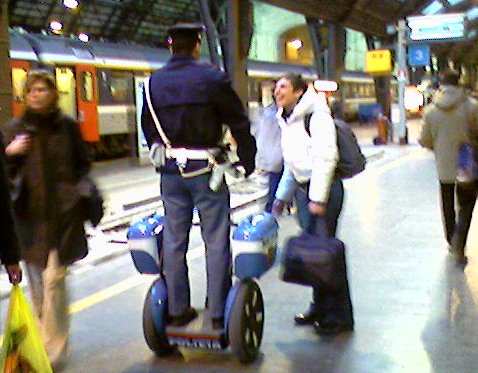
March, 2006, Milan Central Station - the police have new toys!

In Defense of Milan

Nov 14, 2003

Many travelers to Italy seem to be stuck in a rut: the travel forums are an endless litany of Florence, Rome, and Venice. Personally, I don’t even like Florence, but I’ll save that rant for another time. (I hate crowds, especially crowds of tourists where I’m likely to be thought one of them.) So I like to go to the out-of-the-way places, a few of which are mentioned here on my site.

Poor Milan is very mistreated by would-be tourists. Travelers advise each other to skip it: “There’s nothing worth seeing.€”

I beg to differ. Leonardo da Vinci spent some of his most productive years in Milan; we have a castle (Castello Sforzesco) and the Last Supperto prove it. It took me ten years to get to the Last Supper, and I wish I’d gone sooner. Book tickets for the Last Supper here – most of the year you do need to book in advance.

If you care at all about classical music (including opera and ballet), there’s La Scala.

If you like shopping, Milan is one of the fashion and shopping capitals of the world. It’s great fun simply to walk around and look, even if you’re not buying. See it in Milan first; you’ll be wearing it in the US next year.

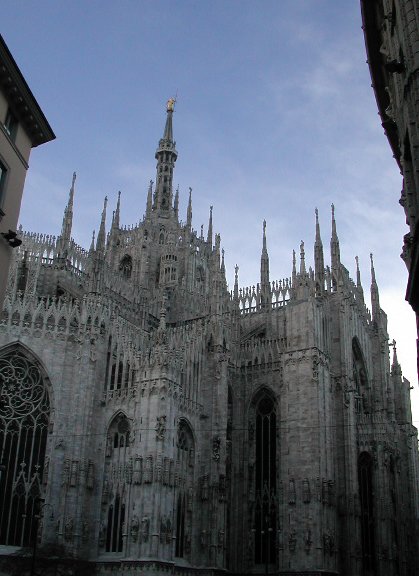
Oh, yes, and there’s also the Duomo, one of the world’s largest and most overdone cathedrals; think of it as fractal Gothic. 600 years and they’re still building on.

Milan is also within easy reach of some of the most beautiful places in the world, such as Lake Como.
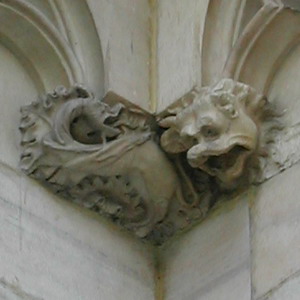
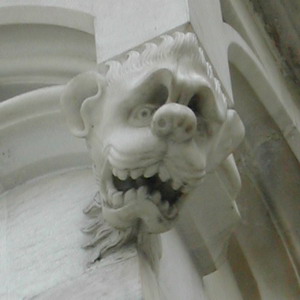
detail, Milan Duomodetail, Milan Duomo

Shopping

Milan has what is probably the world’s oldest shopping mall, the originalGalleria, in the heart of downtown next to the Duomo. But you won’t find “big box” malls such as they have in the US. There are a few, way outside town, but they are mostly discount stores and not very exciting unless you live here. Way, WAAAAY out of town there is the Serravalle Outlet Mall. I’ve never been there, but it’s been favorably covered in the New York Times.

If you want high-fashion clothing and are willing to pay Milan prices (ouch!), the fashion district is also near downtown, around via Montenapoleone and via della Spiga. The shops in Corso Vittorio Emmanuele are slightly more reasonably-priced, cheaper still is Corso Buenos Aires.

The Economist Guide to Shopping in Milan
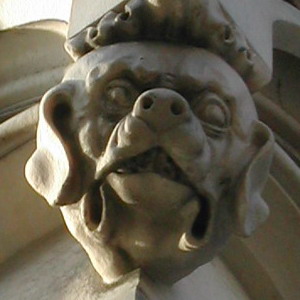
detail, Milan Duomo

Feeling the Seasons in Italy

First week in August, and most of Italy is shutting down, except the beaches and some mountain resorts, which are booming with Italian vacationers. The cities will be largely left to foreign tourists and those who serve them. Kids are off school from mid-June to mid-September, and many adults take off all or most of August.

You might think this an example of “typical” Italian laziness, but the situation down here on the ground makes it clear: it’s too darn hot. In the afternoons, when it’s muggy and even the air is too hot to move, it’s simply impossible to concentrate, and all you want to do is sleep. No one can be expected to be productive; you might as well give in to Mother Nature and go on vacation.

It used to be that way in the US as well, until the invention of air-conditioning. I read somewhere that the pace of government picked up amazingly when A/C was introduced to muggy, swampy Washington.

But most of Italy is not air-conditioned. Except in some offices, I’ve never seen central A/C here the way it’s done in the US. Due to the high cost of electricity, not many families even have room air conditioners. During this June’s heat wave, so many rushed out to buy air conditioners that the national power grid couldn’t cope, and there were rolling blackouts.

Ourselves, we make do with fans, and I’ve become so unaccustomed to A/C that I’m always cold in the US. I prefer not being insulated away from the seasons, no matter how uncomfortable they sometimes get. Here in Lecco I’ve learned that there’s a wonderful breeze off the lake in the morning, so I get up early and open all the windows on the windward side of the house, cooling down and airing out the stuffiness of the night (when windows and shutters on the balcony side have to be closed, for fear of burglars). Around noon I’ll close it all up, to retain the cool when the sun moves around to that side and only hot air blows in. And then I’ll take a nap.

50 Ways to Flush a Toilet

In the Brussels airport, I saw a new piece of technology that I just had to try out: the Lady P Urinoir (in the ladies’ bathroom, naturally). There were written instructions in four languages: “1. Assume skiing position.”

Fortunately, there were also stick-figure illustrations, otherwise I would have had to puzzle about “skiing position,” not being a skier. This instruction displays a certain cultural insensitivity; surely, at an international airport, they don’t think that every visitor knows how to ski?

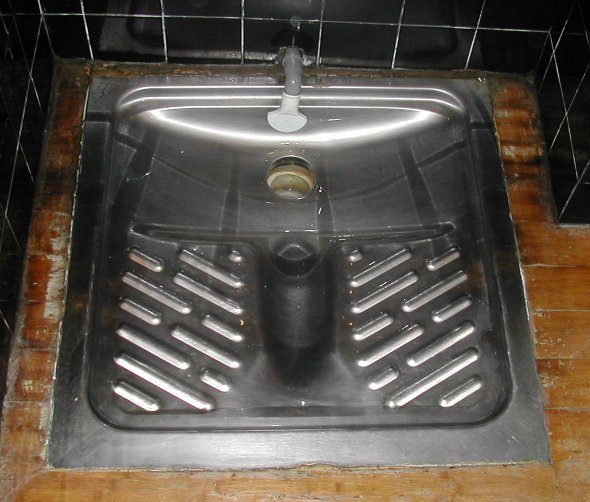
It would be useful if other kinds of toilets also came with instructions. I’ve never seen such a bewildering variety of toilets as I have in Italy. The part you sit on is standard (unless you encounter an old-fashioned squatter; some Americans might be confounded by this), but working out how to flush it may be a challenge.

Here are a few of the options I’ve seen:

American-style tank behind the seat, with flush on upper right corner. The flush may be a button on top of the tank, or a plastic tab sticking out of the upper right side of the tank.

High wall-mounted tank (nostalgia items for some of us), with a pull chain dangling down.

Tank or flush pipes hidden in the wall. Here’s where it gets tricky; there are a zillion ways to flush these things, including:

  • A simple handle that you turn to open a faucet; let the water run til the evidence is flushed away. This ecologically sound – you use exactly as much water as needed – but it’s frustrating when water pressure is low and you’re in a hurry to leave the bathroom.
  • Buttons on the wall somewhere, usually (but not always) above the seat. This can be a small metal button, or a round plastic one, mounted on a larger plastic plate, that you push once to flush. The cleverest I’ve seen is the double button, a trapezoidal shape divided into larger and smaller sections. I assume that this is a water-saving feature, where the size of the section determines the size of the flush: push the small button for a small job, the big button for a bigger job, or, if you’re really worried, both buttons together.
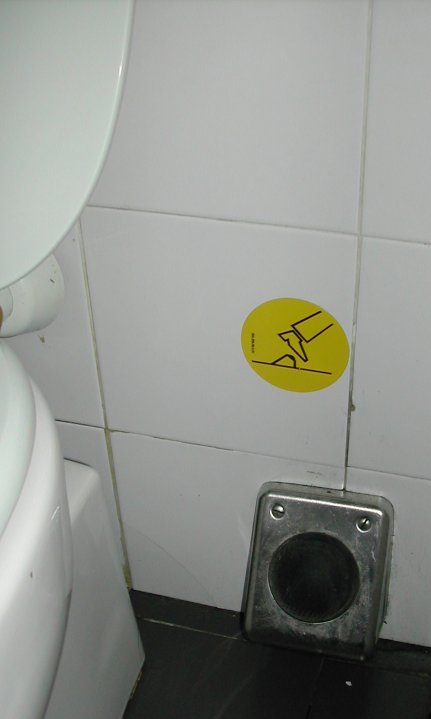
  • Step-on rubber button near the floor, sticks out at an angle, usually on the right side of the bowl. Step on it hard for as long as you want the flush to last.
  • A round plastic button sticking out of the wall at waist level next to the toilet, where you’d more or less spot it while you’re sitting, but may not notice it when you stand up
flush

Note that the “helpful” graphic shows an impossible foot position.

  • Wave-activated sensor. When you’re done, wave your hand in front of the photocell on the wall behind the bowl (there’s an illustration encouraging you to do this), and the flush will take care of itself.
  • Automatic flush. These are supposed to detect when you sit down and when you get up again, but they are almost always miscalibrated and go off while you’re still sitting. And they tend to flush hard – eeyow! that water’s cold! Worse, this is the type most commonly found in roadside rest stops, where the bathrooms are not heated in winter.

When you’ve conquered the toilet, you face the challenge of washing your hands. Many bathroom sinks are equipped with photo sensors, but these can be fussy. I have one friend whose hands are transparent to them – no amount of waving around will get her any water; someone else has to put their hand in front of the sensor for her. Some faucets are activated by pedals on the floor, one for hot and one for cold – highly sanitary, as you don’t have to touch anything with the hands you’re trying to clean. I’ve even seen sensor-activated soap dispensers!

The Unbearable Lightness of Peeing

Had a good laugh at your article on ’50 Ways to Flush a Toilet’. I laughed louder at the German description of the P-lady:

Translated (approximately – have to go from German to Dutch to English):

[NB: Translation based on text at a previous link.]

“Compared to a conventional toilet, the Lady P. is much smaller, more compact, but with its peculiar(*) form it radiates warmth and a certain degree of cosiness(*)”

I have never in my life associated cold white porcelain with “warmth” and “cosiness”, so I wonder if they also produce office furniture. If they can make a toilet radiate warmth, imagine what they could do with a desk or chair!

(*) – Used a Dutch to English dictionary…

Mike Looijmans


Another American looks at Italian toilets, with photos (site not for the squeamish!).

Holiday Hell – Italian Vacation Traffic

Almost every Christmas, we drive halfway down Italy to Abruzzo, where my in-laws are retired by the seaside. This puts us on the road with millions of other Italians going home for the holidays. Much of the flow is north to south: the many southern Italians who migrated to northern Italy decades ago to find work, but still have strong family ties in Sicily, Calabria, etc. So we are part of the grand “exodus,” carefully monitored by the media, with pre-analysis, traffic predictions, minute-by-minute developments, and (afterwards) death toll reports. In recent years we’ve driven on the 24th, when there’s the least traffic (except Christmas Day itself, which we may resort to one of these years). The Sunday before Christmas is also good, as no trucks are allowed on the highways.

There are trains, of course, but travelling by train with a lot of luggage is a pain, and trains have their own risks: The holiday season is when many public services choose to cause the greatest possible disruption, by going on strike. Trains don’t do it too often, but everyone else does. Public transit workers in Milan, Rome, and Genova were on strike for several days during the week before Christmas, causing huge traffic jams as everyone then had to drive to work. This probably put a considerable dent in holiday shopping; I suspect shop owners are not feeling very charitable about anyone’s right to strike at the moment.

Then another protest group got into the act. Italian milk producers are aggrieved because they keep getting fined for producing more milk than European Union quotas allow. For the last several years, they have brought attention to their plight (and won government support for discounts on their fines) by blocking major roads around Milan just before Christmas, particularly near Linate airport. There have been cases (though not this year) of holiday travelers having to walk the last five kilometers to the airport, carrying their own luggage.

(No, this has nothing to do with Parmalat, and I will refrain from any Parmalat jokes as I am sick of them already.)

Between Christmas and New Year’s there is a smaller but still significant movement of people, as many, having spent the obligatory “Natale con i tuoi” (Christmas with your family), now escape to go skiing or for more exotic destinations.

The big “counter-exodus,” of people returning to their working homes from wherever they’ve been, takes place around the Epiphany, January 6th. This year the air traffic controllers are adding to the fun by going on strike January 8th.