Tag Archives: living in Italy

Hospital Stay

I have suddenly landed a temporary but demanding job: nursing my daughter. Ross fell off her horse Sunday afternoon, onto hard ground, and broke her humerus just below the shoulder joint.

The emergency room was humming – it was a beautiful day, everyone was out getting hurt. Just before we got there, an ambulance had brought in a young man in motorcycle leathers, who looked pretty severely injured. According to a conversation I heard among the nurses, Lecco gets a lot of motorcyclists – and accidents – on sunny weekends. Another young man had been out hiking in the mountains, slipped on a patch of ice, and banged his head and chin.

They quickly got Ross through an initial examination and x-ray, drew blood, then took us up to a room on the orthopedic ward. Ross was trembling when the anesthesiologist came to talk to her; given recent family horror stories with hospitals, we were all terrified that she had to go under anesthesia. But those stories took place in the US and the UK. So far, I have no complaints about Italian health care. [later on, we had an Italian horror story to add to the family history]

The anesthesiologist gave her a sedative, and off we went to surgery. Ross told me later that, by the time they actually got her into the operating room, she was giggling and wondering why she had been so scared. She lay there looking at all the bustle around her, wondering if they had a machine that goes “ping!”

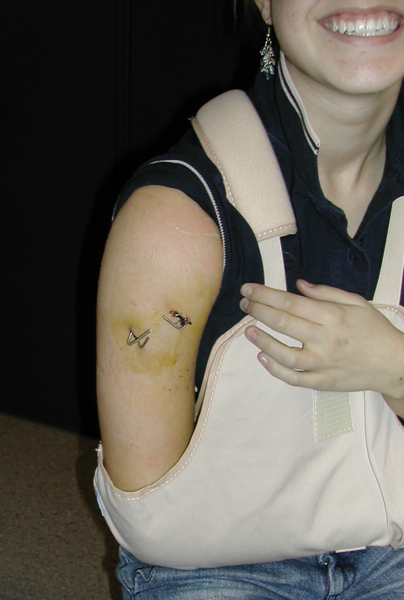
We had arrived at the emergency room at 5:15; by 7:15 she was under. The surgeon had to pull the bone back into place, and then put in three wires to hold it while it heals; Ross is also wearing a sling-and-strap to hold her arm against her body. Her right arm. No drawing in art school for a while.

Giulio (owner of the private stable where we now keep Hamish) and Viola (his daughter, Ross’ classmate and riding buddy) came racing down from their ski weekend to be there, and passed the time during surgery regaling me with stories about their numerous family sports injuries (they ride and ski, Giulio and Viola compete seriously at both). As Giulio pointed out, it’s lucky this happened right before Christmas vacation, so Ross won’t miss too much school.

Giulio also demonstrated the usefulness of the small-town grapevine: when he heard the name of the surgeon, he called his sister-in-law, who happens to work at the hospital as an orthopedic surgical nurse. She said that we were lucky: this surgeon’s a good one. And she came by the next morning to see us in person. If we need any inside information on this case, we’ll know where to get it.

There was a spare bed in Ross’ room, so I was allowed to stay with her. The first night she was in a lot of pain, understandably, but since then has bounced back with most of her usual energy and sense of humor. They let her out yesterday (Tuesday), and today she’s gone back to school (the doctor said there was no reason she shouldn’t, as long as her arm doesn’t get bumped). She’ll need to have the bandage changed every 3 or 4 days, to ensure that no infection enters where the wires are; those will come out after 25 days, and she has to keep wearing the sling til then. So I’ll be accompanying her to doctors a lot, as well as helping her dress, wash her hair, etc. As I said, it’s a job. But that’s what moms are for.

Jan 19, 2004

Rossella‘s arm has healed well. The wounds (from the surgery) were so clean that her bandage needed changing only three or four times over the month. Last Tuesday we went in for a final x-ray and, seeing that everything looked fine, the doctor pulled out the wires, using a pair of common (even somewhat rusty) household pliers. According to Ross, it felt weird, and the idea was gross, but it didn’t actually hurt.

So now she’s down to band-aids over the holes, and only needs to wear the sling at night. We’re trying to schedule physical therapy; in the meantime, she can use her right arm again, as long as she avoids swinging it out from the shoulder – no dancing the Funky Chicken..

The hospital staff were amused: Ross is the only patient in their experience who wanted a picture (while the wires were still sticking out – her arm looked like a construction site), and to keep the wires as a souvenir. But, as they noted, this attitude coincided with the Clockwork Orange t-shirt she was wearing.

Of course she wanted to keep the wires; she couldn’t wait to tell her schoolmates: “Piercing? Hah! I’ll show you REAL piercing.”


Apr 27, 2004

Ross has healed up fine from breaking her arm in December, and is back in the saddle of her beloved Hamish. She’s had some moments of fear, but is gradually feeling comfortable riding again (it was totally up to her to do so; her father and I might have been just as happy for her to give it up now).
Parents Beware: Inappropriate Ads in Italian Cinemas

The other night we went to see “Alla Ricerca di Nemo,” a children’s movie whose original title I think you can figure out. Ross and I had already seen it in the States, but Enrico hadn’t, and it was worth seeing again. The dubbing was very well done, even the difficult Ellen deGeneres character, and the many small children in the audience clearly enjoyed it.

The problem came before the movie started. In Italy, it’s usual before a film starts to show product advertisements (often the same ads you see on TV), as well as upcoming movie trailers. That evening, the very first ad was for a video game: “True Crime: Streets of LA”. In the US, this game is rated for ages 17 and over, as the trailer also should be – it’s all about the violence. Another ad was for a local radio station, an arty black-and-white montage of scenes from everyday life, including a nearly R-rated one of a couple making love.

In the US this could never happen (trailers are carefully rated and shown appropriately), and if it did, there’d be a storm of protest and probably lawsuits for traumatizing the kids. There was no comment in the Italian cinema. Admittedly, most of the kids were still bouncing around and making too much noise to even notice the first ad. Maybe Italian parents are used to this kind of thing and that’s why they don’t make their kids settle down when the ads begin (plus, given chronic Italian lateness, people are still bustling into the cinema during the trailers).

This reminds me of a similar incident from my childhood in Bangkok. I was going to see a kids’ movie, but the trailer was for one of those cannibal horror movies, and showed all the worst scenes – people’s guts being torn out and eaten etc. As you may recall, I am a complete wimp at movies, so this remained seared into my consciousness for years.

An American Thanksgiving in Italy

Our Thanksgiving dinner was, if I say so myself, epic. I printed out the menu in that fancy font that restaurants always use, so people wouldn’t have to ask me what they were eating; here, of course, I’ve added extensive notes.

Antipasti Vari (various antipasti) – Paola brought mini breads, we supplied salame. I didn’t do much on antipasti because so much other food was coming.

Tacchino al Forno (oven-roasted turkey) – The guests were mostly Italian, many of whom had never seen a whole turkey cooked American style. By American standards, this was a very titchy turkey – less than 13 pounds. In the US you can select from a whole range of turkey sizes; here in Italy, you either take the small female (which I did) or the humungous male. The smaller one turned out to fit all right in the 40 cm roasting pan I had bought.

I used some American technology, a Reynolds oven bag that I bought in the US two years ago on Sue’s recommendation. I filled the turkey cavity with mandarin oranges, onions, and herbes de Provence; we didn’t eat this filling, but it helped produce marvellous gravy.

Ripieno di Pane al Mais con Marroni (cornbread stuffing with chestnuts) – A Martha Stewart recipe, bless her. Martha expected me to have canned or frozen chestnuts. Here in Italy, in season, you can find fresh chestnuts in the woods yourself (difficult – everyone else wants them, too!) or buy them at the supermarket, which I did. I then roasted them in the oven and peeled them. Labor-intensive, but worth it. In my opinion, roast chestnuts by themselves smell a lot better than they taste, but when you cook them with meat or in a stuffing like this, they’re heavenly. Stuffing is unknown in Italy, and turned out to be very popular.

Insalata di Finocchio e Mela (salad of fennel and apples) – Another thanks to Martha. Everyone loved the unusual combination.

Puré di Broccoletti e Spinaci (broccoli and spinach puree) – Recipe from The New Basics Cookbook by Rosso and Lukins. Not the most popular dish on the table, especially with my family since I had made a test batch last week and we’d already had enough of it, though we liked it a lot the first time around. I’ve frozen the leftovers to eat when we’re no longer sick of it.

Fagiolini con Gorgonzola e Noci (green beans with gorgonzola and walnuts) – New Basics again, easy and tasty.

Puré di Patate (mashed potatoes) – Everyone loves €˜em. Fortunately, I had help with peeling and chopping 4 kilos of potatoes.

Selezione di Formaggi con Salse (selection of cheeses with chutneys and honey) – One of the guests brought cheeses, and I had also bought some, plus I had made two chutneys, tomato and dried apricot. Don’t be overly impressed – chutney is very easy to make. These recipes were from Madhur Jaffrey. We also had dark honey (from chestnut flowers), which goes well with many cheeses.

Dolci (sweets) – Maryellen brought a wonderful pumpkin pie which she made completely from scratch (canned pumpkin is not widely available here), Elisabetta made a scrumptious chocolate cake with pears – You’ve never had that? It’s an Italian tradition. You put thin slices of fresh pear into a fairly standard chocolate cake (it may be necessary to correct for moisture; I have not actually done this myself) – it’s a wonderful combination. Rossella had made chocolate chip cookies and brownies, but we never even got to the brownies. Her classmates have been happy to polish those off for us.

Recipe Links

Martha Stewart (and many others)

Other Madhur Jaffrey recipe books

Making Room: Italian Stratagems for Living in Small Spaces

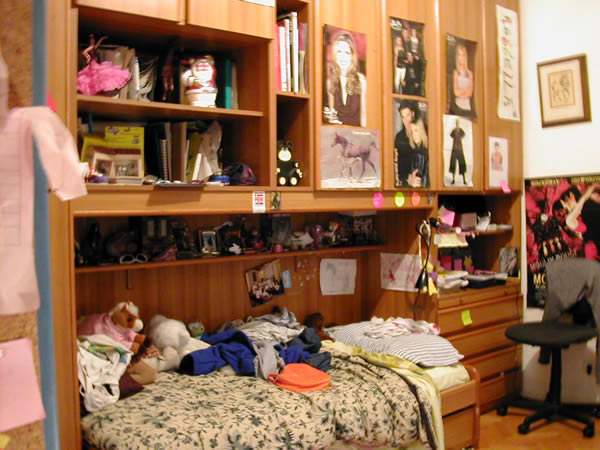
^ top cameretta a ponte in Ross’ room in Milan. Where the chair is at right, a desktop slides out, though Ross never used it that way. (This fuzzygraph is Ross’ early work when we got our first digital camera.)

Living space is tight in Italian cities, which are often geographically constrained because built into, on top of, or between mountains – the kind of urban sprawl you see in America simply can’t occur in most parts of Italy.

Even where there is room to spread out, historically Italians tended not to. This may be due to centuries of history: until recently, Italy was a collection of separate city-states which were often at war with their neighbors; people huddled into fortress towns and cities for safety, and many Italians have never lost this preference for living close together.

Urban Italians have been living in apartments, condos, and townhouses since Roman times. The apartment building was invented in ancient Rome, and even in those days single-family dwellings were only for very rich families. Italian cities today are almost entirely apartment buildings, four to five stories tall in mid-sized towns, eight to ten in larger cities. In many buildings, the lowest floor sare reserved for commercial use. Where we lived in Milan, we had a greengrocer, bar/gelateria, baker, and butcher right downstairs – extremely convenient, since I was always forgetting something in my shopping.

The primo piano (first floor above ground level) is undesirable to live on, partly because of pollution, partly because it’s more vulnerable to housebreaking (that’s why you often see bars on the lower windows of older buildings); first floor apartments are often used as offices.

The higher up you go, the higher the value of the real estate, because the higher floors get more light and air and less pollution, and are less susceptible to being robbed. But the floor space remains the same – usually small. So how do you fit, say, three people, with all their possessions, into 70 square meters (~750 square feet)?

One way is to go vertical. Ceilings in Italy are higher than the American average, (although they’ve gotten lower in modern buildings). You build your bookcases go all the way to the ceiling. Closets are divided vertically into two sections: use the top sections for out-of-season clothing, lifting the clothes on hangers up to the high rod with a long-handled hook.

In some old buildings, the ceilings are so high that apartment owners are able to build in a loft. If you don’t want to go to that much trouble or expense, you can buy a loft bed from Ikea, which leaves a nice workspace underneath. I’ve been tempted by those, but I’m scared of heights, I get up a lot at night, and getting sheets onto such a bed looks like a hassle.

Bunkbeds and loft beds are quite common for kids’ rooms, often built into closet/desk/bed units called camerette (little rooms). A cameretta a ponte (“with a bridge”) has part of the closet built over the bed. There are entire furniture stores devoted to camerette in every conceivable style, some of them the kind of fun furniture kids dream about, with playspace under the bed, a miniature staircase going up to a loft bed (the steps lift up to provide storage space) and/or a slide for disembunking.

  • also see: Housing: How Italians Live
  • My Attitude Towards Italy

    I received email from someone who had visited my website, read a few articles, and concluded that I don’t like Italy much. I am confused by this, especially since the articles she cited (BabiesHomes, and one other, I forget which) didn’t strike me as negative. I see my articles as statements of fact, though written in a wryly ironic tone that might confuse some people, especially if they come looking for “Under the Tuscan Sun”-style warm fuzzies about Italy.

    So, in case it needs clarifying, let me clarify: I do love Italy, and am very happy to live here. It’s probably the best place in the world for me to live, and, even if it wasn’t, my family is there, and that pretty much settles the question.

    But I don’t love Italy blindly. I didn’t move here because I had always dreamed of living here*. So I don’t have particular dreams about Italy to keep alive, and can allow myself to see the bad as well as the good. And I’m not trying to make money out of writing about Italy (well, it would be nice…), so I don’t have to write the kind of sunshine-and-red-wine stuff that most people seem to want to read. The Italy I live in has much to recommend it, but it’s not the Italy you see in glossy coffee-table books. The Italian families I know are not the warm, boisterous, suffocating crowds you see in American sit-coms and movies. My family, friends, and neighbors are real, modern Italians, who rarely conform to Italian-American stereotypes.

    I’m beginning to think that I should write a book about real life in Italy. Not to scare people off, but to point out that daily life in Italy has its own stresses and pains, just as daily life anywhere does. A good bottle of wine with a good meal is a lovely thing to have (even better when combined with a marvelous view), but it doesn’t cure all ills.

    You know what’s really ironic? The average Italian on the street is astonished that I would rather live in Italy than America, or that anyone would (I have had this conversation with many taxi drivers). Like much of the rest of the world, Italians see America as the land of opportunity and riches, of wide open spaces and huge houses. Most of them would not willingly leave Italy permanently, yet they seem to wish that they could participate in the American dream. And they are absolutely floored to be told that many Americans dream – of living in Italy.

    *If you’re wondering why I did move here… go here.