Tag Archives: living in Italy

How My Italian Adventure Began

Strangely enough, my Italian adventure began in India. In June, 1986, I finished up my study abroad year in Benares. It had been a fun but intense time, and I looked forward to a vacation in Mussoorie, my “home town,” site of Woodstock School. My dad was supposed to join me, having just finished a contract in Indonesia, and we would travel back to the States together. When I got to Mussoorie, I used most of my remaining rupees to rent a house on the Landour hillside. I was just settling in, organizing food deliveries with the various wallahs, getting scorpions out of the sink, etc., when a telegram arrived from Dad: “Not coming to India. I’m broke. Make your own way back to the US.”

Umm. This presented difficulties. I did have a return ticket, but we were now in the airlines’ peak season, so I’d have to pay a $100 premium to leave right away. Which was a lot of money in India then, and I didn’t have it. There was no prospect of getting the rent money back from the landlord, nor did I have enough cash to stick it out in Mussoorie til the end of peak season. So I went to Delhi, sold my beloved Nikon, and booked a flight out. I used more of my scarce cash to call my friend Julia at Yale. (We had seen each other the summer before, when she was just returning from her own study abroad year, in Italy, and I was just leaving for Benares.)

“I’m arriving in the States flat broke,” I said. “Please rescue me.”

“Of course,” she said. What are friends for?

I flew into New York on July 6th with $32 in my jeans pocket. Julia’s dad picked me up at Kennedy airport and took me to his home, where I stayed for two weeks, doing odd jobs at his printing company in Darien, CT. I figured I should earn enough to get back to Austin, where most of my stuff was, and I could live with my aunt Rosie til I figured out what to do next.

Julia was spending the summer in New Haven, so I took the train up from Darien to visit her. My return to the US had been so abrupt that she already had a full social schedule for the weekend, and all I could do was fall in with that.

“We have to have a picnic with this Italian guy,” she said, “because I told him I would. I think he likes me, but I’m not interested.”

I shrugged. Whatever. But I had time on my hands, Julia being off at an audition, so I baked banana bread. I had missed cooking in Benares.

When Enrico arrived, Julia introduced us, and I was careful to pronounce his name precisely, rolled R and all; it was oddly important to me to get it right. I don’t know what he saw when he looked at me; something exotic, no doubt: my hands were decorated with henna, a parting gift to myself in Delhi. The three of us picnicked in East Rock Park; Enrico loved the banana bread. After lunch he climbed a tall pine tree.

“Do you think he’s doing this to impress me?” asked Julia.

“No, I think he’s doing it because it’s fun,” I replied.

We parted in the afternoon knowing that we’d meet again in the evening; Enrico and Julia had both been invited to a party by a mutual friend. But Julia received a last-minute invitation to a classical music concert that she couldn’t bear to miss.

“Do you mind if I go? You can go to the party with Enrico.”

No, I didn’t mind.

I met other people at the party, but don’t remember them. Susan, now a family friend, years later said about that evening: “I had just broken up with someone, and had my eye on Enrico, but when I saw you two together, I knew there was no chance.”

We left the party for a concert on the New Haven Green, where we ran into Gabriel and Inger, friends of Enrico’s. The four of us went to a disco in Gabriel’s car, and stayed very late – the club provided a breakfast buffet. I kept trying to call Julia to let her know I wouldn’t be back that night, finally reached her around 3. “I’ll just crash at Enrico’s,” I said.

We did more than just crash. I guess I’ll never be able to lecture my daughter about not kissing on the first date. Oh, well. I never did play by The Rules, and look where it’s got me.

The next day I went back to work in Darien, not sure how to regard the events of the weekend. Just a fun fling, I first thought. Then Enrico began calling: “When are you coming back?”

It took several months. I first returned to Austin, where I realized that I actually had enough credits to graduate from the University of Texas with a degree in Asian Studies and Oriental & African Languages & Literatures (double major). I didn’t need to stay in Texas, and the economy was in a slump, so there didn’t seem much point. I might as well be… somewhere on the east coast?

My next port of refuge was with family friend Donna and her teenage daughter, in the Virginia suburbs of Washington, DC. I stayed with them for several months, working temp jobs to stay afloat. I looked for the cheapest possible way to get to New Haven, and found a ride board in one of the Congressional office buildings. A Federal employee with a large car drove every weekend to his other home in New York state, to tend his garden on the Hudson River. For a share of the gas costs, he’d get me as far as NYC, where I could catch a commuter train into Connecticut.

Also riding in the car that Friday was a woman with a wild history that she was eager to share with us. She was an anthropologist who had studied the Coptic Christians in Egypt, and for years had been the mistress of the prince of all the Copts. She told us lots of interesting things. The poor, mild-mannered Federal employee shrank into the leather seat of his Lincoln, turning various shades of crimson.

“So why are you going to New York?” she finally asked me. I explained that I was going to visit a graduate student at Yale with whom I might be starting a relationship.

“Oh, you can do better than that,” she said. “Let me fix you up with a rich man.” I declined, and continued on my way to New Haven.

Some weeks after this, I landed a “permanent” job as an administrative assistant in the political department of the American Consulting Engineers Council. (Which was an instructive look into the workings of K Street, but that’s another story.) The office overlooked a green square, diagonally across from a Washington Metro stop. So, when Enrico came to visit, he took the train to Penn Station, and then the Metro to meet me at the office. I waited eagerly, looking down from our 5th-floor window, and recognized him across the square by his walk. The thought floated into my mind: “That’s the man I’m going to marry.”

And I was right, though it took him another 18 months to figure it out.

How I Became an Italian Journalist

Soon after we moved to Italy in December, 1990, I read an article in Italia Publishers, a magazine about desktop publishing, in which the writer described his difficulties in finding a font for Hindi. Although he had never been to India, he had been studying the language in Milan for fun, and wanted to write the world’s first Hindi-Italian dictionary. “Well,” I thought, “I’m one of the few people in the world qualified to help him: I speak Hindi and Italian, and I know a lot about desktop publishing.” So I wrote him a letter, care of the magazine, proposing to collaborate on the project.

After a few weeks, the writer called me. The dictionary project had never taken off; he couldn’t find a publisher. “But the magazine editor wants to speak with you,” he said. There was a shortage of journalists who could write about computers, and they were willing to try me out. My first piece was a small review of a piece of Macintosh software, I don’t remember the name, it was an organizer/calendar with “personalities” that would talk to you. The editor of Applicando, then the leading Italian Mac magazine, liked this piece, and more work flowed in from him and other magazines in the same publishing stable.

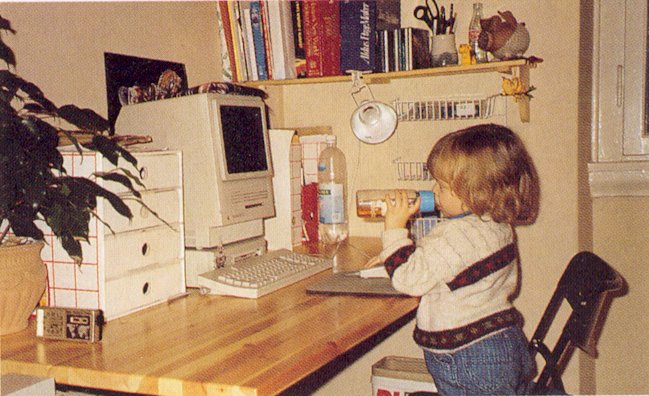
Another early piece was about “The Manhole,” kids’ software for the Macintosh which was more a world to explore than a game. We tested it on Rossella, then only two years old, who had no trouble picking up the concepts of the mouse and pointer. The review included a photo of her in front of the Mac, intent on the screen, with the mouse in one hand and her bottle in the other. NB: The guys who did “The Manhole” later on went on to do Myst.

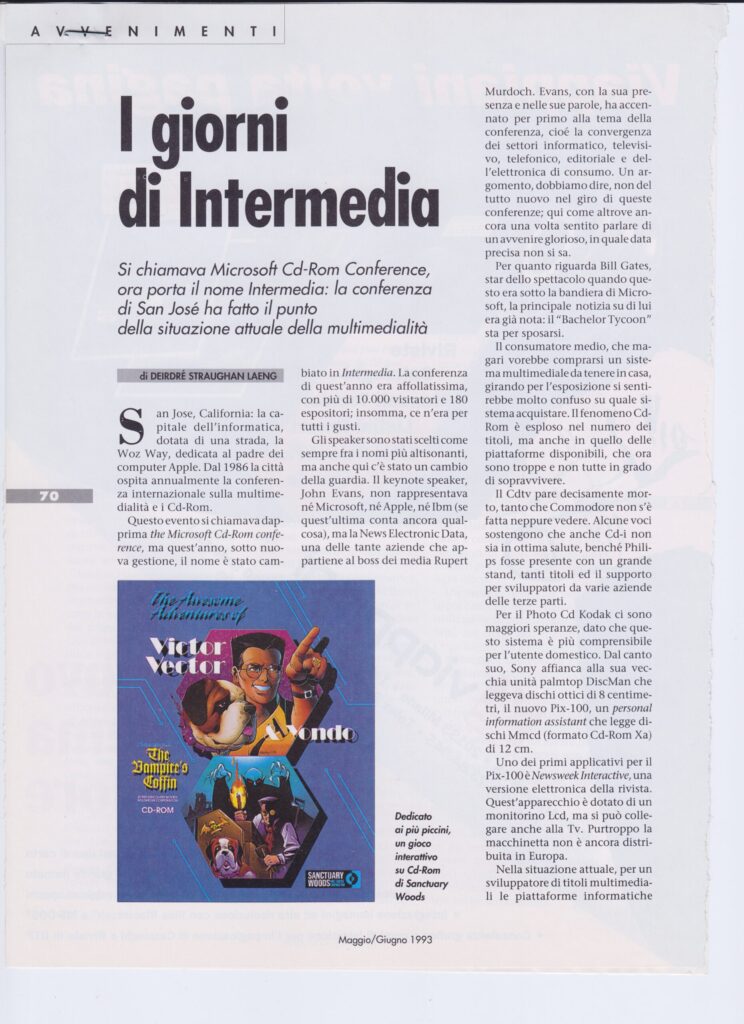
The writing didn’t pay well, but there were perks. I got to go to Edinburgh on a junket paid by Aldus (the company that created PageMaker desktop publishing software). All I had to do was write an article about their new product announcements. I helped pay a couple of trips to Boston by writing articles about the Seybold Conference, to which I got free entrance as an accredited journalist (though I was badly snubbed by a “real” computer journalist I had idolized, Denise Caruso). And I got into the Microsoft CD-ROM Conference in San Jose the same way; by then, Fabrizio and I were going to the conference for other reasons as well.

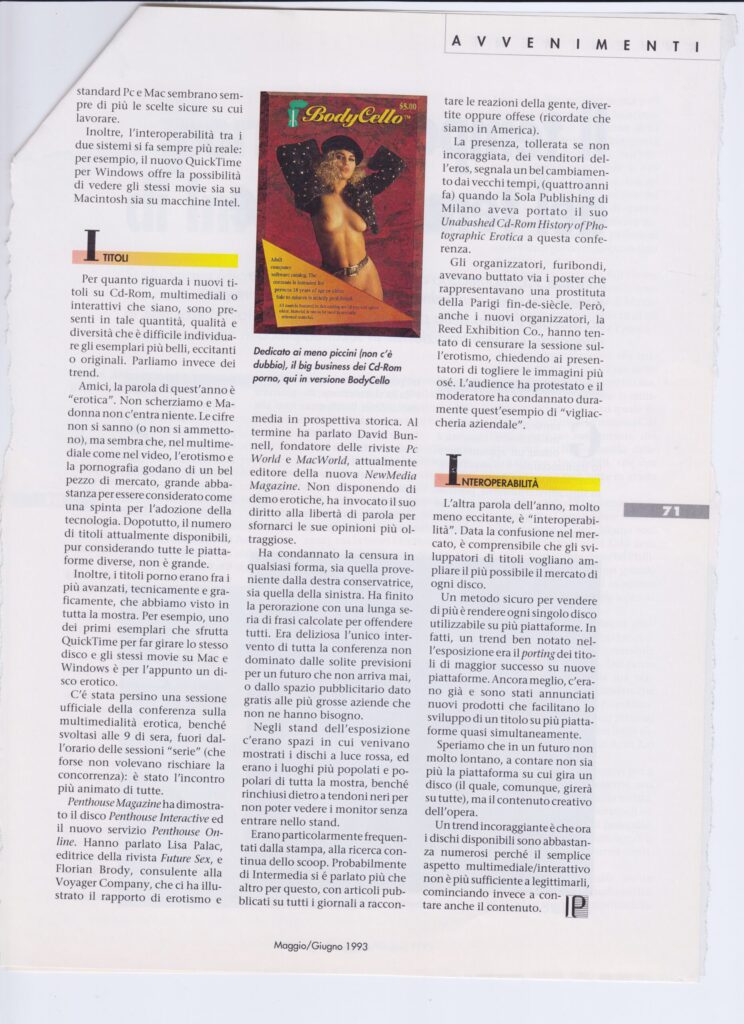
One of the CD-ROM conferences I attended took place in the “porno year.” This was when conference organizers in the US finally decided to admit that pornography was a driving force in software and CD-ROM publishing (as it would later be for the Internet), and to allow the porn merchants to attend on almost the same footing as other publishers. There was a whole floor devoted to porn at the big Comdex show in Las Vegas, but I didn’t go to that. The situation at the CD-ROM conference was funny. The pornies had a section of the floor to themselves, carefully draped off with black curtains. There was also a conference session on pornography, held at 9:00 in the evening, well apart from every other session.

Fabrizio was amused by all this. His first big foray into CD-ROM publishing had been “The CD-ROM Unabashed History of Photographic Erotica,” co-edited with a photo archive in Milan, which he had tried to advertise at the conference several years before. He’d been forced to take down his posters, but word got around anyway – back in Milan, Microsoft ordered two copies for somebody high up in the company.

I looked at some of the porno stuff at the conference, brought back lots of samples, and wrote a wry, amused piece about the American reaction to it all. Nino, the magazine editor, was thrilled to include pictures of the products: “Finally, we have tits – just like Panorama and L’Espresso!” (Two Italian news weeklies which often find ways to work naked women into their covers.)

My article also reported on the results of a “test” I had run at the office, where I got the engineering staff and my husband to watch a porn movie on CD with me. The engineers were intrigued by the fact that the disc was “hybrid” – it would run on both Macintosh and PC systems, a technological trick which the porn publishers pioneered. Everyone commented wisely on the jerkiness of the video, although, given the subject matter, perhaps some jerkiness was to be expected.

The American press had noticed the sudden “legitimization” of digital porn, and had a lot to say about it. Stephen Levy, author of “Hackers,” published in MacWorld an interview with a young porn CD publisher, which I happened to read while on a visit to the US.

Levy asked the publisher what his parents thought of his business. “My dad’s okay with it, but my mom’s not too thrilled,” was the reply. “Well, so-and-so,” concluded Levy sententiously, “you should have listened to your mother.” I was infuriated by Levy’s condescending tone towards his interviewee, especially in light of “Hackers,” where he notes that many computer geeks are lonely young men unable to get dates. It seems to me that digital porn is a sevice to those guys.

Not having a computer available, I scrawled off a furious note in my terrible handwriting, and sent it to MacWorld. Months later, at the SMAU computer show in Milan, I ran into a magazine editor I knew. “Hey, I saw your piece in MacWorld!” he said excitedly. They had published the letter, but since I was not a regular reader of MacWorld I hadn’t noticed. I’ll have to go dig that up someday to remember what exactly I wrote to Stephen Levy. I don’t know whether he ever replied.

Italian Babies: Why So Few Are Being Born

“How to solve Europe’s pension crisis: Work longer, have more babies”

cover of The Economist, Sept 27, 2003 – with a photo of a rather horrified (and rather Italian) -looking woman

“Sheesh! What is wrong with you Italians?! You inherit one of the most beautiful cultures the world has ever seen and you jeopardize it by refusing to breed.”

Reader comment on an article about Italian birthrates, Zoomata

The Economist speaks somewhat tongue-in-cheek; I’m not sure about Zoomata’s anonymous reader. So, in case you’re wondering, today we will address the question of why Italians don’t have more babies.

To quote an American politician, completely out of context: “It’s the economy, stupid.”

First, real estate costs: Buying a home is expensive in the desirable parts of the country, i.e., those where you can actually find jobs. Rentals are almost non-existent, and also very expensive. Until recently, rent laws so favored the tenant that a landlord could well find himself saddled with a tenant who didn’t pay rent, yet could not be evicted until after a long (ten years!) and expensive court battle. People who own real estate are therefore reluctant to rent it, unless they are large-scale landlords who can afford the risk. There aren’t many of these, so the market is tight, and rents are high.

The high cost of renting or buying is also part of the reason young people don’t move out of their parents’ homes until age 30 or beyond, and/or they marry. You can’t afford a home of your own until there are two of you to contribute to the expenses, and even then you probably need help from one or both sets of parents (as we had).

If you’re living at home and not married yet, you most likely don’t have kids. So, by the time an Italian woman marries, she’s often past 30, with few reproductive years left. This is also about the age that people first begin making decent salaries, and, in spite of fairly liberal maternity laws, Italian women face the same career-vs.-family choices that American women do: being a mother slows you down on the career track, so the choice to have a child is also a choice to lower your lifetime income.

Once you do get married and move into your own place, your first home is probably a small one. Enrico, Rossella, and I lived in a three-room apartment for 12 years. And I do mean three ROOMS (plus bath): two bedrooms and a living/dining room; our kitchen was so tiny (1 x 2 meters) that it didn’t count as a room. The refrigerator had to be in the living room, along with the dining table, TV, sofa, and shelving. Enrico’s piano had to go in Rossella’s room, which began to be a problem as she got older and wanted her privacy. Her room also contained a huge closet/bed/desk unit called a cameretta (used partly for storing off-season clothes and other stuff for the whole family) and a second closet, as well as shelving. Our room contained a large closet, our bed, bookshelves, and one corner was my “office”.

Had we had a second child, where would we have put it? Buy a bigger place in Milan, you say? Couldn’t afford that – that’s part of the reason we moved to Lecco. Where I’m now looking for work. And did I mention how hard it is for anyone to find jobs in Italy, especially outside the big cities?

At least in Italy putting kids through college is not the huge financial burden that it is for Americans. Italian universities are essentially free and open to everybody; a modest tuition fee has been introduced in recent years, but the only other expense is for books – IF you live in or near a city that has the kind of university program your child wants to attend. If not, you’re looking at big-city rents again: say 1000 euros a month for a studio apartment in Milan, maybe you can get it down to 500 if your student shares a small apartment with several others. This obviates any small-town low-rents advantage you might have enjoyed previously.

Then, when your kid finishes college, he is likely to be at home again (or still) while searching for a decent job, and then working his way up to a salary level that would permit him to move out. So you’re still supporting this kid, and you’ve got to keep a home large enough to hold everybody until the he’s finally out in his own place, which you will likely help to finance. Oh, and, by the way, that pension you’re being taxed up the wazoo for? Don’t count on it being there when you retire. Which will be later than your parents did, and you’re still going to get less than they did. Why? Because Italy has been paying over-generous pensions for decades, the system is going bankrupt, and there is no political will to make the necessary reforms (just like in the good ol’ USA). You’d better start saving now for your retirement.

So… are you still surprised that 45% of Italian children have no siblings?

See also: Rebecca’s view

Other People’s Bookshelves

In the course of looking for a place to live in Lecco, we’ve seen the insides of many strangers’ homes, up for sale (for the moment we’ve ended up renting, but that’s another story).

The décor was extremely variable. Many Italian homes run to a type I think of as “classic” Italian: heavy, dark wood furniture, with family photos in silver frames, and lots of silver gewgaws of the type that you give as gifts when you want to give something costly but don’t know the recipient’s tastes (I loathe these things: too ugly to display, too expensive to give or throw away).

We did see one place stunningly decorated with masks and sculptures from all over Africa; the owner has travelled there a lot. The interior design of this house was also stunning, with an iron spiral staircase going up to a loft office under the peak of the roof. But the furniture was a little too well-matched for my taste – and it was green! As was the kitchen. What is it with green in this country? Do we have to pay homage to the olive in everything?

Another place had furniture clearly designed by an artist and custom-built for the house. It was made of laminated layers of different woods, cut away in strange angles and curves and polished to a sensual smoothness that made you want to stroke it. If the furniture had been included in the (exorbitant) price, I’d have wanted the place on the spot.

What I found surprising in most of the houses we saw was the lack of books. I admit that we probably err on the side of excess. But I’m always suspicious, and somewhat uncomfortable, in a house with no books. You can tell a lot about a family by what’s on their shelves, and you can always find something to talk about. In one friend’s home, I could see instantly that someone was a classicist. In another, it was downright hilarious how many books we had in common, right across the spectrum from science fiction and fantasy to Indian novels.

Scuola Guida: Learning to Drive in Italy

One side effect of living in Lecco is that I need to drive. Not so much to get around Lecco itself, nor even into Milan, but because our fourth family member, Hamish the horse, now lives in a place not easily reached by public transport. (Yes, there are buses, but they don’t run very often.) So it’s time to get an Italian driving license; the grace period for driving on my American one expired about 12 years ago.

Unfortunately, American licenses are not directly convertible to Italian; you have to go through the same process as an Italian first-time driver. This is far more difficult and longer than getting a license in the United States; I think that’s a good thing, given the challenges of driving in Italy.

The first step to getting a license is to pay three different fees (a total of 33 euros), and have a medical exam of sorts, mostly about vision. That plus filling out some forms gets you a foglio rosa (pink sheet) – a learner’s permit. I am doing all this through a driving school, which is costly, but makes things somewhat easier: they take care of the paperwork and standing in line for you.

Then you have to pass a written “theory” test. It’s only 30 true-or-false questions (three each on 10 topics), but if you miss more than four, you have to wait a month and a day before you can try again, and the test is harder than it looks: it demands a thorough understanding of Italian legal/bureaucratic language, at least as relates to driving. Immigrants not fluent in Italian have the option to take a much easier oral test; I could probably have gotten away with claiming this, but the oral would have taken longer to schedule, so I opted for the written.

The driving school offers theory lessons three times a week. I went to two of these, but found them excruciatingly dull. It’s no doubt great for beginners and non-fluent immigrants to have everything explained six times over, but I find it hard enough to sit through any class for 90 minutes, let alone “Road Signs for Dummies”. The only interesting part was the teacher’s endless stock of horrible stories about drivers who became distracted and “ci ha lasciato la pelle” (literally, “he left his skin,” meaning “he died”). According to the teacher, the major cause of road accidents is: “Dis- dis- …?” (prompting for the word). “Disregard for the rules?” I was tempted to offer, but I kept my mouth shut; I’d already seen that he didn’t understand my sense of humor. The answer he was looking for was “Disattention,” which I suffered in his class more than I ever have on the road.

Fortunately, the classes were not required, and I already had another source of help on Italian driving theory. Cristina, a member of the Expats in Italy online group I frequent, has a very helpful website about driving in Italy, which in turn links to WebPatente, a useful program for learning the theory and practicing for the exam, complete with audio commentary on your results.

The questions asked in the practice exams are presumably based on real exams past and present. The funniest one I ran across in my hours of practice was: “True or False: Distraction and a reduced sense of danger can be caused by… excessively spiced foods.”

This is almost as funny as the question my dad had to answer in a driving test in Indonesia, years ago:

You’re driving down the road and you see a Stop sign. You should:

a. Stop

b. Slow down.

c. Look to see if a policeman is watching.

Meanwhile, back in Italy… I had to argue with Mr. Realini, the owner of the driving school, to convince him that I could prepare myself for the exam without the help of their classes or preparatory quizzes. (NB: My attending or not made no difference to the amount of money they’re getting out of me: a flat fee of 500 euros, plus however many driving lessons at 23 euros each) But, after a couple of nasty head-on collisions with me, he agreed to schedule it for September 22nd.

So I turned up at the school at 10:45 Monday morning. Then had a last-minute panic, because I suddenly realized that the foglio rosa was required for entrance to the exam, and it had vanished from my wallet. I ran home to search (I had time because the earlier exam sessions were running late), but couldn’t find it. Mr. Realini was nice about it (“Happens all the time”), and said we should just go to the exam anyway and see if they would let me in. So myself and four 18-year-olds trooped across the street to the Motorizzazione Civile (“Civil Motoring”? not a very accurate description, in Italy), where two dozen other candidates were waiting, with the owners of their respective driving schools. Mr. Realini, perhaps to distract me, asked what I thought of George Bush, so we had a lively discussion about that. The teenagers were amused, but shy to join in.

Around 12:15 we were finally allowed into the exam room. Our names were called off a computer printout, and each of us had to stand in front of the two examiners while our packet of papers and photo ID were scrutinized. They waved away my lack of a foglio rosa, but wanted to see my permesso di soggiorno (permission to stay in Italy), which I hadn’t known I was supposed to have with me. But at least I knew exactly where that was. I started to call Enrico to bring it (he’d already spent an hour searching for the foglio rosa), but then they decided that I only needed it for the actual driving test.

When all the candidates had been checked in, the examiners asked two people to come up and witness (with signatures) that the exam packets were still sealed. They then opened the packets, and one of them signed each exam sheet before tucking one into each student’s portfolio of papers. Then he called us up one by one to collect our packets. Finally, when all were seated with our papers in front of us, we were allowed to take the sheets out and start the exam.

Almost immediately, a vociferous argument started in the main office outside. I giggled. The examiner smiled ruefully and closed the doors, but you could still hear everything. Finally he poked his head out the door and asked if they could carry on after the exam. A minute later, someone poked his head in to apologize. “Just for this, you all pass,” he joked.

Of course, the first topic on the exam was something that had not come up in the driving school handbook nor WebPatente, about directional signage for roundabouts (which have only recently become popular in Italy). The wording on one of the three questions looked like it might be one of those linguistic traps: is a road coming off a roundabout called a traversa (cross-street), or is there some arcane technical term that I hadn’t heard before? After some pondering, and going on to do most of the other questions, I marked it “false.” You can’t make corrections on this test, so you have to be sure of the answer when you make your mark!

The rest of the test I felt pretty comfortable about, except the questions about the round blue sign with a human figure walking. I was mostly, but not entirely, sure that that meant “pedestrian area,” and answered the questions accordingly.

There was also a question on precedenza (right of way), my favorite subject – just because the rules are so charmingly contrary to actual behavior. The tests use some wildly theoretical intersections, with five or six streets meeting. The situations are all plausible enough, but the correct answers are not. One that sticks in my mind shows a four-lane street with a tram (on tracks) in the middle, flanked by a truck going the same direction. There are cars waiting to cross from each side of a smaller cross-street. Theoretically, the tram goes first, because any vehicle on tracks always has right of way. After that, the car with no traffic to its right should go, then the other car, and the truck last. Yeah, right – try to convince me that, in real life, the truck isn’t going to move at the same time the tram does, or even before! The book does reiterate that, no matter what the rule of precedenza says in any given situation, you should make sure that the other drivers agree with you before you move.

The test sheet was printed in black and white, including the illustrations, but there were two colored brochures of road signs and street diagrams that you could consult for clarity (each picture used in the test is numbered; the images in the brochures have matching numbers). I realized after I had handed in my test that a careful look through the whole brochure would have resolved the pedestrian zone question for me: the sign was there, by itself, just as shown on the test, but there was also another version of it as part of a larger sign with “zona pedonale” clearly printed!

We had 30 minutes to complete the test, but no one took that long. By around 20 minutes, the last test had been handed in, and we proceeded to corrections. Again each person’s name was called, and we had to stand in front of the examiners while they checked the test against the marking sheet, and called out the number of errors with “idoneo” or “non idoneo” (suitable or un-). Only two people failed, one with five errors, one with “many.” I only had one error, on that question about the roundabout, which turned out not to have been a trick after all. So I am suitable for driving – at least in theory.

When told my result, I did the American fist-pump gesture and shouted “Yes!” The other examinees all laughed; one of the examiners said disapprovingly (in Italian): “You’re in Italy now, say Si’.”

October 6, 2003

My classmate Yuti responded:

“This reminds me of my driving test in Bombay in 1981 when I turned 18. The test is supposed consist of an oral test and a test drive. There is a fat rule book, but I was told by my driving instructor that examiners ask only one of three rules, so I was to remember only these, and not bother with the rest. I don’t remember the rules verbatim but they go something like this: (1) you cannot have someone sitting on the car bonnet while the car is in motion, (2) you cannot have more than three persons in the front (in those days cars did not have bucket seats, but one long seat like the back), and (3) you cannot drive without headlights at night. These rules had numbers, like Rule 356, 452, etc.

The examiner would ask “Recite Rule so-and-so”, and you were expected to recite the rule verbatim as per the Rule book. Sure enough, my examiner asked me to recite the rule about sitting on the bonnet. That was the extent of my oral test.

For my test drive, I was asked to reverse park between two cars, and indicate turning left and right. In those days, Indian cars did not have turn indicators, so you had to use your hands. To turn right, you stuck your hand out of the window and made a circular motion with your wrist in a clock-wise direction. To indicate a left turn, you turned your wrist anti-clockwise. It took me 10 minutes to pass both tests. I got my license within a week by bribing the examiner Rs.50 (a hefty bribe in 1981), otherwise I would have waited months for it. But I was in a hurry to hit the road.

Now you know why Indians drive the way they do!”