If I mention that I grew up having live-in servants, many Americans assume that I must have been filthy rich. But, when I lived in Asia, most foreign families there (and many local ones as well) had servants, and needed them for very practical reasons.
Picture yourself as the wife of an American diplomat or businessman or missionary, just arrived in India or Thailand in the 1960s or 70s. You probably don’t speak the language, you may not recognize many of the foods in the market, and you don’t know what they should cost. The market is not an American-style supermarket, with packaged goods stacked neatly on shelves and stickered with set prices: it’s a conglomeration of open-air stalls heaped with produce fresh from the farms, where everyone haggles over prices, and enjoys doing so.
You start at a handicap, however. Your skin color marks you instantly as a foreigner, and you’re assumed to be much wealthier than the natives (this perception is usually correct, by local standards). So the merchants figure you can afford to pay much more than anyone else, and they charge accordingly. You can meekly accept this, paying exorbitant prices for everything, or you can do battle, day after day, whether you enjoy haggling or not.
Or you can hire someone to do it for you.
It’s generally wiser to let someone local do the cooking as well. Basic raw ingredients are different in every country, and someone who has been cooking with them for years will have far more success than you in producing a good meal, at least in the beginning. When we lived in Bangladesh, there were not many vegetables available in winter, except for a particularly bitter kind of spinach. But our cook had been second chef at the Italian embassy, so he knew how to make home-made pasta, and made delicious spinach-filled ravioli. (It’s ironic that I had my first exposure to ravioli in Dacca; I didn’t know then that pasta would become a big part of my life!)
Live-in servants also provided security. House-breaking is common in many parts of the world, and it’s unwise to leave your home completely unattended at any time, especially for foreigners. Again, it’s the wealth factor: everyone assumes (and they’re probably right) that there are more valuable things to steal in your house than others’. So someone needs to be in the house, always. In Bangladesh we had a night watchman, whose job it was to stay awake and visible all night, to deter burglars. When the electricity went out, as it frequently did, he would circle the house, tapping on the walls with a stick and making low hooting noises, to let thieves know that he was alert.
A live-in nanny is a boon to any mother, the more so for women who are raising children in countries not their own, far from the usual support networks of family and friends. And many of these women were not, as you might think, full-time mothers. They were often expected to help their with husbands’ jobs, either very directly (as in the case of missionaries) or in such indirect ways as entertaining. And, yes, entertaining regularly on a large scale is a large job, even when you have servants to help!
So it’s not surprising that many expatriate kids have “native” nannies, and start out speaking a language other than that of their parents; my brother’s first language was Thai. Rudyard Kipling, like many other British children born in India, spoke Hindustani before he spoke English.
The relationship between “masters” and servants in Asia is not like an American employer- employee relationship. Servants become part of the family, and you are responsible for their welfare. They are usually poor and uneducated, and therefore more vulnerable than other members of their own societies – they really do need your help.
In 1985-86, I spent a year in Benares, under the aegis of the University of Wisconsin’s College Year in India Program. Aside from two American-born women of Indian parents, I was the only one in the group who had actually been to India before. (Four years in Mussoorie turned out to be inadequate preparation for Benares, but that’s another story!)
I ended up living in the extra room in the program center, where we all ate meals and had Hindi classes together. Two Untouchable women worked there during the day, one as a cook, the other cleaning.
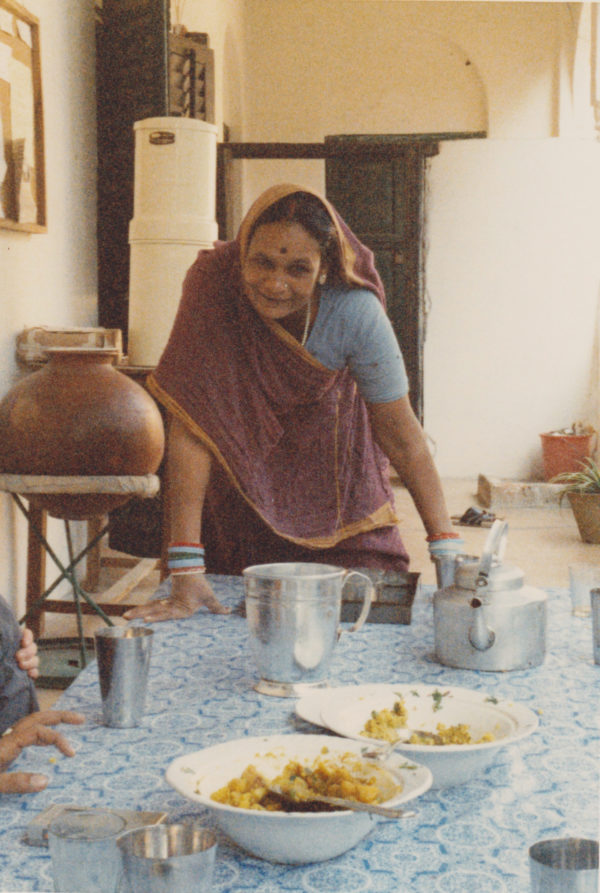
I don’t remember the incident, but one day I spoke to the cleaner, Durga (pictured above), taking her to task for not doing her job properly. I doubt that I was rude, and Durga simply took the criticism as due; she had in fact been slacking. But some other students in the group immediately labeled me “Memsahib,” implying that I had the same snobbish attitude towards the “natives” as British women during the British Raj in India. Coming from equality-minded Americans, this was no compliment. I lived with that label for the rest of the year; they even gave me a trophy inscribed “Memsahib of the Year” at our final farewell party.
What the other students failed to understand was the reciprocity of the relationship. I had the right to tell Durga to do her job, but I also had an obligation to stand by her when she needed help; Durga and I both knew that. She came to me one day complaining of pain in her eyes. After consulting with our language teacher, I accompanied Durga to the hospital.
We were there for many hours, waiting in various lines and rooms. Durga had never been inside a hospital, and was terrified – she clung to my arm and cried. I was appalled by how rude the hospital staff were to her, apparently because she was Untouchable. I don’t know what treatment, if any, she would have received if I hadn’t been with her. I stayed with her, defended her as best I could, and bulled my way through every obstacle until she was finally examined by an eye specialist, who diagnosed glaucoma.
The Program paid for her medicines, but the story didn’t end there: she still needed to go back to the hospital for follow-up visits. Strangely, the students who had protested so loudly at my giving Durga orders never volunteered to accompany her to the hospital.