All posts by Deirdre Straughan

Whose Story is It, Anyway?

When I wrote about leaving Italy (but not my husband), a long-time reader expressed concern about my marriage, saying that it was clear that my primary relationship is with my daughter Rossella, whereas my husband Enrico is “merely a footnote.”

I appreciate this reader’s concern, but was quick to correct (I hope) his misconception. It’s true that I have written more about Ross, and in more detail, than I do about Enrico. But that doesn’t necessarily reflect the importance of each in my life.

It’s a generational thing. Ross, having grown up with the Internet, shares her life online in a way that is completely normal for her generation, but which leaves her father shaking his head in bemusement: “When I was young, I would never have dreamed of making public some of the things she does, even if I’d had the technology.”

So it’s simply out of respect for his privacy that I don’t write much about Enrico.

This brings up a larger question that has been on my mind for some time: we all have stories to tell, and much of what I share online is, one way or another, stories. But the most interesting stories involve other people, who don’t necessarily want those stories told about them. And I can’t be sure about others’ sensitivity level. While I have rarely or never told a story with deliberate intent to cast anyone I know in an unflattering light, on a few occasions people have been unhappy about what I wrote about them. And there are lots of stories I haven’t yet told out of respect for others’ privacy. Still, I wonder: whose story is it, anyway? What legal or moral right do I have to tell my own tales when they happen to involve other people?
Keeping Cool, Italian Style: Energy Efficiency and Home Safety, All in One

Although it’s hot here in the summer, Italy’s not big on air conditioning, preferring to rely on older methods for keeping cool.

Most Italian buildings are naturally insulated, being made of concrete, brick, or stone. The older they are, the thicker the walls, which of course adds to the insulation. Windows are protected by shutters, whose style varies with location and age of the building. These insulate against the weather, but also protect against thieves (housebreaking is far more common here than street mugging).

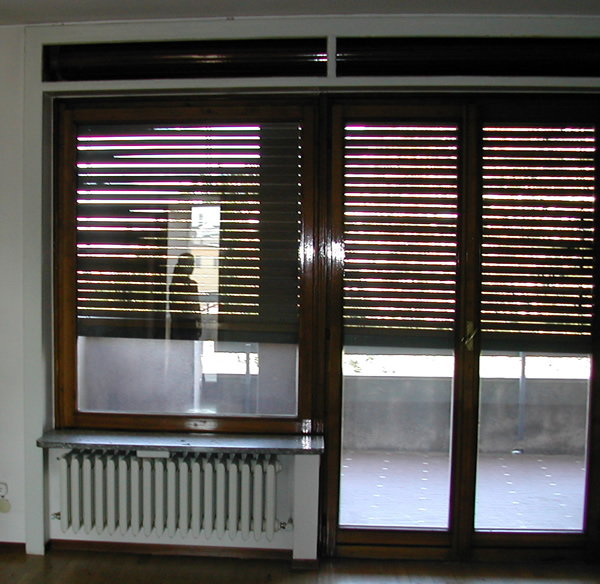
Our apartment in Milan had tapparelle: slatted, roll-down shutters operated by a pulley system with a cloth strap that you pulled, hand over hand, to raise or lower them. This was barely within the limits of my strength on our large bedroom window, even though the shutters were made of plastic – we were on the 7th floor, so security wasn’t much of an issue.

My in-laws’ apartment in Rome, being on the first floor, had to have strongtapparelle. The originals were elegant wood, but, when they began to break down with age, this proved very expensive to replace, so the new ones were steel painted a woodish sort of color. Those were even heavier than the wood, so we were thankful for the electric motor that raised and lowered the 3-meter-widetapparella in the living room – until the electricity went out…

^ Wooden tapparella on our first apartment in Lecco – operated by a hand crank (not visible in this picture), it took forever to open or close. Then the slats started breaking…

The problem with tapparelle as a safety feature is that, to be safe, you have to close them at night – clever Italian house thieves have been known to use sleeping gas on homeowners to ensure easy pickings inside the house. So the shutters in Rome had to be closed, no matter how hot the night. The most you could do was leave them slightly open so that a centimeter or two of air could pass underneath and through the slim cracks between the slats.

Back in Milan, surrounded by other 7th and 8th-floor apartments, we closed thetapparelle for privacy, except on a few summer nights when we were too hot to care if the neighbors saw us naked in the moonlight (it was too hot to wear clothes or have sheets over us on the bed, either). We found a partial solution in putting a new type of frame on the bedroom tapparella, which could be tilted out on a hinge even when the shutter was fully rolled down, so we could get air in under it, and look down into the street, but no one could look across or down into us.

Here in Lecco, most houses have persiane – hinged shutters with fixed, louvered slats pointing downward, so no one can see in, but you still get some light and air. We don’t feel the need to close these most of the time, even though we don’t have curtains: the position of our house is such that no one can look into our windows, unless they use binoculars. But the persiane are useful to keep the sun out while letting air in. On summer afternoons I close everything up on the sunny side of the house – shutters and windows – and the rooms stay relatively cool til the evening breezes come and it’s time to open it all up again.

Note: Yes, we also use fans.

My New Baby

Isn’t it gorgeous? It’s my very own Thumper, aka Sun Fire X4500 Server.

Jeff Cheeney and I (and whoever we can rope in to help) are going to make it into a video compression/archive/streaming server. (Before you start worrying about budget, don’t: this one is rebuilt and didn’t cost us anywhere near sticker price.)

Why do I need such a thing? Take a look:

I’ve shot over 100 hours of video since I began videoblogging for Sun about a year ago, and much more is on the way. I haven’t edited even half of it, partly because I’m doing all the editing and compression a Windows laptop which I also have to use for all my other work. So it would be useful to be able to offload some of the processing onto a different machine, one that can also archive and share the results.

This is also a learning exercise, to see what we can do with all this cool technology we have around, similar to the project that Jeff and Chase distilled into a ten-minute recipe for building a NAS box. Similar also to Dominic’s new recipe series, which began recently with Configuring Sun Storage J4000 Arrays and the ZFS File System in Ten Minutes.

It will probably take some months of poking around and figuring things out, and we’re not entirely sure we’ll be able to boil this one down to “Build a Video Archive/Server in 10 Minutes” – but that’s what we’re trying for. We’ll keep you posted!

Learn Italian in Song: Certi Momenti

Certain Moments

Pierangelo Bertoli, 1980

A song in favor of a woman’s right to choose, from a time when either choice to be made for an unwanted pregnancy resulted in social stigma. Unfortunately, the song is relevant still today. For the moment (2008), abortion is legal in Italy, but the political right wing and the Catholic church are doing what they can to make obtaining an abortion – or even birth control – more difficult. Teenage pregnancy has not been a big phenomenon in Italy to date, but at this rate…

A year or two ago we went out to dinner at Taverna ai Poggi, a restaurant near our home in Lecco. The only table left was in the basement, alongside a large (pre-arranged) banquet of some sort. We were a merry little bunch, and the restaurant staff kept apologetically asking us to quiet down so we wouldn’t disturb the other group. Perforce, we listened to them, and were astonished to hear a long recital of vitriolic anti-abortion poetry. Had I had my wits about me, I should have replied with this song.

Anna che hai scavalcato le montagnee hai preso a pugni le tue
tradizioni

lo so che non é facile il tuo giorno

ma il tuo pensiero é fatto di ragioni

i padri han biasimato la tua azione

la chiesa ti ha bollato d’eresia

i cambiamento impone la reazione

e adesso sei il nemico e cosi’ sia

ritornello:

Credo che in certi momenti il cervello non sa piu’ pensare

e corre in rifugi da pazzi e

non vuole tornare

poi cado coi piedi per terra e

scoppiano folgore e tuono

non credo alla vita pacifica non credo al perdono

Adesso quando i medici di turno rifiuteranno di esserti d’aiuto

perchÉ venne un polacco ad insegnargli

che é piu’ cristiano imporsi col rifiuto

pretenderanno che tu torni indietro

e ti costringeranno a partorire

per poi chiamarlo figlio della colpa

e tu una Maddalena da pentire.

(ritornello)

Volevo dedicarti quattro righe,

per quanto puo’ valere una canzone

credo che tu abbia fatto qualche cosa

anche se questa é solo un’opinione

che lascerai il tuo segno nella vita e i poveri bigotti reazionari

dovranno fare senza peccatrici

saranno senza scopi umanitari

(ritornello x2)

Anna, [you] who have climbed the mountainsand have beaten up your traditions

I know your day isn’t easy

but your thought is made up of [correct] reasons

The fathers have censured your action

the church has declared you a heretic

change requires reaction

and now you’re the enemy, and so be it.

refrain:

I believe that in certain moments the brain doesn’t know how to think anymore

and runs into crazy refuges and doesn’t want to return

then I fall with my feet on the ground

and lightning and thunder explode

I don’t believe in the peaceful life,

I don’t believe in pardon.

Now that the doctors on duty

will refuse to help you

because a Polack* came to teach them

that it is more Christian to impose oneself by refusal

They will expect that you turn back

and they will force you to give birth

to then call him “child of shame” and you a Magdalene to repent.

(refrain)

I wanted to dedicate four lines to you, for whatever a song may be worth

I believe you have done something,

although this is only an opinion,

that will leave your sign in life

and the poor reactionary bigots

will have to do without [female] sinners

they will be without humanitarian aims.

* Polacco in Italian is not a pejorative term. It merely connotes a male citizen of Poland, in this specific case, Karol Wojtyla, aka the late Pope John Paul II. However, I think the context justifies using the pejorative English term rather than the neutral (and potentially confusing, in spite of capitalization) “Pole”.

if you find this useful and want more, let me know!

Gallery: Introbio and Villa Migliavacca

Another day trip in the Lake Como region, to a small mountain town called Introbio. Of “particular interest,” as Italian tourism guides say, is Villa Migliavacca. According to the sign: “Built in the 1920s for the Milanese Antonio Migliavacca, pioneer in advancing tourism in Valsassina, it is the work of architect Bottoli, also Milanese. The construction, in neo-Medieval style, is scenically placed in the large garden. It is now the seat of the township and Mountain Community of Introbio.”

Photos