All posts by Deirdre Straughan

Here We Go Again: The Beginning of the Second Iraq War

Whatever one’s feelings about the rightness or otherwise of it, war is never a comfortable time. This one in particular is cause for nervousness among Americans overseas. I’ve just received email from the US Embassy in Rome advising “American citizens in Italy to take prudent steps to ensure their personal safety in the coming days. Remain aware of surroundings, avoid crowds and demonstrations, keep a low profile, vary times and routes, and ensure travel documents are current.”

Strangely enough, all this is very familiar to me. In 1984, I made a long visit to my dad in Jakarta, Indonesia, and ended up working in the commercial section of the US Embassy. One of the perks of the job was an Embassy carpool which took us to work and home again every day.

Then the Islamic Jihad issued death threats against US and European citizens in Indonesia (I don’t remember why, if there was any reason other than “We hate you”). The French and British embassies promptly evacuated all diplomats’ families. The US Embassy didn’t send anyone home, but instituted security measures, like varying the times and routes of our daily carpool rides to the office. “Varying times” meant that the car could show up anytime between 6:00 and 9:00 am, and “varying routes” meant that the trip could take even longer than usual. In the event, nothing happened, and after a while life returned to normal, though a year or two later a rocket was fired into the Embassy grounds.

So I am eerily accustomed to this feeling of being under seige, of having to think about where I should and shouldn’t go (no more movies in English at the cinema, maybe no cinema at all). No big change in lifestyle is needed; I rarely find myself among crowds of Americans anyway. A “worldwide caution” also just issued by the Embassy warns of “potential for retaliatory actions to be taken against US citizens and interests throughout the world.” Okay, so I won’t eat at McDonald’s or Burger King — no great loss! (Later: A McDonald’s window was smashed in Milan during peace protests on Saturday, March 22.)

I had much the same feeling of “they’re out to get me” for some time after 9/11, with one big difference: this time, a lot of Italians have it in for me, too. In Italy, as elsewhere in the world, there have been huge peace demonstrations, which the US embassy advised American citizens to avoid: not all the demonstrators would have distinguished between George Bush and Americans in general. There are also a lot of Arabic-speaking and/or Muslim immigrants and businesses in our neighborhood. I’m not sure what to think of them or what they would think of me, especially since Milan was found last year to harbor Al Qaeda’s European headquarters (NOT in our neighborhood).

It’s depressing, this feeling that some people hate me enough to kill me simply because of my citizenship, and wouldn’t bother to find out first what I actually think about things.

And, as is inevitable for Woodstockers, I know people directly endangered by the war: an Indian schoolmate living in Baghdad with her Iraqi husband. Her mother taught me Hindi for several years and was our class homeroom teacher; I worry about her, worrying about her daughter (ironically, her son lives in the US).


Cricket Fanatics

My friend and Woodstock classmate Yuti Bhatt responds to the articles on sports fans:

The section on Sports Fanatics is interesting in light of the fact that more than a billion people at this very moment are engrossed in a series of games being played over a period of 43 days in South Africa.

I am talking about the Cricket World Cup. Cricket is played by a handful of countries, yet the World Cup 2003 has the largest number of spectators (both on and off the field) of any sporting event ever, barring the FIFA [Soccer] World Cup. Even more than the Olympics. I am sure you have experienced the passion and fanaticism that cricket evokes in India, and even at Woodstock, dorm staff are being lenient about lights-out, so that the kids can watch the late-night games.

An average-sized stadium in India holds up to 40,000 spectators, and at Eden Gardens in Calcutta, cricketers play to crowds numbering 120,000 (not counting those perched on surrounding tree-tops and buildings). In spite of these numbers, spectator violence in cricket is rare. In “white” countries, one section of the stadium has no stands or seats. In its stead is a patch of green, where families can lay out their mats and picnic baskets, drink beer, watch the game, and even have a nap in the afternoon. So what if the game being played is between West Indies and Sri Lanka. Your neighbour could be an Aussie or a Kiwi whose favourite batsman is Sachin Tendulkar [an Indian cricket star]. Often described as “the game of glorious uncertainties” and mirroring “life itself”, about one-fifth of the world is right now looking forward to 23rd March when the Finals take place. Yesterday, there was a minor revolt in a prison here, because the prisoners wanted a TV to watch the games. Happily for India, we are on a roll, and have secured our slot in the Semi-Finals. The most likely scenario will be an India-Australia Final.

I responded to Yuti: “I thought I read something while I was in Delhi about fan unruliness at cricket, something about throwing water bottles onto the pitch?”

Yuti answered: “Yes, there have been incidents of fans throwing stuff, not on the pitch, but on fielders near the boundaries. It happened in India last year and also in Australia. A star player usually asks the crowd to behave, and that often does the trick. But in the 1996 World Cup, a match was awarded to Sri Lanka purely because of the Calcutta crowd’s misbehaviour. We were losing and they just couldn’t stomach that. The umpires summarily declared Sri Lanka the winners. The International Cricket Council can even ban a venue for a few years if its spectators make a habit of misbehaving. So far as I know, that hasn’t happened yet.”

Medical Privacy

…One big aspect of Italy’s national health system that I forgot to mention previously: it’s available to EVERYBODY. There’s no nonsense like asking for insurance information while you’re bleeding in the emergency room (they do ask for your national health card, but if you don’t happen to have it on you, no one cares). And there’s no such thing as being uninsurable because of pre-existing conditions. You’re in the system and you get treated, period. Quite a few people not in the system, i.e. illegal immigrants, also get treated.

I met a guy once in Austin, Texas, who was undergoing an extremely expensive experimental treatment for multiple sclerosis. He could not change jobs, because that would force a change in insurer, and no new insurer would take him on, knowing they’d have to take on that expense. There is something very wrong with this picture. You can only be insured if you’re healthy?

This ties in with the privacy concerns that Brin addresses. Medical records stored in electronic format can be hacked into and viewed by people other than our doctors. One risk is that a company might decline to hire you after learning about an expensive medical condition that they wouldn’t want their insurance to have to cover. In America this is a legitimate fear; your career mobility and life could be ruined by leaked information. The answer to this is the Italian (and British, and Canadian, and…) one: a national health system, where you’re covered no matter what you’ve got.

50 Ways to Flush a Toilet

In the Brussels airport, I saw a new piece of technology that I just had to try out: the Lady P Urinoir (in the ladies’ bathroom, naturally). There were written instructions in four languages: “1. Assume skiing position.”

Fortunately, there were also stick-figure illustrations, otherwise I would have had to puzzle about “skiing position,” not being a skier. This instruction displays a certain cultural insensitivity; surely, at an international airport, they don’t think that every visitor knows how to ski?

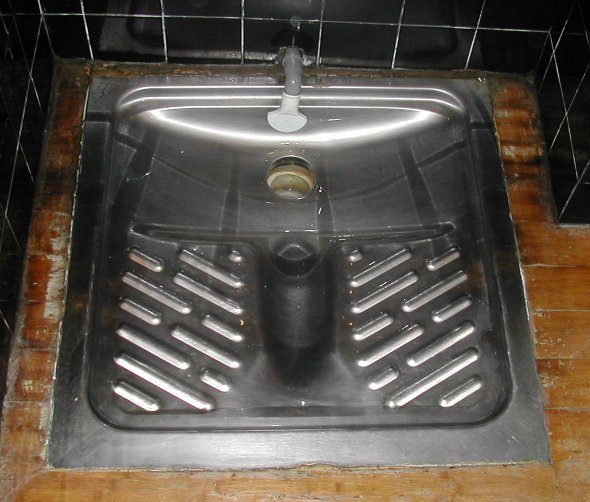
It would be useful if other kinds of toilets also came with instructions. I’ve never seen such a bewildering variety of toilets as I have in Italy. The part you sit on is standard (unless you encounter an old-fashioned squatter; some Americans might be confounded by this), but working out how to flush it may be a challenge.

Here are a few of the options I’ve seen:

American-style tank behind the seat, with flush on upper right corner. The flush may be a button on top of the tank, or a plastic tab sticking out of the upper right side of the tank.

High wall-mounted tank (nostalgia items for some of us), with a pull chain dangling down.

Tank or flush pipes hidden in the wall. Here’s where it gets tricky; there are a zillion ways to flush these things, including:

  • A simple handle that you turn to open a faucet; let the water run til the evidence is flushed away. This ecologically sound – you use exactly as much water as needed – but it’s frustrating when water pressure is low and you’re in a hurry to leave the bathroom.
  • Buttons on the wall somewhere, usually (but not always) above the seat. This can be a small metal button, or a round plastic one, mounted on a larger plastic plate, that you push once to flush. The cleverest I’ve seen is the double button, a trapezoidal shape divided into larger and smaller sections. I assume that this is a water-saving feature, where the size of the section determines the size of the flush: push the small button for a small job, the big button for a bigger job, or, if you’re really worried, both buttons together.
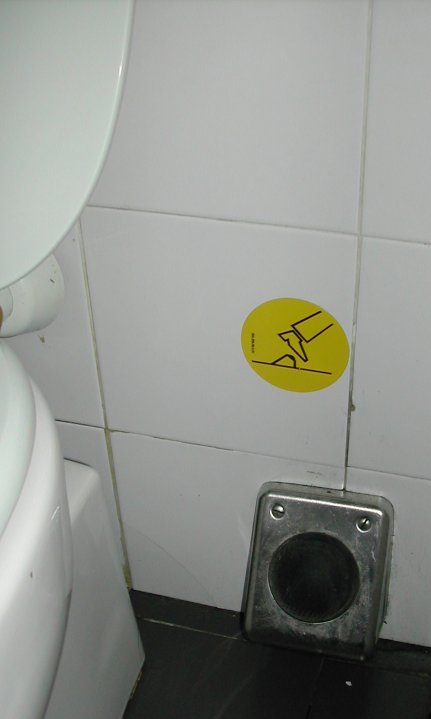
  • Step-on rubber button near the floor, sticks out at an angle, usually on the right side of the bowl. Step on it hard for as long as you want the flush to last.
  • A round plastic button sticking out of the wall at waist level next to the toilet, where you’d more or less spot it while you’re sitting, but may not notice it when you stand up

flush

Note that the “helpful” graphic shows an impossible foot position.

  • Wave-activated sensor. When you’re done, wave your hand in front of the photocell on the wall behind the bowl (there’s an illustration encouraging you to do this), and the flush will take care of itself.
  • Automatic flush. These are supposed to detect when you sit down and when you get up again, but they are almost always miscalibrated and go off while you’re still sitting. And they tend to flush hard – eeyow! that water’s cold! Worse, this is the type most commonly found in roadside rest stops, where the bathrooms are not heated in winter.

When you’ve conquered the toilet, you face the challenge of washing your hands. Many bathroom sinks are equipped with photo sensors, but these can be fussy. I have one friend whose hands are transparent to them – no amount of waving around will get her any water; someone else has to put their hand in front of the sensor for her. Some faucets are activated by pedals on the floor, one for hot and one for cold – highly sanitary, as you don’t have to touch anything with the hands you’re trying to clean. I’ve even seen sensor-activated soap dispensers!

The Unbearable Lightness of Peeing

Had a good laugh at your article on ’50 Ways to Flush a Toilet’. I laughed louder at the German description of the P-lady:

Translated (approximately – have to go from German to Dutch to English):

[NB: Translation based on text at a previous link.]

“Compared to a conventional toilet, the Lady P. is much smaller, more compact, but with its peculiar(*) form it radiates warmth and a certain degree of cosiness(*)”

I have never in my life associated cold white porcelain with “warmth” and “cosiness”, so I wonder if they also produce office furniture. If they can make a toilet radiate warmth, imagine what they could do with a desk or chair!

(*) – Used a Dutch to English dictionary…

Mike Looijmans


Another American looks at Italian toilets, with photos (site not for the squeamish!).

Sports Fanatics

My last two pieces, on fan violence and dyed hair, between them spurred more discussion than anything I’ve yet written in this newsletter. With the permission of the authors, I will quote some of their very thoughtful replies, with further thoughts of my own.

American readers are baffled by the need for the safety measures at soccer games, and, as John Francini says, “look upon the tribal behavior of European soccer fans with an unalloyed mixture of dismay, confusion, and stark blinking incomprehension. While there are rare occasions where Americans will do stupid things in the aftermath of a football game (like the idiots who rampaged through the streets of Oakland after the Raiders got thoroughly trounced in last month’s Superbowl), by and large fans of two opposing teams do not go around taunting one another en masse with songs, chants, et cetera. Nor do they beat each other up, even if the Raiders fans do dress themselves up in the most outrageous getups. And they certainly don’t need to be separated by team, as soccer fans seem to.”

John asked: “Just what are the common sports in Europe besides soccer, and how popular are they in comparison to it? Here, we have several different sports to pay attention to during the year, so American football is just one of many: baseball in the spring and summer, football in the autumn, basketball and hockey in the late fall and winter.”

He’s got a point. The sports that John mentions are pretty much equally important in America, and all of them are played in major national leagues. Many Americans are knowledgeable and passionate about more than one sport. Europeans don’t have so many to choose from. Aside from soccer, there’s cricket and rugby (in the UK); I don’t know much about these, but suspect that their fan bases are not nearly as large as for soccer. In Italy, we have a basketball league, but its fan base is very, very small. Perhaps having more sports to think about keeps Americans from becoming dangerously obsessed with one sport and one team.

Rich Levin raised an interesting point: “The US is usually criticized for a more violent culture: movies, TV, etc. and the higher crime rates. But you never see anything equivalent at sporting events. Maybe we take our violence more seriously in the US.”

Some American sports, e.g. football and hockey, seem to be inherently more violent than soccer, although this is to some extent the ritualized violence that I mentioned before (wrestling is even more ritualized, apparently). Perhaps these sports are therefore more effective at venting fan violence vicariously than is soccer.

In “Bowling for Columbine,” his documentary film about American gun culture, Michael Moore ponders the opposite phenomenon: why is it that America’s neighbor, Canada, has similar gun ownership rates, yet a far lower incidence of gun murders than the US?

Several readers made the explicit link (which I had not) between ardent sports fandom and religious belief (John Sanders reminds me that ‘fan’ derives from ‘fanatic’). Rick Freeman points out that both seem to be a mystery to me. He’s right about that; I am profoundly atheistic about sports and religion. Though I feel no need for either in my own life, I appreciate that sports and/or religion contribute a great deal to others’ lives. But I find it sad and baffling that something which is beautiful and inspiring for many, in the hands of a few fan(atic)s is used, often brutally, against non-believers or members of opposing faiths.


Stadium violence is once again on the collective mind in Italy. A newscast quantified the problem apallingly: maintaining order in the stadiums costs 32 million Euros per major match. A new law has been passed making it possible to arrest hooligans on the basis of photo or TV evidence – if they can be caught within 36 hours of the incident. The law also provides for changing schedules, or completely suspending games for up to a month, in response to anything unusually horrible.