Category Archives: bio

Close Neighbors: Living Cheek-by-Jowl in Italy

The vast majority of Italians live in villages, towns, and cities – very few have ever experienced the American “norm” of living in a single-family dwelling surrounded by its own plot of land. The ancient Romans invented the apartment building, an urban space-saving solution which has remained popular throughout Italian history and across the country.

This means that almost everybody in Italy lives very close to somebody else. In these circumstances, you had better learn to love thy neighbor as thyself – or at the very least to get along with him – because you’ve got him practically in your lap.

The impact of this proximity is somewhat reduced by the fact that Italian apartment buildings are far more solidly built (of steel, concrete, and brick) than American ones (wood frames and plywood). I have experienced apartment living in both countries, and can tell you that sound doesn’t travel nearly as easily through Italian walls as American ones.

On the other hand, Italian homes are not sealed up and air-conditioned/heated all year as many American ones are. Whenever it’s warm enough (and sometimes even when it’s not), windows are wide open, and the only thing protecting you from your neighbors is distance – not nearly enough distance.

The first thing you notice is that Italians are LOUD. Which can be fun. During our early years in Milan, we – and everyone else in Italy – were watching a World Cup football game on a hot summer night, with our windows flung wide. Our living/dining room opened onto the courtyard of our building complex, along with dozens of our neighbors’. When Italy scored, the entire city erupted in cheers, echoing so loudly around the walls that it felt as if we were in a stadium. This gave us a pleasurable sense of being part of a community while sitting home on our own sofa.

You can hear the neighbors’ family arguments (and they can hear yours). You can smell what they’re having for dinner. Many Italians’ chief objection to having immigrants next door is that “their food smells funny”. Personally, I was very happy when a bunch of Sri Lankans moved in below us – their cooking smelled heavenly to me, and I wished they would invite us over. Except once a week or so when they had some exceptionally fishy fish.

There are laws of buon vicinato (good neighborship), including the times at which you must be quiet so people can sleep (including an afternoon nap period), and where you can hang your laundry (facing the interior courtyard – it can’t be visible from the street: we don’t want the place to look trashy).

Italians are accustomed to all this, and by and large it works well. Neighbors greet each other in the halls, chat in the elevators, and generally manage to get along.

But sometimes they don’t. For weeks now, the Italian media has been obsessed with a crime that took place in Erba, a mid-sized town between Como and Lecco. A young woman, her mother, and her two-year-old son were murdered in their apartment, along with a neighbor whose husband was also left for dead with his throat slashed, but survived after being pulled from the apartment, which had been set afire in an attempt to destroy the evidence.

Suspicion first fell on the young woman’s Tunisian husband, who had just been released from a minor jail sentence (drug-related), but it quickly became clear that he had a cast-iron alibi: he was in Tunisia.

Last week the survivor was finally in condition to speak and provide information leading to the arrest of the downstairs neighbors, who eventually collapsed under interrogation and admitted to the premeditated massacre. The two families had been quarrelling for years over the noisiness of the murdered family: loud quarrels between the Tunisian husband and his Italian wife, the child crying, etc.

The young woman’s parents also lived in the building, so it wasn’t strange that her mother was present when the neighbors came up armed with knives and a crowbar, ready to kill – they were happy to dispatch the mother as well, whom they considered an impicciona (interfering busybody).

That the other neighbors got involved was almost accidental: they had heard the screaming, thought it was the usual family feud below, and decided to wait til it blew over to take their dog for a walk. When the wife finally went out with the dog, she found the apartment in flames, saw the horror inside, and ran screaming for her husband. The murderers then tried, only half successfully, to remove them as witnesses.

This kind of large-scale slaughter would scarcely raise an eyebrow in the US, but in Italy it’s big news. And I’m glad of that – I don’t want to live in a country that takes such violence for granted. The Italian public is really upset, apparently because it’s the neighbors. Had it been the Tunisian husband, they would have shrugged it off: What can you expect from these Muslim immigrants? But – my god! – the (Italian) neighbors! What is this world coming to?

It’s nice that Italians in general trust their neighbors enough to be so shocked at this betrayal. In many parts of the US, being murdered by one’s neighbors would be no particular surprise.

A newspaper headline January 13th read: “Massacre in Erba: The Couple Had Already Tried to Kill Them”. (I did not bother to read the details.)

Family Portraits

Americans may be the most-photographed people in the world. Many American families, especially those who have children, sit for a formal photographic portrait every year, documenting the stages of their lives as the children are born and grow. (For holiday portraits, some families even dress in matching clothing, which may be taking things a little too far…)

Most American schools publish yearbooks which include an individual portrait of every child, every year, and parents are expected to buy packages of their kids’ yearbook photos to share with friends and family. When I was in school, you had to get the package that included lots of little copies of your picture, to give out as tokens of friendship.

Every occasion in an American child’s life may be marked with a formal portrait: graduation (there are graduation ceremonies for kindergarten!), sports teams, school events and trips, religious rites, proms, etc. It’s quite common in American homes to see walls entirely covered in family portraits and commemorative photos.

Part of the reason, I think, is that many American extended families are geographically dispersed and don’t see each other frequently, so it’s nice to have photos to send to family members and friends far away – I certainly enjoy the Christmas card family photos that I receive. Doting grandparents hang photos of their grandchildren, and insist on giving guests the full tour of the family, which I find very sweet (and informative).

In the Italian homes I’ve visited, I haven’t seen evidence of such a strong tradition of family portraits (nor have I heard of any offer of relatively cheap portrait packages such as you find in the US). But why would there be? In Italy, extended family members tend to live in the same town, same neighborhood, and possibly under the same roof! They see each other all the time – no need for reminders. If anything, they’ll have a few silver-framed foto ricordi (photo memories) from special vacations, and probably a wedding picture, on view somewhere in the house. (Weddings in Italy are photographed and videoed as much as anywhere else – a topic for another article.)

When you do see family portraits in Italy, they may be paintings. After all, many of the paintings in museums today were originally created as someone’s family portrait, and, in Italy, families go back a very long way: some fine paintings have simply never left the possession of the original family. The Titian portrait of a cardinal that I once saw at the home of a classmate of my daughter Ross was there because the cardinal was an ancient, distant relative of the family.

My husband’s family is neither wealthy nor noble, but we nonetheless have some paintings to remember them by. These are hung in the most “formal” area of our house, while – in deference to my American sensibilities – photos of friends and family run up the walls along the stairs to Ross’ room on the top floor. My aunt Rosie had a wall in her house covered in several generations of family photos; I liked being part of that, and, when she died, I brought back some of those pictures to add to our own picture wall.

I haven’t had an American-style studio portrait done since I was in college. We photos of Ross done a few times, but Enrico, Ross, and I have never yet had occasion to sit for a family portrait together.

I usually feel uncomfortable in front of the camera, and am not convinced that the average studio photographer could accomplish a shot of me that I would like. So I was intrigued by the photos my dad and his wife Ruth had done at a photo studio near their home in Milton Keynes (UK). The results were terrific, and very different from the usual stiffly-posed studio portraits I’ve seen. And they had so much fun doing it that Ruth gave gift packages, first to her sister and brother-in-law, then to me and Ross during our recent visit.

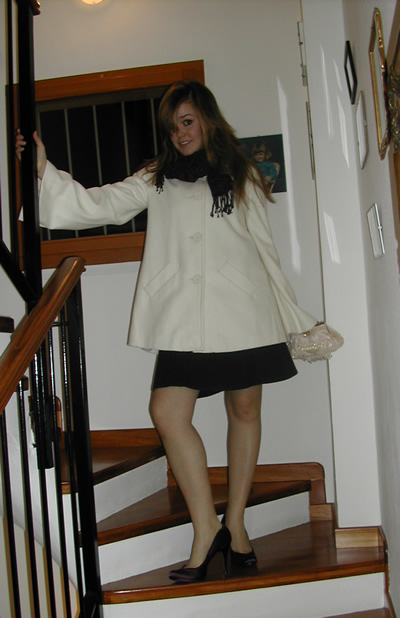
photo at top: Ross ready for an evening out. Over her shoulder you can see one of the portraits we had done when she was small.

Coming Out (to me)

Dec 27, 2006 – revised and expanded Jan 12, 2008

I grew up in a household without homophobia: one of my dad’s childhood friends was gay (and had known he was since age seven), a fact which never bothered Dad, who had other gay and lesbian friends in high school and college. No one ever told me otherwise, so, if I thought about it at all, I assumed that being gay was simply an aspect of a person, no more surprising or shocking than their race, religion, or native language.

I didn’t actually have much exposure – knowingly – to gay people until I got to college. Woodstock School in India in my day was tolerant of every other aspect of humanity except homosexuality, but its tacit intolerance of that was based more on ignorance than revulsion. In India, it was customary for men to walk down the street arm in arm or hand in hand with men, and women with women, while it was forbidden for men and women to have physical contact in public. This aspect of Indian culture was cause for some imported discomfort among Woodstock school boys (many of them American), so our public displays of affection were rigorously heterosexual – and those were forbidden by school rules, out of respect for Indian (and Christian missionary) culture.

So, although there were gay people at Woodstock when I was there, at the time I was neither aware of them nor sensitive to the issues of gayness. Some of those gay people were not themselves aware of it then – not surprising, in that environment.

I therefore arrived at college in the US with complete tolerance for, matched by near-complete ignorance of, American gay culture. (I loved “The Rocky Horror Picture Show,” which is in some sense a celebration of sexuality in all its forms, but too camp to be a useful guide to average gay comportment!)

I don’t remember particularly noticing any gay people around me in my first year or two of college (except at that Joan Armatrading concert in Santa Cruz). Then I got a crush on a guy who, though happy to spend time in my company, was oddly elusive, and always talking about his sisters – I grew confused as to how many sisters he had! He didn’t respond to my low-key, clumsy attempts at flirtation, but I was used to that – I wasn’t any good at flirting, and guys tended to either not notice at all, or run away screaming.


Eventually he came out to me, which resolved my increasing confusion, though I don’t now remember what specifically was said. We remained good friends, and I had my first experiences of open gay culture – most memorably, a disco party at which all the men and all the (straight) women threw themselves enthusiastically onto the dance floor for “It’s Raining Men”.

Sometime during the 1990s, during one of my frequent US trips, a Woodstock schoolmate took the unprecedented – and for her very scary – step of coming out to me. Or, at least, she tried to. She came to Boston to visit me from Northampton, MA, a town which I now know is reputed to be “the lesbian capital of America.” I didn’t know that then, and knew even less about lesbians than I did about gay men. My poor friend dropped any number of hints, and must have begun to wonder if I was being wilfully ignorant.

Finally she said: “I bought a pickup truck. I felt it would make a statement.”

I stared at her blankly. “A statement of what? That you move a lot?” (Having to frequently pack up one’s household to move was the only reason I could think of to own a truck.)

She almost gave up at that point. It wasn’t until she was on the step of the train, about to leave to return to Northampton, that she blurted out: “I wanted to tell you: I’m lesbian.”

“Uh, okay,” I answered, or something similarly lame. And the train pulled out. I felt terrible that I hadn’t understood her in time to have a real conversation about it, but I certainly wasn’t perturbed by the fact in itself, and we had plenty of later opportunities to talk about it.

Some years later, leaving California after a business trip, I used a phone in the business class lounge at the airport to have a long conversation with her about the wisdom or otherwise of coming out to our schoolmates. (I was in favor.) When I finally hung up the phone, a man sitting nearby gave me a huge smile. I supposed he was gay and liked what he had heard me saying.

My next new gay friend, years later, was Gianluca, a colleague in California. I was initially attracted to him, which I should have taken as a signal: somehow, most of the men for whom I feel more than a momentary attraction turn out to be gay. Perhaps it’s a marriage-saving reflex: I’m rarely attracted to any man who might actually be a threat to my husband.

It took some time for me to figure out that Gianluca was gay, and even longer for him to come out to me. Once we went to see some art film, and there was a trailer for a foreign movie about women’s sexuality. “Oh, I want to see that,” I exclaimed. Gianluca seemed completely uninterested.

Instead, he wanted to see “Jeffrey,” a film about a gay man. I figured that, while a red-blooded heterosexual man might reluctantly go along with someone else’s suggestion to see a gay film (as my college boyfriend had), he was not likely to propose it himself.

So we went to see it, and both laughed our asses off (it’s a cute movie, and was ground-breaking at the time). As we sat in the emptying theater afterwards, an obviously gay couple came up to chat with Gianluca. “Well,” I thought to myself, “I may not be sure he’s gay – but they are!”

It was that same evening or soon after that he finally invited me to see his apartment. As he threw open the door he said, “Now you’re going to see a whole new side of me!” The art posters of nude men on the walls came as no surprise whatsoever. So Gianluca officially came out to me, and we had a long talk about that.

Gianluca had led a sheltered childhood, and as a child was confused about the feelings he felt. He told me that at age 14 he finally learned that homosexuality existed, while watching a TV program on AIDS. So he simultaneously realized that he was gay, and became convinced that he was condemned to die.

It was heartbreaking to me to think of a child living with such enormous fears, all alone, feeling unable to talk to anybody about it. I don’t want that to happen to any other teenager if I can do anything to help.

The long dance around Gianluca’s finally coming out to me also made me understand just how fraught this process can be. I could feel vaguely insulted to think that anyone wouldn’t instantly know that I am homophobia-free. On the other hand, it seems utterly absurd that, in modern society, gay people feel the need to be so very careful. Oh, I totally understand their reasons – I just think it’s crazy that society forces that caution upon them. I have a lifelong habit of telling people exactly who I am and what I think. I had never realized what a luxury that is. I cannot imagine always having to weigh what you’re going to say to whom – and most of the time concluding that it’s probably safer to hide a large part of who you are from most people. This, too, is terribly sad.

I would like to think that everyone I care about feels free to be absolutely who they really are with me. So I have no patience with waiting to get to “do I know you well enough to tell you I’m gay?” – and my gaydar is now developed enough that I’ve usually figured it out long before we get there. I give the other party every possible opening (in tête-à-tête situations, to protect their privacy), dropping heavy hints to let them know that “If you were gay, it’d be okay.”

My reward is that moment of relaxation, a visible unclenching, when the person realizes that I’m not going to freak out, that I accept and like them as they are. And then a true friendship can begin.

Out With the Old, In With the New

The first time I visited Milan was in early January, 1991 – it must have been right after the New Year. We arrived in the city late at night and had to walk some way to find our hotel.

As we went, I asked Enrico if Milan’s garbage collectors were on strike or something. I was startled by the amount and nature of the garbage on the sidewalks: old appliances and furniture, heaps of trash, broken dishes and glassware, all scattered untidily around as if everyone had suddenly heaved all their old junk out the windows at the same time.

Which was exactly what they had done. Enrico explained to me that it was an Italian custom at the new year to replace old, worn out housewares. Traditionally you threw the the old stuff out the window at midnight on New Year’s, to signify your readiness to welcome the new year into your home.

This was never as popular in northern Italy as in the south, and I’ve hardly noticed it in Milan since that year, but they tell me that in Napoli the custom is still going strong: you don’t want to be walking under anyone’s windows at midnight. But then, you don’t want to be much of anywhere in Napoli on New Year’s: every New Year’s Day the media trot out the statistics on the night’s deaths and injuries due to over-enthusiastic use of fireworks and even firearms. Everyone wants to make a big bang to welcome in the new year, and often they’re too careless (or drunk) to see where they’re aiming. Italy’s north-south prejudices aside, there do seem to be more fatalities in Napoli than anywhere else in the country. Too many guns in circulation.

As for house junk: I tend to get rid of it throughout the year. Even with plenty of space in our new home, I feel oppressed by too many possessions, and give short shrift to the idea that “we might as well keep it around, we might want it someday.”

This year we actually have some housewares to get rid of: the old, scratched, survivors of a set of drinking glasses I bought years ago at an outlet store in downtown Milan. They were so beautiful back then: slightly pear-shaped with heavy bottoms, delicately tinted in six different colors, and two sizes, tall and short.

After we moved to Lecco and had, for the first time in our lives, a dishwasher, I was suddenly dismayed to realize that they had lost all their color: “not dishwasher safe” was a new concept to me. Ah, well. Reflect upon the evanescence of material objects, and heave them out the window.

NB: Don’t forget your red underwear!

What are your New Year’s customs?

A “Typical” Italian Christmas

Of course , our family is far from typically Italian. Even my husband’s family isn’t very typical: his mother moved around a great deal while she was growing up, and had only two brothers (who both died young), and Enrico’s father was an only child – hardly the norm in his day! So the close family isn’t numerous, and what we do have is spread all over northern Italy. (Let’s not even start on my side of the family.)

Enrico and his brother also moved around a lot in their youth (thanks to their parents’ teaching careers), both went to grad school in the US, and Bruno now teaches in Norway. Their mother (widowed two years ago) lives in Abruzzo (Italy’s central east coast). So getting together for the holidays will always involve travel for somebody. And this is the first big difference between us and most Italian families: I need to find some statistics to support this hypothesis, but my hunch is that most Italians marry within their hometown – what choice do they have, since they mostly stay there all their lives!? Extended families don’t have to go far to see each other every day, and getting together for Christmas is no big deal.

Perhaps for this reason, there is no tradition in Italy of sending Christmas cards. Everyone to whom you might want to send holiday greetings is near enough that you can deliver your greetings in person. If you do live far away, there’s not much point in Christmas cards: the Italian post office is historically so unreliable that your Christmas greetings might arrive in time for Easter – if at all.

So, for those of my friends and family who may be wondering why I stopped sending Christmas cards or even letters years ago, that’s the reason – or at least the excuse!

We do try to bring the family together most Christmases. Last weekend Enrico brought his mother up from Abruzzo. This unfortunately meant that she spent a lot of the week alone in our house (though Ross was very good about coming home straight after school to make lunch for her).

Enrico and I had a not-unusually-frantic week before Christmas – final classes for him, for me work as usual including four hours’ commute most days (I stayed home Tuesday, intending to work, but ended up in bed with a migraine instead). We did the usual last-minute shopping for presents and to stock the house with holiday food:
torroncini

Well, sweets are easy. But what to do about our main holiday meal? Do we even have a family tradition? When Enrico’s grandmother was alive, for the Christmas first course she made passatelli in brodo – a tradition from her side of the family, which came from Emilia-Romagna (though she herself was born in Brazil). When, in later years, we had Christmas in Abruzzo, we often had scripelle in brodo, which I adore. But Enrico forgot to get the scripelle (eggy crepes) while he was there, and no one in the family knows how to make them.

During our TVBLOB holiday lunch, I asked some of my colleagues about their family traditions. We have people from all over Italy (as well as the UK, Japan, Israel, Australia, and the US), so there was a wide variety. Italy’s south seems to lean towards various forms of pasta al forno (oven-cooked pasta, e.g. lasagne), while the north, broadly speaking, prefers broth-based first courses. Enrico voted for tortellini in brodo (which a Milanese colleague also told me was traditional in his family), while I was dubious that we needed pasta at all, since I had decided to make turkey with stuffing and mashed potatoes – none of which is part of any Italian tradition. Several colleagues told me that their families eat agnello (lamb) for their Christmas main course. I like agnello, but don’t know how to cook it, while I do know how to cook turkey.

My colleagues are mostly much younger than I am, and still have Christmas at their parents’ homes with Mamma to do the cooking. In our family, I am the lady of the house, and in charge of the holiday cheer – a responsibility not to be taken lightly.

Friday evening Enrico and I managed to meet up in Lecco to do some food shopping, including a stop at Rusconi, Lecco’s finest macelleria (butcher). We bought a piece of beef for brodo (broth), and a beautiful rolled roast of veal with chestnuts and lard, which I planned to make for Saturday dinner when Bruno and Ingvild arrived from Norway (where they get lots of great fish, of course, but meat is expensive).

Also traditional during the Christmas season are Italian winter fruits (apples, pears, mandarin oranges) and exotic fruits from all over the world. I’m not sure why the exotics, but it means that our fruttivendolo (greengrocer) had stuff that even I’ve never seen, from South America I guess, as well as the more familiar mangoes, papayas, and lichis.

My coup for Friday was getting Rossella‘s big Christmas present: a pair of shoes she had told us she lusted for. Ross every year well before Christmas starts telling us about all sorts of gifts she’d like – just in case we didn’t have any ideas of our own. This gives us plenty of scope to surprise her – she doesn’t know which, if any, of the requested items she will receive (certainly not all, given her expensive tastes and our limited budget).

She had described these shoes in loving detail, along with where to get them, and mentioned that they were the last pair in the store. When I arrived, the owner remembered her trying them on the day before, and was surprised at my attempt to make a surprise of the gift: I refused to have it “wrapped” in a bag with the name of the store on, and didn’t even let them put their sticker on the anonymous gift wrapping they did.

Of course I ran into Ross on the street in Lecco five minutes later. “Did you get me something?” she asked mischievously. “Nope,” I said, pressing my anonymous cloth shopping bag under my elbow. “I’m just going to give you money, and you can buy what you want.” Later we passed by the shoe store window together and Ross gasped: “They’re gone!” “Oh, were they there? I guess I missed them. These other ones are cute…” I can’t believe she fell for it – I’m not that good an actor. But she claims that she was genuinely surprised on Christmas morning, and she certainly was genuinely delighted.

Saturday morning Enrico and I did more shopping, finally managing to find the fresh chestnuts that I needed to make stuffing. I use a recipe from Martha Stewart, but Martha has it easy: she can buy chestnuts frozen or canned. I have to buy them fresh, then roast and peel them myself. Here they are just before roasting:

castagne - chestnuts

Each one had to be pricked with a knife so that it wouldn’t explode in the oven. It took me halfway through Sunday to get them all ready to be added to the stuffing.

Our plan to have the veal roast for Bruno and Ingvild’s welcome dinner was thrown off: they arrived very late Saturday night after a horrendous day of travel (Denver and Heathrow weren’t the only airports having weather problems). So we had to eat the roast on Sunday, although Christmas Eve (la vigilia di Natale) is traditionally a day of “fasting” – or at least, in modern times, light eating in preparation for the feast to follow. And we did have the tortellini in brodo that Enrico wanted, for Sunday lunch. (The leftover homemade broth was used in risotto last night.)

tortellini in brodo

On Sunday I made the cornbread and did everything else needed for the stuffing – had to make cornbread from scratch since I can’t get cornbread mix here. Someone on the Expats in Italy forum gave me a localized recipe using polenta. The result is not so great that I’d really enjoy eating the cornbread on its own, but it’s fine for use in stuffing, with a pleasantly gritty texture.

Some regions and families in Italy celebrate (with a big meal) right after midnight mass on Christmas Eve (which, once midnight has passed, is Christmas morning, I guess). Here in Lecco it seems that everyone goes to mass: Ross and her friends stopped in at Lecco’s main church at midnight with the idea of attending mass, but found it too crowded to hang around. Instead, they had their own version of Christmas eve dinner.

I think the Lecchesi after mass generally go home and to bed, waiting to open presents the next morning, as we did. Ross is now old enough, and stays out late enough, that we actually had to wake her for this! While I was waiting, I put the stuffing into the oven to bake, and started preparing the herb mixture for the turkey.

Our oven isn’t big enough to fit an entire turkey: I cook a turkey breast, using a recipe that calls for putting a mixture of herbs, onions, and lemon zest under the skin. Italian turkey breasts are packaged without the skin, so I spread the herb etc. paste over the bare breast and then layer on slices of pancetta (bacon):

turkey wrapped in pancetta

Then we went to open presents, as you might guess by the shapes: lots of books! (The amount of reading we do is also NOT typical of Italian families.)

We drag out present-opening as long as possible, taking time to enjoy each others’ gifts (and reactions). By the time we got through the pile, the stuffing was cooked and it was time to put the turkey in.

Italian poultry always takes a lot longer to cook than American recipes expect – maybe there’s less water in the meat? The recipe wanted me to cook the turkey for less than an hour, but it took more than two before the meat thermometer registered done.

We didn’t just sit there hungry and waiting, however: we had a wonderful antipasto. Bruno and Ingvild always bring lots of yummy salmon with them (they say it’s the only thing that’s relatively cheap in Norway). Salmon can be found year-round in Italy, but a lot of it is sold at Christmas: it has become a standard holiday luxury item. We ate two types (one smoked, one marinated) with toast, butter, and mustard sauce, which was plenty to hold us until the rest of the meal was ready. After the antipasto everyone drifted away from the table again, browsing through their Christmas books, drinking prosecco, and (in my case) checking email.

We re-set the table and got lunch onto it by around 2 pm. I have finally learned how to make mashed potatoes from scratch really well: the trick (thanks to the Silver Palate cookbook) is to cook the potatoes very soft, drain them, heat a mixture of milk and cream separately, then beat the two together with a hand mixer.

After lunch, I took a nap.

In the evening, we noshed some more on salmon and turkey, then watched “Brokeback Mountain” – not very Christmassy, I know, but I had got it for Ross for Christmas because she loved it, but I had never seen it myself. Wow. Amazing movie. I dreamed about it afterwards.

Today is Santo Stefano, St. Stephen’s day, also a national holiday in Italy – a wise tradition, I think, as we all need time to recover from holiday excesses. This is the day when families traditionally go on a gita (daytrip), but I let Enrico go with the in-laws – after a frantic week, I’m enjoying the peace and quiet at home. Ross has left for Bormio where she and a bunch of friends are renting a house together for a week. Their original idea was to ski, but there’s no snow (this winter so far has been unusually warm and dry) – the poor dears will have to make do with the hot springs.

* A Note on Panettone

I actually don’t like panettone all that much. But we learned a trick from Julia while we were staying with her and Dani back in April (for Rosie’s funeral). At the time, Italy’s traditional Easter cake, colomba (shaped like a dove, sort of) was already available in stores. I brought one as a gift for Julia and Dani. Julia said it was similar to Mexican pan dulce, and treated it the same: sauteed in a pan with lots of butter. Yum!

This turns out to work very well with panettone, too: the warmth and slight crispness make it much more interesting.

What (and from where) are your holiday traditions?