Category Archives: bio

Adjusting to America

When I announced my move to the US, a number of people, particularly other American expatriates, wondered how I would cope with the shock of life in the US after 17 years in Italy.

It hasn’t been much of a shock at all.

This is partly because I haven’t had/allowed myself time to brood about it. My new job keeps me (very happily) very busy, and I travel a great deal for both work and personal reasons.

But I was also better prepared for re-entry this time. I didn’t expect to feel like a native here, and that lack of expectation has saved me some grief. Though I seem to have gotten better at passing for a “normal” American, my life is so complicated that any personal conversation quickly gets into the territory of the unusual. But this seems to bother the people I meet less than it used to, or perhaps I’ve gotten better at explaining it in ways that don’t seem arrogant or… well, whatever it was that others thought they perceived about me during my earlier US re-entries. It’s certainly easier to be happy in the US now that people don’t think I’m an arrogant bitch. ; )

Nor am I facing the culture shock that many expected me to.

There’s a lot to like about living in the United States.

For one thing, I’m enjoying the novelty of convenience. America is a consumer society, and, whatever else you may feel about that, you’ve got to admit that it makes shopping easy. You can buy just about anything at just about anytime, and “if for any reason you are not satisfied,” you can return it and get your money back – no questions, no argument.

Shopping online is also wonderfully easy, and shipments arrive when and where expected, whether sent by courier or through the US postal service. If you haven’t struggled with Italy’s legendarily bad poste, you have no proper appreciation of the sheer joy of a reliable postal service!

People also ask if I miss Italy. So far, I really don’t. I enjoyed being back there (in brief spurts) in June, and will doubtless enjoy planned visits at Christmas and hopefully also in the fall – I do like to see my husband from time to time. But I don’t waste any energy on missing the lifestyle I enjoyed there, and, when I scan the Italian headlines, I just end up depressed.

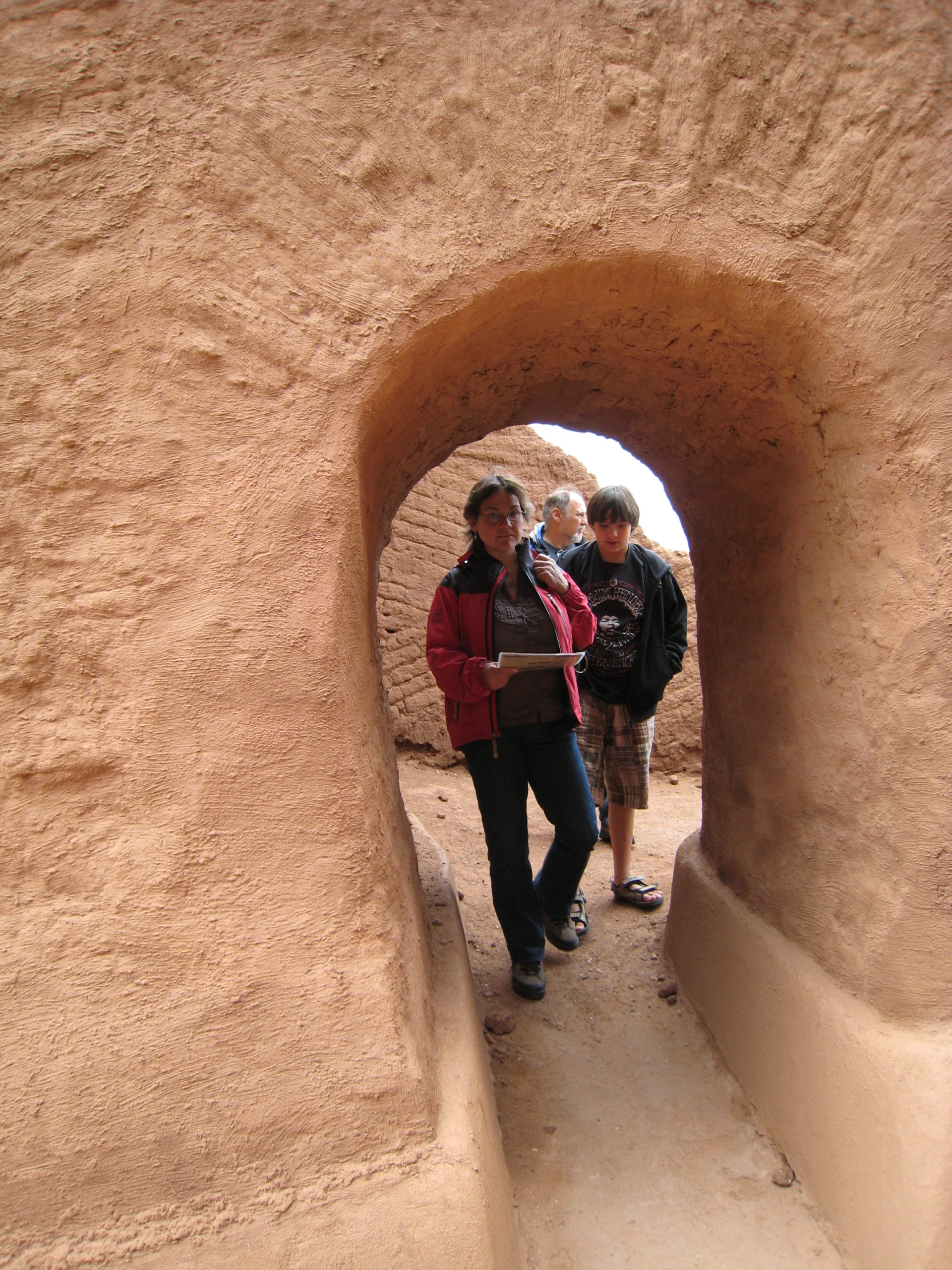
Pecos Pueblo and Santa Fe, New Mexico

Enrico and I visited Steve and Sharon in Las Vegas, New Mexico (my third visit to them in 12 months!), arriving late Friday night. Saturday we all (including Robin) visited Pecos Pueblo and Santa Fe.

Before entering the park grounds, we toured the visitor center exhibit about the history of Pecos Pueblo. It was well done, as these things usually are at US National Parks, but I find the bloodthirsty history of the Catholic Church upsetting. I left the others watching an antiquated film about the Indians putting the poor, innocent padres to death, without waiting to find out whether it gave equal time to what the Church subsequently (and previously) did to the Indians.

Santa Fe

Enrico and Steve went to the Georgia O’Keefe museum, but I’m not a huge fan and Robin emphatically did not want to go to a museum, so he and Sharon and I ambled around town, looking at art galleries (what’s the difference with museums, from Robin’s point of view? I dunno).

As always, I was most attracted to anything featuring horses, and was delighted to find the work of someone who actually can sculpt them well, Star Liana York. I’ll have to save up first, though…

Also saw some fun and unusual stuff I’d consider buying in Pop Gallery, a refreshing change from the overwhelming (and, in the aggregate, somewhat boring) mass of Southwestern-themed art prevailing in Santa Fe.

There was a “mountain traders’ fair” going on in the courtyard of the Palace of Governors. Sorta like a Renaissance festival, including the love of antique weaponry. Just slightly different costumes. Some of the “mountain people” looked like refugees from “Pirates of the Caribbean.”


Hello, Dolly!

Now that I’m living in the US, I have a chance to do things I haven’t done much during my years in Italy, such as go to concerts (other than classical; living in Milan, we had good access to classical music).

My dad took me to concerts fairly frequently during my childhood years in Pittsburgh. We saw Arlo Guthrie and Kris Kristofferson just about every year, and Frank Zappa once, just when “watch out where the huskies go…” was big on the radio. Concerts were a lot longer in those days, and I was young – I managed to fall asleep right in front of the speakers at Frank Zappa. To my chagrin, Dad always refused to take me to see the Rolling Stones – after Altamont, he was afraid of violence.

There are concerts in Italy, of course, but they’re mostly by Italian musicians whom I don’t care much about. The big American groups only come around every few years, and my taste rarely coincides with that of the Italian concert-going public. In other words: the musicians I’d like to hear rarely come to Italy (though Enrico did see Paul Simon just before he came on his current US visit). Enrico and I saw Jethro Tull ages ago in Milan, and David Byrne a bit more recently, then Alex Britti and Randy Newman.

I’m not in the habit of following concert schedules, but the day I did my Colorado driving test, I ate lunch in a little Nepali restaurant next door to the DMV, and picked up a local paper to read while I was eating. I happened to notice that Dolly Parton would be playing in Denver while Enrico was visiting, so I called him up and asked if he’d like to go. He’s mostly familiar with her from the movies 9 to 5 and The Best Little Whorehouse in Texas, but that was enough to make him like the idea. And, for my first concert back in the US, you can’t get more all-American than Dolly!

The ticket gods love me: without particularly trying, I got seats in the center pit, four rows from the stage. For about $100 each, after taxes, fees, and parking. And Dolly gave us our money’s worth: two hours on stage, with a pretty damn big band.

I was interested to see that a good part of the audience was gay, both men and women. Upon reflection, this makes sense: Dolly was camp long before that term entered mainstream consciousness, and drag queens strive for precisely the Dolly look: spangly tight-fitting dresses, enormous wigs, enormous boobs, and enormous makeup – plus lots of jokes about it all. Her tag line is: “It costs a lot of money to look this cheap,” and she was quick to repeat it onstage, as I knew she would be.

Sadly, Dolly herself is not looking so great these days; I think she’s had an overdose of “work” (cosmetic surgery). While she sang Here You Come Again, her big crossover hit of 1977, the screen behind showed pictures and video of her during that period, and I’ve got to say: she looked a lot healthier when she was rounder. Nowadays her cheeks are hollow and her legs like two sticks. Why is it that so many famous women seem to be anorexic these days? It’s not an attractive look.

It was also interesting that her encore number, Jesus & Gravity, went over like a lead balloon: previously-enthusiastic faces turn to stone (though there were a handful who clearly did love the song). Hmm. It appears there are more atheists in America than the politicians would have us believe.

Duchess, a Dog

From 1967 to 1972 my family lived in Bangkok. My dad worked for the US Agency for International Development, so we were officially part of the diplomatic community, with all the rights and privileges pertaining thereto.

One of which was to live in a sort of expatriates’ ghetto, an apartment compound called Red Rose Court – eight or ten rows of three-story townhouses, all rented by falang (foreign) families. This little village was administered by Orapa, a Thai woman so fierce that her title – “landlady” – was synonymous with fear (for me, at least – I was a timid child).

Red Rose Court had a large driveway running its length, on one side bordered with a tall hedge of red – not roses! – hibiscus. The main gate opened onto the large, heavily-trafficked avenue that was Red Rose Court’s official address. Out the front gate and half a block to the right were a few shops that I was allowed to visit to buy candy.

The back gate gave onto a smaller, dirtier street where I was forbidden to go at all. Both gates were usually open during the day, but by some unwritten rule (I don’t remember whether there were guards) no one came in except people who were supposed to be there. And some of Bangkok’s teeming population of mangy, underfed, abused stray animals.

I was a timid child, but not stupid, and I loved animals. I learned early the trick of: “Mom, it followed me home, can I keep it?” My mother loves cats, so it wasn’t difficult to persuade her, and we acquired two cats that way. Dogs, too, realized that we foreigners were a soft touch, especially compared to Thais, who were often cruel with strays – I had seen Thai kids throwing rocks at dogs, and hitting them with sticks.

It didn’t take much street smarts for any animal to realize that Red Rose Court was a gold mine: 40 families with kids, many of them nostalgic for pets they had left behind in America, and most far more disposed than the locals to be kind to animals. When a small, skinny street dog made overtures, the kids in the compound responded gladly (in spite of our parents’ dire warnings about animals carrying rabies), and showered her with love and treats. She was grateful and affectionate, if not terribly clean. But the dirt didn’t show much against her coat. She was a color that would be called tortoiseshell on a cat; being a dog, she was brindled.

Street dogs all over Asia are much the same (I believe someone has written a thesis explaining why): medium height and light build, very short fur in various colors, lopped-over ears, stringy tails, and, usually, a head-down, furtive demeanour. They are also treated much the same all over Asia: badly.

We kids kept the dog for several weeks, hiding her when grownups were around because we were pretty sure they wouldn’t approve. But Orapa knew everything that went on in Red Rose Court, and she definitely didn’t approve of filthy animals sullying her property. She called in the dog catchers.

Had they arrived during school hours, the dog would have simply and quietly disappeared. But the dog catchers showed up with their big nets – just like in Warner Brothers cartoons – at a time we were all around, and we knew immediately what was up.

Instead of a quiet roundup of one insignificant dog, the catchers and Orapa found themselves confronted with a howling, weeping mob of kids of all ages. Though Orapa tried to calm us by claiming that the dog wouldn’t be hurt, we knew she was lying: in Thailand at that time there was no question of holding an animal at a shelter for adoption: she would simply be killed, immediately (and probably not “humanely”).

We led them a merry chase, always getting between the dog catchers and the dog, with Orapa screaming behind, until they finally cornered us. Then there was a standoff, the dog catchers not quite daring to physically wrest the dog from us.

My mother swooped in like an avenging angel and offered to officially adopt her. I’m not sure Orapa appreciated this – if this lowly street dog was elevated to the status of official pet, she would have to continue to tolerate its presence, and the defeat grated on her.

Duchess, as my mother named her, was one smart dog. Though she hadn’t had any contact with my mother before, she recognized her savior, and adopted our family in turn. She behaved well through being vetted and bathed, and stuck close to home ever after.

The following year my dad was posted back to Bangkok (after two years in Vietnam), and Duchess moved with us to a big house the next street over, a property also managed by Orapa. In a house like this, a watchdog was essential – housebreaking was so common, and the thieves so skilled, that we knew foreign families who lost one stereo after another, and never even heard anyone in the house.

Nothing of the sort ever happened to us. Perhaps because she had been so cruelly treated on the streets, Duchess hated Thais (though she accepted our servants as part of the family), and would attack strangers on sight, no questions asked. Workmen, gardeners, and other legitimate visitors had to be escorted through the property, and no one else got in at all. In our three years in that house, we only ever had one thing stolen: a table cloth that was drying on the clothesline near the back fence. My dad was roused by Duchess’ barking just in time to see someone scrambling over the wall – and leaving a bloody trail behind.

My parents separated in 1972 and I left Thailand with my father to return to the US, while my mother stayed behind in Bangkok and remarried. Duchess stayed with her and Gary til they, too, moved; then she stayed with Wandee, who had been our maid. Most expatriates didn’t try to carry pets from country to country – too expensive, risky for the animals, and in some places simply impossible. A constant theme of the roaming expatriate life is the repeated loss of dear, familiar fixtures in your life such as pets.

I remember another dog that got left behind by a Red Rose Court family. It stayed in Red Rose Court, adopted by another family, but every time a car came down the driveway, it would race out to see if its own, original family had finally come back. It was heartbreaking to see this dog running out, time after time, car after car, ears pricked and tail up with happy expectation. Then it would see that the car was the wrong one, and just collapse in on itself, drooping with disappointment.

I wonder if Duchess acted that way when we left.


Note: I confess that I actually wrote this several years ago, for my friend Claudia who was thinking of putting together an anthology, but apparently never found a buyer. I’ve been thinking about stories lately, so decided to dig out this one and share it.

Whose Story is It, Anyway?

When I wrote about leaving Italy (but not my husband), a long-time reader expressed concern about my marriage, saying that it was clear that my primary relationship is with my daughter Rossella, whereas my husband Enrico is “merely a footnote.”

I appreciate this reader’s concern, but was quick to correct (I hope) his misconception. It’s true that I have written more about Ross, and in more detail, than I do about Enrico. But that doesn’t necessarily reflect the importance of each in my life.

It’s a generational thing. Ross, having grown up with the Internet, shares her life online in a way that is completely normal for her generation, but which leaves her father shaking his head in bemusement: “When I was young, I would never have dreamed of making public some of the things she does, even if I’d had the technology.”

So it’s simply out of respect for his privacy that I don’t write much about Enrico.

This brings up a larger question that has been on my mind for some time: we all have stories to tell, and much of what I share online is, one way or another, stories. But the most interesting stories involve other people, who don’t necessarily want those stories told about them. And I can’t be sure about others’ sensitivity level. While I have rarely or never told a story with deliberate intent to cast anyone I know in an unflattering light, on a few occasions people have been unhappy about what I wrote about them. And there are lots of stories I haven’t yet told out of respect for others’ privacy. Still, I wonder: whose story is it, anyway? What legal or moral right do I have to tell my own tales when they happen to involve other people?