Category Archives: bio

Off the Phone in Italy

Since I’ve been in Italy, I’ve gotten out of the habit of telephoning: anywhere, anyone, for any reason. Aside from the enormous difficulties of installing a phone line in Italy and keeping it working (which, if you’re lucky, you will only suffer through once), everything involved in using a phone is simply ridiculously difficult here.

They keep bringing us new phone books every year, but I haven’t actually opened one in as long as I can remember. Why? Because it’s almost impossible to find any useful information in them. When I left the US in 1991, I was accustomed to using the yellow pages to find businesses or services close to home. The categories made sense to me, and were usefully cross-referenced.

With the Italian Pagine Gialle, I soon gave up. There is some logic to how businesses are described there which completely eludes me. This may have been an early lack of vocabulary on my part, but there are other problems.

What if I already know the exact business I’m looking for and its address, and simply need a number to call them? Hah! Life should be so easy. The Pagine Gialle (or Bianche – white pages) don’t help there, either.

Next time you buy something with a credit card in an Italian shop, look at the credit card receipt, which carries the official incorporated name of the business. This name is often not even remotely similar to the shop name on the sign outside.

It is this official business name which gets listed in the phone books, I suppose because all of the business’ financial and legal documents, including its phone contract, are done in this name. Which is absolutely no help to you, the consumer.

The online version of the Pagine Gialle has the same problem. At a conference I attended in Torino last December, one of the speakers was an exec from PagineGialle.it. I cornered him afterwards to ask about this.

"It’s our biggest problem," he sighed. "To have anything other than the official business name listed, they have to pay. Most don’t bother."

No concept of "doing business as", evidently.

So, if you use a business that you think you might want to call sometime, be sure to pick up a card and take it home – that’s the only way you’re ever going to find their number.

This doesn’t apply to larger and non-storefront companies – most of those are listed under the name you’re familiar with, so you can find a number and just call, right?

Wrong.

Not many Italian companies seem to be using voicemail, which phone-tree-scarred Americans might think is a relief. In Italy, you call a central switchboard number, you get a live person.

But who have you got? As Michelle points out, it’s not necessarily a receptionist. I have seen with my own eyes security guards at the entrance to one of Fastweb’s corporate HQs in Milan, attempting to shepherd visitors through an elaborate entry process (including printed badges with photographs) – while simultaneously answering switchboard and tech support calls!

It’s no wonder, then, that no receptionist I’ve encountered in Italy has ever offered to take a message and have me called back, and they seem surprised and offended when I request it. The best you’ll get is: "He’ll be back after so-and-so time, call then."

All this probably accounts for the rapid spread of cellphones in Italy. There has never been a directory of cellphone numbers, but no one missed it because the landline directory we already knew was of limited usefulness anyway. People print their cell numbers on their business cards, so you’d better hold onto those and/or put the numbers into your phone.

With a cellphone, you don’t have to go through a switchboard, and, in the rare event that a call goes unanswered, you can always leave a message or send an SMS.

All of this fits neatly into Italy’s cultural preference for personal connections. Cold-contacting a new company (even if you want to buy something from them!) can be damned near impossible here: it all depends on who you know personally – and having their cellphone number.
Finishing Touches

When we moved into our apartment in Milan in 1991, we were young and just getting started in life – which is code for "didn’t have much money". Our furniture all came from Ikea, with supplementary storage: the old trunks we had shipped our stuff in from the US.

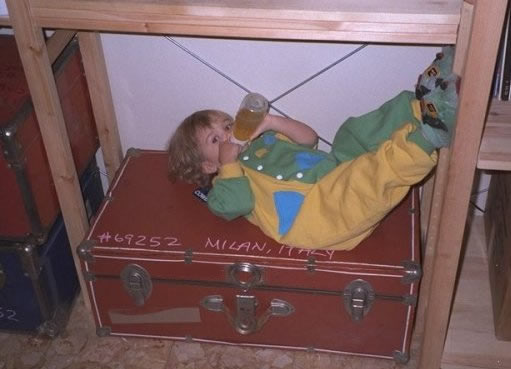
Rossella in the shelf

Our light fixtures for years were the same bare bulbs on wires that had been present when we bought the place. Once you’re accustomed to the fierce, unobstructed glare of a 150-watt bulb, it’s hard to get used to lower levels of light.

But, over time, we gradually upgraded some of our cheap furniture to get more storage space, Enrico got a new piano, and real light fixtures slowly began to appear. Each choice of a new one was agonizing. When we replaced the final bare bulb with a real ceiling lamp, sometime around 2001, we joked: "Now the house is all finished – we’ll have to move!"

And, not too long after that, we did move. The thirteen years we had spent in that apartment in Milan was the longest I’d ever lived in any dwelling in my life (which might be the case for Enrico as well – his family, unusually for Italians, moved quite a bit when he was young). We were no longer accustomed to change. Perhaps that’s why we were in a hurry to feel settled in our new apartment in Lecco, and had it completely furnished, including ceiling fixtures, in record time. Of course we then had to move again.

We’ve now been in our house for three years, and, once again, it was unpacked and looking very finished, very quickly. But it’s a big place; there’s always room for improvement.

Some time during the second year we finally replaced the last temporary light fixture, in the entryway. There had been no reason to rush: it had a big white-glass globe bulb, and almost looked intentional. Except that Enrico tended to point it out to any visitors complimenting us on our lovely home: "Yes, but we still have to find a light fixture for that…"

So finally one day he came home with this:

light fixture, Leuci, Lecco

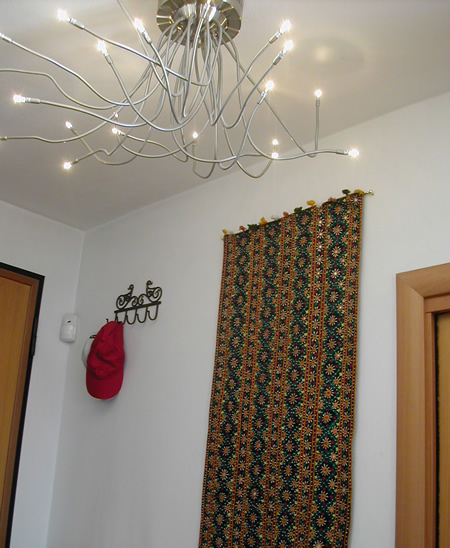
It’s even local, made by a company in Lecco called Leuci. High coolness factor: you can position the tentacles any way you want.

The hanging is Indian; I won it at auction at the Woodstock reunion last summer. We still needed a coat rack for that corner – always useful by an entry – and Enrico found this adorable wrought-iron one in a small town in the mountains during one of his hiking excursions. (No, Italians don’t usually wear baseball caps – I use them to keep the sweat out of my eyes when gardening.)

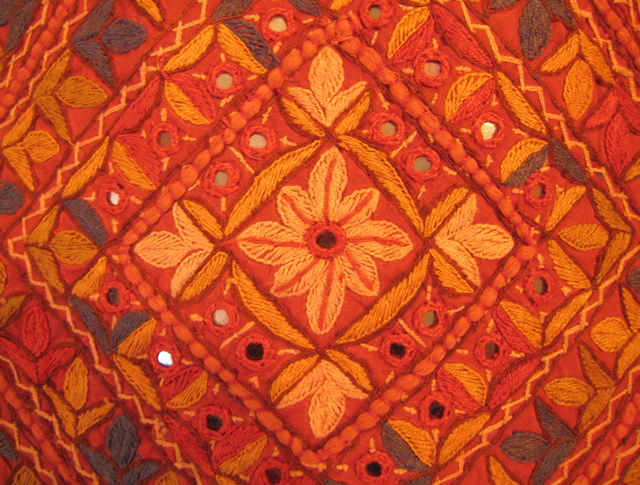
More recently, we hung a beautiful tapestry (handcrafted by a women’s cooperative in Gujarat) that my classmate Sara brought us – stunning piece, see the detail at the top of this page. I moved next to it a watercolor of the Mussoorie hills done years ago by my Woodstock art teacher, Kathleen Forance, which had previously been overlooked and neglected in a hall corner.

…and I can think of lots more things to do to the house (not to mention the garden). My stay with Gianluca and Brian in San Francisco was inspiring: Brian’s trained as an interior designer, and it shows in their beautiful place. I’ll have to steal a few ideas from him. And I plan on some serious shopping during my upcoming India trip.

But we’ll never call this house "finished" – if we did, we would have to move again.

The Lawsuit Society

Americans seem to have a very legalistic approach to life – the polar opposite of Italians’ very relaxed attitudes towards the actual law, let alone life in general.

Boarding the CalTrain to go back to San Francisco, I had no idea where to put my big suitcase. On the way down I had put it on a seat, and wondered if that was allowed, but there were many seats free at the time. This train was more crowded. This bag wouldn’t fit under the seats, and there are no overhead racks (I couldn’t have lifted it up there anyway).

The first car was marked as being capable of transporting bicycles, so I got on that one and found a big open space right at the front of the seating area, completely unoccupied. I wondered vaguely if this was where people were supposed to put bikes, but didn’t think too hard about it (it had been a long week, I wasn’t thinking or noticing much at all). I put my suitcase in one corner of that open space, and sat down in a nearby seat where I could keep an eye on it.

An old lady with a wheeled walker got on some time later, and the conductors very solicitously parked it alongside my case as they helped her on board.

Then one of them asked: "Whose luggage is this?"

"Mine."

"Well, ma’am , did you see this sign that says it’s against federal law?" (I hadn’t, though it was a large one – tired, remember?)

"We could get a big fine."

"Where would you like me to put it?" I said this as non-aggressively as I could, though I was thinking: "You could get a fine? That’s just weird."

"There’s a baggage car two cars back."

Unlike the accomodations for bicycles and ‘passengers in need of assistance,’ the fact that there was a car designated for baggage had not been clearly denoted along the platform. I would have had to walk back two cars, dragging the suitcase. The conductors did not insist on this, but I found it amusing – and somewhat irritating – that my wrongdoing was chided in terms of "we could get fined." Why not just say: "If this space is needed for a handicapped passenger, you’ll need to move your suitcase." Which of course I would, gladly and immediately – surely that would be the minimum of civilized behavior?

However, the way the rebuke was phrased made me feel that the assumption was that I would behave like a jerk unless bludgeoned by threat of a fine (though there was an interesting twist: they, the railway employees, would get fined. Was this supposed to engender sympathy?)

America lives by legal threats and lawsuits. An outdoor dinner was given for attendees of another event at the hotel where we were having a conference. One of the guests fell down somehow. A server rushed inside to a lobby phone and called security: "He’s not hurt, but I have to report it." Two security guys in dark suits, with walkie-talkies, converged on the scene, one carrying a clipboard with a questionnaire that he required the guest to answer. I suppose the point was to get an immediate statement and signature, before the guy had time to think about how to turn a minor accident into an opportunity to sue somebody. The Cover-Your-Ass nation: Whatever happens, make sure you can’t be blamed for it.

What do you think? am I reading this all wrong?

Web Women Weekend

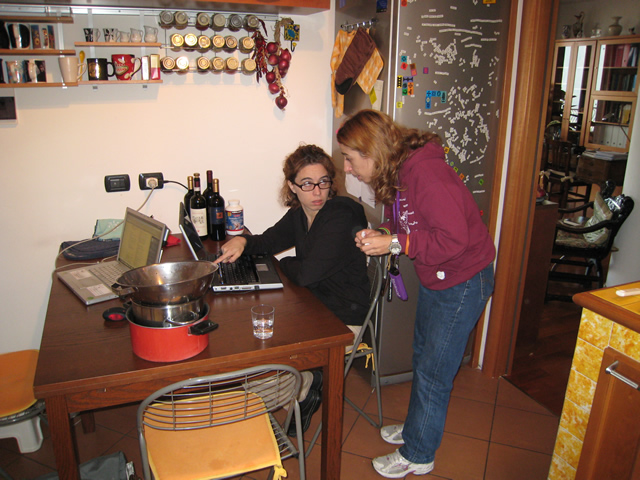
^ top: the finer points of CSS – Tara and Elena in my kitchen

Increasingly frustrated with the low visibility of women in technology in Italy, back in June I and a few like-minded ladies hatched a plan to start doing something about it.

The first step was to get together. So I invited them all up for a weekend at our house (sent Enrico off to visit his mother – yes, he is a supportive husband!).

Turnout was not as large as I had hoped (the house could have slept 14 or so), but those who came were motivated – most had to be, to trek all the way out here.

Friday night it was just me, Tara, and Elena. It had been a long week for us all, so we ate dinner, watched a movie, and went to bed.

The next morning I woke up early (as usual) and got to work cooking (while my computer was compressing video for Sun). Tara and Elena eventually wandered in and set up their laptops on the kitchen table, working separately and together on this and that. It was oddly comforting to have them there while I cooked (usually a lonely activity for me); I’d like to have girl geeks in my kitchen more often!

The crew gradually assembled and introduced themselves:

  1. Tara Kelly, founding partner of PassPack
  2. Elena Franco, aka Delymyth, sysadmin
  3. Silvia Cavallon, a former colleague of mine from Incat days, now a tech support manager for HP
  4. Sara Rosso, Internet Services Manager at Ogilvy Interactive
  5. Sara Maternini, corporate blogger and event manager for San Lorenzo, who kindly furnished us with a six-pack of Franciacorta (Italian champagne-method wine)
  6. Celia Abernethy, web designer/builder/programmer and owner of MilanoStyle
  7. Susan Quercioli, a manager of technical projects and people
  8. me

Talk flowed, mostly informally, but that doesn’t mean we weren’t sharing useful information.

There were the expected horror stories:

  • Every woman in Italy knows that being married and in età fertile (of childbearing age) is an enormous handicap in finding a job. It is perfectly legal for a prospective employer to ask your age and marital status (indeed, many job announcements specify the age range they will consider). Italy’s generous maternity leave law has backfired: no one wants to hire a woman who may go out to have a baby, costing the company money. And there are no real protections against discrimination of any sort in the Italian job market.
  • As in many other countries, women in Italy are paid less than men for the same work (and all Italian salaries are low against European averages, especially considering the cost of living here). One of the group, upon requesting a raise, was asked: “Doesn’t your husband earn enough to support you?” As if her work was just a hobby! The reality is that most women in Italy who work do so because their families need their income as much as their husbands’, so, yes, we need (as well as deserve) equal salaries.
  • We see our male colleagues getting jobs, raises, and promotions based on their skills at self-promotion as much as or more than for their actual abilities or work accomplishments – and getting paid more for doing less than we do!
  • And on, and on…

So, yes, there is plenty for women in IT in Italy to be unhappy about. But we didn’t get together just to bitch. The point of the weekend was to discuss what we can do to help ourselves, each other, and the larger community of girl geeks in Italy.

Under Sara Rosso‘s (welcome) leadership, each of us described what we hoped to get out of this event. These included:

  • “How should I write my curriculum to reflect my real-world experience, especially since I don’t have the formal qualifications that companies think they need?”
  • “I’m a female manager in a male world, and I think I can see better, let’s call them more ‘feminine’, ways of managing people. But in my job I don’t have any role models I can look to for advice or examples. I’d like to have someone to talk to about my ideas.”
  • “I’ve been badly underpaid in my career, partly because I find it hard to negotiate, partly because I don’t know the Italian market value of my skills. Where can I get information on salaries and freelance rates, and advice or training in how to negotiate?”
  • “I wanted to change jobs, but I didn’t know enough about possible Italian employers to tell which companies I might actually like to work for.”
  • “It’s great to know that I’m not the only woman in high tech in Italy, and not the only one to deal with these issues. When can we meet again?”

^ Sara Rosso and Susan Quercioli [Susie Q?]

Sunday morning the first-round attendees left, to be quickly replaced by:

  1. Enrica Garzilli, Sanskritist and journalist
  2. Ruhama Zayit, software engineer at TVBLOB
  3. Bruna Gardella, Senior Analyst at Etnoteam Spa

More useful experiences and information were shared (as well as an Indian lunch that I cooked).

At the end of the two days, we had some next steps:

  • Set up an online community where we can discuss and plan. For the time being, this is a Yahoo group.
  • Though we did not explicitly say so, one of the aims would naturally be to get more women to join this community – if you want to join, head on over and ask!

Possible projects for the community:

  • Periodic social events – aperitivi, Girl Geek dinners. A monthly aperitivo in Milan will probably start in November (2nd Tuesdays), organized by Lisa Morris of TVBLOB. And we’re discussing a date and a speaker for the next Girl Geeks Dinner.
  • Practical workshops where we can learn skills we feel we are lacking. One specific suggestion was negotiation – ideally, with role-playing to help us learn how to do it. We need to share info on where we might find people to do such workshops and how we would finance them (e.g., a good friend of mine is the Italy coordinator for the Open University, which might be interested in doing something relevant).
  • Job bank? At the very least, we can start sharing information on jobs we’re aware of via the Yahoo group.
  • Salary bank, with a wide range of both men’s and women’s salaries and freelance rates (in Italy), to help us see how we’re doing and price future jobs and freelance work. Bruna told us that Il Sole 24 Ore already runs quantomipagano.com, which looks very useful but does not cover freelance or contratto a progetto rates. Perhaps we can persuade Il Sole that it’s in everybody’s interest for them to expand their database to include this info. Who has a contact there?
  • Events calendar. Sometimes we don’t go to technical conferences or barcamps because we feel overwhelmed by the vast majority of men there. A shared calendar will let us track events we might be interested in, and encourage each other to go.
  • Speaker lists. Another reason we don’t go to events is because we’re not represented among the speakers – we get tired of being talked at by men. We can develop and maintain a list of women qualified, willing, and able to speak on various technical topics, and, um, gently suggest them when we know about events being organized.
  • Many of us don’t have women technical colleagues we can talk to at work, so we would like to both give and receive mentoring (on specific questions or for general support and advice).

Having this nascent supportive community of women in IT is already proving useful. Had I met Bruna a year ago and talked with her about some Italian IT companies she’s familiar with, I might not have been so much in despair about my job prospects in Italy. Celia said that, had she known us three years ago, she might not have abandoned the web business she enjoyed (and in fact she’s now thinking about getting back into it!).

Your thoughts and contributions welcome!

The Ever-Expanding Holiday Season

Yesterday the local supermarket stuffed an advertising flyer into our mailbox, as they do about once a week. This one was unusual. Blazoned across the front was “E’ gia’ Natale!” (It’s already Christmas!)

I almost puked.

It’s not even November, and we’re already talking about Christmas. At this rate, Italy will soon have caught up with the U.S. in terms of over-advertising the holidays. (As I mentioned some time ago, the UK is already almost as bad).

And I’m not even Christian, and this makes me sick. I used to enjoy the Christmas season, whose bright lights and shiny decorations help me cope with the depressing deep dark nights of winter. Now I feel oppressed by it. And this oppression begins earlier and earlier every year. The feeling that I must buy something – anything! -for all the “important people” in my life.