Category Archives: Italian culture

Colpo di Fumo

wrote earlier about Italian superstitions, including the dreaded colpo d’aria – a draft of cold air, blamed for everything from head colds to paralysis. Zeev responded:

“Christmas of ’87 was the first time I went to Italy. At that time I was living in Ticino [the Italian part of Switzerland] for an extended period; I have good memories from the area, but being in Mendrisio in the evenings is like being alone in the desert. A few days before Christmas, I realized that being there during the holiday season would be even worse, so I decided to use the time to see some people in Germany and Sweden.

I took the train to Cologne. The cars were full of happy Italians travelling north for a vacation. There was one drawback to the company: everybody was smoking heavily. I had quit smoking about 10 years earlier, and had difficulty with smoke. I asked them to do me a favor and stop smoking in the compartment, but their understanding of the situation was that it was my problem, so I should leave the compartment — which of course wouldn’t solve a thing, as the corridors were also full of smoking Italians. So I opened the window. To my surprise, everybody fled the compartment within seconds. Now I finally know why: colpo d’aria.”


I wish that approach worked for me. We often find ourselves surrounded by smokers at restaurants, but occasionally we also happen to be near a window. If we open it, however, someone is bound to whine about the corrente (draft), a complaint which is always considered reasonable, whereas our complaining about smoke is not taken in the same spirit. One of the few things I miss about life in the United States, and especially California, is the lack of smoke. I will be relieved when Europe catches up.

Which may take a while. Italian restaurateurs are up in arms over a new anti-smoking law, due to come into effect next January, which will force them to create ventilated smoking areas physically separated from non-smoking areas.

A few larger restaurants already have non-smoking sections, though it can be difficult to get seated in them. One place we used to frequent had such an area, but closed it off sometimes when there was a shortage of waiters. Recently, at another restaurant, they didn’t want to seat only three of us in the non-smoking section, because the tables were set for four or five. I had to insist that we were non-fumatori accaniti (ferocious non-smokers). One very good pizzeria near our former home in Milan never had a problem seating us in one of its two large non-smoking rooms, though these were always more crowded than the smoking area. It seems that there is unmet demand, even in Italy, for smoke-free dining.

Sadly, smoking is still very much in vogue here, and socially accepted even for 13- and 14-year-olds. Many kids consider it a declaration of adulthood, and begin as soon as they reach high school, if not earlier. As far as I can tell, their parents don’t even try to combat it, and tobacconists have no qualms about selling cigarettes to young kids. Rossella is one of few non-smokers in her class (students are allowed to smoke on school grounds, although, as of this year, not inside the building); by now she’s made such a fuss about her friends smoking that she’d look like a complete idiot if she ever tried it (good!).


Feb 9, 2004

From March 1st, smoking will be completely banned on all Eurostar and Intercitytrains in Italy. It is already banned on all most regional (local) trains, which leads to scenes of smokers lined up at the door, cigarettes already in hand, as the train pulls into the station. They barely get one foot on the platform before they light up, one after another, hurrying away in a desperately-puffing line.


Apr 16, 2004

I’m pretty certain that Italy’s new rules about non-smoking sections in restaurants will only come into force next January, but, to my surprise and delight, several of our favorite restaurants have already gone completely non-smoking. It appears that some restaurant owners and staff were glad to have the excuse. I wish Austria were as forward-looking. We didn’t get to enjoy any of Vienna’s centuries-famous coffee bars; every one we stepped into reeked of stale smoke and beer. So we ended up at Starbucks, that bastion of American cultural imperialism, where smoking was not allowed.


Apr 27, 2004

I finally asked a bar owner why some bars and restaurants have already gone totally non-smoking; I thought the law didn’t go into effect til next year. He explained that the law actually went into effect THIS January, requiring all public places to have a completely separate and ventilated room for smokers, or to ban smoking completely. Those who choose to separate out the smokers have a year’s grace period in which to do the construction; those who have no such intention are supposed to already be completely non-smoking. Of course, this being Italy, there are probably some (many?) who have not yet done anything and will claim, if asked, that they intend to build a smoking section by next January, when in fact they have no such intention (or ability — some places are simply too small), and are just buying themselves and their smoking customers another year.

Interestingly, the recent ban on smoking in pubs in Ireland seems to have gone down well, in spite of strident protests before it went into effect. It was widely supported before the fact by the union of pub employees, and many customers seem now to find that they actually prefer their pubs without smoke. The die-hards are reportedly organizing booze-and-smoking parties in their own homes, which will cause the pubs to lose business (and the neighbors to complain), but won’t damage the alcohol industry.

Sandokan – an Italian Children’s Classic

We saw Pirates of the Caribbean in Italian, though I felt it lost something in translation. But it was fun, pretty much what you’d expect from a movie developed from an amusement park ride. And it reminded me that I’ve been meaning to write about Sandokan.

Sandokan, a character created in 1883 by an imaginative but completely untravelled Italian named Emilio Salgari, is a Malaysian prince, deposed by the British and Dutch colonialists who have taken over his country. Unable to reclaim his throne, “the Tiger of Malaysia” takes to piracy, harassing the colonialists, along with his fearless band of seamen and his Portugese sidekick, Yanez.

I find very amusing the reversal on typical colonial literature of the period: here the baddies are the white men, such as the real historical character, James Brooke, the “White Rajah of Borneo.”

Salgari wrote over 80 novels, stories of adventure set in exotic lands from Malaysia to India to the Caribbean. His work enjoyed periods of great popularity in many languages and countries, but has only very recently begun to be translated into English. For those who read Italian, some works are available for download.

Sandokan was made into several TV miniseries in Italy in the 1970s, starring Kabir Bedi, a half-Indian half-Italian actor. Rather too tall for a Malaysian, but awfully handsome, so who’s complaining? Besides, the Englishman James Brooke was played by an Italian (who also once or twice played James’ Bond’s nemesis Blomfeld), and Yanez the Portugese by a Frenchman, and since the series was apparently shot in India, all the “Malaysians” must be Indian. Oh, well. Inaccuracies notwithstanding,the series is fun, and is available on DVD.

Pictures etc. from the TV series

learn the song!

Salgari was never high literature, and even in the original Italian the writing is a bit clumsy (how many times in one paragraph can you use the word cupo – dark?). You read these for the grand adventure tales they are, so, if that’s what floats your boat, I do recommend them – and now two of them are available in English:

Nov 24, 2007

The kind people at ROH Press wrote to let me know:

“ROH Press has just released a new modern translation of The Tigers of Mompracem. You can read sample chapters on our website.

Next year marks Sandokan’s 125th anniversary so we’ve also issued The Pirates of Malaysia  and The Two Tigers.”

How to Get (Slightly) Better Customer Service

David Pogue of the New York Times has written a series of articles on “Customer Service Cluelessness,” in which he postulates that the incorrect billing many of us suffer from various companies is actually a money-making stratagem: most of us won’t notice small discrepancies on our bills, or won’t spend the time to communicate with the companies to get them fixed, so the companies get to keep the bulk of their ill-gotten gains.

As I mentioned before, Tiscali, my former ADSL provider, tried to stick me for € 570 back in July, after I had left their service. But that was only the end (I hope) in the Tiscali saga.

That began two years previously, when I was first trying to get ADSL up and running in Milan. I applied online in April, had some paperwork problems, and didn’t actually receive the modem until June. Then there were problems with the line, which would have to be fixed by Telecom Italia, and Tiscali told me that could take weeks – by which time I expected to be out of the country. I told them: “Call me as soon as it’s fixed;” the only other way for me to know it was working would have been to test it myself every day.

I didn’t hear anything. I returned to Milan on September 10th, 2001, and called tech support again the next day.

“Oh, that was fixed back on July 11th,” he said, “Why don’t you try it now?”

I tried to go to to CNN, but couldn’t get through. “Still not working,” I said.

“Try our site,” he said.

I did. It had a news feed. And that was how I found out about the Twin Towers. “Something very bad is happening,” I said, and hung up on him.

The good news was that the line was in fact working. However, when the bill arrived, they had billed me back to July, wanting me to pay for two months in which I had not been using it, because I didn’t know it was working.

I called customer service. “We got it working in July,” they said, “so we began billing in July.”

“I was home and could have used it til August,” I replied, “but you were supposed to TELL me it was working, and you didn’t.”

“The technician tried to call.”

“He must not have tried very hard. We have an answering machine. Or why didn’t he send email?” No satisfactory answer was forthcoming.

I decided to make a formal complaint. The customer service rep said I should write all the details in an email and send it to an anonymous customer service address.

“Fine,” I said. “I’ll copy it to your president. What’s his name?”

“That’s not necessary,” said the lady stiffly. And she refused to tell me the name. I was surfing the net while on the phone with her. A few clicks later, I found Tiscali’s corporate site.

“Ah, here he is: Renato Soru. Okay, let’s try renato.soru@tiscali.com…”

She went into a panic. “He’ll never read it!” she said.

I wrote a long message with all the details, being careful to give praise where that was due (“The customer service rep was very polite, even when I was screaming at her.”) and to explain what went wrong and where, and what kind of restitution I was expecting.

Renato Soru did read it, or at least his secretary did, and she replied politely that Dr. Soru thanked me for letting him know how things were going in customer service. She claimed that I would still have to pay for those two months, but in fact I was never billed for them, either through oversight or because someone realized that I shouldn’t be.

Writing to the big boss is an old trick in the US, but it seems that Italians are not used to it. It will still get results even in many US companies, if nothing else to get you off upper management’s back. Of course the email address of the president/CEO is not going to be posted on the website, but it’s usually pretty easy to guess: try variations on firstname.lastname@companyname.com, firstinitiallastname@, etc.; something is bound to work. webmaster@companyname.com may never answer you, but the president might.

Now we’re having a big hassle with Telecom about overbilling (to the tune of 500 euros). It’s time to write another letter…

Bridging the Holidays: Extra-Long Weekends in Italy

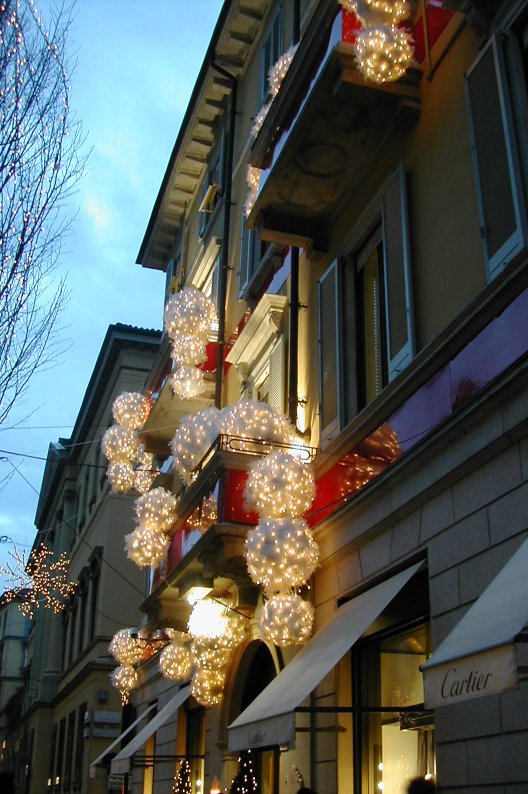
Last weekend was the real start of the holiday season for Italians, even though shops and towns started decorating a few weeks ago. The Feast of the Immaculate Conception [of the Virgin Mary], a national holiday, falls on December 8th.

These days, the holiday is mostly enjoyed as a long weekend and the start of the ski season, when families can get away to the mountains because the kids are off school. Shops are open, even on Sunday, because this is also the start of the Christmas shopping season, as Thanksgiving is for Americans.

The Milanese often get an extra-long holiday: December 7th is the day of Milan’s patron saint, Ambrose. Every city and town in Italy has a patron, and therefore a holiday on the saint’s day. This year the Milanese lose out: December 7th was a Sunday, and Milanese schoolkids were in school on Saturday.

So why were the Lecchesi off school Saturday? December 6th is the feast of San Nicolo’, Lecco’s patron – this must be the same Saint Nicholas who puts gifts in the shoes of good little children in Germany on this date (hence the legend of Santa Claus). I had thought San Nicolo’s day was in late June, when we had fireworks and the blessing of the lake, but I now know that that was simply a “Feast of the Lake,” with a rite performed in Nicolo’s name.

When I was a kid, Americans celebrated George Washington’s birthday and Abraham Lincoln’s birthday on their respective actual dates, both in February. Nowadays this has been slimmed down to a generic “Presidents’ Day,” always celebrated on a Monday, though most states now also give a holiday for Martin Luther King.

The Italians have not succumbed to the American habit of making holidays “efficient.” Americans set these floating holidays on a Monday or a Friday so as to assure themselves a three-day weekend. The Italians simply take il ponte (the bridge): if a holiday falls on anything other than Monday or Friday, many people will simply take off the extra day(s) in between, creating a long weekend. Schools have long since bowed to the inevitable, and made all the bridges official school holidays. Some schools even have a week-long holiday in February, in hopes that everyone will go off for their settimana bianca (“white week” – ski holiday) at the same time, minimizing the disruption to teaching.

The Lecchesi have beaten the Milanese at holiday bridges. If December 6th and December 8th are holidays, there is no way anyone’s going to school on the 7th, no matter what day of the week it is.

Catholic Dogma

Dec 17, 2003

I have a lot of Catholics subscribers, it turns out (including one who, as I already knew, is an Augustinian monk and priest), so my confusion over the Immaculate Conception has been cleared up.

“The Feast of the Immaculate Conception celebrates the conception of Mary herself, not that of Jesus. According to Catholic dogma, Mary is the only human to have ever been conceived without original sin. Supposedly this was a pre-requisite for Jesus’ birth, and was foretold by the prophets.

As Catholic dogma goes, this element has been argued back and forth through time, and was only made a permanent fixture in 1854.

You can find a (relatively) brief summary of the history of the IC’s observance here.

A longer discussion, with Biblical evidence for it is here.”

John Francini

American Holidays

Dec 17, 2003

Julie, our correspondent in Austin, responded: “You might be interested to know that Confederate Heroes Day combines the birthdays of Robert E. Lee (Jan. 19) and Jefferson Davis (June 3).” And you’ll notice that it falls very close to (or on) Martin Luther King Day. I’ve heard that some state agencies give their employees the option to take one holiday or the other… but that may just be a rumor.”

Scheduling Holidays

Aug 25, 2004

Prime Minister Berlusconi a few months ago proposed to increase Italian productivity by canceling some holidays, and rescheduling others to fall on Fridays or Mondays and do away with the costly ponte. Predictably, there was screaming and jeering from all fronts.

If you check the helpful US consulate calendar, you’ll see why: most of the holidays are religious ones of long standing. Probably the Pope would scream at any attempt to change them in the name of mere economics, and most Italians would defend them in the name of tradition, even though they aren’t very practicing Catholics.

The Communists (yes, we still have them) would scream if Labor Day were touched – after all, it’s meant to be a day off to celebrate the workers. That leaves the days which commemorate historical events: Liberation Day (liberation from the Nazis and defeat of the Fascists, April 25, 1945), and Republic Day (June 2, 1946, when Italy voted to be a republic instead of a monarchy). The latter has been created (or reinstated) fairly recently by President Carlo Azeglio Ciampi, in a quixotic effort to foster a sense of nationalism and patriotism among Italians – he’s also behind the recent proliferation of the Italian tricolore flag.

Berlusca would also like to reduce the number of vacation days granted to Italian employees. Yeah, right, good luck with that… He himself needs all the holiday time he can get, for cosmetic surgery! I’m not kidding – he had a facelift last Christmas, and a hair transplant just now.

Aug 30, 2004

Aldo tells me: “This has already been tried some 20 years ago.They removed some religious feasts from the calendar, including January 6 (the Epiphany) and June 29 (the feast of St. Peter and St. Paul). Some years later they were forced by popular demand to reinstate Jan. 6th as a holiday. Too bad June 29th was not reinstated – it’s my birthday, and it was fun to have a 100% sure day off for that!”

American Stars in Italian Advertising

It’s not common to see big-name American stars in TV ads in the US, but they’re quite willing to do such ads overseas. Here in Italy I’ve seen Harrison Ford in an ad for a French car brand. Andie McDowell has for years advertised an expensive brand of shoes, and more recently cosmetics, for which she appears in TV commercials apparently speaking perfect Italian with no trace of an accent. Leonardo diCaprio has appeared in an ad for Apple Computers. Both Naomi Campbell and George Clooney have appeared in Martini ads; at least both of them actually do spend time in Italy. (In case you’re wondering, Clooney’s villa is on the posh side of Lake Como, near the city of Como – nowhere near us. If I ever run into him, I’ll let you know.)

The Clooney ad is one in a series on the theme “No Martini, no party,” and is cute enough to warrant a description: George rings a doorbell. The door opens, he’s greeted by several attractive young women, and a party is clearly going on inside. “Hello, George,” they say enthusiastically. Then they see that he’s empty-handed, and slam the door in his face, saying: “No Martini, no party.” George realizes his mistake, and returns with a case of Martini. This time the girls greet him warmly, take the box, and slam the door in his face again.

Gwyneth Paltrow has also appeared in Martini ads, which raised some comment as she has stated publicly that she doesn’t drink alcohol.