Category Archives: Italian language

Italian Orphan Names

Italy has a millennia-old tradition of abandoning unwanted infants. The Romans exposed them on remote hillsides to be (hopefully) adopted by someone who needed a child or (more likely) eaten by wolves. In more recent times, babies were left on church steps, in most cases to be raised by the Church. Since no one knew who their parents were, these abandoned children were given surnames denoting their orphan status:

  • Orfanelli – little orphans
  • Poverelli – little poor (people)
  • Peverelli – slightly disguised version of the above
  • Trovato, Trovatelli – found, little foundling
  • Esposito – exposed. BTW, it’s pronounced eh-SPO-sih-toe, not ess-po-ZEE-to

These names have by now been inherited for generations, but, somewhere along the line, these folks’ ancestors were abandoned as infants.

Nicole over at zoomata.com sent me the following:

“Innocenti and Nocentini are both common names of orphan origins in Florence, from the Ospedale degli Innocenti (Hospital of the Innocents)… where babes were left, no questions asked, in a little revolving door in a corner… It’s still there, with a little iron grate over it.”

Being Bilingual is Good for Your Brain

There is a deep-rooted superstition among some Italian doctors and teachers that raising a child bilingual causes the child problems, such as slower overall language development, and academic problems later in school. Fortunately, I never fell for that line, as I had done my homework about bilingualism while still pregnant (above). And it doesn’t stand up to common sense and experience – in many parts of the world, including many parts of Italy, it is very common for children to grow up speaking a local dialect or language in addition to their country’s official tongue(s). Swiss children, depending what part of Switzerland they live in, routinely speak at least two major languages – sometimes languages as unrelated to each other as French and German – and learn another one or two at school.

But I know of some multi-national families in Italy who were browbeaten into raising their children to speak only Italian at least until school age, missing the perfect opportunity for the kids to become bilingual easily and naturally. These kids as a result could not communicate with half of their blood relations, and had one parent who could not speak to them in his/her own language. How terribly sad.

Fortunately, a new study shows that being bilingual, far from being a disadvantage, is good for your brain. Now we have ammunition against stupid interference from “authorities”:

Italian Law and Naming Your Baby

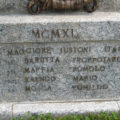
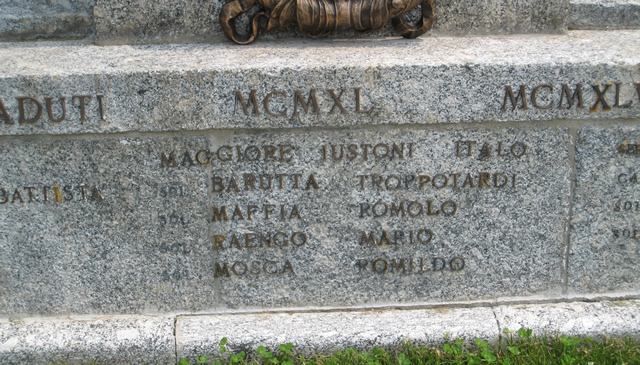
above: “What were they thinking?” department: This monument to those fallen in WWI in the Lake Como town of Gravedona shows someone whose parents named him “Troppotardi” – “too late”.

An article in Il Corriere della Sera points out that Italian law aims to prevent children being given “ridiculous, shameful, or embarrassing” names by their parents.

The official whose job it is to decide these things (the Public Prosecutor of the Commune where the birth is registered) sometimes has to sort out perplexing problems, such as whether to allow an Italian child to be given an American name taken from a soap opera. Good question. The other day I heard a mother in Lecco calling her small daughter Karen. She pronounced it CAHR-en – not ugly, but strange-sounding to both English and Italian speakers.

The article also mentions that it is illegal to give masculine names to females and vice-versa, which has stymied some parents who wanted to name their daughters Andrea. Pronounced an-DRAY-uh in Italian, it’s a masculine name, the equivalent of Andrew. In English it’s pronounced ANN-dree-uh, and is feminine.

An Italian colleague who moved to California discovered just how much trouble this can cause. He made a health insurance claim for a decidedly male complaint. When the check didn’t arrive, he called the insurance company to inquire. “This is obviously a fraudulent claim,” they told him nastily. “How can someone named ANN-drea have a prostate problem?”

Learning Italian

When I first met Enrico, I spoke no Italian, and at some point early in the relationship I decided to learn it. I already had one language under my belt: I had studied Hindi in high school and college, and spoke it fluently. Italian is a lot easier. In terms of pronunciation, it’s one of the simplest languages on earth, having far fewer discrete sounds even than English (whereas Hindi has far more: I had had to learn to distinguish between four different T sounds and four different D sounds – aspirates and non-aspirates, dental and palatal).

Italian grammar is more complex than English, but far less complex than Hindi (not as many inflections). Italians are so delighted that you’re even trying that they will forgive a multitude of errors, which can be a handicap for a learner as they often won’t tell you when you make mistakes.

I took Italian classes at the US Department of Agriculture in Washington, DC. Taking a night class once or twice a week is not an efficient way to learn a language. I got to where I understood a lot, but couldn’t say much. That was cured in the winter of 1989, when Rossella was a baby. She and I stayed a month in Rome with my in-laws, while Enrico was hopping back and forth across the Atlantic, working on his PhD at Yale and searching for an academic job in Italy. My mother-in-law speaks no English (she does speak French), so I was forced to speak Italian. By the end of the month, Enrico’s friends were all commenting on the huge improvement in my Italian.

My spoken Italian took another leap in 1991, when I began working for Fabrizio. He conducted the interview entirely in Italian, and never mentioned that he spoke English. And he had no qualms about correcting my Italian. Some weeks after I started, I ran across a document in the office, written in near-perfect English. “Who wrote this?” I asked. “He did,” said the secretary. But, to this day, Fabrizio refuses to speak English with me. He claims that he can’t understand my accent, though he understands everyone else, American or British (or Chinese or Japanese), just fine. I don’t mind speaking only Italian with him, but it gets awkward when other non-Italian-speakers are around, as I then have to translate for their benefit.

I developed a new skill with Fabrizio: simultaneous translation and transcription. If he wanted something written in English, he would dictate it to me in Italian, and I would type it straight out in English. I’m not sure I could do simultaneous translation if I had to speak, but I can do it typing, as fast as he can talk.

All of my in-laws are university professors, so from them I learned excruciatingly correct Italian. My suoceri (mother- and father-in-law) never use strong language. At most, my suocero says things like “Perdiana!” or “Perbacco!” – “by Diana” or “By Bacchus” – I suppose it’s okay to take the name of the lord in vain, so long as it’s not a god you actually believe in. Or he says “Per tutti i dindiridin.” Don’t ask me what that means.

From Fabrizio, I learned a very different category of Italian. Not that it hasn’t been useful.

Naming a Multicultural Baby

Having been saddled all my life with a name that no one can spell or pronounce, I am always curious about how people get their names – especially, of course, the unusual ones. In July, 2003, the New York Times ran an article about what people are naming their kids, based on the Social Security Administration’s data on popular baby names; the writer, expecting her own child, used this as the basis for research on what not to name her baby.

The upside of having an unusual name is that you’ll probably be the only person of that name in any given group. At UC Santa Cruz, I learned that a girl in my college was called Deidre, which she pronounced “Day-dree” (I’m Deirdré pronounced “Dear-druh”) – close enough for me to get excited about it, though she wasn’t impressed. Things got very weird when we ended up sharing a house the following summer, along with a third woman (named Mary). Since no one could spell or pronounce either of us, poor Mary never knew who the phone messages were for.

If you’re Italian, you most likely know someone else with the same name as you. According to my friend at Zoomata.com (and my own observations), most Italians have traditional names out of the calendar of Catholic saints, though they may get them by way of a grandparent or other relative. (The exceptions to the saints are classical Roman names such as Olivia, Livia, Lavinia, Massimo.) This gives parents a very limited pool of names to choose from, and non-standard names are rare.

The result is that, for any given name, you probably know a bunch of people who have it. Enrico and I can never refer to “Paola” without having to qualify which of several Paolas we’re talking about. Enrico himself is in the fortunate category of names which are easily recognized and not considered weird, but uncommon enough that you probably don’t know more than one. Well, maybe two.

When we had to choose a name for our own baby, we had several criteria to consider. We didn’t know that we were having a girl (we had asked not to be told, and when people asked us “What are you having?” we answered: “A baby.”); nonetheless, by some instinct, we put a lot more thought into a girl’s name than a boy’s. We wanted a name that would be easily spelled and pronounced by both sides of the family, and that might somehow signify the baby’s multiculturalness. Among others, I considered one of my favorite Indian names, Gayatri, but Enrico was afraid that would be too weird for Italy, though I argued that it’s similar to a classic Latin name, Gaia.

I initially wanted to choose a “Rose” based name, to honor my beloved aunt Rosie (Roselyn), who had been a friend as much as a relative, and an important influence on my personality and attitude. But Enrico didn’t like the Italian names Rosalia or Rosalinda – he said they sounded old-maidish. (Perhaps they were more southern Italian and/or old-fashioned).

We were reading Gone with the Wind at the time; we used to read together, alternating chapters so that Enrico could hear my English pronounciation, and practice his own with corrections from me. Yes, hang on, this is relevant. When the film “Gone with the Wind” reached Italy just after WWII, the heroine’s name was translated as Rossella O’Hara. The name Rossella, meaning “little red” (originally applied to redheads) already existed in Italy, but was extremely rare until the film came along. Then it suddenly became popular, so there is a generation of Rossellas, just over 50 years old now.

“Rossella” seemed like a good name for several reasons: being best known as the Italian translation of a very American character, and that character being a strong, resourceful woman (though she certainly has her flaws). I thought it would be fairly easily spelled and pronounced by Americans, though that has proven not to be true; everyone wants to spell it with only one S, and pronounce it accordingly: Rozella. It’s a long O and a soft S: Rohss-ella (don’t forget to roll the R!). Rossella herself generally tells English-speakers to call her Ross (rhymes with “Boss”).

The name, after a period of popularity in Italy, went into decline again and isn’t used much these days, so we thought our Rossella wasn’t likely to be confused with any other Rossella in her age group. This, too, proved not to be true: there was another Rossella in her elementary class.

But we didn’t know these things when she was born. As I held my beautiful new baby in my arms, the labor nurse asked me: “What are you going to name her?”

“Rossella.”

“Oh, that’s beautiful. And thank god it isn’t Morgan or Brittany.”


^ top: 1989, the year of our daughter’s birth, was the 50th anniversary of the releases of Gone with the Wind and The Wizard of Oz; these commemorative stamps were issued in the US.