Category Archives: living in Italy

Commuting – Daily Train Travel in Italy

A few people wrote to commiserate over my long commute from Lecco to Milan and back. Most of the time, I actually don’t mind it. In the mornings I’m able to get some thinking done, and can work on my new office laptop. The evening commute is a good time to decompress between the stresses of the office and those awaiting me at home.

I have an iPod now, Ross’ hand-me-down since she used her Easter money from her nonna to buy herself a bigger and fancier one – 15 GB of music wasn’t enough for her. Given the problems with the old iPod, I was very reluctant for her to buy a new one, but the new one so far is working fine, and even the old one works more reliably using the USB 2 cable that came with the new one.

I saw somewhere online that someone wrote a university paper bemoaning the notion that iPods cause people to use music only as a soundtrack to whatever else they’re doing, thus debasing the music: if you can’t pay full attention to it, you aren’t appreciating it properly.

That may be true for some people, but that’s not how I use the iPod. I don’t usually listen to music while doing intellectual tasks, as I find it too distracting, and I rarely have time to sit around and just listen to the stereo in the taverna (den), so about the only time I could listen to music was in the car (not an ideal environment, our noisy old Fiat). With the iPod, I can sit on the train and watch the scenery go by, and really listen for the first time in years.

Music purists also bemoan the low quality of the MP3 compression format, but it’s good enough that, with the iPod “earbuds” stuck right into my head, I’m hearing nuances that I never noticed in years of listening to these same songs.

The iPod is also useful for drowning out everyone else on the train. Italians talk endlessly, loudly, and not necessarily just to people they know. Sometimes I overhear amusing things, but sometimes it just gets on my nerves. And the loudest voices are often the most grating ones, and the least worth hearing…

Jul 5, 2005

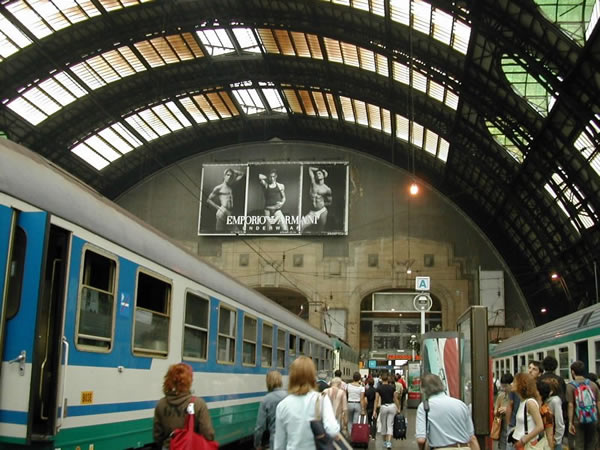
Maybe I spoke too soon when I said that commuting into Milan daily isn’t so bad. It’s summer now, when commuting can be absolute hell.

The trains I take in the morning are usually air-conditioned – not even necessary at that time of day. However, for some unfathomable reason, no matter what train I take in the afternoon/evening, the A/C is intermittent at best, and a closed-up metal train car quickly becomes a sauna. Most of the time trains are moving, so the logical solution would be to open the windows. Ah, but then we have to contend with the dreaded colpo d’aria. Many Italians are convinced that sitting in a draft can be fatal. So when the train is finally rocking along and a nice breeze is blowing in, someone is bound to close the window. Next time this happens, I think I’ll tell them: “You are at far less risk of dying from the colpo d’aria than from me killing you right this minute.”

During one trip last week, I was moving along the train when I saw a woman sitting on one of the fold-down seats in the train’s entryway, with a thoroughly miserable-looking child. These areas are closed off from the train compartments by doors, so when the outer doors are shut, they become airless little boxes. And there she sat, sweating. As I opened the door to go through to the next compartment, someone called to the woman to come and sit with them. All the windows were open and the compartment was delightfully cool. “Oh, no,” she responded. “As long as those windows are open, I’m not coming in there. Michele [the little boy] will be sick tomorrow.” More likely Michele fainted ten minutes later from heat prostration.

Gardening: In Italy, a Man’s Home is His Orto

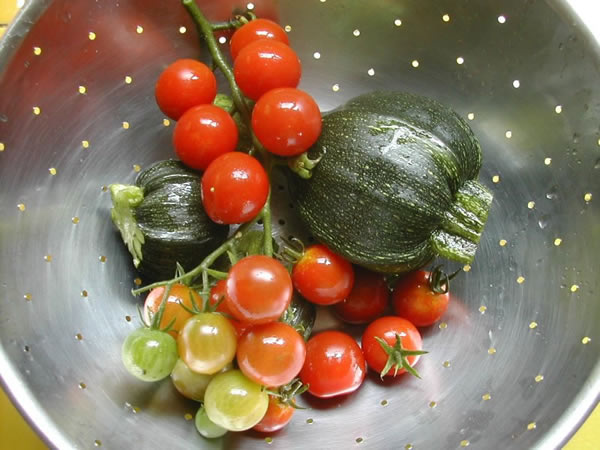
^ Fresh produce from our garden. The zucchine aren’t supposed to be that shape; they had long skinny ends which I cut off because they were rotting; the uneven growth might be due to uneven watering (we’re still learning). I also need to learn to look more closely at the tomatoes before I cut them. But it makes a visually interesting assortment.

Our new home has a bit of land around it, so, for the first time in 30 years, I can plant in something bigger than a windowbox. There’s a lot to do to turn this mess into a garden, however – the previous owners neglected it terribly. For starters, since we moved here I’ve grubbed up several hundred kilos of dandelions and other weeds from the lawn. (I don’t mind. I find weeding therapeutic during times of frustration, such as phone calls to Telecom Italia.)

I planted bulbs back in October, in the bare patches left after the dandelions were removed, so we have cheerful clumps of daffodils, with hyacinths, tulips, and irises coming along later. My weeding activities have given the lawn a mangy look, but I’m reseeding it with grass and wildflowers.

Measured horizontally, our backyard would be about 10 by 12 meters. But we’re on a slope – in its natural state, this land would be almost vertical, so when the house was built, the land got terraced. There’s a piece of flat yard extending about four meters from the door of our basement-level den out towards the lake, then there’s a six-meter drop. The mass of earth (building rubble and very clayey soil) is kept in place by a stack of open cinder blocks, mostly filled with rocks and weeds (yes, my fellow Woodstockers, we have our very own khud!). There’s another three-meter terrace of flat land below, then it drops three meters (more cinder blocks) to a tiny strip (1/2 meter) of dirt abutting the neighbors’ fence. All this is traversed by a narrow staircase of more cinder blocks.

What to do with this peculiar arrangement? The top level we’ll mostly keep clear, in hopes of eventually having a lawn worth enjoying. And lawn chairs – it gets lots of sun. We’ve planted ten rose bushes along the low fence that stops people falling down to the terrace below, and yesterday I put up a low enclosure for the turtles. (Predictably, they spent most of the time trying to get out of it.) After I decide exactly where I want that to be permanently placed, we’ll put in a little pond so that they can stay out there full-time when the weather’s warm enough.

The terrace below is in the process of becoming a vegetable garden (orto). For this, I have help. We had scarcely moved into the new house last September when Mimma (the wonderful Sicilian lady who cleans and irons for us) brought her husband Domenico to have a look. Retired from factory work, Domenico is a keen gardener, maintaining their own orto somewhere near Lecco, as well as gardening for several other people.

Domenico is a very practical man: his first suggestion was to plow up everything, including the top level, and make it all into orto. I resisted this – I want a place to lounge in the sun, when I have time for such things. (And can stop myself leaping up to dig, plant, or weed.) We do have a patch of herbs in the corner by the garage, and I’ve planted green beans on the other side of the fence where the roses are (there’s just enough space between fence and drop for me to walk along). This may be unorthodox, but legumes fix nitrogens in the soil (so I’ve read), so they should be good for the roses, and of course they can climb the fence.

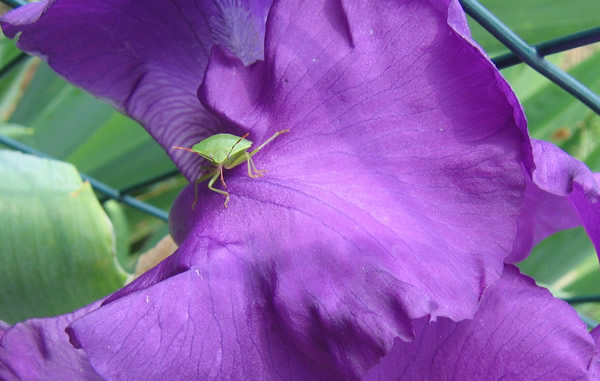
green bug on purple iris

Down below, I’ve already planted various salad greens, with parsely, basil, and coriander in alternate rows. I am reading up on organic gardening, trying to find natural preventatives and remedies – it seems silly to go to all the trouble of planting our own veggies, and then have to spray them with nasty chemicals and wonder what we’re eating. So far I’ve read that garlic and other “smelly” plants help discourage bugs; I’ve planted garlic around the roses. I’m growing marigolds from seeds and will transplant them out to the orto when they’re bigger, as they, too, are said to have a bug-scaring smell. And nasturtiums, which not only smell bad to bugs, but can be eaten by humans (both flowers and leaves, in salads).

In a few weeks, when the weather is truly warm, we’ll buy vegetable plants – eggplant, tomatoes, zucchine, cucumbers, peppers – which Domenico will come plant for me. Yesterday he brought some sapling trees from his own orto (two figs, four hazelnuts) which he planted along the bottom of the first retaining wall; when they get bigger, they may help prevent a landslide. This whole hillside used to be a hazelnut orchard, and the neighbors still have some very nice trees, but our property was completely deforested by someone stupid, and is therefore prone to slippage.

The rows of cinder blocks are offset from each other and stick out just enough to make little planters, so I’m slowly filling them up with odds and ends: two miniature carnation plants, small succulents that will expand to fill their spaces, and wild strawberries. The property is full of strawberry plants, but they have a tendency to grow where they will get stepped on, so I’m transplanting them to the cinder blocks, which should make perfect strawberry planters.

…and I could go on all day, obviously. I’d forgotten how much I love gardening, it’s been so long since I had a real opportunity to do it. I like watching things grow. And having an orto is very much an Italian tradition – anyone who has a patch of land, no matter how small, plants things that they can eat. Part of eating good food is having it fresh, and it doesn’t get any fresher than right out of your own garden. I’m looking forward to putting own on produce on our dining table this summer!

May 11, 2005

I should have been grateful for the unusually long winter. Now spring has set in with a vengeance, and with it, allergies. We had a beautiful weekend, and I would have loved to be out gardening, but I was stuck in my room with my clean-air machine, taking allergy pills and eyedrops (probably more of both than I should), and nonetheless in sneezing, eye-burning misery. Oh, well. At least I have a nice view of all the burgeoning greenery from my window…

Why Italians Have Stopped Eating Out

Like most people in Italy, we don’t go out for dinner as much as we used to. We love to eat out, and there are many great restaurants in Italy, but who can afford them anymore?

It started with the euro. The official conversion rate was 1936.27 lire to the euro. In other words, a pizza that used to cost 8,000 lire, if converted correctly, should cost slightly over 4 euros. In practice, many restaurants just lopped off three zeros, so a pizza that used to cost 8,000 lire now costs 8 euros. It almost seems reasonable at first glance, til you realize that you are now paying almost 16,000 lire for a pizza, which no one would have dreamed of doing pre-euro.

In Milan a few weeks ago, we ate at a restaurant that we had frequented for years, and considered good quality at a medium price. This assessment proved to be sadly out of date. Between the three of us, we had three primi (first courses), two secondi (second courses), one dessert, four ¾ litre bottles of water, ½ litre of wine, and one coffee. The primi (first courses) were good, the secondi decidedly less so: Enrico’s bollito misto (boiled meats) was unimpressive – I can buy better mostarda myself! – and my agnello al scottadito (grilled lamb ribs) seemed almost fried rather than grilled, certainly not tender as they should be. And the bill was 98 euros! Definitely not worth the price.

We saw only two or three other tables of patrons while we were there, and the chef spent most of the evening standing around in the hall. Not a good sign, but no more than he deserved for charging us an arm and a leg for a sub-par meal. Until recently, some restaurants might have imagined they could rely on the less-discerning palates of tourists, but, with the dollar in free-fall, many Americans can no longer afford to come to Italy at all, or at least need to eat more cheaply while they’re here. Italian restaurateurs need to rethink their pricing and quality before they go out of business in droves.

Looking Out on Lake Como

Lake Como is shaped like an inverted Y, and Lecco sits on its southeastern tip, where it debouches into the river Adda. This end of the lake is deep and narrow, hemmed in by high cliffs (a bit like a Norwegian fjord), so any wind from the north is funneled through a narrow passage before it comes screaming down on Lecco.

I woke up at 5:30 this morning to a high wind banging our shutters; I eventually had to get up and close them all.

Now the sun is finally rising, casting pink light on the freshly-snowcapped mountain that I can see from my studio, and there are fast-moving whitecaps on the lake.

This house is hazardous to my productivity. Instead of working, I gaze out the window, fascinated by the endlessly-changing panorama of light on the mountains. Few offices in the world can boast such a view. It may not be good for my output, but it’s definitely good for my soul.

What’s in a Title? Signora vs. Signorina in Italy

I’m 42 today and, waking up with blue circles and bags under my eyes, I look it. Well, that’s the result of two days on my feet in the kitchen, cooking for 35 people (yes, I did have lots of help – thank you, Shannon!) for our annual Thanksgiving/ birthday/ housewarming feast (the housewarming part is not meant to be annual). Most of the time, people say I look young for my age, and I don’t think it’s just idle flattery.

I’ve been trying to understand the logic by which Italians decide to call me signora (Mrs.) or signorina (Miss). When Ross was small and I was in daily contact with her teachers and other parents at her schools, I was accustomed to being signora, because everyone assumed that, as a mother, I must also be a Mrs.

This signora habit almost got me arrested once. I was getting off the bus in Milan, in a hurry to pick up Ross from daycare, and swept right past the squad of public transport inspectors doing one of their random checks. I completely ignored the calls behind me of “Signorina! Signorina!,” assuming they couldn’t be directed at me. So the inspectors thought I was running away to dodge a fine for travelling without a ticket (actually, I am always scrupulous about bus and train tickets, except when I forget to stamp them).

I’m often called signorina even now. This may be because I often dress informally, by Italian standards, in jeans and sweaters. In a business suit and heels, I’m almost always signora. On some occasions, the choice of address seems to be based on the speaker’s desire to flatter me, and which term they think will accomplish that.