Category Archives: Italy

Learn Italian in Song: Balla Linda

Another classic from Lucio Battisti.

Dance Linda

ritornello        refrain
Balla Linda balla come sai        Dance, Linda, dance as you know how
Balla Linda, non fermarti        Dance, Linda, don’t stop
Balla Linda, balla come sai        Dance, Linda, dance as you know how

Occhi azzurri belli come i suoi        Blue eyes like hers
Linda forse non li hai        Linda maybe you don’t have
Ridi sempre, non parli mai d’amore        You always laugh, you never speak of love
Pero’ non sai mentire mai.        But you never know how to lie
Mh Mh        Hmm hmm
Bella sempre, dolce come lei        Always beautiful, sweet as she
Linda forse tu non sei        Linda perhaps you aren’t
Tu non dici che resti insieme a me        You never say you’ll stay with me
Per non mi abbandoni mai        But you never abandon me
Tu non mi lasci mai        You never leave me
Ti cerco e tu, e tu ci sei        I look for you, and there you are
Ti cerco e tu mi dai quel che puoi        I look for you, and you give me what you can
Non fai come lei, no non fai come lei        You don’t do like her, no you don’t do like her
Tu non prendi tutto quello che vuoi.        You don’t take everything you can.

(repeat)

Learn Italian in Song: A Casa d’Irene

At Irene’s House

Nico Fidenco

I giorni grigi sono le lunghe strade silenziose            The gray days are the long, silent streets
Di un paese deserto e senza cielo            of a deserted country without a sky

(ritornello)            (refrain)
A casa d’Irene si canta si ride            At Irene’s house [people] sing and laugh
C’e gente che viene, c’e gente che va            There are people who come, people who go
A casa d’Irene bottiglie di vino            At Irene’s house bottles of wine
A casa d’Irene stasera si va            Tonight [people] go to Irene’s house

Giorni senza domani e il desiderio di te            Days with no tomorrow and the desire for you
Solo quei giorni che sembrano fatti di pietra            Only those days which seem made of stone
Niente altro che un muro            Nothing else but a wall
Sormontato da cocci di bottiglia            topped with shards of broken bottles

(ritornello)            (refrain)

E poi, ci sei tu a casa d’Irene            And then there’s you at Irene’s house
E quando mi vedi tu corri da me            and when you see me you run to me
Mi guardi negli occhi, mi prendi la mano            you look into my eyes, you take my hand
Ed in silenzio mi porti con te            and in silence you take me with you

(ritornello)            (refrain)

Giorni senza domani e il desiderio di te            Days with no tomorrow and the desire for you
Nei giorni grigi io so dove trovarti            In the grey days I know where to find you
I giorni grigi mi portano da te            the gray days take me to you
A casa d’Irene, a casa d’Irene            At Irene’s house, at Irene’s house

(ritornello)            (refrain)

Keeping Cool, Italian Style: Energy Efficiency and Home Safety, All in One

Although it’s hot here in the summer, Italy’s not big on air conditioning, preferring to rely on older methods for keeping cool.

Most Italian buildings are naturally insulated, being made of concrete, brick, or stone. The older they are, the thicker the walls, which of course adds to the insulation. Windows are protected by shutters, whose style varies with location and age of the building. These insulate against the weather, but also protect against thieves (housebreaking is far more common here than street mugging).

Our apartment in Milan had tapparelle: slatted, roll-down shutters operated by a pulley system with a cloth strap that you pulled, hand over hand, to raise or lower them. This was barely within the limits of my strength on our large bedroom window, even though the shutters were made of plastic – we were on the 7th floor, so security wasn’t much of an issue.

My in-laws’ apartment in Rome, being on the first floor, had to have strongtapparelle. The originals were elegant wood, but, when they began to break down with age, this proved very expensive to replace, so the new ones were steel painted a woodish sort of color. Those were even heavier than the wood, so we were thankful for the electric motor that raised and lowered the 3-meter-widetapparella in the living room – until the electricity went out…
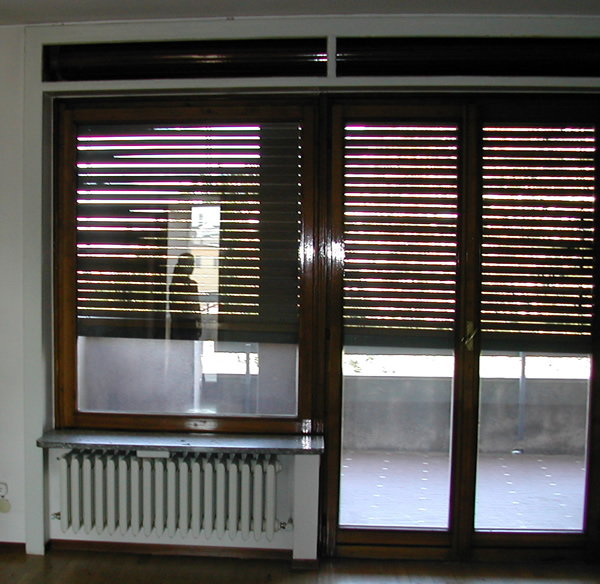
^ Wooden tapparella on our first apartment in Lecco – operated by a hand crank (not visible in this picture), it took forever to open or close. Then the slats started breaking…

The problem with tapparelle as a safety feature is that, to be safe, you have to close them at night – clever Italian house thieves have been known to use sleeping gas on homeowners to ensure easy pickings inside the house. So the shutters in Rome had to be closed, no matter how hot the night. The most you could do was leave them slightly open so that a centimeter or two of air could pass underneath and through the slim cracks between the slats.

Back in Milan, surrounded by other 7th and 8th-floor apartments, we closed thetapparelle for privacy, except on a few summer nights when we were too hot to care if the neighbors saw us naked in the moonlight (it was too hot to wear clothes or have sheets over us on the bed, either). We found a partial solution in putting a new type of frame on the bedroom tapparella, which could be tilted out on a hinge even when the shutter was fully rolled down, so we could get air in under it, and look down into the street, but no one could look across or down into us.

Here in Lecco, most houses have persiane – hinged shutters with fixed, louvered slats pointing downward, so no one can see in, but you still get some light and air. We don’t feel the need to close these most of the time, even though we don’t have curtains: the position of our house is such that no one can look into our windows, unless they use binoculars. But the persiane are useful to keep the sun out while letting air in. On summer afternoons I close everything up on the sunny side of the house – shutters and windows – and the rooms stay relatively cool til the evening breezes come and it’s time to open it all up again.

Note: Yes, we also use fans.

Learn Italian in Song: Certi Momenti

Certain Moments

Pierangelo Bertoli, 1980

A song in favor of a woman’s right to choose, from a time when either choice to be made for an unwanted pregnancy resulted in social stigma. Unfortunately, the song is relevant still today. For the moment (2008), abortion is legal in Italy, but the political right wing and the Catholic church are doing what they can to make obtaining an abortion – or even birth control – more difficult. Teenage pregnancy has not been a big phenomenon in Italy to date, but at this rate…

A year or two ago we went out to dinner at Taverna ai Poggi, a restaurant near our home in Lecco. The only table left was in the basement, alongside a large (pre-arranged) banquet of some sort. We were a merry little bunch, and the restaurant staff kept apologetically asking us to quiet down so we wouldn’t disturb the other group. Perforce, we listened to them, and were astonished to hear a long recital of vitriolic anti-abortion poetry. Had I had my wits about me, I should have replied with this song.

Anna che hai scavalcato le montagnee hai preso a pugni le tue
tradizioni

lo so che non é facile il tuo giorno

ma il tuo pensiero é fatto di ragioni

i padri han biasimato la tua azione

la chiesa ti ha bollato d’eresia

i cambiamento impone la reazione

e adesso sei il nemico e cosi’ sia

ritornello:

Credo che in certi momenti il cervello non sa piu’ pensare

e corre in rifugi da pazzi e

non vuole tornare

poi cado coi piedi per terra e

scoppiano folgore e tuono

non credo alla vita pacifica non credo al perdono

Adesso quando i medici di turno rifiuteranno di esserti d’aiuto

perchÉ venne un polacco ad insegnargli

che é piu’ cristiano imporsi col rifiuto

pretenderanno che tu torni indietro

e ti costringeranno a partorire

per poi chiamarlo figlio della colpa

e tu una Maddalena da pentire.

(ritornello)

Volevo dedicarti quattro righe,

per quanto puo’ valere una canzone

credo che tu abbia fatto qualche cosa

anche se questa é solo un’opinione

che lascerai il tuo segno nella vita e i poveri bigotti reazionari

dovranno fare senza peccatrici

saranno senza scopi umanitari

(ritornello x2)

Anna, [you] who have climbed the mountainsand have beaten up your traditions

I know your day isn’t easy

but your thought is made up of [correct] reasons

The fathers have censured your action

the church has declared you a heretic

change requires reaction

and now you’re the enemy, and so be it.

refrain:

I believe that in certain moments the brain doesn’t know how to think anymore

and runs into crazy refuges and doesn’t want to return

then I fall with my feet on the ground

and lightning and thunder explode

I don’t believe in the peaceful life,

I don’t believe in pardon.

Now that the doctors on duty

will refuse to help you

because a Polack* came to teach them

that it is more Christian to impose oneself by refusal

They will expect that you turn back

and they will force you to give birth

to then call him “child of shame” and you a Magdalene to repent.

(refrain)

I wanted to dedicate four lines to you, for whatever a song may be worth

I believe you have done something,

although this is only an opinion,

that will leave your sign in life

and the poor reactionary bigots

will have to do without [female] sinners

they will be without humanitarian aims.

* Polacco in Italian is not a pejorative term. It merely connotes a male citizen of Poland, in this specific case, Karol Wojtyla, aka the late Pope John Paul II. However, I think the context justifies using the pejorative English term rather than the neutral (and potentially confusing, in spite of capitalization) “Pole”.

if you find this useful and want more, let me know!