I was, unusually, in Milan yesterday (a Saturday), working at my office with Sean Carlos (who’s teaching me cool new website tricks, more on that later). We went out for lunch, and were just getting ready to leave the restaurant when three young guys came in, whom we noticed particularly because one had hair in dreadlocks down to his waist, the second had a nearly shaved head, while the third was normal-looking, at least as far as haircut goes. They asked the restaurant owner for plastic bags, apparently to carry their jackets and motorcycle helmets in. His attitude towards them was puzzling; all I could think was that he disliked being asked for bags when they hadn’t even bought anything.
We walked a couple of blocks to my usual coffee bar, where everybody seemed completely freaked out, looking out the windows nervously. The barista explained that there had been some kind of demonstration on Corso Buenos Aires, the big shopping street a few blocks away, and something had gone wrong – gunshots had been heard, and there were police helicopters hovering over the neighborhood.
When we went to take the metro to our respective destinations later that afternoon, there was an announcement that the trains were not stopping at the Porta Venezia and Palestro stations “for public security reasons.”
The evening news was full of it. A (legally-organized) parade was planned by the “Fiamma Tricolore” (Tricolor Flame), a neo-Fascist organization. This was considered by the extreme leftists to be a deliberate provocation, and may well have been, given that the Fiamma guys had to be forcibly dissuaded by the police from marching under banners with swastikas and other Fascist symbols – which are illegal to display in Italy. So the lefties organized an illegal (because no permission was applied for) counter-demonstration, which, although it took place hours before the Fiamme arrived, quickly turned to violent chaos. They torched cars and shops, and set off nailbombs and firebombs. The photos are horrific, considering that this is, for heaven’s sake, Milan!
The good citizens of Milan, in fact, were so angry that some demonstrators had to be rescued by the police to prevent them being lynched by local residents. Almost 50 demonstrators were arrested, and nine police injured, though thankfully none seriously.
I guess that, because no one got killed, it isn’t news – I can only find one reference in the press anywhere in the world outside of Italy, and that was in New Zealand – at least our friends in the Antipodes are paying attention.
It seems to be an Italian cultural trait to leap immediately to conspiracy theories, but in this case they may be right. We’re in the midst of a closely-fought and increasingly acrimonious election, in which it’s hard to tell which side is being more stupid. It is entirely possible that someone on the right hired provocateurs to ensure that the counter-demonstration got out of hand. It’s equally possible that the extreme leftists are stupid enough to do that on their own, without considering that they are losing votes for the left and playing into the hands of the right (with friends like these…).
The comedy of errors rolls on. After much discussion, Berlusconi and Prodi (the leader of the loose and fractious coalition of the left) finally agreed terms for an American-style TV debate, which will take place on Tuesday night (our beloved Montalbano got moved to Monday, otherwise the public would have faced a truly difficult choice).
Now that we are officially in campaign season, the rules on par condicio (equal access to the media) have set in, so Berlusconi’s access is theoretically limited. Today he wasted ten minutes of a 30-minute interview with TV journalist Lucia Annunziata, walking off the set because he didn’t like her questions. When he kept evading a straight answer, and she kept insisting on one, he said: “You are violent, you should be ashamed of yourself.” “You don’t know how to talk with journalists,” she snapped back.
Let’s see, what else… one minister in Berlusconi’s cabinet left office a couple of weeks ago after wearing on TV a t-shirt printed with some of the famously offensive Mohammed cartoons, provoking riots in Libya in which some demonstrators were killed by the police. This ex-minister may face charges under Article 404.
Then a few days ago the minister for health found himself under investigation for Watergate-like spying on political rivals. He proclaims his innocence, but has resigned so as not to further tarnish his party.
We await developments to see what the next damn silly gaffe from either side may be. Hopefully no more violent demonstrations, but at this point I fear that anything is possible.
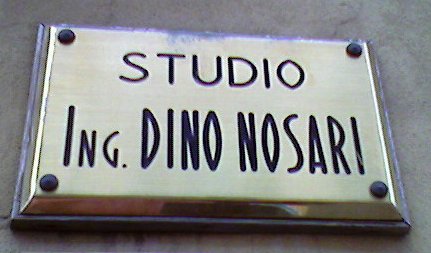
Dino [DEEN-oh] is a common nickname for a number of names. This guy must have a sense of humor: “Dino Nosari” sounds like dinosauri – dinosaurs.
photo taken in Mantova
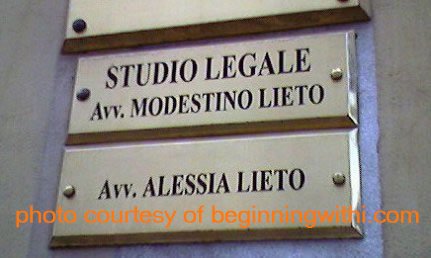
I’d never heard the name Modestino [mod-ess-TEEN-oh] (literally “little modest one”), but it’s rather sweet, especially in combination with his surname, Lieto [lee-AY-toh] – Happy.
photo taken in Lecco
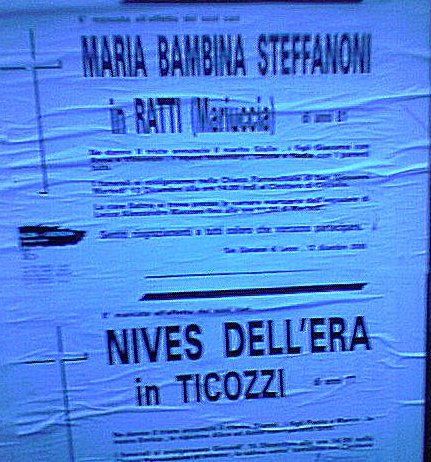
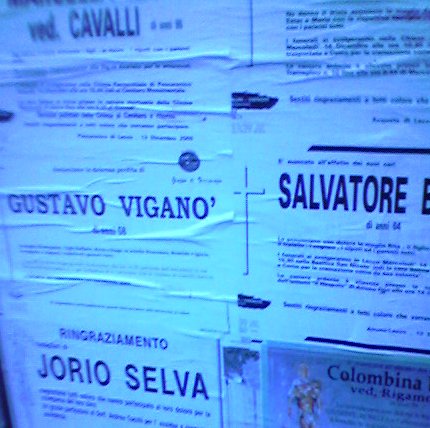
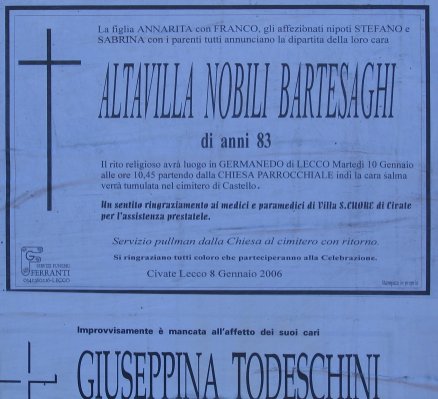
More names from death announcements.
“Maria Bambina” I suppose refers to the childhood of the Virgin Mary, but seems an odd choice of name. No wonder she was nicknamed Mariuccia [mahr-ee-OOCH-ah] (“cute little Mary”). Then she married into the Rats (Ratti).
Nives I’ve heard before, but would have thought it a Spanish name.
Upper left: somebody, widow of Horses
Gustavo is an old-fashioned name, Jorio I’ve never seen before [YOR-ee-oh], Salvatore [sahl-vah-TORE-ay] is very southern Italian, and… Colombina [col-om-BEAN-uh] – Little dove
Heavens, what a name! Altavilla (high villa) Nobili (nobles). At least he gave his kids fairly normal names (Annarita and Franco).
Marshall reminded me of a very funny and supposedly true case in Italy. It requires some explanation: When a woman marries, she is formally known as “Maidenname Firstname in Husband’s Surname,” I guess “in” signifies that she has married into the husband’s family (though I’ve only seen this construction used in death announcements). So there was a lady with the surname Milolava (“I’ll wash it”) whose parents rather cruelly named her Domenica (Sunday). She married a Signor Piazza, so she became “Sunday I’ll wash it in the piazza.” What “it” may signify is up to your imagination.
Really, some parents ought to be shot for how they name their kids. Years ago, in Washington, I had a data entry temp job for an insurance company. One of the records I entered was for a woman named Candy Caine. Evidently her parents wanted her to grow up to be a Playboy Bunny.
Jan 19, 2004
Ivo wrote me about his friends, interestingly surnamed “Della Bella” (of the beauty), who have relatives with the unhappy surname “Della Morte” (of death). So what did these sadistic parents name their child? Angelo.
And another in the series: “What were your parents thinking?!?”
In the Italian online white pages, you can do a reverse lookup (when you know the number, get the name). Some time ago, the following Internet meme was circulating: go to the white pages and look up a certain number. The resulting name, presumably someone’s legal name, was Bocchino Generoso (Bocchino being the surname – names are listed surname first). Bocchino is slang for fellatio, Generoso… well, you can guess. Unless this is the stage name of a gay porn artist, this guy must hate his parents. Interestingly, when I went back to check a few weeks later, the number was no longer listed.
Enrico and I went to Mantova for a weekend getaway. Friday afternoon we drove to Montecchio Maggiore to leave his mother with her cousin Nini’, and visit with some of Nini’s seven children and various grandchildren, including the irrepressible Claudia, now in her fourth and final year of a Fine Arts degree at the Accademia di Venezia. We also went to the home of Rosamaria and Ruggero to see video of their trip last summer through the American southwest – on bicycles. Everyone in Arizona thought they were insane, bicycling up to 100 km per day in the blazing heat. They belong to a local cycling club which covers thousands of kilometers per year. Naturally, both are in incredible condition!
Saturday morning we got up relatively early, drove to Mantova, and checked into the first hotel we managed to find (the town is a labyrinth of one-way streets): Hotel Rechigi, four stars, 130 euros plus another 20 for parking. A bit expensive for what it was, but certainly central – walking distance from everything.
We set out immediately, stopping off for coffee and a traditional tortino di riso(rice cake) at a lovely coffee bar, then on to Palazzo Ducale, the sprawling palace built by the Gonzagas and decorated by, among others, Andrea Mantegna.
Your only choice here is a guided tour. Our guide was apologetic, saying that it would be much nicer for everyone to be able to go at their own pace, but apparently the museum doesn’t have funds for enough guards to keep an eye on everything. (The entrance fee was only 6.50 – perhaps they should raise their prices.) So we had to stay more or less together as a group with our guide, which sometimes meant waiting til another group had finished in a particular room, or being rushed through when we might have liked to linger.
I got confused at one point when we intersected another group in a huge room containing huge paintings (mostly by Rubens). Enrico and I spent a long time there while our group went off somewhere else, and a guard (apparently the only one with a set place in the museum) told us off for listening in on another guide’s explanation. “That’s a private guide,” he said officiously. And I was supposed to know that – how? Pardon me for stealing soundwaves.
I was listening in hopes of an explanation for the paintings around the top of the room – a tromp l’oeil curtained colonnade. The yellow curtains were mostly closed, or slightly drawn but mostly concealing… horses. Generally you could only see legs, though sometimes there was hint of a nose, and in one niche the curtain draped over the horse’s exposed rear end. In no case could you see an entire horse.
I was mystified by this – was the artist unable to paint a whole horse? – but the private guide offered no explanation. When we eventually found our own guide, I asked her about it. “That room is called the Room of the Archers. Local legend has it that the painting refers to a game the archers used to play, where they had to recognize their own horses behind a curtain. But I think actually the painter was trying to imitate Mantegna’s masterly use of perspective, as you will see in the Camera degli Sposi.”
I remain dubious of both explanations. A game of trying to recognize one’s horse by seeing its legs beneath a curtain sounds neither fun nor particularly challenging, but neither is a horse behind a curtain a good way to demonstrate perspective in painting. Boh.
Everntually we reached the famous Camera degli Sposi (Room of the Newlyweds) aka the Camera Pinta (Painted Room), which was stunning. (No photography or filming allowed, so you’ll have to find your own images to refer to.)
Mantegna’s use of perspective was certainly masterly, and undoubtedly astonishing for his day. The room is painted to resemble a curtained loggiafrom which the viewer looks out on scenes of Gonzaga family history, with intricate landscapes beyond (including a charming, though fantastical, view of Rome – Mantegna at the time had never been there). The ceiling is “pierced” by a tromp l’oeil hole, showing blue sky with a few fleecy clouds, and a strange cast of characters, including fat-buttocked cherubs with butterfly wings, looking down into the room. Apparently from their perspective the hole is a well – there’s even a bucket perched on the rim.
There were many more nobly decorated rooms, all blurring together in my memory now except for the fact that most painters of the period seemed to have no idea what a horse’s head actually looked like. In one huge painting of a battle, all the horses had eyes like humans, both in shape and color (blue) and in being set into the front of the horses’ faces. We had been told that the Gonzagas were very fond of horses (part of their fortune was based on their stud farm), so it seemed odd that they would not have said: “Look, here’s a real horse, just paint it, damn you!”
It took nearly two hours to get through Palazzo Ducale; we finished just in time for lunch. Ristorante Broletto, which we happened upon by accident, was quite good. I had the classic Mantovan dish, tortelli di zucca (pumpkin) with sage butter, followed by punta di vitello (roast veal) with chestnuts. I hadn’t expected that cut of veal to be so fatty, but it was very tasty, and chestnuts with meat are a divine combination.
The menu was one of those unintentionally funny ones where someone had relied on a mechanical translation. “Punto di vitello alle castagne” came out as “point of veal to the chestnuts.” I am considering offering a service in which I will translate menus into correct and appealing menu-style English, in exchange for a meal or two.
While at that restaurant, we heard the waiter arguing with a British tourist who was in search of risotto with sausage and red wine. “Risotto alla Mantovana is made with sausage and white wine,” said the waiter. “You won’t find it with red wine around here.” “But we had it made with Teroldego, in Trentino.” “Yes, but not here.” The tourist was rather missing the point of local specialties.
After lunch we walked several kilometers across town to Palazzo Te, a famous example of some kind of architecture, which we had been told was famous because it was built all on one level. But actually it’s on two levels, the second floor having recently been fixed up to house some miscellaneous collections of Italian Impressionist paintings, old coins and official measures, and Egyptiana. I assumed that these (relatively) low-ceilinged rooms under the roof had been intended for servants, though the attendant I asked said that no one knew what they had been used for. (Why are my questions always the difficult ones?)
The fancy rooms on the ground floor were decorated with paintings and frescoes, including the famous Room of the Giants, whose rounded corners contribute to the illusion that you’re immersed in the scene of the giants attacking Mount Olympus (and being repelled by Zeus’ thunderbolts, which bring huge stones crashing down on them). The room is painted from ceiling to floor, but the lower parts of the walls are faded, and etched with centuries of graffiti – sadly, even in 1746 there were idiots roaming about scratching their names on beautiful things.
That was one of the few rooms with a guard on duty, presumably to prevent anyone else following this sad example. Otherwise, Palazzo Te was surprisingly unwatched, so I was able to get away with a bit of filming (maybe it was even allowed – signage isn’t always very good).
There were more examples of the painters of the time playing with perspective, the funniest of which you’ll have to see in the accompanying video. One set of paintings I particularly liked was a series of the Apostles, clearly painted from real, and probably humble, models: the faces were interesting and human, lacking the artificial nobility and sanctity often given to such figures.
Oh, and there were some really good horses, presumably some of the Gonzaga stud, and definitely painted from life (by Giulio Romano). See the video for them as well. (Drat! They didn’t come out well enough in the video to be worth including. You can see some pictures here.)
On the way back from Palazzo Te we stopped at the Casa del Mantegna, just opened to house a historical exhibit celebrating the 500th anniversary Mantegna’s death. The museum is small but well-stocked, with examples of letters from Mantegna to his patrons (“I and my family remain your most devoted servants…”), complaints about the encroachments of a neighbor on his property, about not being paid for his work, etc. There’s a video explaining many of the elements in the paintings in the Camera degli Sposi, and another about the nine-panelled “Triumph of Caesar,” now hanging in Hampton Court Palace (the Gonzaga family sold their entire collection of paintings to England’s King Charles – thankfully, the Camera degli Sposi is frescoed, so the paintings could not be detached and sold off). Adjacent to this were two small canvases by Rubens, superficially copies of two of Mantegna’s panels, but interestingly different in details such as the faces.
All this high art left me with questions to which I currently have no answers. Speculations from the crowd are welcome:
If someone like Mantegna could have painted whatever he wanted to, what would it have been? (In other words, didn’t the great painters ever get sick of religion, portraits, classics, and allegories?)
If he were painting today, what subjects would he choose?
Artists today have absolute freedom to pick their subjects and styles. Whether or not they find buyers is another question, but few have patrons in the old sense. I guess this is a good thing for the artists, but what the hell happened to technique? Most of the modern art I have seen arguably requires creativity and imagination, but little of it involves much technical skill.
And what ever happened to beauty? With all the famous old paintings I have seen, I get tired of the subjects – I have seen enough crucifixions and martyrdoms to last a lifetime – but there is amazing beauty in most of them, even when the subject is depressing or downright horrific. When I look at modern art, my reaction may be: “that’s interesting,” “that’s arresting,” or “that’s shocking,” but rarely: “that’s beautiful.” (Most often, in fact, my reaction is: “That is incomprehensible and ugly.”)
We wandered the streets a little more, rested a bit back at the hotel, then went out in search of dinner. Following our usual technique, Enrico asked a local – a tobacconist, which happened to be the first shop we came across (you don’t ask at a hotel or bar, because they may have a vested interest somewhere): “Where would a real Mantovano go to eat?”
He laughed, and directed us right around the corner to the Trattoria da Chiara (via Corridoni 44/46, phone 0376223568) – and what a find it was. I had apasticcio di melanzane (eggplant casserole with tomato sauce and a bit of cheese, flavored with thyme and lots of olive oil), followed by tagliata alla veluttata di zucca con grana e aceto balsamico (sliced steak on a bed of pumpkin puree with thin slices of grana cheese and balsamic vinegar). Enrico had tagliatelle with wild boar, followed by stracotto di asino (slow-cooked donkey stew) with polenta. It was all wonderful.
Can’t say as much for the hotel that night. Beds in Italian hotels tend to be hard, with small pillows – not a good combination for my back and shoulders. We couldn’t figure out how to turn the heating down; the thermostat on the wall didn’t seem to have any effect at all, so I kept waking up choking with heat and dryness, til I finally opened the window around 4 am. At least the shower was good and hot water plentiful, and the included breakfast not bad.
Sunday it was raining hard and the streets, so crowded the evening before with Mantovani out for their Saturday shopping and socializing, were deserted, except for a group of tourists huddled forlornly under the porticos, straining to hear their guide’s inaudible megaphone.
We visited the archaeological museum, which is only one room, but at least it’s free. Like similar municipal museums all over Italy, it displays relics from millennia of history- neolithic, bronze age, Etruscan, Roman, Gothic, medieval – all collected in the local area. I was particularly taken with a small bronze bas relief of Achilles embracing Penthesilia, looking down into her face. It expressed a tenderness and farewell that strikes to the heart, though I was disconcerted to find, upon looking up the myth, that this scene takes place when Achilles has just killed her in battle, then falls in love with her beautiful corpse. The piece is gorgeous, and I think I now understand collectors’ lust. Unfortunately, I wasn’t even allowed to take a picture of it.
We stopped by the Tourist Information office to find out what else we should do, and were warmly recommended to see the Teatro Bibbiena, a “small jewel” built into the Accademia, of which Mantova is particularly proud because Mozart mentioned in one of his letters that it was the most beautiful theater he’d ever seen. And so it was. It has five or six levels of boxes, with intricate arches and balustrades made almost entirely of wood, but painted convincingly to look like stone.
When we came in, a group of musicians were gathering for a rehearsal (Mozart). The music in that atmosphere was too lovely to resist: I hid in the boxes and snuck footage, not sure whether I was supposed to or not, but no one came to look, in fact the lady who sold us the tickets had told us casually that we could move the rope barriers and go upstairs, anywhere we wanted. We took her at her word.
We left Mantova around 11 am and headed back towards Montecchio. We considered a stop at the castle above Soave, but an outdoor visit in pouring winter rain had no appeal. We drove around on the tiny, windy back roads, following hand-painted signs to “Agriturismo La Baita,” outside a village that we later learned was called Castelcerino. When we finally found it, this proved to be a baita (mountain cabin) with a nice open fire. We had a mixed grill of thin steaks, sausages, and bacon (grilled in a slab, like British gammon steak), and grilled polenta, plus side dishes of salad and roast potatoes, and a quarter liter of the house wine (a thin, bitter Soave). We finished up sharing an apple cake (just to be polite to the hostess…), then had coffee. The total bill was 25 euros – very cheap, by today’s standards.
A friend of mine who works for an electronic components company was feeling punchy one afternoon…he forwarded me his correspondence with a client for whom English was (thankfully) a second language.
from: [client, name withheld]
to: Rose
cc: David
Subject: missed item
Dear Rose,
I hope you are well.
In October, 2004, we ordered the following item from you:
Spacers – 2,000 pcs.
Now we found out that we have not enough NUTs for that screws. So we have enough screws (spacers) and washers but nuts are missed. The difference is circa 700 pcs. We kindly ask you if is possible to send us that nuts to complete that item asap.
Thanks and best regards,
[client]
From: David
Dear Mr. [client]:
As the new manager of the export department I want to thank you for your email. I am sorry to learn of the missing nuts, but is it possible that it has taken you almost a year and a half to discover your nuts were missing? According to point 6d of [company]’s Terms of Sale (see the our website) the purchaser has up to 8 days to report defects or irregularities and such a missing part is an apparent anomaly.
However, I am concerned about your nuts and am therefore prepared to make an inquiry to our warehouse as to where they might be. In the event that our stock shows an abundance of stray nuts, or an inordinately low number of accompanying screws, I will happily forward your missing pieces, proving once again our commitment to the QUALITY of our products and service.
Rose is away on Maternity leave, but she will be happy to know I am doing my best to track your nuts in her absence.
Best regards,
David
[company]
From: [client]
To: David
Subject: Re: R: missed item
Dear Mr. [David],
Thank you for answer. Yes it is possible to find your mistake after one year and half because we do not want to complicate your life and when we received your goods we knew the quantity is not OK. But as manufacturer we have all components in stock and when the quantity limitates to zero we put the order for new quantity. And as we work with your company more than 10 years we intended to ask you for the missed nuts with the next order of spacers but we have not ordered this components until now and now we have more than 700 screws in stock and zero of nuts.
The nuts should be packed in complete with other components like screw and washer, every component should be in the quantity of 1000 pcs in one bag. But in the kit were not enough nuts. So you will not find the special code for nuts in your warehouse but you have only one code as spacers for the kit. So please check with your supplier to send you the nuts to complete the item screws.
Best regards,
[client]
From: David
To: [client]
I have passed your claim to the quality control team that will conduct a rigorous search for your missing nuts. Additionally, they will perform a cross-referenced check to determine if other clients have experienced the dissatisfaction of nutless screws. Correct, we have no special nut code. I have instructed our team to inspect the unit x/xxxxx while paying special attention to the number of nuts in the bag.
I hope to have positive news soon and I promise to keep you abreast of developments!
Italian law on “crimes of opinion” has recently (Jan 25th) been revised as follows (excerpted and translated from here):
“…Safeguarding of [all] faiths, instead of [just] the state religion [i.e., Catholicism] …Article 404 – (Offenses against a religious faith by means of vilipendio [~insult] or damage to property) – Anyone who, in a place designated for worship or in a public place or place open to the public, offends a religious faith, insults… things which are considered sacred or consacrated to a faith, or are used in the exercise of faith, or commits such acts during a religious function held by a minister of the faith in a private place, is punished with a fine of 1,000 to 5,000 euros.” (NB: Previously, the punishment was up to three years in jail, though I don’t know whether this was ever applied.)
“…Changes also to the Mancino law on racism, with punishment taking the form either of a fine or up to 18 months in prison for propaganda of ideas based on racial or ethnic superiority or hatred, and the instigation to commit acts of discrimination for racial, ethnic, national, or religious reasons. However, jail sentences of six months to four years are prescribed for anyone who instigates or commits acts of violence or provocation to violence for racial, ethnic, national, or religious motives.”
Hmm. How to reconcile the fact that inherent in some religions are bald statements of racial, ethnic, or sectarian superiority? Classical Hinduism encodes the idea that Brahmins are superior and Untouchables inferior to every other caste. A Brahmin’s forbidding his daughter to marry an Untouchable might therefore be punishable by law in Italy.
A “crime of opinion” seems to me a dangerous concept in itself. Who’s to decide what is and is not a reasonable opinion? Not so long ago, the idea that women should be allowed to work outside the home for equal wages as men was considered ridiculous in Europe – and is still considered ridiculous, if not illegal, in some countries.
Several European countries have laws against Holocaust denial, as recently applied in Austria to British “historian” David Irving. That, like the Italian laws about religion quoted above, is going too far. No country can (or should) make enough laws to explicitly protect against every possible kind of hurtful speech. People should be free to state whatever wacky stupidity they believe in, and other people should be free to refute it. If a nut job like Irving had a job in a reputable university, I’d be worried. But his views are anathema to most people; the resulting social and professional shunning should be sufficient punishment for him. To draw a parallel, there are white supremacists in the US who state that black people are genetically inferior to whites. They are free to state those opinions, but they don’t get hired as professors of biology (or anything else).
Trying to keep such beliefs down by law tends to be counter-productive: the believers can then present themselves as martyrs for their faith, attracting more adherents. Children raised to think for themselves will become adults who laugh at such views. Children raised to blindly follow the dictates of another person, or a book, or a way of life, are less likely to have the critical faculties needed to evaluate every opinion that comes their way.