Category Archives: Italy

Italians Flying the Flag

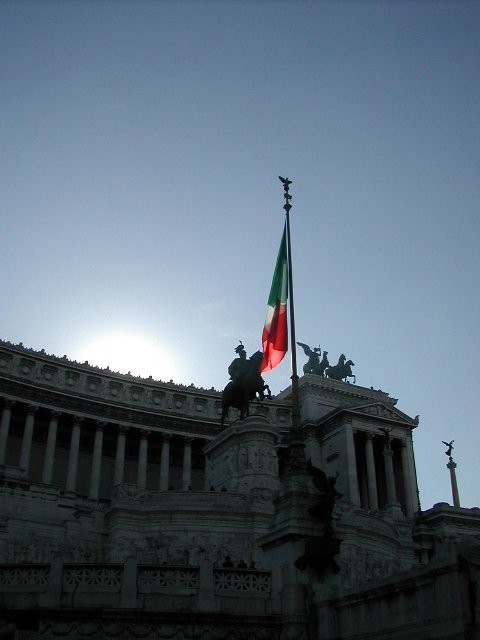
Italians are not much for patriotic displays. You rarely see Italy’s ‘Tricolore’ flag flying, except during World Cup soccer. During his first run for office ten years ago, Silvio Berlusconi brought to Italian politics the very American notion that ‘flag = patriotism = [my] political party’. Billboards for his Forza Italia party were swathed in red, white, and green. As owner of the popular AC Milan soccer team, he also managed to mix sport into his message: ‘Forza Italia’ (‘Let’s Go, Italy!’) sounds like a cheer for the Italian national team – no accident, of course.

As I recall it, that election coincided with a World Cup, or maybe it was a European championship. At any rate, between that and Berlusca, there were Tricolore flags everywhere. I asked my daughter, then three years old, if she knew what that flag meant. “Oh, yes,” she said brightly: “Those are the colors of Milan” – the football team!

photo: The Tricolore flying at the Vittorio Emmanuele monument in Rome.

Montorfano: A Medieval Village Above Lago Maggiore

In November of 2004 we visited Montorfano, a village near Lake Mergozzo, just north of Lago Maggiore.

It’s famous for the Romanesque church of St. John the Baptist, built in the 11th or 12th century (photos below).

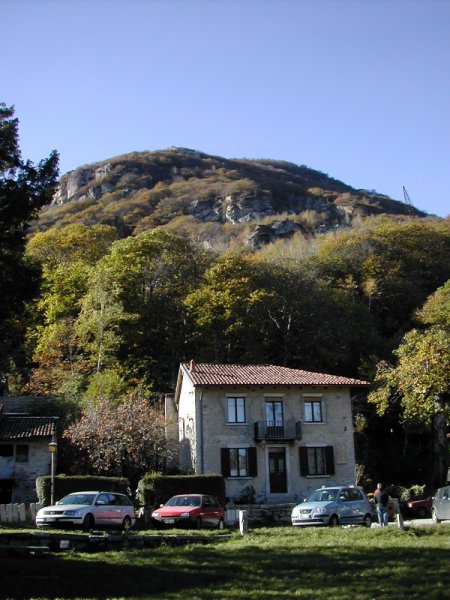
above: This, I suppose, is the “orphaned mount” from which the town gets its name.

Romanic church of St. John the Baptist, built in the 11th or 12th century

Romanic church of St. John the Baptist, built in the 11th or 12th century

Romanic church of St. John the Baptist, built in the 11th or 12th century

ruins of much earlier buildings, dating from the 5th or 6th and 9th centuries.

^ next to the church, ruins of much earlier buildings, dating from the 5th or 6th and 9th centuries.

an ancient waterway, used in transporting granite from a local quarry

an ancient waterway, used in transporting granite from a local quarry.

a house in the village with a Peace flag

^ a house in the village with a Peace flag

old stone road

old stone road

steps up to the restaurant where we ate lunch. These steps were originally build to get granite down from the quarry

steps up to the restaurant where we ate lunch. These steps were originally build to get granite down from the quarry

same path, on the way back down

same path, on the way back down

What’s in a Title? Signora vs. Signorina in Italy

I’m 42 today and, waking up with blue circles and bags under my eyes, I look it. Well, that’s the result of two days on my feet in the kitchen, cooking for 35 people (yes, I did have lots of help – thank you, Shannon!) for our annual Thanksgiving/ birthday/ housewarming feast (the housewarming part is not meant to be annual). Most of the time, people say I look young for my age, and I don’t think it’s just idle flattery.

I’ve been trying to understand the logic by which Italians decide to call me signora (Mrs.) or signorina (Miss). When Ross was small and I was in daily contact with her teachers and other parents at her schools, I was accustomed to being signora, because everyone assumed that, as a mother, I must also be a Mrs.

This signora habit almost got me arrested once. I was getting off the bus in Milan, in a hurry to pick up Ross from daycare, and swept right past the squad of public transport inspectors doing one of their random checks. I completely ignored the calls behind me of “Signorina! Signorina!,” assuming they couldn’t be directed at me. So the inspectors thought I was running away to dodge a fine for travelling without a ticket (actually, I am always scrupulous about bus and train tickets, except when I forget to stamp them).

I’m often called signorina even now. This may be because I often dress informally, by Italian standards, in jeans and sweaters. In a business suit and heels, I’m almost always signora. On some occasions, the choice of address seems to be based on the speaker’s desire to flatter me, and which term they think will accomplish that.

Italian Orphan Names

Italy has a millennia-old tradition of abandoning unwanted infants. The Romans exposed them on remote hillsides to be (hopefully) adopted by someone who needed a child or (more likely) eaten by wolves. In more recent times, babies were left on church steps, in most cases to be raised by the Church. Since no one knew who their parents were, these abandoned children were given surnames denoting their orphan status:

  • Orfanelli – little orphans
  • Poverelli – little poor (people)
  • Peverelli – slightly disguised version of the above
  • Trovato, Trovatelli – found, little foundling
  • Esposito – exposed. BTW, it’s pronounced eh-SPO-sih-toe, not ess-po-ZEE-to

These names have by now been inherited for generations, but, somewhere along the line, these folks’ ancestors were abandoned as infants.

Nicole over at zoomata.com sent me the following:

“Innocenti and Nocentini are both common names of orphan origins in Florence, from the Ospedale degli Innocenti (Hospital of the Innocents)… where babes were left, no questions asked, in a little revolving door in a corner… It’s still there, with a little iron grate over it.”

Home Ownership in Italy: Garbage and Sewage

Living in a villetta a schiera (townhouse or row house) is quite different from living in a condo apartment building. We learn something new every day.

Garbage is an endlessly complex question. We can put out the umido (wet waste) three times a week, but that can’t include garden trimmings. The comune will supply 150 biodegradable bags per year, free of charge, but we have to go to some particular office during a particular two-week span each year to pick ours up. We haven’t figured out yet whether they will also supply the sacchetti viola andtrasparenti (violet and transparent bags) that we need for recyclables and general waste – it would be nice, as these cost about 20 cents each (perhaps that includes tax?). General waste goes out twice a week, and the sacchetto viola (however many you have) only once. We’ve been giving the recycling guys plenty to do, but are now finally getting rid of the last of our moving boxes. By next week we’ll probably have our outside portico finally cleared – now that the weather’s too cold to use it.

We had to buy a new stove top and oven to fit into the spaces in the kitchen that had been built-in by the previous owners. We learned that gas ovens are going out of style in Italy; 99% of the built-in ovens available are electric. Which could get horribly expensive if you use the oven frequently, as electricity is costly here. For this reason, and because I prefer it for cooking, I insisted on gas. Our plumber, who is well-versed in the ever-changing laws regarding these things (as he must be, since he certifies his installations), learned that the law about gas appliances and air circulation does not even address built-in gas ovens, presumably because they have become so rare. So our set-up is probably legal in default of an actual law about it.

Our new home includes a bit of garden (a lot of it vertical, but that’s okay – we can plant those nice flowers you see growing out of walls all over Switzerland). The lawn has been neglected for years, and is lush with dandelions and some other kind of low-lying weed that chokes out the grass. If you’re keen on lawns, you might think there’s nothing worse than a lawn covered in weeds. Well, there’s one thing that’s infinitely worse: a lawn covered in weeds covered in sewage and toilet paper. Yes, we had a problem with the plumbing.

The previous owner conveniently forgot to mention that anything was wrong, but we learned all about it when, by sheer coincidence, we ended up calling the same sewage guys who had already been here twice in six months. So they suspected that the problem is not ours alone – it’s the main pipe for the whole complex (four families), which has bent, probably due to earth slippage. Since our connection to this pipe is the lowest of the four, we’re the first to suffer when it blocks – I had noticed a foul-smelling burble of liquid coming up through a hole in the concrete manhole cover in our yard. This manhole turned out to cover a drainage reservoir, about half a cubic meter, from which stuff is supposed to drain immediately into the sewage pipe. When we opened it, it turned out to be completely full. (No, I didn’t take video of that.)

Unblocking the mess required inserting a hose as far as possible and squirting in water under high pressure. On the first couple of attempts, from our manhole, this merely caused a backup and overflow, proving the sewage guys’ thesis that the problem was further down. I wish it had not taken spreading disgusting stuff all over our yard for them to determine this.

They then dragged their hoses down to the neighbor’s yard where our collective pipe connects to the city line, and proved, as suspected, that the block was there. Fortunately, they did not spew sewage all over the neighbors’ carefully-manicured lawn, which would have been far more tragic than what they did to my weed collection.

Eventually the line was cleared, and they washed as much of the yuck as they could back down the hole, using the high-pressure hose. But my weeds were furred with toilet paper and the general smell was not pleasant – I’m glad this didn’t happen in summer!

So I spent a couple of hours digging up weeds (something I needed to do anyway), which also removed a lot of the toilet paper (I wore gloves). I hadn’t realized gardening was such backbreaking work – my right arm was so painful from unaccustomed exercise that I couldn’t sleep that night.