Category Archives: Italy

Integration of Muslim Students in Italian Schools

The integration of Islamic immigrants into Italian society raises thorny problems. A Milan high school has announced that this fall it will have a first-year class composed only of Muslim students, at the request of their parents. These students have completed eight years at a private Islamic school in Milan. (This school is not accredited by the Italian education authorities, so why are 400 students allowed to attend it? By law, all children resident in Italy must attend regularly-licensed state or private institutions.)

In the past, students of this Islamic school would either stop at 8th grade (also illegal in Italy, which currently requires school through age 15), return to their countries of origin, or continue their studies with private tutors. Their parents asked a local social organization to help create a special section in a regular Italian high school where the kids could continue their studies, be kept together as a group, and the girls (17 of the group of 20) could wear the veil. The principal of a social sciences high school and the Italian social workers saw this as a step towards integration for these kids, who come from rigidly religious families that will not allow them to mingle with Italians.

Continue reading Integration of Muslim Students in Italian Schools

In the Company of Lawyers

I’ve spent the last two weeks interpreting (English to Italian and back again) for depositions in an arbitration between a Venezuelan and an Italian company – work that I was offered via a colleague on the board of Democrats Abroad-Milan. It was arranged at the last minute, so the hirers didn’t insist on any special qualifications beyond fluency in both languages, and an American accent (for the benefit of the court reporters coming from Miami to transcribe). The money was very, very good (and very handy right now), so I made time for the job.

It was an interesting, though exhausting, experience. It wasn’t quite simultaneous translation, but near enough, especially when the lawyer started machine-gunning questions. And I had to think hard about precise shades of meaning. In a legal situation, it’s more important to get the exact meaning of both questions and answers than to translate elegantly – which frustrated me at first, since I’m a writer, and style is important to me.

The English language skills of the witnesses varied, improving steadily as we moved up the ranks of the company (cause or effect?). Everyone we interviewed was an engineer in some sense or other, and therefore understood and used many English terms in his everyday work. (“His” is the correct pronoun – they were all men.) And there are many English words in common use in business Italian where there is no efficient equivalent in Italian, e.g. “training.”

Most of the witnesses understood English well enough to follow most of the questions, although, when a single question ran on for a hundred words, I often lost track of it myself. With some witnesses, I was a mere convenience – they spoke and understood English well enough to do it all in English, so their lawyers’ insistence that I translate both questions and answers was simply a play for time, a way of forcing the witnesses to slow down and think before they spoke. One man kept answering the questions before I had a chance to translate. His lawyers frowned at me every time this happened but, hey, he’s your witness – you tell him how to behave. He was senior enough that I wasn’t going to interrupt his train of thought to translate a question that he had clearly understood perfectly. I also didn’t want to insult anyone’s English abilities.

The last witness, a senior VP, conducted his deposition entirely in very good English, and was in no danger of shooting off his mouth.

There were two tracks of depositions going on at the same time, and in the second week professional interpreters were brought in for the other track. I learned from them that I was being a masochist – the pros work half-day shifts, and were astonished that I was doing full days, especially with no prior experience. They agreed with my finding that about 40 minutes at a time is the most one can expect to be effective – around the 45-minute mark I would begin to feel my synapses smoking. Thankfully, there were breaks every hour, to change the videotape and allow the teams of lawyers to confer among themselves.

I came away with a few observations which had nothing to do with translation. One was a reinforced belief that I would never be able to work for a typical Italian company of this type. There were six or seven levels of hierarchy among the various men we interviewed, with the guys at the top living on Mount Olympus as far as their juniors were concerned. In turn, the top guy had about 1300 people working for him, most of whose names he barely knew. <shudder> I couldn’t bear to be in an organization like that. Even at Roxio, I had direct access to the CEO (and a cubicle conveniently located outside his office). Not that that access did me much good…

I also admired the skills of the lawyers. In addition to the law (of at least three countries), they had to know the reams of documentation that had already been presented in the case, as well as the reams being generated in the current testimony, and make use of it to try to trap the witnesses into admissions which the witnesses’ lawyers were equally cleverly helping their clients to sidestep. They all brought an oratorical and actorly flair to the process, one side building up the emotional pressure and trying to cause a slip, while the other side made convenient objections and used the hourly breaks to instruct the witnesses (I presume – I was never privy to what went on between the witnesses and their counsel).

I developed techno-lust for the Blackberries that all the lawyers were so attached to. I had vaguely heard about these and knew them to be particularly popular in Washington, and had just noticed them advertised by Italian mobile phone providers. One of the lawyers told me they’re cheap in the US – as low as $120 for the device, plus $25 a month or so for the service. Not cheap in Italy, as I shortly discovered. One of the companies is charging 576 euros for the device, and after that I didn’t bother to ask how much they were charging for the service. I’ll either have to wait, or figure out whether it’s possible to use a US-purchased Blackberry with an Italian SIM card.


Being Bilingual is Good for Your Brain

There is a deep-rooted superstition among some Italian doctors and teachers that raising a child bilingual causes the child problems, such as slower overall language development, and academic problems later in school. Fortunately, I never fell for that line, as I had done my homework about bilingualism while still pregnant (above). And it doesn’t stand up to common sense and experience – in many parts of the world, including many parts of Italy, it is very common for children to grow up speaking a local dialect or language in addition to their country’s official tongue(s). Swiss children, depending what part of Switzerland they live in, routinely speak at least two major languages – sometimes languages as unrelated to each other as French and German – and learn another one or two at school.

But I know of some multi-national families in Italy who were browbeaten into raising their children to speak only Italian at least until school age, missing the perfect opportunity for the kids to become bilingual easily and naturally. These kids as a result could not communicate with half of their blood relations, and had one parent who could not speak to them in his/her own language. How terribly sad.

Fortunately, a new study shows that being bilingual, far from being a disadvantage, is good for your brain. Now we have ammunition against stupid interference from “authorities”:

The Historic Villas of Bergamo

Italy, like England, has its share of stately homes, and of owners who can’t afford to maintain them. So some clever person came up with the idea to open to the public some of the historic villas of Bergamo, for a limited time. None of these places is so amazing as to entice a regular flow of visitors, but the three (out of a possible five) that we saw were interesting enough to merit a Sunday afternoon visit.

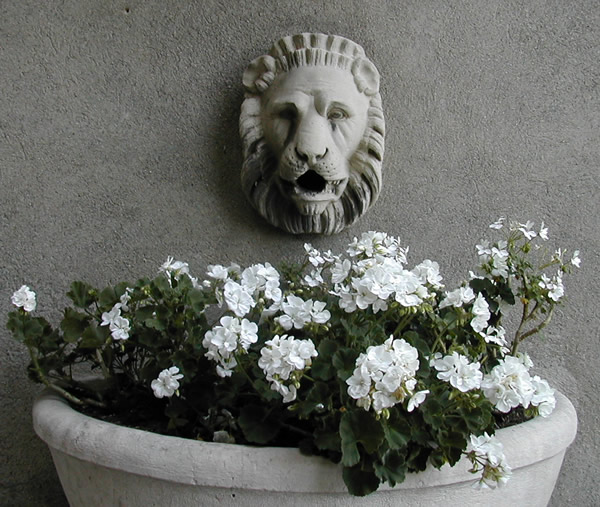
The noble families who built, decorated, and redecorated these places were not among Italy’s most famous (and famously wealthy) families; their funds often ran short of their ambitions. At Palazzo Terzi, we were invited to admire the imposing fireplace in the main reception room. About four meters high, it featured huge stone lions supporting a massive mantel, surmounted by a shield flanked by female figures. The guide helpfully pointed out that the bottom section was marble, but the top was of molded and carved plaster: “You’d never notice the difference, except that the plaster is cracked in places.”

All three villas were richly decorated with paintings on the walls and ceilings, often with clever tromp l’oeil effects, to make ceilings look higher and walls more intricate than they really are. Palazzo Moroni’s decoration includes a series of allegorical paintings illustrating the virtues a noble family should have, as dictated by a local bishop: antiquity, riches, dignity, valor, knowledge, nobility of blood and heart, sanctity, courage, and luck. The Moroni family crest features the mulberry tree, because the family had made its money (and consequently been raised to nobility) growing silkworms for the Italian silk industry.

Palazzo Moroni also houses a well-known painting, The Knight in Pink, by Giovan Battista Moroni. The guide pointed out that the painting includes a Latin tag which translates as: “Better the second than the first.” No one is sure whether this refers to the knight’s wives, or life experiences in general.

A tomb in Casa Palma Camozzi Vertova gave pause for reflection. “This tomb contains a certain de Augustis, buried in the 15th century” explained the guide (as we could also see from the inscription). “No one knows who he was.” So much for carving your name in marble for posterity.

photo at top: courtyard of Palazzo Terzi

gallery of all the photos I took in Bergamo that day

School “Mortality” in Italy

Today is the last day of school (in Lombardia). Making the local headlines yesterday was a 14-year-old girl who threw herself off a bridge, because she knew she would fail her first year of high school. Her reaction is both extreme and unusual, because failing one or more years of high school – any high school – is common in Italy, and doesn’t carry much stigma. Ross estimates that 8 or 9 of her class of 28 (including herself) are likely to flunk.

Some likely reasons for this high failure rate (or mortalita’ scolastica – “school mortality,” as it’s called) include:

Between a heavy curriculum and often-incompetent teachers, students are left to make their own way through reams of material covered badly, if at all, in class. Sometimes they are even expected to study and understand a new topic on their own, before any mention is made of it in class. The lucky ones have parents who can help them, and/or can afford to pay outside tutors for help in one or more subjects. These tutors are usually teachers themselves, either just starting out (and lacking, as yet, a permanent position), or retired, or teaching at other schools. I am tempted to wonder whether the problems outlined above are wilfully ignored because they provide extra income (tax-free, under the table) for otherwise underemployed and underpaid teachers.

Even for the kids bright enough to get through it all on their own, 34 hours a week in the classroom, plus homework, is a lot of studying. And it’s exhausting for parents to come home from their own jobs and then have to spend an hour or two getting their heads around academic subjects they haven’t touched in years, in order to help their children with homework.

No wonder we’re all completely burned out. Today’s the last day of school. All the kids will be doing something to celebrate the end of a gruelling year, whether they passed or not. We parents deserve a pat on the back as well, for all OUR hard work. In fact, we deserve a party. But I’m too tired to organize one right now.

Results

Jul 5, 2004

Ross did manage to pass her first year of high school, with three “academic debits.” This means that she has lots of homework to do over the summer, and by early September must be ready to prove to her teachers that she has done it. She’s very busy at theatre camp in the US for six weeks now, so August is going to be a hell of homework and nagging for all of us…

next: private school