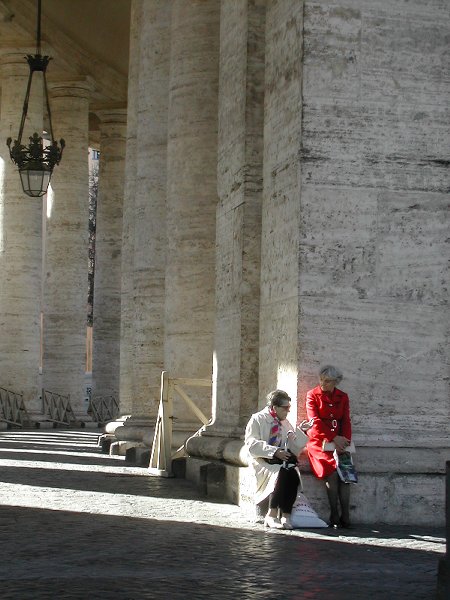
One aspect of Milan I’m really tired of is that it seems so old. Europe’s population in general is ageing, but the average in Milan seems to be even older, though I don’t know why that should be. Surely they could find some cheaper and more congenial place to retire. New Yorkers retire to Florida to get away from cold winters, icy sidewalks, and a fast-paced life that has no time for people who move slowly. Why don’t the Milanese?
Whatever the reason, there are a lot of old people in Milan. Nothing inherently wrong with that; some of my favorite people are a lot older than I am, and I count them as friends. But life in Milan must be harsh for the old, because most of them seem to be in eternally bad moods, always looking for something to complain about. This is so widespread that we notice any old person who actually looks happy. A few days ago, in the subway, Rossella and I saw an old couple smiling and laughing together. It was so unusual that it made our day.
Milan’s oldies seem especially to seek occasions to complain about the younger generations. A friend witnessed this scene:
An old man got onto a crowded bus. He planted himself in front of a young man wearing a workman’s coverall, who sprawled, exhausted, in a seat. The old man glared at him for some minutes, until a young woman nearby nervously offered him her seat.
“No,” said the old man, “I’m waiting for this jerk to get up and do the right thing.”
The younger man raised his eyes and said, “I just finished working for fourteen hours. You’re retired and haven’t done a damn thing all day. I’m not moving.”
It’s a phenomenon familiar to people who have moved around a lot: when you’re about to leave a place, you are suddenly out of patience with it. Annoyances you’ve put up with for years loom large, and you count the days til you can get the hell out. This is a defense mechanism: by concentrating on what you dislike, you hope to lessen the pain of leaving the things and people you do like.
Thus with me and Milano at the moment. We’re getting ready to move to Lecco (a mid-sized town on Lake Como, not very far away), and I am at the end of my tether with everything Milanese. I’ve had enough of sidewalks used as dogs’ toilets, gypsy beggars who all whine the same tale with the same words and faux mispronunciations (I could recite it along with them), of nearly getting run over in crosswalks, of bitchy old ladies who bear a grudge against anyone younger than themselves. Most of all, I am tired of pollution and the respiratory problems that result; I hope Lecco will cure all that.
This move is different, though. I’ve been in Milan – in the same apartment! – more than twice as long as any previous place in my life. I now know what it’s like to be part of a neighborhood. The shopkeepers know my habits (odd American ones, such as making pot roast out of beef rather than veal), and will give me credit when I don’t have cash. They adore my constant striving to give them exact change, and always carrying a cloth shopping bag instead of taking plastic ones. The owner of the coffee bar downstairs frequently gives Rossella chocolates; in all these years, he never figured out that she always gives them away.
I will miss some favorite restaurants, where we’ve been regulars for years. I will miss knowing where to find things, especially things that are hard to get in Lecco, such as Indian spices, Basmati rice, and fresh coriander. I will miss being able to get almost everywhere I need to go by public transport – one of this summer’s ordeals will be getting an Italian driver’s license (and, believe me, it will be an ordeal). I will miss having many cinemas, theatres, and museums close by, even if we hardly ever go to them.
On the other hand, in Lecco we’ll be living three blocks from Lake Como, instead of three blocks from more gray squalor. We’ll be living in an apartment twice as large as our current three rooms, and I can finally have an office NOT in the bedroom. And a kitchen larger than one meter by two. Am I looking forward to the move? You bet.
This question came up recently on one of the expats-in-Italy boards I hang out on (it had coincidentally already been on my mind): How do you make friends with Italians?
Although most of the Italians I’ve met are warm and friendly and great fun to have dinner with, I’m not sure that I have any really close Italian friends. There are Italians with whom I can enjoy a long chat when the occasion happens to arise, but no one I’d call up and pour out my heart to when I need an understanding ear. I do have friends like that, both in Italy and elsewhere, they just don’t happen to be Italians.
I’ve observed, over the years I’ve been here, that most Italians don’t make friends as easily as many Americans do. I think it’s a matter of practice. Many Americans move around a great deal (most within America, some outside), and have repeatedly faced the need to make new friends. When you move a lot, you learn to get to know people quickly.
Most Italians stay all their lives in the city of their birth (if they possibly can); some never even move out of their original neighborhood, though they may commute across town for work. Some commute between cities, working somewhere during the week and returning home on weekends. Some are forced to migrate for work, but still maintain strong ties with their paese, a word meaning both “town” and “nation” – which reflects Italy’s long history as a collection of separate city-states.
Hometown ties extend even to strangers. When we first moved to Italy, our car (donated by my husband’s parents) had a license plate from Teramo, a town in Abruzzo. We drove it to Milan for our first reconnaissance visit. Late at night, at a toll booth just outside the city, a man in a car beside us shouted excitedly: “Are you from Teramo? That’s where I’m from, but I live here. I’m in the Guardia di Finanza. If you ever need any help, just look me up!” (The Guardia di Finanza are the financial police, who investigate accounting frauds, tax evasion, etc. – I hope never to need him!)
Kids usually stay in the same school for the complete cycle at each level: five years of elementary school, three of middle school, and five of high school. As far as I can tell, Italians form their enduring friendships during their school years, and, even if they grow up to be very different from those friends in lifestyle, experiences, careers, etc., they don’t feel a strong need for new friendships in later life.
I just ran across an article in the International Herald Tribune which suggests that this is also true in other European cultures: “the therapist stated categorically that people just did not make friends any longer in middle age. That advice, suggested Draguns, reflects cultural traditions in Germany and the Netherlands, where people tend to limit their friends to those they made in school and to keep the same friends through old age…”
I’ll be curious to hear from my European readers about this, to agree or refute or expand. I wonder: do Europeans feel that American-style friendships are shallow, because they happen so quickly? Some undoubtedly are, but not all. Some of my closest friendships have been formed very quickly, often with other third-culture kids who feel the same need I do to find the right people and make friends quickly.
Update: A few years later I began meeting and hanging out with il popolo della rete – Italians who are active online – and then began to find like-minded Italians to be friends with.
What’s your experience of making friends in Italy?
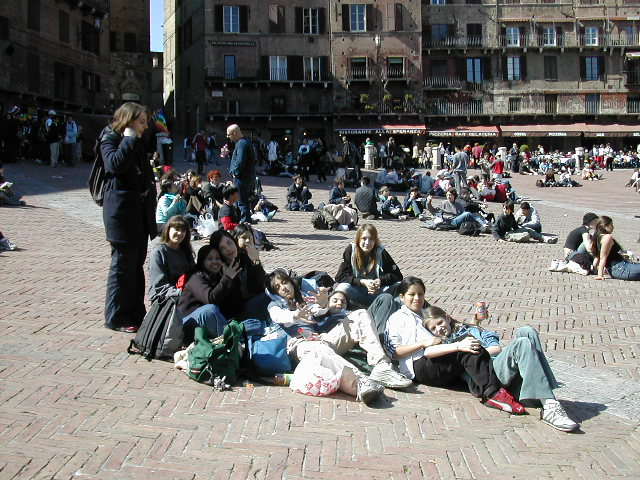
^ downtime in Siena during a class trip to Tuscany
It’s traditional in the Italian school system, at least from middle school on, for each class to take a school trip (gita scolastica) most years. Rossella started at age five, during her last year of scuola materna. Though most of them had never been away from home before, the kids were thrilled to go; their parents were absolutely traumatized. We arrived at the school early Monday morning to put the kids on a big bus. They were all laughing and excited; some parents were holding back tears. One mother told me that her big, tough-guy husband had invited their son to sleep in the parental bed the night before, because he “already missed him.”
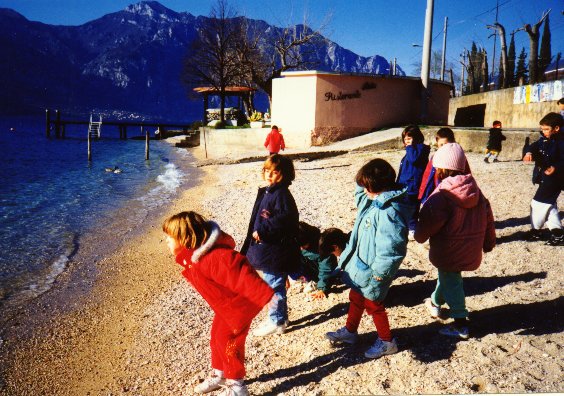
^ the trip to Malcesine
They went to the shores of Lake Garda, staying in a villa owned and managed by the Comune di Milano (city government) specifically for the use of schools and summer camps. There are similar facilities all over northern Italy: in the mountains, on the beaches, and on the lakes.
^ on the shores of Lake Garda
It’s obvious that Italian schools haven’t experienced the lawsuits so familiar to Americans. We were told in advance that one of the activities would be a boat trip on the lake. I asked about life vests – many of these kids couldn’t swim! – and was met with puzzled looks. The question was not satisfactorily answered, so I refused permission for Ross to go on the boat trip; one other mother followed suit. Ross was angry at being left out, but the teacher who stayed on shore with them bought them ice cream as consolation, so she got over it.
They went on outings in the town, visiting crafts workshops and buying souvenirs. One night there was a disco for them at the villa (they had all brought dressy clothes for the occasion, their first dance!).
They returned safe and sound Friday evening, and every parent was on hand to meet them, weeping with joy. I noticed a woman standing nearby whom I didn’t recognize as a parent. In reply to my inquiring glance, she said: “It’s just so sentimental, I love to watch.”
During Ross’ elementary school years the trips were similar, always staying in facilities run by the Comune. My memory isn’t clear; maybe they only made one or two long trips, and did day trips the other years. Ross also went to summer camps several times; this is another wonderful service provided by the city government, so that kids can get out of the filthy city in July while their parents are still working. Costs are low (and scaled to income), and you can choose from any of the locations where the Comune has facilities; Ross always went to the beach.
In middle school, the trips become more ambitious. After all, these kids are in Italy, with thousands of years of history and art (and stunning natural beauty) available within a few hours’ bus ride, if not on their very doorsteps. In 6th grade, they went to the Trentino region, staying in a hotel (school trips occur mostly in March, off-season for hotels all over Italy). They went on hikes in the mountains, visited a farm to see cheese made, and the Thun factory to see ceramic crafts made, and saw other local sights.
In 7th grade, they spent a week in Tuscany, on a galloping tour of several towns. Ross grew bored of churches, but, for the kids, the barrage of culture isn’t really the point of the trip: the point is being away from home with your friends, staying up all night talking, and getting into mischief. I admire the stamina of the teachers who accompany them!
Many classes take a trip outside of Italy sometime during the middle school years. Ross missed out because she changed schools for 8th grade: her former classmates went to Austria this year, her new classmates had already gone to France last year (they are studying French as their third language). So this week she’s been in Tuscany again. But it’s not a great loss for Ross: she’s already been all over Europe and the US with her parents.
In the Brussels airport, I saw a new piece of technology that I just had to try out: the Lady P Urinoir (in the ladies’ bathroom, naturally). There were written instructions in four languages: “1. Assume skiing position.”
Fortunately, there were also stick-figure illustrations, otherwise I would have had to puzzle about “skiing position,” not being a skier. This instruction displays a certain cultural insensitivity; surely, at an international airport, they don’t think that every visitor knows how to ski?
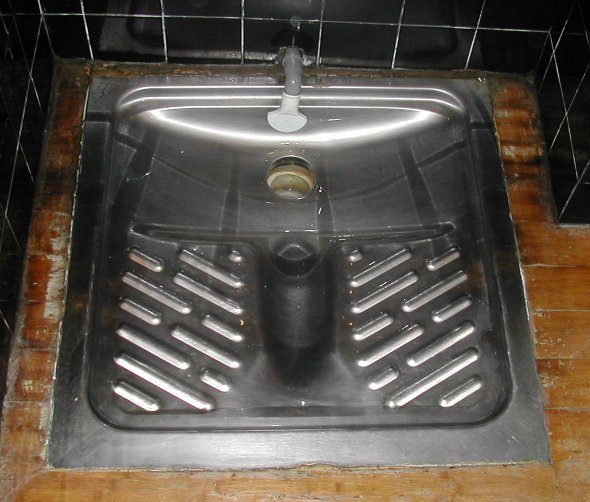
It would be useful if other kinds of toilets also came with instructions. I’ve never seen such a bewildering variety of toilets as I have in Italy. The part you sit on is standard (unless you encounter an old-fashioned squatter; some Americans might be confounded by this), but working out how to flush it may be a challenge.
Here are a few of the options I’ve seen:
American-style tank behind the seat, with flush on upper right corner. The flush may be a button on top of the tank, or a plastic tab sticking out of the upper right side of the tank.
High wall-mounted tank (nostalgia items for some of us), with a pull chain dangling down.
Tank or flush pipes hidden in the wall. Here’s where it gets tricky; there are a zillion ways to flush these things, including:
A simple handle that you turn to open a faucet; let the water run til the evidence is flushed away. This ecologically sound – you use exactly as much water as needed – but it’s frustrating when water pressure is low and you’re in a hurry to leave the bathroom.
Buttons on the wall somewhere, usually (but not always) above the seat. This can be a small metal button, or a round plastic one, mounted on a larger plastic plate, that you push once to flush. The cleverest I’ve seen is the double button, a trapezoidal shape divided into larger and smaller sections. I assume that this is a water-saving feature, where the size of the section determines the size of the flush: push the small button for a small job, the big button for a bigger job, or, if you’re really worried, both buttons together.
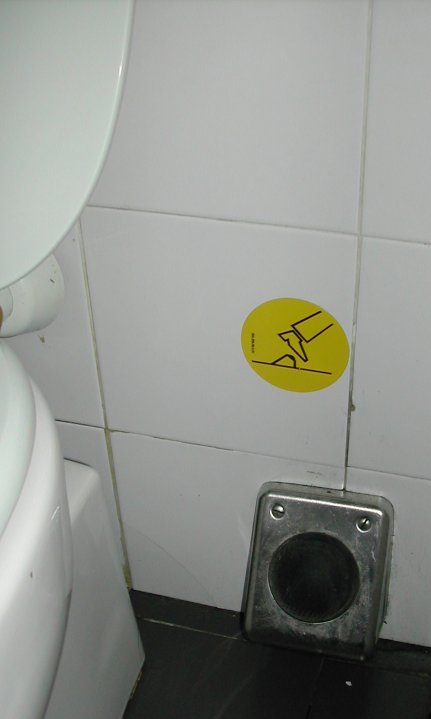
Step-on rubber button near the floor, sticks out at an angle, usually on the right side of the bowl. Step on it hard for as long as you want the flush to last.
A round plastic button sticking out of the wall at waist level next to the toilet, where you’d more or less spot it while you’re sitting, but may not notice it when you stand up
Note that the “helpful” graphic shows an impossible foot position.
Wave-activated sensor. When you’re done, wave your hand in front of the photocell on the wall behind the bowl (there’s an illustration encouraging you to do this), and the flush will take care of itself.
Automatic flush. These are supposed to detect when you sit down and when you get up again, but they are almost always miscalibrated and go off while you’re still sitting. And they tend to flush hard – eeyow! that water’s cold! Worse, this is the type most commonly found in roadside rest stops, where the bathrooms are not heated in winter.
When you’ve conquered the toilet, you face the challenge of washing your hands. Many bathroom sinks are equipped with photo sensors, but these can be fussy. I have one friend whose hands are transparent to them – no amount of waving around will get her any water; someone else has to put their hand in front of the sensor for her. Some faucets are activated by pedals on the floor, one for hot and one for cold – highly sanitary, as you don’t have to touch anything with the hands you’re trying to clean. I’ve even seen sensor-activated soap dispensers!
The Unbearable Lightness of Peeing
Had a good laugh at your article on ’50 Ways to Flush a Toilet’. I laughed louder at the German description of the P-lady:
Translated (approximately – have to go from German to Dutch to English):
[NB: Translation based on text at a previous link.]
“Compared to a conventional toilet, the Lady P. is much smaller, more compact, but with its peculiar(*) form it radiates warmth and a certain degree of cosiness(*)”
I have never in my life associated cold white porcelain with “warmth” and “cosiness”, so I wonder if they also produce office furniture. If they can make a toilet radiate warmth, imagine what they could do with a desk or chair!